
Document Review
The methodology-first screening system that cuts false positives by 60%
Stop wasting time on papers with weak methods. Screen by methodology first, then abstract—and eliminate half the papers you'd otherwise misread.
You’ve got 67 PDFs in Zotero, a supervisor asking for an inclusion list by Friday, and every abstract sounds more convincing than it deserves to. The fastest way to cut false positives is blunt: read the Methods section before the abstract, reject weak designs in 2–3 minutes, and only then spend attention on findings.
The 60% figure comes from the math most teams never run. If 48 papers pass abstract screening and only 18 survive methods review, 30 of the 48 were false positives. That’s 62.5% of your “maybe” pile wasting review time.
This system doesn’t make you read less carefully. It changes when you become careful.
Why abstracts mislead you about paper quality

Abstracts are useful for orientation. They’re awful as a quality gate.
A good abstract compresses the research question, sample, result, and claimed contribution into 200–300 words. It also has a job to do: persuade a reader that the paper deserves another click. The weak study and the strong study both know this.
Researchers behave accordingly. In a survey of science and health researchers, 98.6% said they read the abstract first, and 75% perceived it as the easiest section to read, according to the PMC study on how researchers read IMRAD papers. Easy wins. Until it doesn’t.
The trap is that abstracts rarely carry the disqualifiers. Missing blinding may sit three pages later. A “statistically significant improvement” may come from 50 participants, a 30-person comparison group, and a post-hoc subgroup that wasn’t the primary outcome when the study began.
You don’t catch that by reading the abstract twice.
The abstraction problem gets worse in interdisciplinary work. A machine-learning paper, a clinical trial, and an education intervention can all describe “improved outcomes,” but the minimum acceptable design differs. If you haven’t already defined your methodological floor, the abstract smuggles in assumptions you meant to inspect.
A useful shortcut: treat the abstract as a claim sheet, not an evidence sheet. It tells you what the authors want to be true. The Methods section tells you whether the paper earned the sentence.
This is also why generic speed-reading advice only goes so far. We’ve covered broader tactics for how to read research papers, but screening is a narrower job. You’re not trying to understand every paper. You’re trying to avoid admitting bad ones into the pile.
How methodology-first screening works in practice

Open the PDF. Skip the abstract. Go straight to Methods.
Most papers that follow IMRAD structure place methods after the introduction; if the journal uses a nonstandard layout, search for “Methods,” “Study Design,” “Participants,” or “Data Collection.” The first pass should answer a few plain questions before the paper gets any more of your day.
Start with sample size. Is there a power calculation, or at least a sample-size justification? If a paper claims a meaningful effect from a tiny convenience sample, don’t let a polished abstract talk you out of noticing.
Then read the design type. Randomized controlled trial, cohort study, case-control design, cross-sectional survey, qualitative interview study, lab experiment, simulation paper. Each has different failure modes. If you need a refresher on those categories, the companion guide to research methodology types is the table you want open beside the PDFs.
Next, check the outcome measure. A clinical intervention paper with self-reported outcomes is not the same as one with blinded assessment. A classroom study that reports student satisfaction has a different evidentiary weight from one measuring performance against a pre-specified rubric.
Keep the gate simple:
Abstract-first screening | Methodology-first screening |
|---|---|
Read the abstract, then get curious | Read the design before granting curiosity |
Let strong claims pull you forward | Make sample and bias carry the first burden |
Discover fatal flaws after 15 minutes | Reject weak methods in 2–3 minutes |
Build a “maybe” pile that swells | Keep the inclusion pile small and defensible |
Keshav’s well-known paper on reading research proposes a three-pass approach rather than reading straight through from page one; the Duke-hosted “How to Read a Paper” PDF makes the same practical point: selective passes beat linear reading. Methodology-first screening is a harsher version of that idea. It front-loads the rejection criteria.
There’s a small catch. You need to decide what “adequate” means before screening starts.
For an RCT, that may mean randomization, allocation concealment, and blinded outcome assessment where feasible. For qualitative work, you may care about sampling strategy, saturation, and coding reliability. For observational studies, confounding adjustment may be the first gate.
Write that down. A hidden checklist becomes reviewer mood.
The false-positive trap: why abstract-first fails at scale
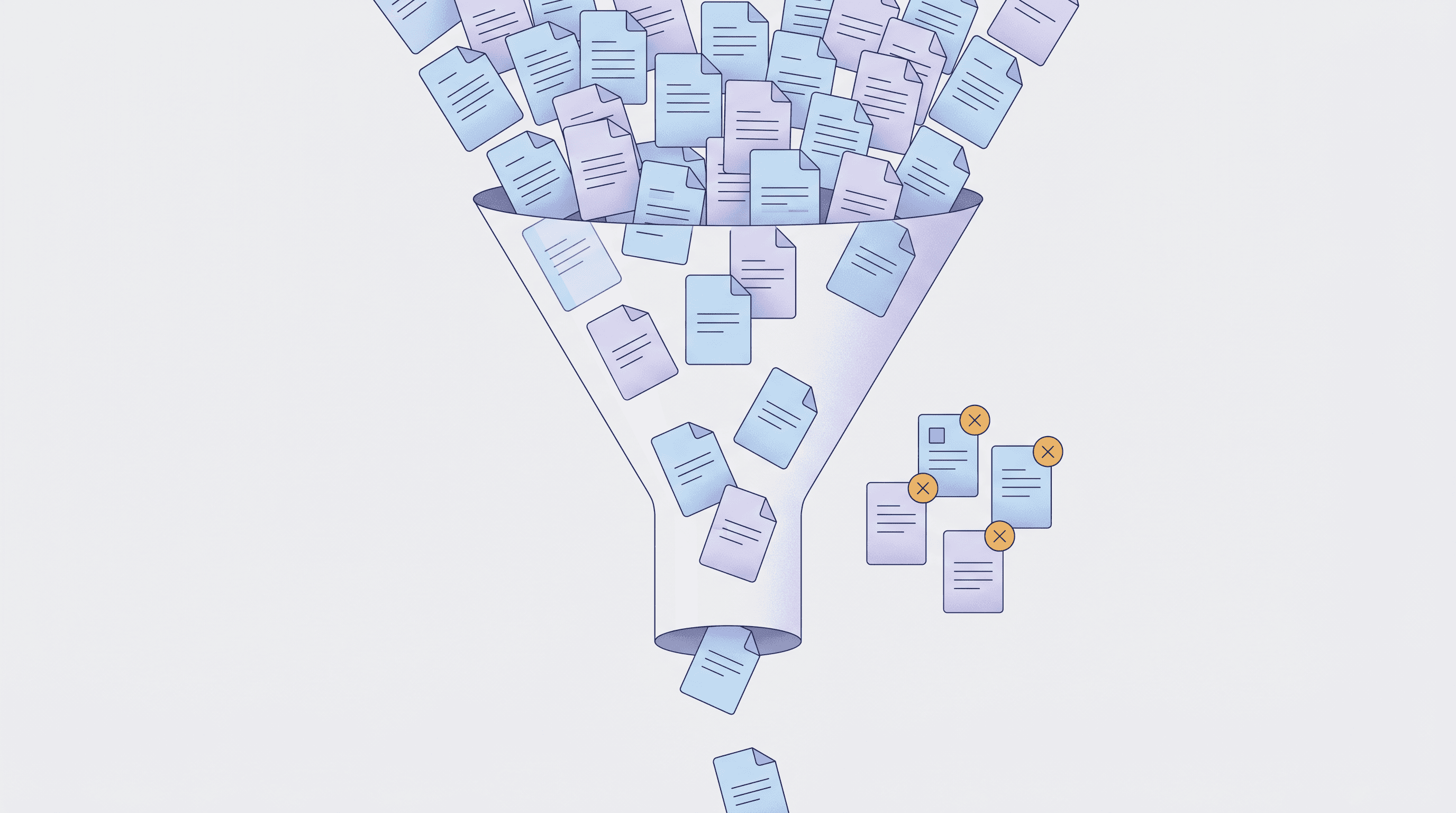
False positives don’t feel expensive one by one. That’s why they survive.
One extra abstract takes five minutes. A skimmed introduction takes seven. The methods section reveals the obvious flaw, and you move on annoyed but not alarmed.
At 80 papers, the arithmetic changes. In the diabetes-intervention screen behind the 60% figure, 48 papers passed the abstract-first filter. Only 18 survived full-text methodology review. The other 30 looked eligible until someone checked the design closely.
That’s a 62.5% false-positive rate inside the abstract-pass pile.
The failure pattern was boring, which is exactly what makes it useful. Small convenience samples. Historical controls standing in for real comparison groups. Outcomes measured by the same team that delivered the intervention. Subgroup findings written as though they had been planned from day one.
The literature on screening has the same smell: human screening is noisy, even when reviewers are careful. An NCBI-indexed study on error rates during abstract screening in systematic reviews examined false inclusion and false exclusion rates during abstract screening by pairs of independent reviewers. The point isn’t that abstract screening is useless. It’s that abstract screening generates error, and the workflow has to assume it.
False positives hurt more than false exclusions in early triage because they hide. A rejected paper is gone. A falsely included paper becomes a file to reread, discuss, code, and later remove.
This breaks the moment two reviewers disagree on what “adequate control” means. One reviewer accepts historical controls for a pragmatic field study; another treats that as high risk of bias. Without a methods-first sheet, the disagreement appears late, after both people have already spent time reading results.
A methods-first system pulls that fight to the surface early. Messy, but cheaper.
Building a 30-minute methodology-first triage workflow
Batch 10 papers. Don’t start with 60.
A 30-minute screen gives enough volume to see the pattern without turning the task into a slog. Use Google Sheets, Airtable, Notion, Excel, or a Tiptap-style note table if that’s where the project already lives. The tool matters less than the fields.
Use six columns:
Paper title
Sample size
Design
Control or comparison condition
Main bias risk
Pass / fail / unclear
Don’t overbuild the sheet. You’re screening, not doing final extraction.
For each PDF, jump to Methods and spend 2–3 minutes. Record the sample size as written. Name the design in your own words if the authors bury it. Add one bias risk, even if the paper passes.
“Unclear randomization” is better than a blank cell. “Self-reported outcome only” will save you a second reading later.
The NHLBI Study Quality Assessment Tools are useful because they force reviewers to focus on internal validity and study-design-specific flaws. You don’t need to import every question into your triage sheet. Pull the minimum gate for your review and apply it consistently.
Only after a paper passes the methodology gate should you read the abstract and results. Now the abstract has a job it can actually do: help you understand the claim once the design has cleared the floor.
A 30-minute batch might look like this:
Minute | Action | Output |
|---|---|---|
0–3 | Set inclusion floor | One-sentence rule |
3–25 | Screen 10 Methods sections | Pass/fail/unclear sheet |
25–28 | Recheck unclear papers | Two or three flagged rows |
28–30 | Count rejects | Baseline false-positive estimate |
This is where an AI assistant earns its keep, if you keep it on a short leash. Use it for extraction, not judgment.
For example, upload five PDFs and ask for sample size, design type, primary outcome, and whether blinding is described. If your files already sit in an AI workspace, Otio’s unified research library and PDF reader let you keep the paper, extraction chat, and notes in one place instead of bouncing between a PDF viewer and a separate chatbot.
AI will still miss things. It may treat “participants were randomly assigned by classroom” as individual randomization. It may fail to notice that the outcome assessor was also the intervention lead. The human decision stays with you.
For a more general document-review setup, the guide to analyzing a research paper with AI covers the broader workflow. Here, the narrower rule is cleaner: ask the model for fields, then make the call yourself.
When methodology-first screening saves the most time
Methodology-first screening pays off when the search results are noisy.
Systematic reviews and meta-analyses are the obvious case. You may begin with 100, 300, or 1,000 records, and the title/abstract screen can admit too many papers that later collapse under full-text review. A Springer paper on conducting systematic literature reviews notes that SLR guidance is scattered and often less stringently presented than expected, which is one reason replicability suffers.
Methods-first screening gives your inclusion logic a paper trail. If a supervisor asks why a study was rejected, “n=24, no control, post-hoc outcome” lands better than “abstract seemed weak.”
Rapid evidence assessments are another strong fit. Emerging topics attract preprints, pilot studies, and underpowered early trials. Reading abstracts first can make the field look more mature than it is.
Clinical guideline work needs an even harder gate. If the review requires RCTs, matched observational studies, or a minimum risk-of-bias rating, don’t let an abstract create exceptions one paper at a time. Exceptions breed.
Interdisciplinary reviews may benefit most of all. A computer-science reader evaluating epidemiology papers can be fooled by unfamiliar conventions. A public-health reader evaluating machine-learning benchmarks can miss train/test leakage or weak external validation if the abstract sounds confident.
The method also works outside medicine. In education, screen for control condition and outcome validity. In management research, look for sampling frame and construct measurement. In ML, check dataset split, baseline comparison, and whether the evaluation metric matches the stated task.
Mostly. There are papers where methods-first is too blunt.
If you’re doing a scoping review, you may care more about mapping concepts than excluding weak evidence. If you’re studying research rhetoric, the abstract itself might be the object. In those cases, methods-first screening becomes a tag, not a gate.
For literature-heavy projects where you’re still defining the field, use broader discovery tools first. We’ve compared literature review tools for that stage; the methods-first system starts once you have a candidate pile and need to cut.
Tools and shortcuts for faster methodology extraction

The fastest tool is still Ctrl+F.
Search “Methods,” “Study Design,” “Participants,” “Procedure,” “Measures,” or “Outcomes.” In medical papers, “Methods” usually gets you there. In social science, “Participants” can be faster. In ML papers, “Experimental Setup” may hold the details you need.
PDF readers vary. Adobe Acrobat is fine. Zotero’s PDF reader works well for annotation. Preview on macOS is fast but thin. Browser PDF viewers are acceptable until you start doing this for a team, at which point shared notes become the bottleneck.
AI helps most when you ask for a fixed extraction table. Don’t ask whether the paper is “good.” Ask for the fields: sample size, design, comparison condition, primary outcome, blinding or masking, pre-registration if reported, and one sentence on bias risk.
That wording keeps the model away from vibes.
Tools like Claude, ChatGPT, Gemini, and Otio can all extract methodology details from dense text. The difference is workflow. If your PDFs are scattered across downloads, Zotero, and Google Drive, the friction becomes file handling rather than reasoning. Otio’s multi-window split view and per-chat model selection are useful when you want one chat extracting methods from Paper A while another compares the pass pile across papers.
Intelligent skimming interfaces point in the same direction. The arXiv paper on Scim and skimming support for scientific papers frames the problem plainly: researchers need to keep up with large literatures, but skimming scientific articles is time-consuming and difficult. A good methodology-first workflow makes the skim boring on purpose.
A shared spreadsheet still wins for team review. Use one row per paper. Add reviewer initials. Require a short reason for every reject.
This prevents a common failure: duplicate screening with incompatible standards. Reviewer A rejects for “no blinding.” Reviewer B keeps the same paper because blinding wasn’t feasible in that study design. The sheet exposes the mismatch before it contaminates the final inclusion list.
For summaries after the pass pile is clean, use dedicated summarization workflows. The guide to AI tools for summarizing research papers is better for that later stage. Don’t summarize junk.
Start screening your next batch with methodology first
Pick 10 papers. Set a timer for 30 minutes.
Read only the Methods section. Record sample size, design, comparison condition, and one bias risk. Mark pass, fail, or unclear. No abstracts until the paper clears the gate.
After 10 papers, count how many you rejected. Then ask a sharper question: how many of those would have sounded acceptable from the abstract?
That gap is your false-positive problem.
If the reject pile is large, keep going in batches of 10. If every paper passes, your search query may already be tight, or your methodology floor may be too forgiving. Check it before you scale to 80 PDFs.
For teams, share the triage sheet before anyone reads results. You want disagreements about blinding, sample adequacy, and control conditions early. By the time you’re writing the synthesis, those calls should be boring.
If you want the PDF, extraction chat, and screening notes in one place, try Otio for your next literature review.
FAQ
Q: Won't I miss important papers if I reject them based on methodology alone?
A: If the methodology can’t support the claim, the finding shouldn’t carry much weight in your review. Use “unclear” for borderline cases rather than forcing an early rejection.
Q: How do I know if a sample size is “adequate”?
A: Look for a power calculation or sample-size justification in the Methods section. If it’s missing and the groups are small, mark the paper as high risk and check your field’s norms before admitting it.
Q: What if I'm screening papers from different fields with different methodological standards?
A: Create a field-specific checklist before screening starts. RCTs, qualitative studies, observational designs, and ML benchmarks fail in different ways.
Q: Can I use AI to do methodology-first screening for me?
A: Use AI to extract fields quickly, then make the pass/fail decision yourself. The judgment depends on your review question and inclusion criteria.
Q: How much time does methodology-first screening actually save?
A: In the 80-paper example, abstract-first screening produced a 62.5% false-positive rate among papers that initially passed. Your savings depend on how noisy the search results are and how strict your methods gate is.