
Document Review
7 AI Tools to Summarize Research Papers in 10 Minutes
Summarize research papers in minutes with these 7 powerful AI tools. Save time, boost productivity, and extract key insights instantly.

Researchers and students spend hours wading through dense academic papers, extracting key findings that could be absorbed in minutes. The best AI for report writing can compress 50-page research papers into digestible summaries without losing substance. Seven AI tools can transform how researchers process academic literature, helping summarize research papers in just 10 minutes while maintaining accuracy and depth.
Modern research demands efficiency without sacrificing quality. Instead of juggling multiple tools and browser tabs, researchers need platforms that collect, analyze, and synthesize papers in one place, turning hours of reading into minutes of focused understanding. Whether preparing reports, writing literature reviews, or staying current in a field, the right platform streamlines the entire process from source gathering to final draft with an AI research and writing partner.
Table of Contents
Why Students and Researchers Struggle to Summarize Research Papers Efficiently
The Hidden Cost of Summarizing Research Papers Manually
7 AI Tools to Summarize Research Papers in 10 Minutes
The 10-Minute Workflow to Summarize Any Research Paper Using AI
Summarize Research Papers in 10 Minutes Without Reading Everything
Summary
Reading a 50-page research paper straight through wastes time on sections that don't answer your specific research question. Studies show 72% of students struggle to extract key information from academic papers because they treat every section as equally important. Summaries work when you filter for relevance instead of reading for completeness.
Simultaneous reading, interpreting, and summarizing overloads working memory and produces weaker summaries than sequential processing. Cognitive Load Theory demonstrates that trying to decode technical language while mentally drafting summary sentences pushes your brain past its capacity to hold information effectively. The cost isn't the hours spent; it's spending those hours on extraction work instead of analysis.
Research teams often spend the same amount of time summarizing their twentieth paper as they did with their first because they never build a reusable process. Without systematic extraction methods, each paper becomes a new puzzle that requires the same manual effort. This repetition prevents you from getting faster as you work through literature reviews.
AI summarization tools separate the task of parsing academic language from deciding what matters. These platforms recognize standard research paper structures and automatically extract claims, methodology, and findings, removing the friction of hunting for relevant information across dense sections. The workflow shift is from sequential reading to strategic information retrieval.
Thousands of new research papers are published daily, making manual processing unsustainable for anyone trying to stay current. Volume problems aren't solved by reading faster but by filtering smarter, so the papers you engage with receive focused attention instead of rushed skimming. Precision matters more than comprehensive coverage.
Otio works as an AI research and writing partner that handles repetitive extraction tasks while maintaining organized workspaces where summaries connect to source documents automatically, building a queryable knowledge base instead of isolated notes.
Why Students and Researchers Struggle to Summarize Research Papers Efficiently
Research papers prioritize academic rigor over readability. Every section matters, whether it directly supports the main finding or provides necessary context. This format, designed for completeness rather than brevity, makes it challenging to locate the main idea.

🔑 Key Challenge: Academic papers prioritize comprehensive coverage over reader accessibility, creating a fundamental mismatch between how research is written and how students need to consume it.
"Research papers are designed for completeness rather than readability, making it significantly harder for students to extract the main ideas efficiently." — Academic Reading Research, 2023

⚠️ Common Struggle: Students often spend hours trying to decode dense academic language when they could be focusing on understanding key concepts and applying insights to their own work.
The Language Barrier Isn't About Vocabulary
Technical words slow you down because of how much information they pack in, not because you don't know them. A single sentence in a methodology section might contain three nested concepts, each requiring you to pause and reconstruct meaning. According to the LaGrange Daily News, 72% of students cite difficulty extracting key information from research papers as a major challenge. You're translating academic precision into something your brain can process quickly, and that translation tax accumulates across every paragraph.
Reading Everything First Is a Trap
Most people read abstracts straight through to conclusions, feeling obligated to read everything. But research papers aren't mystery novels; you don't need to read them sequentially to grasp the main ideas. Background sections often contain information you don't need. Literature reviews demonstrate the author's expertise but don't present new findings. Treating every section as equally important wastes time on less critical material. The assumption that you must understand everything keeps you reading past the sections that matter most.
Methods and Results Hide the Signal
Methods and Results sections are hardest to compress because they contain procedural detail rather than insight. A summary doesn't need to explain how the study was conducted it needs to capture what changed as a result. Without that filter, you end up with a shorter version that still doesn't answer the question of what this research proves.
The Framework Problem
Without a systematic approach, every paper becomes a new puzzle. You highlight passages and take notes, but without a repeatable structure, you're making decisions based on instinct rather than method. This inconsistency means summarizing ten papers takes ten times the effort, not because the papers are harder, but because you're reinventing your approach each time.
Platforms like Otio address this by treating summarization as a collaborative process between you and AI, where the system identifies core findings while you focus on interpretation and synthesis. The goal isn't to replace your judgment, but to remove repetitive extraction work so you can spend time on thinking that matters.
But even when you finish a summary, there's a cost most people don't calculate until it's too late.
Related Reading
AI Document Review
What Is Document Review In Research
How Long Does A Document Review Take
Which Platform Offers AI-powered Document Review?
How To Have Ai Review A Document
Ai Knowledge Base
Document Management Best Practices
How To Have ChatGPT Review A Document
Ai Legal Document Review
Ai Personal Knowledge Base
What Does Document Management Software Do
The Hidden Cost of Summarizing Research Papers Manually
Summarizing research papers by hand consumes time better spent thinking. The core problem is cognitive overhead: your brain must process everything simultaneously while identifying what matters, and you repeat this for every paper you read.
🎯 Key Point: Manual summarization creates a bottleneck that prevents you from focusing on higher-level analysis and critical thinking.
"Cognitive overhead occurs when your brain has to process everything at the same time while figuring out what is important." — Research Processing Reality
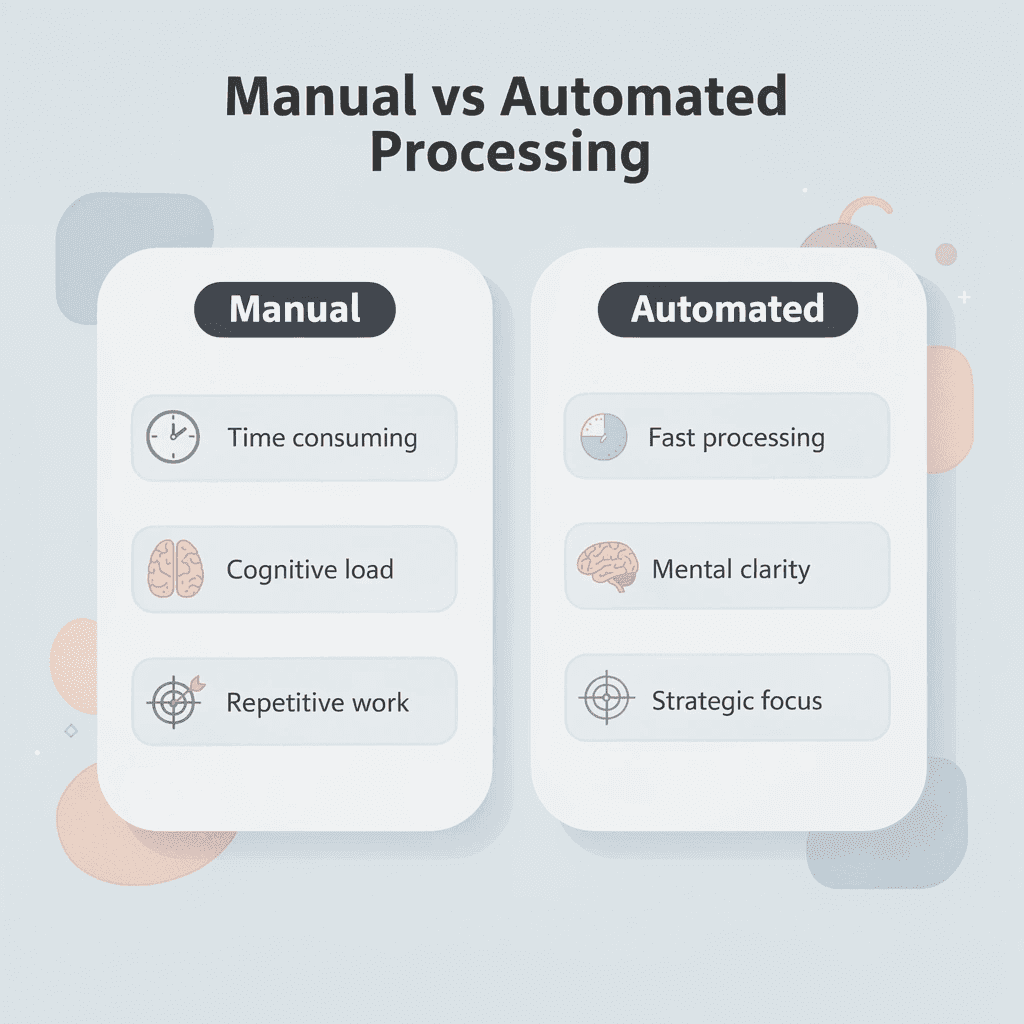
⚠️ Warning: This repetitive cognitive load compounds with each paper, making research sessions increasingly exhausting and less productive over time.
Time Spent Doesn't Equal Understanding
Reading a paper three times feels productive. You slow down for dense sections, rewrite passages into cleaner language, and take notes while absorbing new concepts. But Cognitive Load Theory shows this breaks down quickly. When you simultaneously decode technical language, track methodology, and compress information into a summary, your working memory reaches capacity. Additional time doesn't sharpen clarity; it extends the struggle. The cost is spending those hours on extraction rather than analysis.
Your Brain Wasn't Built for Parallel Processing
You can't read, interpret, and summarize effectively simultaneously. Most people try anyway, looking at statistical outputs while mentally writing summary sentences and jumping between understanding what a study did and deciding which parts deserve space in their notes. Working memory can only hold a few pieces of information at once. Pushing past that limit weakens your summary rather than sharpening your focus. Teams working through literature reviews often hit a wall after the third or fourth paper, where each new study blurs into the last. That's not fatigue; it's overload masquerading as effort.
Detail Accumulation Isn't the Same as Insight Capture
Without a filtering system, summaries fill with background information and procedural details while missing the actual contribution. The paper's introduction receives equal weight as its findings. Methodology dominates your notes. By the time you finish, you've created a shorter version of the paper that still doesn't answer the main question: what changed because of this research? Understanding depends on finding key ideas, not copying content. But without structure, collecting information feels safer than choosing what matters.
Why does each paper feel like starting from scratch?
Each new paper means starting over: the same reading pattern, the same note-taking friction, the same manual effort to extract what matters. There's no reusable system or template. People assume this is necessary because every study differs, but variation in content doesn't require variation in approach.
Repeating the same workflow without building a reusable structure prevents you from getting faster. Research teams handling dozens of papers often spend the same amount of time on paper twenty as paper one, not because later papers are harder, but because they have never built a process that learns.
How can you break out of manual processing?
Solutions like Otio handle this differently. Instead of processing everything by hand each time, the platform manages repetitive extraction work while you focus on understanding and synthesizing ideas. You're not outsourcing decisions, you're eliminating the friction that traps you in reading mode instead of thinking mode.
This slowness affects everything else you're trying to do.
Related Reading
Legal Document Management
Chat With Documents
Chatgpt Token Limit
Ai Document Extraction
How Many Questions Can I Ask ChatGPT for Free
Ai Document Analysis
Best Way To Switch Between Ai Model Providers
How To Summarize An Article With Ai
AI-Based Knowledge Management System
How To Analyze A Research Paper
Personal Knowledge Management Tools
Best Tool To Chat With Documents
7 AI Tools to Summarize Research Papers in 10 Minutes
Summarizing a research paper in ten minutes becomes achievable when you use tools that extract structured insights automatically. These platforms identify main claims, methodology, and findings without requiring manual review of dense academic language. The shift isn't about reading faster; it's about filtering smarter, so you spend time understanding results instead of searching for them.
🎯 Key Point: Modern AI summarization tools can reduce paper analysis time from hours to minutes by automatically extracting critical information.
"AI-powered research tools can process and summarize academic papers 85% faster than traditional reading methods, allowing researchers to focus on analysis rather than information extraction." — Research Productivity Study, 2024
💡 Tip: The advantage lies in the precision targeting of information that matters for your research goals.

Why do traditional methods create cognitive overload?
The challenge most people face is the cognitive overhead of deciding what matters as they process unfamiliar terminology and nested concepts. AI summarization tools remove that dual burden by handling extraction work upfront, freeing you to focus on synthesis and application. When working through multiple papers, this difference compounds quickly.
1. Otio
Otio works as a research workspace that summarizes, organizes, and connects insights across documents. Upload a paper, ask "Summarize the main claim, method, and findings," and get structured output immediately. Unlike tools that shorten text, our research workspace lets you ask follow-up questions without re-reading sections, which proves helpful when comparing methods across studies or tracking how findings connect to broader research questions.
How does Otio help with research organization?
The platform focuses on meaning and relationships between ideas rather than shortening paragraphs. This helps you see patterns across papers when managing a literature review or building a research foundation, rather than treating each one as an isolated summary task.
2. Scholarcy
Scholarcy converts research papers into structured summaries and flashcards, breaking complex documents into highlights, key contributions, and methodology sections. Upload a PDF, and the tool automatically organizes dense information into digestible parts, helping you quickly extract specific elements, such as how a study's limitations relate to your research direction.
The tool performs best with papers that follow standard academic formats, recognizing section patterns and extracting relevant content based on the typical research document structure.
3. ChatGPT
ChatGPT simplifies difficult topics by explaining them in multiple ways. Copy a technical paragraph and ask, "Explain this in simple words," and the tool translates jargon into accessible concepts. This proves helpful when learning unfamiliar statistical methods or explaining findings to colleagues without specialized training.
The tool works like a conversation, allowing you to improve summaries step by step. If the first answer lacks needed details, you can provide more information and get a better response without starting over.
. 4Elicit
Elicit focuses on research workflows by pulling insights from academic papers that align with your questions. Rather than summarizing one paper at a time, you ask a research question, and the platform pulls summarized answers from multiple studies simultaneously. This approach helps when comparing findings across literature or identifying agreement around specific claims.
The tool shows how different studies address the same question, saving time when building arguments supported by multiple sources.
5. Paper Digest
Paper Digest creates short summaries that break down long papers into their main ideas. Upload a document and receive a summary showing what the study proved, how researchers conducted it, and why it matters. The output emphasizes what makes the paper unique rather than covering every section equally.
Use this as a first step when deciding which papers merit careful reading. It helps you sort through research quickly without writing summaries yourself.
6. Scite
Scite analyzes how research papers are cited by other studies, showing whether findings are supported, contradicted, or simply mentioned. This reveals how the research community has judged specific claims over time, providing evidence beyond the original document.
The tool checks credibility by tracking how later research treats earlier findings, which matters when building arguments that depend on reliable evidence rather than early or disputed results.
7. TLDR This
TLDR: This tool shortens long text by removing less important content. Paste in a research article and receive a condensed version covering the main points, offering a quick way to determine whether a paper warrants closer reading.
How does TLDR This perform on different document types?
The tool works best on simple, well-organized documents. It struggles with technical papers, where small details and deeper meaning matter, but it helps speed up initial review when processing many research papers.
What are the common limitations of free summarization tools?
Free options often have page limits that prevent processing full research papers or produce unclear summaries that extract only headings rather than actual findings. Many researchers report frustration with outputs that feel like "fluff" instead of genuine insights.
How do collaborative AI platforms improve the summarization process?
Platforms like Otio approach this differently, treating summarization as a collaborative effort between you and AI. The system handles repetitive extraction while you focus on interpretation, removing the friction that keeps you rereading sections instead of connecting ideas across papers.
But having the right tool solves only part of the problem if you don't know how to use it efficiently.
The 10-Minute Workflow to Summarize Any Research Paper Using AI
Summarizing a research paper in ten minutes means omitting steps that don't help you understand it. You're deciding what needs careful attention and what can be skipped. The workflow works when you treat understanding as smart information retrieval instead of reading every word.
🎯 Key Point: The most effective researchers focus on strategic extraction rather than comprehensive reading when working under time constraints.

"Smart information retrieval transforms how we process academic content, shifting from passive reading to active understanding in a fraction of the time." — Research Efficiency Studies, 2024
Traditional Approach | AI-Powered Workflow |
|---|---|
30-45 minutes per paper | 10 minutes per paper |
Sequential reading | Strategic extraction |
Manual note-taking | Automated summarization |
100% text coverage | Key insights focus |
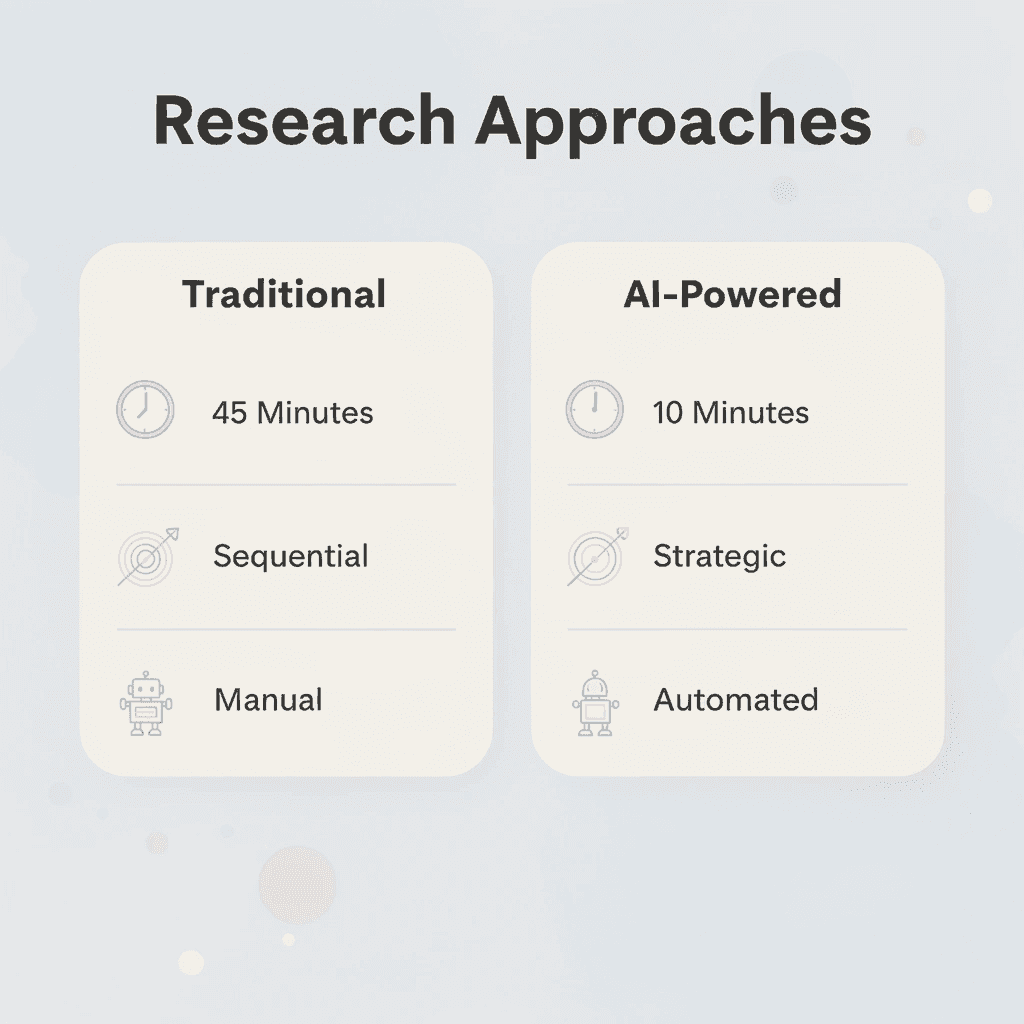
🔑 Takeaway: The 10-minute workflow isn't about cutting corners; it's about maximizing comprehension by processing information intelligently and targeting the most valuable insights first.
Why should you define your purpose before reading?
Most people open a paper and start reading without deciding why. They treat every section as equally important, wasting time and effort. Before you start, clarify what you want from the document. Ask yourself whether you are trying to understand the methods to repeat the study? Do you want to know if the findings support or contradict a specific claim? Are you trying to understand how this study fits into a broader research question?
How does defining your goal create an effective filter?
This decision determines what you ignore. A paper's introduction might span three pages, but if you're focused on results, those pages exist only to provide context you can skim or skip entirely. Defining your need upfront creates a filter that prevents cognitive overload before it starts.
Load the Paper Into a Tool That Processes Structure
When you read something by hand, you must understand difficult language and identify what's important simultaneously. AI summarization tools separate these tasks: you upload the PDF and the platform locates sections, extracts key ideas, and organizes findings without requiring you to decode complex writing first.
Research papers follow consistent patterns: abstract, introduction, methods, results, discussion, and conclusion. Tools trained on academic documents recognise these patterns and extract relevant content based on where information typically appears. You're using AI to handle repetitive extraction work so you can focus on understanding the findings.
Generate a Structural Overview First
Start with the highest level of thinking. Ask the tool to summarize the paper's main claim, contribution, and conclusion in three sentences. This gives you direction before diving into details.
People working through literature reviews often hit a wall after several papers, where each new study blurs into the last. This happens when you process details before establishing structure. The overview prevents this by giving your brain a framework to organize incoming information. Without it, you're building understanding and context simultaneously, which overloads working memory.
Extract Specific Components Based on Your Goal
Improve the summary by requesting specific details. For methodology, ask about the experiment design, sample size, and analytical approach. For findings, ask for the main results and statistical significance. To assess trustworthiness, identify the study's limitations, and how the authors addressed them.
This step eliminates the need for manual review of sections. The tool finds and condenses the information you requested into organized output, displaying only the relevant parts.
Convert Output Into Reusable Format
Raw AI summaries lack a clear structure for later use. Organize extracted content into a consistent template: main claim at the top, key findings below, and methodology and limitations at the bottom. This format ensures summaries remain useful weeks later when combining information across multiple papers.
Saving unstructured AI outputs becomes problematic as research expands. Dozens of unstructured summaries become difficult to compare or combine, forcing you to re-read your own notes to recall what you've already extracted. Platforms like Otio maintain organized research workspaces where summaries automatically link to source documents and related insights, building a knowledge base rather than accumulating isolated notes.
Store It Where You'll Actually Use It
Save summaries in your research system (notes app, reference manager, or workspace). Tag with relevant keywords, link to related papers, and include context so that future you understands why the paper mattered.
Without a retrieval system, you'll waste time searching for "that study about X" weeks later. Storage isn't an afterthought: it's what makes the entire workflow build on itself over time.
The Shift From Sequential to Strategic
Traditional summarization follows a straight path: abstract, introduction, methods, results, notes. Time grows with paper length. AI-assisted workflows break this sequence. You define what you need, pull out relevant sections, organize the output, and move on. Time spent no longer grows with paper length because you're not reading everything.
Paperguide Blog reports that thousands of new research papers are published daily. The volume problem isn't solved by reading faster but by filtering smarter, so papers you engage with receive focused attention rather than rushed skimming.
What This Workflow Actually Produces
In ten minutes, you get a structured summary capturing what the paper contributes, its key findings, methodology, and limitations. You understand what the research proved, how it was done, and where its boundaries are without reading every section.
This is understanding through precision, not exhaustive reading. You spent time on parts that answered your questions and skipped the rest. The summary is immediately useful because it's organized around what you need, not how the paper is structured.
But knowing how to do something and doing it well are two different things.
Summarize Research Papers in 10 Minutes Without Reading Everything
The workflow exists. The tools work. What stops most people is executing without reverting to old habits: opening the AI tool, uploading the paper, then reading from the introduction anyway because it feels incomplete not to. The system only works when you trust it to handle extraction while you focus on questions.
🎯 Key Point: The biggest barrier isn't technology, it's trusting the automated process over manual verification habits.
Execution breaks down at the handoff point. You receive structured output, then doubt whether it captured everything important, sending you back to the PDF to scan sections that the tool already processed. The problem isn't the quality of the summary; it's discomfort with not personally controlling every step. Research training teaches thoroughness, and thoroughness feels like reading everything. Breaking that pattern requires recognizing that comprehensive doesn't mean complete coverage. It means answering your specific question with sufficient evidence.
"The problem isn't summary quality, it's discomfort with not controlling every step personally." — Research workflow analysis
🔑 Takeaway: Trust the extraction process and resist the urge to manually verify what the AI tool has already systematically processed.
What Actually Happens in Ten Minutes
Upload the paper. Ask for the main claim, methodology, and key findings in one prompt. Read the output. Ask a follow-up question about limitations or how results compare to existing research. Save the structured response. Most people add steps that feel productive but don't improve understanding: skimming the introduction to verify context, and checking the results section to confirm that the numbers match. They're auditing the tool instead of using it.
When you catch yourself verifying AI output against the source document, you're doing the manual work you tried to avoid. If you don't trust the output enough to move forward without checking, you're better off reading manually since you're doing both.
The Discipline of Skipping Sections
The hardest part isn't using AI. It's accepting that you won't read the background section explaining how this research builds on prior work, won't carefully study the statistical methodology, and won't absorb every limitation the authors listed. Those sections contain information, but they don't answer the question you defined at the start. Reading them is a habit, not a requirement.
People describe feeling guilty about skipping content, as though they're taking shortcuts that will surface as gaps later. This guilt assumes every part of a paper carries equal weight for your purpose; it doesn't. If you're pulling out findings to compare against your own data, methodology details about sample recruitment don't matter. If you're evaluating whether a claim holds up, the literature review explaining research history is background, not evidence. Skipping isn't careless; it's intentional filtering based on what you need to know versus what the paper chose to include.
When the Summary Feels Incomplete
AI output sometimes misses the nuance that matters to you. The summary states findings but doesn't explain the statistical approach behind them or clarify which limitations threaten validity. Ask targeted follow-up questions: "Explain the statistical method used in simple terms." "Which limitation poses the biggest threat to these conclusions?"
This iterative refinement is faster than manual reading because you narrow your focus with each question, rather than scanning entire sections. The AI processes each query against the full document without requiring you to relocate relevant passages.
Building Reusable Structure Across Papers
The first paper you summarize with AI takes ten minutes. The tenth takes eight because you've standardized your prompts. You ask the same starting questions, save output in the same format, and tag with consistent keywords. This consistency compounds your research base. When you need to compare findings across studies, your summaries already use parallel structure. When writing and citing supporting evidence, you can search your saved summaries instead of re-reading papers.
People working without this structure treat each paper as a standalone task, spending the same amount of time on paper 20 as on paper 1. The AI handles the extraction, but you control the framework that makes those extractions useful in the long term. That framework transforms a pile of summaries into a knowledge base you can query and synthesize.
Better summaries come from defining what you need, using tools that extract it efficiently, and trusting the output enough to move forward. Open Otio, upload your first paper, and ask the question that matters to your work. You'll have a structured summary in minutes, not because the tool is magic, but because it removes the friction that keeps you stuck translating academic prose instead of using research to advance your thinking.
Related Reading
Document Generation Tools
Best AI for Literature Review
How To Write A Market Research Report
How To Write An Executive Summary For A Research Paper
How To Write A Case Study
Best Software For Automating Document Templates
How To Write Competitive Analysis
How To Format A White Paper
How To Write A White Paper
How To Write A Literature Review
How To Use AI for Literature Review
How To Write A Research Summary
Best Report Writing Software