
Document Review
7 AI Tools to Analyze Research Papers in 10 Minutes
Learn how to analyze a research paper fast with 7 AI tools that help you review methods, findings, and key insights in 10 minutes.
Staring at a 40-page research paper with dense methodology sections and unfamiliar terminology can feel overwhelming, especially when you have a dozen more waiting in your queue. AI document review has transformed how researchers, students, and professionals approach this challenge, turning what used to take hours into minutes. Seven powerful AI tools can help you analyze research papers efficiently, extract key insights, and understand complex academic content without getting lost in the details.
These tools excel at breaking down complex studies, but researchers need a solution that brings everything together in one place. Advanced platforms can process multiple papers simultaneously, generate summaries, extract citations, and provide instant answers to specific questions about your documents. Instead of switching between different platforms or manually highlighting sections, you can organize your entire research workflow with an AI research and writing partner that handles the heavy lifting of identifying methodologies, results, and conclusions across all your sources.
Summary
Research papers contain multiple layers of information, but not every section carries equal value for every reader. When everything feels mandatory, analysis slows dramatically because readers treat technical definitions, literature reviews, methodology details, and data tables with the same weight. Without a filtering system to separate core findings from supporting context, most students and researchers spend 45 minutes to several hours on a single paper, re-reading complex sections while trying to understand, interpret, and evaluate simultaneously.
Cognitive overload from processing too much information at once actually reduces learning efficiency according to Sweller's Cognitive Load Theory (1988). Miller's research (1956) showed that humans can hold only a limited number of information chunks in working memory at once, which means that trying to read, interpret technical language, evaluate methods, and connect ideas across sections together decreases clarity rather than improving it. The real cost isn't the difficulty of understanding complex research; it's spending too much time extracting insights without a structured system in place.
Misinterpreting results happens frequently when readers focus on what a paper says rather than what it actually proves. One published study used URL-based detection to identify disinformation in social media comments, assuming any comment linking to low-credibility sources endorsed them. Manual review of flagged comments revealed the opposite: users linked to those sources to mock or criticize them, not support them. The methodology couldn't distinguish context or intent, producing misleading conclusions that went undetected until someone verified the findings manually.
The shift from three-hour reading sessions to ten-minute analysis isn't about skimming or cutting corners. According to Venkata Naga Sai Kumar Bysani's December 2025 LinkedIn post, a report that once took 3 hours now takes just 45 minutes when researchers stop reading everything manually and start using tools that pull structured insights on demand. The compression occurs because targeted questions extract specific information (methodology, limitations, key findings) rather than absorbing content linearly from the abstract to the conclusion.
Research paper analysis becomes evaluation rather than just comprehension when you ask the right questions in the right order: What problem is this solving? What claim are the authors making? Does the sample size justify the generalization? Do the results show causation or just correlation? Without a repeatable process for filtering and categorizing information, every paper feels like a new problem, slowing analysis, making it less consistent, and making it harder to scale across multiple sources.
AI research and writing partner addresses this by letting you chat directly with uploaded research papers to extract methodologies, evaluate limitations, and verify conclusions within a unified workspace where answers come grounded in your own sources with citations included.
Table of Contents
Why Students and Researchers Struggle to Analyze Research Papers Efficiently
The Hidden Cost of Analyzing Research Papers Manually
7 AI Tools to Analyze Research Papers in 10 Minutes
The 10-Minute Workflow to Analyze Any Research Paper Using AI
Analyze Your Research Paper in 10 Minutes Using Otio
Why Students and Researchers Struggle to Analyze Research Papers Efficiently
Research papers are designed to share complete academic arguments, not to be read quickly. Most students and researchers lack a way to distinguish important material from supporting details, leading to excessive rereading. The problem isn't a comprehension difficulty; it's that readers treat every section the same and lack a plan for extracting key ideas.
"Most students and researchers don't have a way to tell what's important from what just supports it, so they spend too much time reading and reading again."
🔑 Key Takeaway: The real challenge isn't comprehension difficulty; it's the lack of strategic reading approaches that help distinguish between core arguments and supporting evidence.

⚠️ Warning: Reading research papers like regular text without a systematic approach leads to inefficient time management and poor information retention.
Too Much Information, No Hierarchy
Research papers contain multiple layers: technical definitions, literature reviews, methodology, data tables, limitations, and implications. Treating all sections equally feels complete but isn't necessary. Not every section carries the same value for every reader. Understanding the main finding and evaluating evidence doesn't require reading every citation or memorizing every detail. When everything feels required, analysis slows down.
Reading for Completion Instead of Judgment
Most people read research papers like textbooks: starting with the abstract and moving through each section sequentially. The problem is that research paper analysis requires evaluation, not comprehension alone. You must judge whether claims are supported, methods are sound, and conclusions follow from results. According to a 2025 Zendy survey of 1,500+ students and researchers, a common frustration is spending hours reading without answering basic questions, such as: What did this paper prove? Is the evidence strong? Deferring judgment until after finishing reading separates understanding from critical thinking.
Methods and Results Become Bottlenecks
Methods and results sections are often the hardest to work through. Methods read like technical manuals without context, while results present data that tables and figures don't explain on their own. One researcher discovered this while reviewing unusual findings: the automated system had misclassified most flagged data points. The methodology treated every low-credibility URL as evidence of disinformation, missing cases where users linked to those sources to mock or criticize them. Without filtering for intent and context, the analysis produced misleading conclusions. Results become bottlenecks when you don't know which questions to ask first.
What happens when you read research papers without a system?
Without a system, every paper feels like a new problem. You highlight too much, summarize entire sections without organizing them by category, and move through the paper hoping meaning will emerge. But research papers require active filtering, not passive absorption. Without a repeatable process, analysis becomes slower, less consistent, and harder to scale across multiple sources. You finish reading but cannot explain the paper simply or compare it to others.
How can AI tools streamline research paper analysis?
Platforms like Otio solve this problem by letting you chat directly with your research papers. You can ask specific questions to extract methods, results, and conclusions without having to read the entire document. Rather than switching between highlighting tools and note-taking apps, our AI research and writing partner operates in a single unified workspace, where the AI finds answers based on your sources, complete with citations. This cuts down the time from "I need to understand this paper" to "I know what it says and whether it's credible" from hours to minutes. The real cost of this inefficiency isn't time alone: it's what gets missed when analysis takes too long to sustain.
Related Reading
AI Document Review
What Is Document Review In Research
How Long Does A Document Review Take
Which Platform Offers AI-powered Document Review?
How To Have Ai Review A Document
Ai Knowledge Base
Document Management Best Practices
How To Have ChatGPT Review A Document
Ai Legal Document Review
Ai Personal Knowledge Base
What Does Document Management Software Do
The Hidden Cost of Analyzing Research Papers Manually
Analyzing research papers by hand feels reliable because it mirrors how we learn to work with academic material: carefully, thoroughly, step by step. Yet that same approach creates hidden slowdowns in research speed.
🔑 Key Insight: The manual approach that feels most thorough creates the biggest bottlenecks in your research workflow. The real cost is spending excessive time extracting insights without an organized system, leading to cognitive overload, misinterpretation, and inefficiency that compounds across every new source you analyze. "The hidden cost isn't time alone, it's the compounding inefficiency that worsens with every new source you analyze."
⚠️ Warning: Without systematic extraction methods, each additional paper doesn't just take longer, it makes processing all previous papers less effective due to cognitive overload.

Spending Too Long on a Single Paper
Most researchers spend 45 minutes to several hours reading one paper from start to finish, re-reading hard sections, and taking notes. Many believe deep understanding requires reading everything carefully. However, according to Sweller's Cognitive Load Theory (1988), processing too much information simultaneously reduces learning effectiveness. Longer reading often leads to slower analysis. The real problem isn't the time spent but rather the failure to extract important information in a focused way.
Cognitive Overload From Dense Information
Research papers require you to read, interpret, and evaluate simultaneously. You must understand technical language, interpret methods and results, connect ideas across sections, and retain multiple concepts at once. Working memory has limits: Miller (1956) showed that humans can hold only a limited number of information chunks at once. Processing everything together reduces clarity due to overload, not effort.
What happens when readers misinterpret research results?
Without a clear system, readers misunderstand what papers prove. They confuse correlation with causation, miss limitations, and accept conclusions without checking the methods. One researcher manually reviewed 25 comments across three years to verify a published study's findings. The original research used URL-based detection to identify disinformation, assuming comments with low-credibility URLs supported those sources. Manual review revealed that the opposite users linked to them to mock or criticize them. The methodology couldn't distinguish context, leading to misleading conclusions. The cost extends beyond misunderstanding to making decisions based on weak or incorrect insights.
How can AI tools help verify research conclusions?
Platforms like Otio let you chat directly with research papers. You can ask specific questions about research methodology, gaps in coverage, and whether conclusions are sound—without reading the entire paper. The AI finds answers in your sources and includes citations in a single workspace. This cuts the time from "I need to understand this paper" to "I know what it says and if I can trust it."
Repeating the Same Analysis Process Every Time
Each new research paper is approached from scratch: you read everything again, rebuild understanding manually, re-interpret similar structures repeatedly, and create no reusable system. The belief is that every paper differs, requiring a fresh approach. But repetition without systems reduces efficiency. According to the Nielsen Norman Group (2020), repeated manual workflows increase friction and slow performance. But the tools that promise to solve this often create an unmentioned new problem.
Related Reading
Legal Document Management
Chat With Documents
Chatgpt Token Limit
Ai Document Extraction
How Many Questions Can I Ask ChatGPT for Free
Ai Document Analysis
Best Way To Switch Between Ai Model Providers
How To Summarize An Article With Ai
AI-Based Knowledge Management System
How To Analyze A Research Paper
Personal Knowledge Management Tools
Best Tool To Chat With Documents
7 AI Tools to Analyze Research Papers in 10 Minutes
Tools that extract structure from research papers work by treating analysis as a conversation with the document. You ask what the main claim is, what method was used, and what limitations exist, and the tool retrieves those answers directly from the source. This shifts your role from reader to evaluator.
🎯 Key Point: The power of AI analysis tools lies in their ability to transform you from a passive reader into an active evaluator who can quickly extract the most important insights.
"The difference between reading for three hours and analyzing in ten minutes is knowing which questions to ask and having a system that answers them without making you go through every paragraph by hand." The difference between reading for three hours and analyzing in ten minutes is knowing which questions to ask and having a system that answers them without requiring you to review every paragraph by hand. This approach transforms research analysis from a time-consuming process into a strategic evaluation focused on the core elements that matter for your work.
🔑 Takeaway: Smart research analysis isn't about reading everything—it's about asking the right questions and letting AI tools extract the answers that drive your understanding forward.
1. Otio
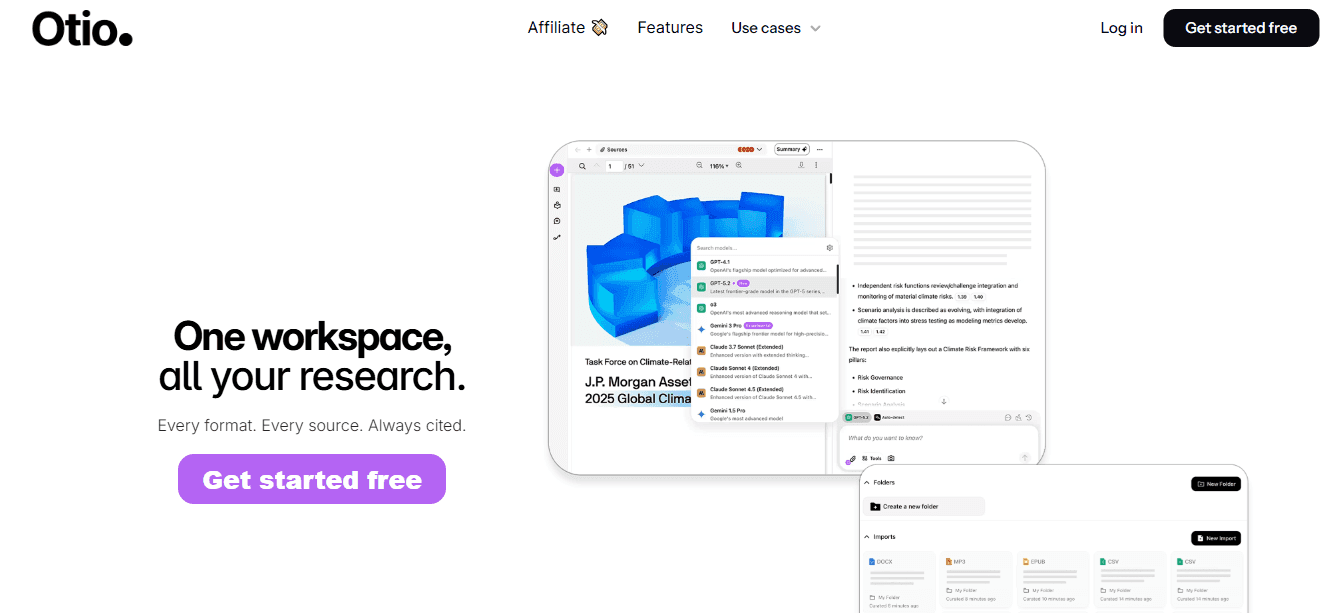
Otio is built for researchers who need to work across multiple papers without losing context or switching between tools. You upload your sources, and our AI becomes a research partner you can question directly.
How does Otio extract insights from research papers?
Upload a paper and ask: "What methodology did the authors use, and what were the key limitations?" Otio extracts that information and cites the exact sections. You receive answers grounded in your source with verifiable citations.
What makes Otio's workflow compression so effective?
What makes this effective is the unified workspace. You chat with your sources, extract insights, compare findings across papers, and build notes without fragmenting your workflow. According to Venkata Naga Sai Kumar Bysani's LinkedIn post from December 2025, a report that once took 3 hours now takes 45 minutes when you use tools that pull structured insights on demand, rather than reading everything manually. This compression occurs because you ask targeted questions rather than absorbing everything linearly. You focus on what matters for your evaluation, not what the paper presents first.
2. Scholarcy
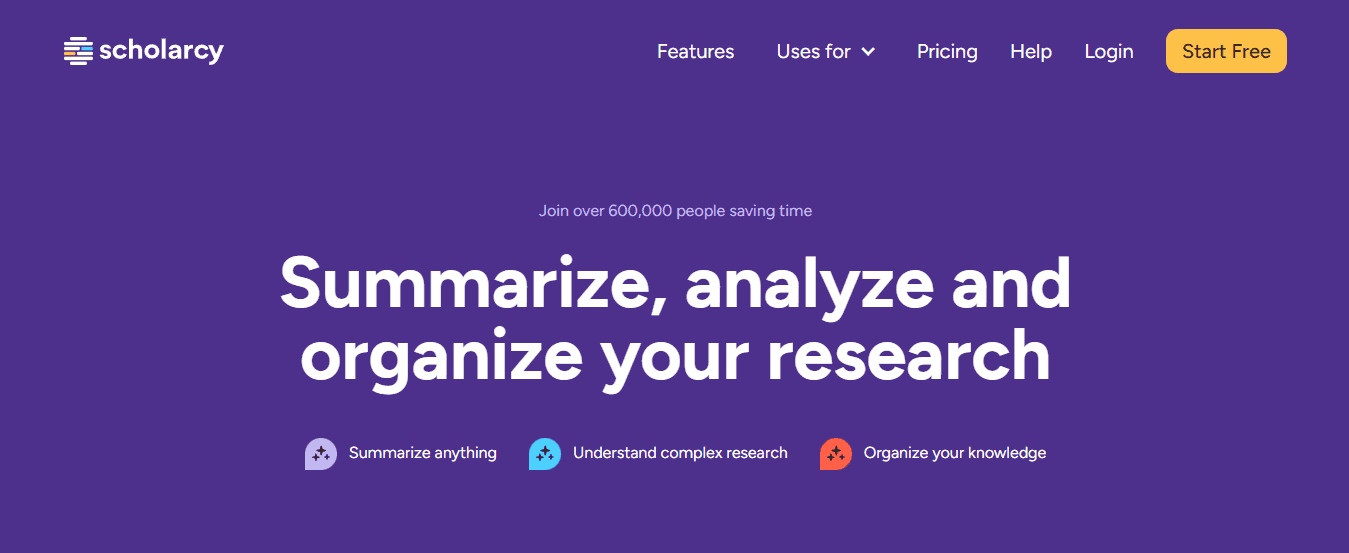
Scholarcy converts academic papers into structured flashcards. Upload a PDF, and it breaks the content into sections: highlights, summary, key contributions, methodology, and references.
How does Scholarcy organize research content?
The value is in the organization. Instead of reading the entire introduction to find the research gap, Scholarcy extracts that information. Instead of scanning the discussion for its implications, it isolates them in a separate card. You see how the argument is structured before committing to a full read.
When does Scholarcy work best for researchers?
This works best when you need to assess many papers quickly. Determine whether a paper is relevant to your research question in under five minutes, then decide which ones deserve deeper analysis.
3. ChatGPT
ChatGPT can clarify hard-to-read sections when you copy and paste them directly into the tool. For example, copy a paragraph about methods and ask: "Explain this in simple terms and tell me what assumptions the authors made." The limitation is that it doesn't remember document context across conversations unless you upload files. For quick clarification, especially when technical language obscures meaning, it removes friction effectively. The utility lies in turning complexity into plain language without sacrificing accuracy. You're not oversimplifying; you're making it accessible.
4. Elicit
Elicit is designed for research workflows. You ask a research question, and it pulls summarized findings from multiple academic papers, showing how different studies approached the same problem.
Ask: "What methods have been used to detect misinformation in social media comments?" This surfaces papers, extracts methodologies, and presents them in a comparison table, revealing patterns across studies without requiring individual review of each one. This is valuable when building a literature review or understanding how a field has evolved: you're synthesizing insights across many papers rather than analyzing one in isolation.
5. Scite
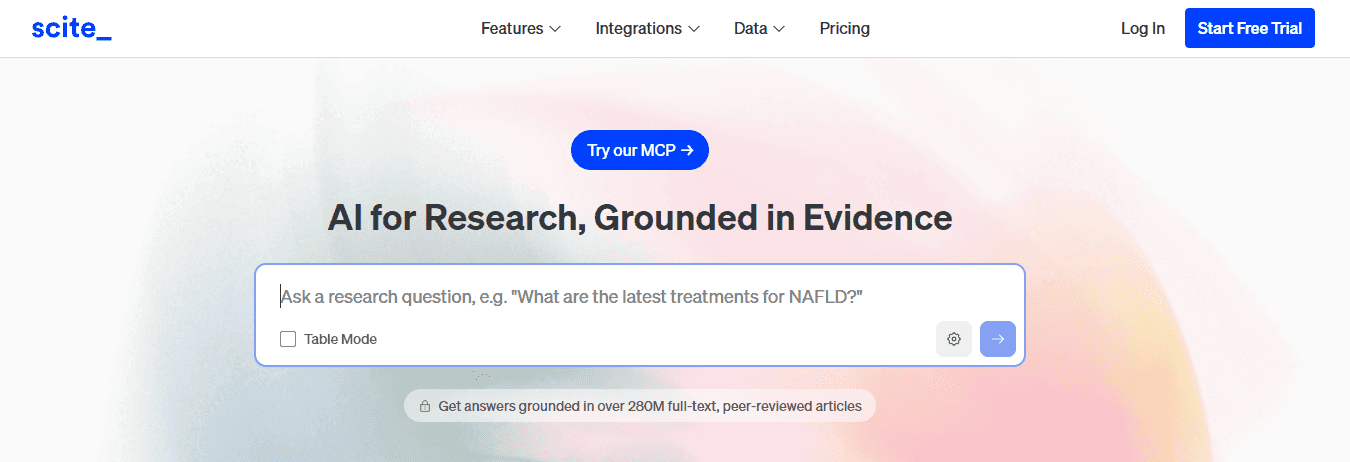
Scite shows how research papers are cited and whether those citations support, contradict, or mention the original claim. Upload a paper or search for one, and Scite displays the citation context. If a paper claims a specific intervention improves outcomes by 40%, Scite tells you whether later research confirmed that finding, challenged it, or cited it without testing it. A claim isn't strong just because it's published; it's strong when other researchers successfully replicate it. This lets you see whether the research community validated a finding, not merely what the authors concluded.
6. Paper Digest
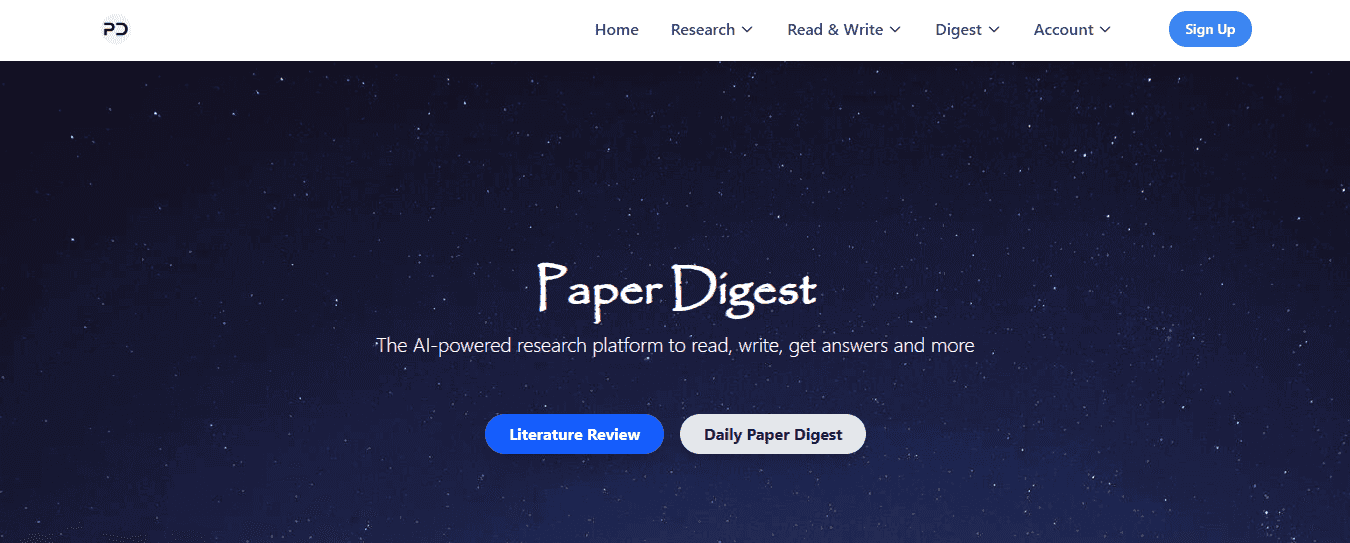
Paper Digest creates short summaries and key insights from papers you upload, breaking down the main idea, methodology, and findings in a few paragraphs. You can understand the main argument in under two minutes, helping you decide whether to read the full paper. Use it to sort through papers before a detailed review.
7. TLDR This
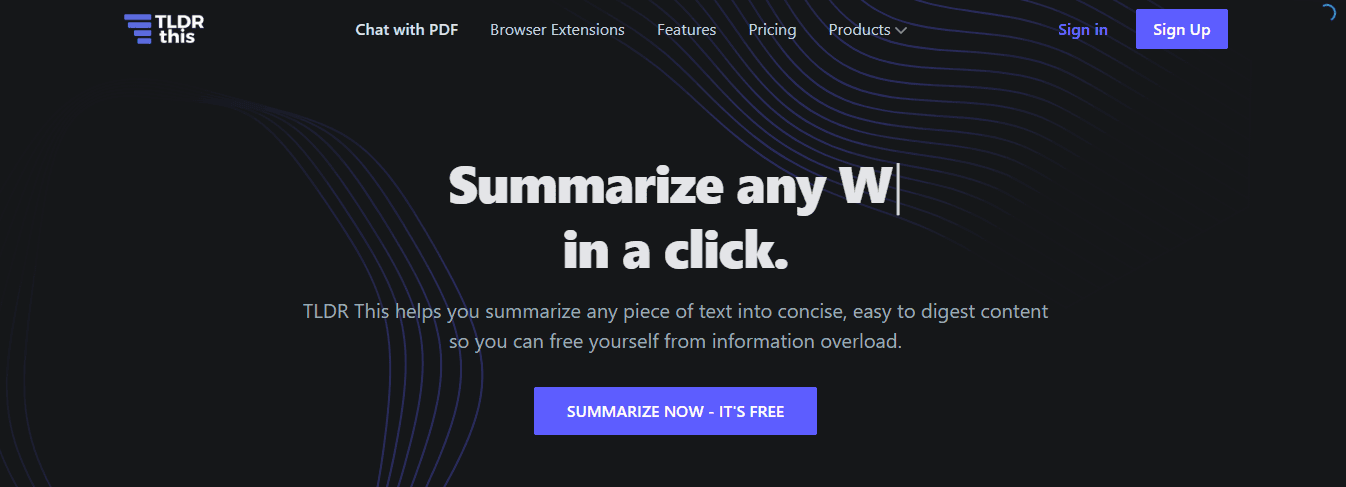
This tool shortens long text by creating quick summaries. Paste a research article into it, and it generates a summary highlighting the main points in an accessible language.
What are the limitations of automated summaries?
It's useful as a starting point, not an ending point. You get enough context to understand what the paper is about and whether it's worth reading further, but summaries lack nuance: you'll still need to verify claims and check methodology yourself.
Why does asking the right questions matter?
Most of these tools solve the same main problem: they cut down the time between "I need to understand this paper" and "I know what it says and if it's trustworthy." But speed matters only if you ask the right questions in the right order.
The 10-Minute Workflow to Analyze Any Research Paper Using AI
Analyzing a research paper in ten minutes means treating it like a source to question, not a text to read from start to finish. Pull out the main claim, check the supporting evidence, and find the key insight by asking focused questions rather than reading passively.
🎯 Key Point: The workflow is about asking better questions in the right order.
💡 Tip: This strategic approach transforms passive reading into active analysis, allowing you to extract maximum value in minimal time.
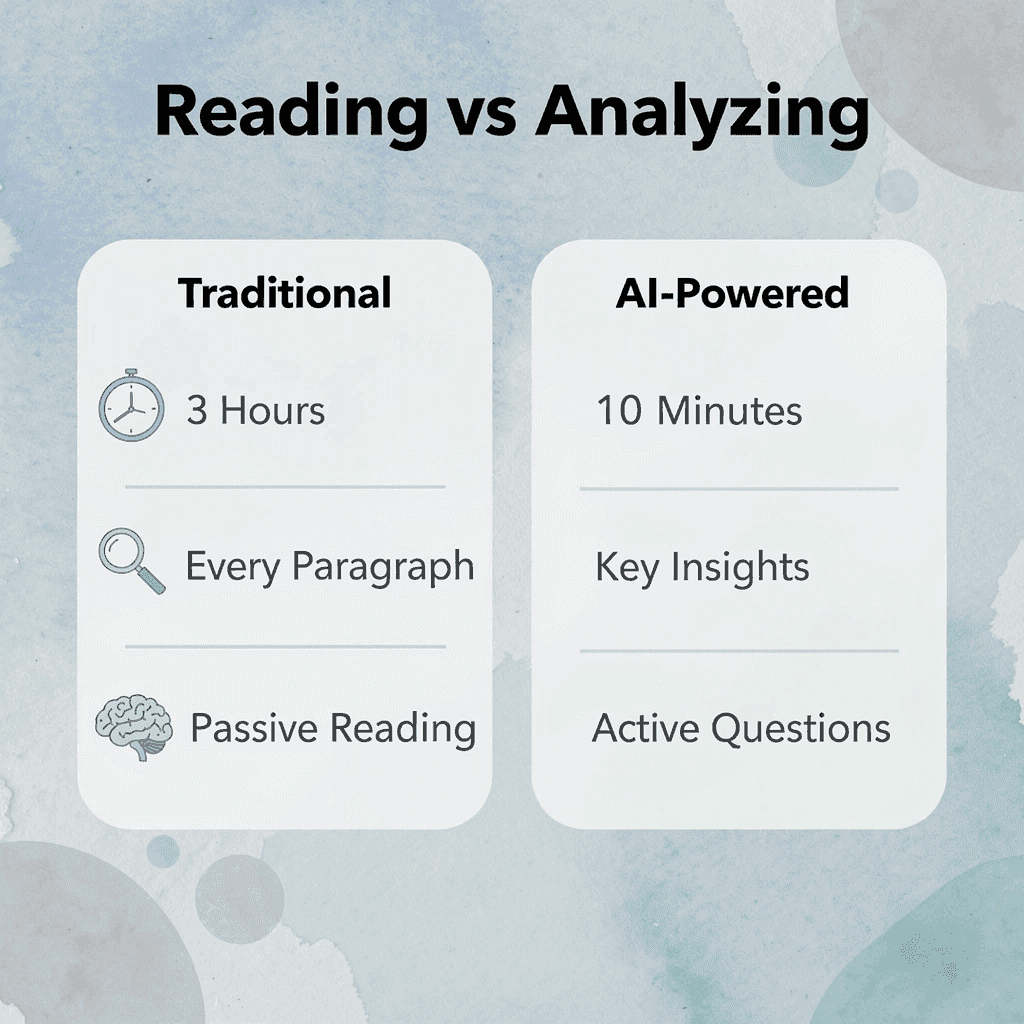
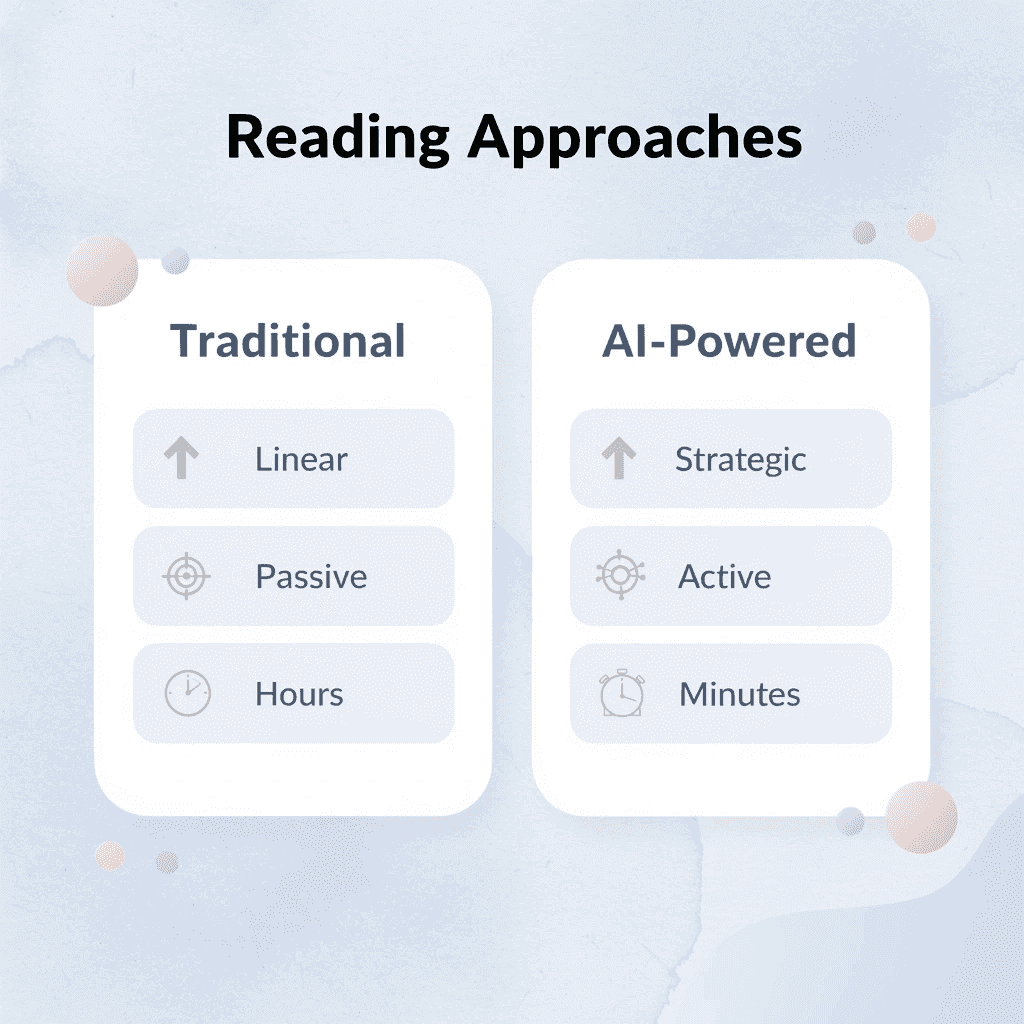
Traditional Reading | AI-Powered Analysis |
|---|---|
Linear start-to-finish | Strategic questioning |
Passive consumption | Active extraction |
Hours of time | 10 minutes focused |
"Strategic questioning transforms research paper analysis from hours of passive reading into 10 minutes of focused insight extraction." — Research Analysis Best Practices
Define Your Goal Before You Open the Paper
Most people start reading without deciding what they need from the paper, creating friction because every section feels equally important. If you're extracting the main finding, you don't need to read every citation in the literature review. If you're checking the methodology, you can skip the theoretical background. Your goal determines which sections deserve attention and which you can skip. Ask yourself, am I pulling out the core argument? Checking research quality? Comparing this study to others in the field? Without this clarity, you default to reading everything, which guarantees you'll spend three times longer than you need to.
How do you transform a paper into an interactive tool?
Upload or paste the paper into a system designed for extraction, not linear reading. This eliminates manual scanning and lets you prepare the document to answer specific questions rather than process it page by page.
What platforms enable direct questioning of research papers?
Platforms like Otio let you upload research papers and ask questions like "What method did the authors use?" or "What were the main limitations?" The AI pulls answers directly from your document with citations to exact sections, providing responses grounded in the source rather than general summaries from training data. This approach keeps you in a single workspace rather than switching among a PDF reader, a note-taking app, and a chatbot.
What should you identify first when reading a research paper?
Start with the foundation: the research question, the hypothesis, the method, and the key findings. These four elements form the paper's skeleton. Once you grasp the structure, everything else becomes context or support.
What key questions help you understand the paper's purpose?
What problem is this paper solving? What claim are the authors making? How did they test it? What did they find? Most papers answer these questions directly in the abstract and conclusion, but framing them as direct questions forces precision.
Why should you understand the argument before analyzing evidence?
It is easier to evaluate research papers when you understand the argument before assessing the evidence. Jumping into the methodology without knowing what the authors are trying to prove means analyzing details without context.
What should you focus on when evaluating research quality?
Focus on quality, not content. The method shows whether the research design supports the claim. The results show whether the data prove the authors' conclusion.
What key questions reveal methodological weaknesses?
Does the sample size justify the generalization? Are variables clearly defined? Do results show causation or correlation? Are limitations acknowledged? Many papers present findings confidently without addressing methodological constraints. A claim of 40% improvement from a 30-person study over two weeks is a red flag. Confusing correlation with causation weakens any claim.
How can flawed methodology lead to misleading conclusions?
One study used URL-based detection to identify false information in social media comments, assuming that any link to a low-credibility source indicated user support. Manual review revealed the opposite: users linked to those sources to criticize or mock them. The methodology couldn't distinguish between intent, leading to misleading conclusions. This gap becomes apparent when evaluating the method and results together.
Reduce Everything Into Usable Insights
Your analysis isn't complete until you can explain the paper in simple terms. Extract the main finding, the supporting evidence, and its implications. If you cannot summarise it in three sentences, you haven't finished analyzing it. Organize your insights into three questions: What did this paper prove? What evidence supports it? Why does it matter? This structure clarifies your thinking and creates reusable insights.
Store Your Analysis in a Structured Way
Save your analysis with a short summary, key insights, and evaluation notes. This makes it searchable and referenceable without re-reading the entire paper, building a knowledge base rather than a pile of highlighted PDFs. Structured extraction isn't about cutting corners; it's about focusing effort where it creates the most value: judgment, not absorption. You're still engaging deeply with the research, just through targeted questions instead of passive reading. Applying this workflow to an actual research paper reveals where the process accelerates or stalls.
Analyze Your Research Paper in 10 Minutes Using Otio
If analyzing a research paper takes one to two hours, the problem isn't the paper; it's reading while simultaneously thinking, evaluating, and summarizing. You can compress that process into less than ten minutes by treating the paper as a source to interrogate rather than a text to absorb.
💡 Tip: Transform your research workflow by asking the right questions upfront instead of reading linearly through dense academic text. Open Otio, upload your research paper, and ask: "What is the main claim, method, and key findings?" Then ask: "What are the limitations and key insights?" Our AI extracts structured answers grounded in your document, complete with citations. You work within a unified workspace where every answer comes directly from your source, without switching between PDF readers, note-taking apps, and chatbots. In under ten minutes, you'll have the core idea, method, key findings, and a usable summary.
🔑 Takeaway: The fastest path to research comprehension is structured interrogation, not sequential reading. "You can compress that process into less than ten minutes by treating the paper as a source to interrogate instead of a text to absorb." — Otio Research Analysis Method
Research clarity isn't about reading more. It's about using a better system.
Related Reading
Notebooklm Limits
Ai Tools To Summarize a Research Paper
Legal Document Data Extraction
Top Ai Tools For Document Review
Notebooklm Vs Notion
Best Automation Tools For Document Management
Best Hr Document Management Software
Best Document Management Software For Small Businesses
ChatGPT File Upload Limits
Best Ai Tools For Research Projects
Best Document Management Software For Law Firms
Notebooklm Alternatives
Claude Ai File Upload Limits
Best Document Management Software