
Financial LLM
CB Insights vs Pitchbook Detailed Comparison
Compare CB Insights vs Pitchbook to see which platform offers better data, pricing, and features for investors and startups.

In the world of financial analysis, having the right tools can make all the difference. Whether you're a seasoned professional or just starting, you've likely encountered the challenge of sifting through vast amounts of data to find the information you need. This is where CB Insights and Pitchbook come in.
These powerful platforms provide comprehensive data on private companies, investors, and deals, enabling you to make informed decisions. In this guide, we'll compare CB Insights and Pitchbook, highlighting their strengths and weaknesses to help you choose the best tool for your needs. And if you’re interested in writing and researching faster with AI, stick around till the end to discover how Otio’s AI research and writing partner can help you achieve your goals. We will also touch upon tools for Financial LLM.
Table Of Contents
What is CB Insights?
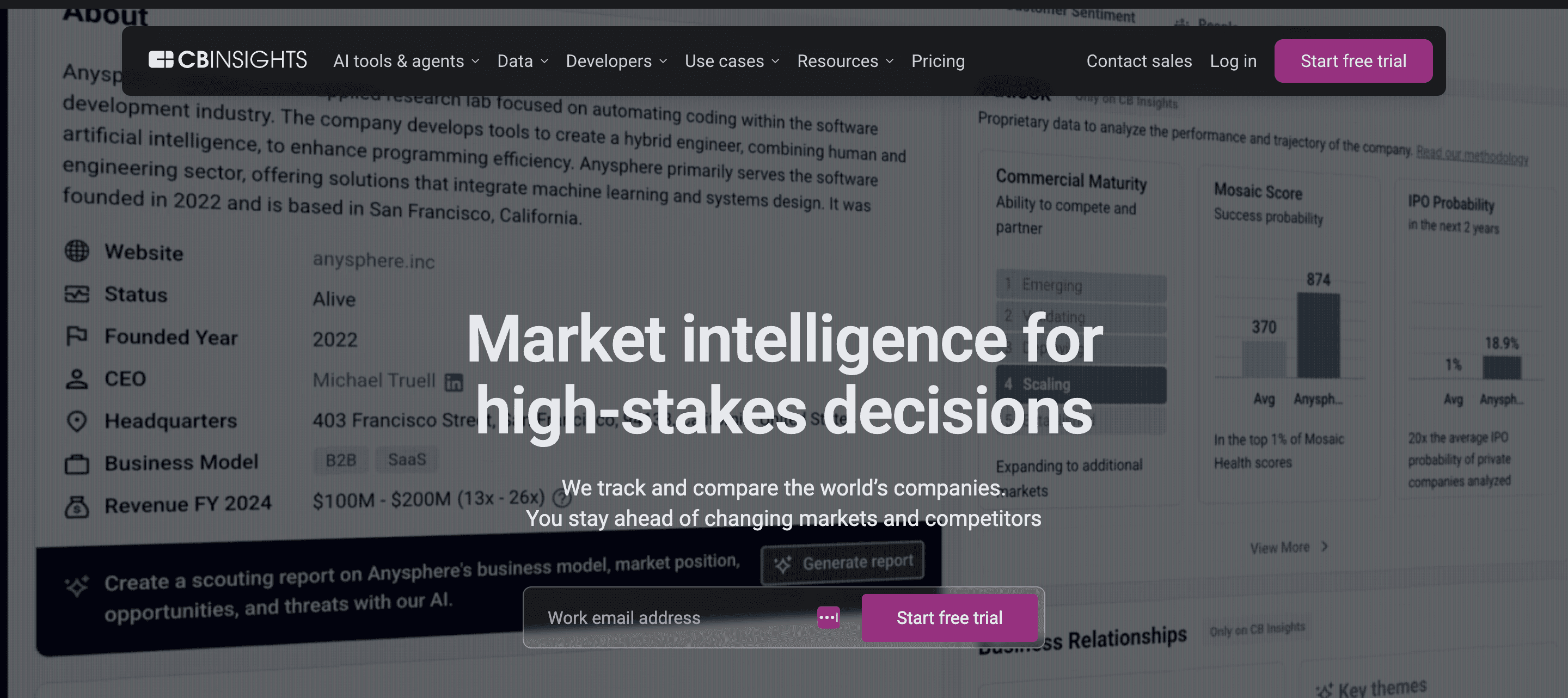
CB Insights is a market intelligence solution that provides data and insights for various industries, including investment banking, venture capital, corporate development, private equity, and more. The platform allows users to analyze market data and identify feasible project paths using predictive modeling and natural language processing (NLP) functionality.
It also provides mosaic scores that enable users to gain visibility into the progress rate of emerging organizations. This can help professionals explore promising investment opportunities by evaluating emerging trends. Otio also has web scraping capabilities that allow researchers to access a diverse array of information beyond traditional academic papers and search engines. This makes it a powerful tool for streamlining the research process and helping users transition from reading list to first draft more quickly.
What is Pitchbook?
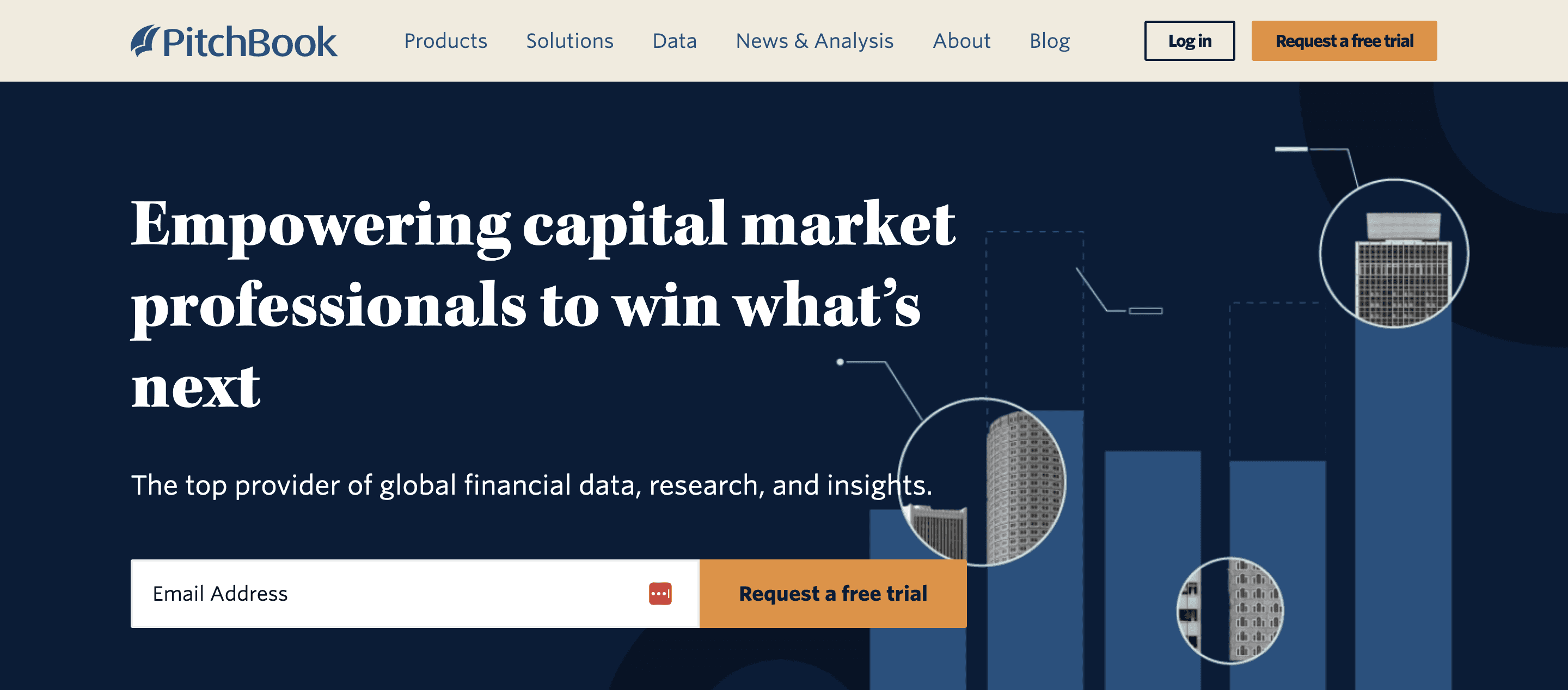
PitchBook is a data and research platform designed to help professionals analyze private markets. It aggregates financial data from thousands of sources, offering a comprehensive database of private and public companies, investment rounds, and market trends. Put simply, Pitchbook provides a database of Private Market data. When you sign up, you get access to this data for market research. But PitchBook is indeed packed with features that make it a go-to tool for investors, analysts, and business development teams. Here are some of its key offerings:
Private Market Data
Extensive data on private companies, including valuations, revenue estimates, and funding history.
Investor & Company Profiles
Detailed investor database profiles of venture capital firms, private equity funds, and businesses across industries.
Deal Sourcing
Track mergers, acquisitions, and funding rounds in real time.
Market Trends & Analytics
Generate charts and reports to visualize industry trends and competitive landscapes.
Fundraising Insights
Research investment firms and their historical deal activity to identify potential funding sources.
Let Otio be your AI research and writing partner — try Otio for free today!
Related Reading
• How to Improve Finance Processes
• Financial Reporting Challenges
• Financial Forecasting Techniques
• Financial Data Extraction
• Financial Statement Analysis Techniques
• How to Forecast Budget
• Market Research Challenges
• How to Do a Cost Analysis
• AI Financial Modeling
CB Insights vs Pitchbook Detailed Comparison

1. Core Focus and Purpose
CB Insights is centered around innovation intelligence. Its primary goal is to assist companies in predicting technology trends, understanding startup ecosystems, and identifying disruptive competitors. The platform serves corporate strategists, innovation teams, and M&A professionals who need to stay ahead of market changes. PitchBook, in contrast, focuses on private market intelligence. It provides comprehensive data on venture capital (VC), private equity (PE), and mergers & acquisitions (M&A). The platform is used by investment professionals, financial advisors, and corporate development teams.
Summary
CB Insights is trend-forward and predictive, while PitchBook is investment-focused and historical.
2. Data Coverage and Strengths
CB Insights excels in tracking startups, emerging tech sectors, and innovation trends. It utilizes machine learning to analyze data from news, patents, regulatory filings, and other sources. The platform visualizes how technologies evolve and identifies which companies are leading these changes. PitchBook provides detailed financial and deal-level data, including funding rounds, valuations, investor profiles, LP/GP relationships, M&A terms, and fund performance. It provides more comprehensive financial metrics, including earnings, multiples, and historical ownership records.
Use-Case Difference
CB Insights is better for forecasting industry trends and monitoring competitors. PitchBook is superior for investment due diligence and deal analysis.
3. Types of Users and Industries Served
CB Insights is used by Fortune 500 strategy teams, product managers, consultants, and innovation leaders. The platform’s visuals are designed to cater to executive-level decision-making. PitchBook is preferred by venture capitalists, private equity professionals, and investment bankers. Financial analysts and M&A professionals use it for deal transparency and financial benchmarking.
Key Takeaway
CB Insights supports strategic, innovation-driven decisions, while PitchBook serves finance-heavy, transaction-driven users.
4. User Experience and Interface
CB Insights provides an intuitive, modern interface with clean data visualizations and interactive dashboards, enabling users to explore connections among startups, technologies, and investors without the need for spreadsheets. PitchBook can be data-dense and complex to navigate. It is feature-rich and offers Excel plugins for customizable exports. CB Insights prioritizes user-friendliness and visuals. PitchBook focuses on flexibility and depth.
5. Data Collection Methods
CB Insights utilizes machine learning and NLP to collect unstructured data, including press releases and patent applications, excelling in pattern recognition and trend detection. PitchBook employs a human-centric model, with data analysts verifying information through direct contacts to ensure accuracy for deal data and financials.
Difference
CB Insights is automated and scalable. PitchBook provides verified data for investment research.
6. Innovation and Future Focus
CB Insights is a forward-looking platform that publishes reports on market shifts and the probability of disruption. It helps companies decide whether to build, buy, or partner. PitchBook focuses on historical performance and current market structures. It traces investment trends and financial returns.
Bottom Line
CB Insights focuses on the future of business, while PitchBook concentrates on the past and present of private markets.
7. Pricing and Access
Both platforms are expensive and target enterprise clients. PitchBook is generally priced higher due to its detailed financial data and analysis. CB Insights offers more flexible pricing for strategic teams. Otio is an AI-native workspace explicitly designed for researchers. It helps them collect data from a wide range of sources, extract key takeaways with AI-generated notes and source-grounded Q&A chat, and create draft outputs using the sources they've collected. Let Otio be your AI research and writing partner — try Otio for free today!
Limitations of CB Insights and Pitchbook
Both platforms deliver powerful market intelligence, but each carries constraints that shape how and when you can use them effectively. CB Insights excels at tracking private tech companies but offers almost no public company coverage, while PitchBook struggles with public market depth and lacks the research breadth many analysts need for cross-sector work. These aren't minor gaps. There are structural limitations that force you to layer additional tools, subscriptions, and workflows just to answer questions that should feel straightforward.
CB Insights: Built for Tech, Blind to Everything Else
CB Insights was designed with venture capital and technology markets in mind. That focus creates clarity for some users and blindness for others.
1. Private tech companies only, with minimal public market access
If your research spans both private startups and publicly traded competitors, CB Insights won't give you the full picture. You're left toggling between platforms to compare a Series B SaaS company with its public-market rivals.
2. No access to regulatory filings, ESG reports, or primary sources
You can't pull SEC filings, global regulatory documents, ESG disclosures, newspapers, trade journals, expert call transcripts, or broker research. That means every time you need primary source validation or deeper context beyond CB Insights' proprietary summaries, you're opening another tool.
3. Dashboards and reporting features lack flexibility
Customization options trail competitors. If your team needs tailored views, specific KPI tracking, or white-labeled outputs, you'll find the platform rigid. What works out of the box might not bend to match your workflow.
4. No intelligent search functionality
Search relies on basic keyword matching. You can't use natural language queries, semantic search, or AI-driven discovery to surface connections across datasets. Finding the right signal often means knowing exactly what terms to input.
5. Technology-focused coverage leaves other industries underserved
Healthcare devices, industrial manufacturing, consumer packaged goods, and financial services outside fintech receive thinner, less granular coverage. The platform wasn't built for these sectors, and it shows in the completeness and depth of insight.
6. Not suitable for small-scale firms or solo practitioners
Pricing and feature sets are targeted at enterprise teams and institutional investors. Smaller firms, independent consultants, or early-stage analysts often find the cost prohibitive relative to how much of the platform they'll actually use.
PitchBook: Strong on Private Markets, Weak on Public Context
PitchBook dominates private capital markets and M&A intelligence, but step outside that zone, and the platform thins out quickly.
1. Limited public market coverage
Public company data exists, but it's not the platform's strength. Depth, timeliness, and analytical tools for public equities lag behind dedicated public market platforms.
2. No expert call library
You can't access expert interviews, primary research calls, or specialist insights that provide qualitative context around quantitative data. That leaves you relying solely on documents and datasets without the human perspective that often clarifies ambiguity.
3. Restricted access to earnings transcripts, no SEC or global filings
Earnings call transcripts appear in limited form. SEC filings and international regulatory documents aren't available, forcing you to pull those from separate sources every time you need to verify claims or dig into financial footnotes.
4. No advanced AI search or sentiment analysis
Search remains manual and keyword-dependent. There's no sentiment tracking across news, no AI-powered thematic clustering, and no natural language interface to ask complex questions and get synthesized answers.
5. Equity research costs extra
Broker research and sell-side equity reports aren't included in standard subscriptions. If you need that layer of analysis, expect another fee tier.
6. Trade journals and industry publications aren't indexed
Niche industry reporting, trade press, and sector-specific publications fall outside PitchBook's scope. You're back to manual searches or separate subscriptions to track emerging trends in specialized markets. According to AlphaSense, no quantifiable data on the limitations of CB Insights and PitchBook is available from independent research sources, so these gaps surface through user experience rather than published benchmarks.
Why These Limitations Compound Over Time
The real cost isn't a missing feature. It's the cognitive overhead of stitching together partial answers from multiple platforms, remembering which tool holds which data type, and manually reconciling conflicting information across sources. You start a research question in CB Insights, realize you need public comps, switch to another terminal, notice a regulatory flag, open the SEC site, want expert context, check if your firm has access to expert networks, then try to synthesize everything in a Word doc or spreadsheet. By the time you've assembled a coherent view, hours have passed, and your focus has fractured.
Most research platforms assume you'll adapt your workflow to fit their structure. That assumption breaks down when your questions don't respect those boundaries. When you're comparing a private biotech startup's valuation against public pharma peers while tracking regulatory sentiment and expert opinions on pipeline risk, no single platform gives you everything. You're forced into a multi-tool juggling act that slows momentum and increases the risk of errors.
An AI Research and Writing Partner like Otio changes that dynamic by letting you collect insights from CB Insights, PitchBook, and any other source into one workspace where you can chat with documents, extract key points, and draft analysis without switching contexts. Instead of managing five browser tabs and three subscriptions to answer one question, you centralize the messy parts, automate the repetitive synthesis, and focus on the insight work that actually matters. But even with better workflows, the question remains: if both platforms carry these structural gaps, what other tools fill the space differently?
8 Best Alternatives for CB Insights and Pitchbook

The market for company intelligence and financial research tools has expanded far beyond the two-platform choice most people default to. Some alternatives specialize in AI-powered search across unstructured content, others focus on emerging markets or specific geographies, and a few reimagine research workflows entirely. The right choice depends less on brand recognition and more on what questions you're actually trying to answer, and how much synthesis work you're willing to do manually. What follows isn't a list of "similar but cheaper" options. These platforms solve different problems, serve different workflows, and make different tradeoffs between breadth, depth, and usability.
1. Otio
AI-Native Research & Synthesis Workspace
Otio doesn't compete with CB Insights or PitchBook on proprietary datasets. It competes on what happens after you've gathered information from any source. You collect articles, PDFs, tweets, YouTube videos, reports, and web pages, then let AI generate notes, summaries, and draft outputs grounded in those specific materials. The platform addresses a different bottleneck. Most researchers don't struggle to find data anymore. They struggle to make sense of it quickly enough to meet deadlines, spot patterns across fragmented sources, and turn raw information into coherent analysis. Otio focuses on that synthesis layer, where generic chatbots fail because they lack document context and traditional databases fail because they stop at data delivery.
Best use cases
Market research requires non-traditional sources, competitive landscape analysis pulling from blogs and social content, literature reviews spanning academic and industry publications, investment memos synthesizing diverse materials, and early-stage idea validation before committing to expensive subscriptions.
Strengths
AI-generated notes stay grounded in your uploaded sources rather than hallucinating generic responses. Works with unstructured formats that most databases ignore. Web scraping reaches beyond paywalled or academic content. Faster insight generation than manual reading and note-taking.
2. AlphaSense
Enterprise-Grade Market & Competitive Intelligence
AlphaSense built its reputation on search quality. The platform uses advanced natural language processing to surface relevant passages from earnings calls, SEC filings, broker research, expert interviews, and internal documents faster than keyword matching ever could. Consulting firms, asset managers, and Fortune 500 strategy teams rely on it when document volume overwhelms human reading capacity.
The semantic search engine understands context and intent, not just exact phrase matches. You can ask complex questions and get back specific excerpts with surrounding context, ranked by relevance. That capability matters most when you're tracking competitive moves across dozens of transcripts or monitoring regulatory sentiment shifts across hundreds of filings.
Best use cases
Equity research requiring deep document analysis, strategy consulting projects synthesizing competitor intelligence, industry trend analysis across public company disclosures, and competitive benchmarking using earnings call language and executive commentary.
Strengths
Best-in-class AI search that finds connections manual reading misses. Access to expert call transcripts adds qualitative depth. Document-level insights surface faster than traditional read-and-highlight workflows. Strong for public companies and market intelligence, where text analysis drives conclusions.
Limitations
Private startup coverage is thinner than PitchBook's venture capital focus. Pricing targets enterprise budgets, making it prohibitive for smaller teams. Overkill if your research centers on early-stage companies without extensive public filings or transcripts.
3. Dealroom
European & Global Startup Intelligence
Dealroom tracks over 2M+ startups and scaleups with particularly strong coverage in Europe, deep tech sectors, and government-backed innovation ecosystems. The platform excels at ecosystem mapping, showing how startups cluster geographically and which policy initiatives drive regional growth. The visualization tools make patterns visible quickly. You can see funding flows by country, track emerging tech hubs, and identify which sectors attract capital in specific regions. That geographic and ecosystem intelligence often matters more than individual company metrics when you're advising governments, planning market entry, or tracking shifts in innovation concentration over time.
Best use cases
Startup ecosystem analysis for policy or investment decisions, government and innovation research requiring regional breakdowns, deep-tech and AI company mapping across geographies, and European market intelligence where other platforms show gaps.
Strengths
Excellent data visualization that makes complex ecosystems comprehensible. Strong public-private sector collaboration data. Good categorization of emerging technologies and innovation themes. Often more transparent for public-sector research needs.
Limitations
Less depth on US venture deals compared to PitchBook. Limited financial modeling tools for valuation work. A smaller overall dataset means some niche sectors lack comprehensive coverage.
4. S&P Global Market Intelligence
Institutional-Grade Financial & Market Data
S&P Global serves banks, insurers, asset managers, and government agencies requiring regulatory-grade accuracy and historical depth. The platform covers tens of thousands of financial institutions worldwide with data structured for risk analysis, credit assessment, and macro research. This isn't a startup database. It's built for understanding financial system interconnections, regulatory compliance, and institutional behavior patterns. If your work involves banking sector analysis, credit risk modeling, or financial policy research, the data quality and institutional coverage justify the cost. For venture capital or private tech company research, it's the wrong tool entirely.
Best use cases
Banking and financial services research, risk and credit analysis requiring regulatory-grade data, financial sector competitive intelligence, institutional investor analysis, and macro research connecting market structure to specific institutions.
Strengths
Extremely reliable data trusted for compliance and regulatory work. Massive institutional coverage with deep historical datasets. Strong regulatory and risk intelligence frameworks. Integration with other S&P Capital IQ tools for financial modeling.
Limitations
Weak on startups and venture capital ecosystems. Very high cost structures target institutional buyers. Not beginner-friendly, with steep learning curves and complex interfaces designed for specialist users.
5. FactSet
Integrated Financial Research Workstation
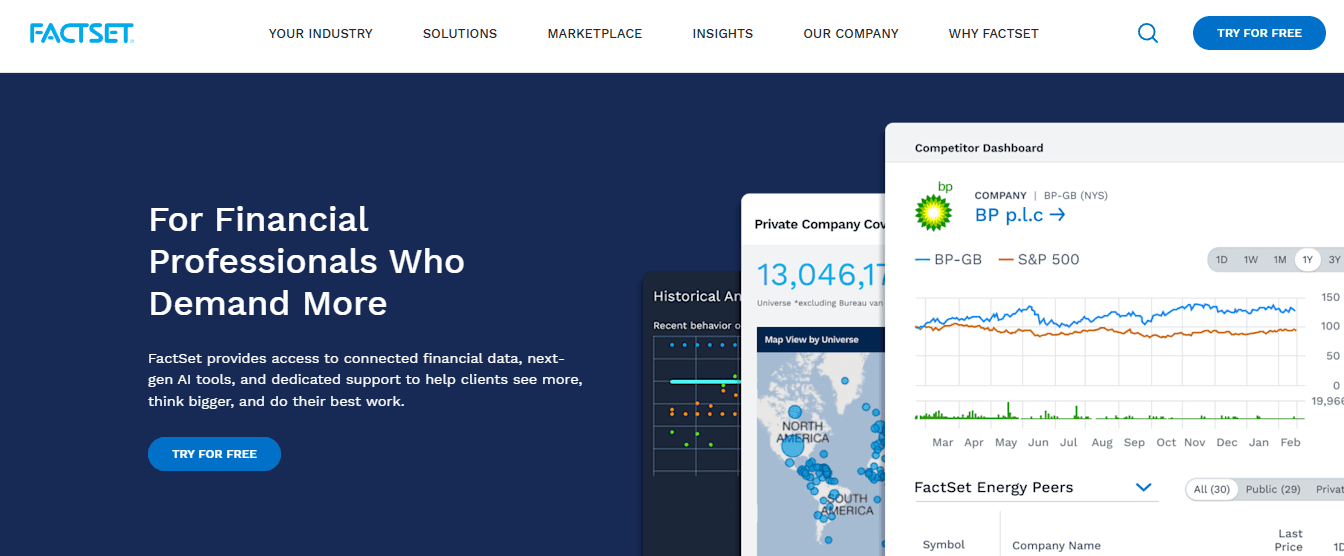
FactSet built its reputation among investment bankers, hedge funds, and asset managers who need real-time market data, news, analytics, and screening tools integrated into a single workstation. The platform's strength lies in customization and alerting, letting analysts build dashboards tailored to specific strategies and receive notifications when relevant events occur. The screening tools let you filter thousands of securities by complex criteria combinations, surfacing opportunities or risks based on financial metrics, ownership changes, analyst sentiment, or news flow. That capability matters most for public market decision-making, where timing and comprehensive market coverage drive performance.
Best use cases
Portfolio management requiring real-time data and alerts; equity and macro research spanning multiple asset classes; financial screening and quantitative analysis; and investment banking workflows integrating deal flow with market intelligence.
Strengths
Highly customizable dashboards tailored to specific workflows. Advanced screening tools with complex filter combinations. Real-time alerts keep analysts informed without the need for constant manual checking. Strong integration across market data, news, and analytics.
Limitations
Minimal intelligence on startups or private companies. Expensive, with pricing models targeting institutional budgets. A steep learning curve requires investment in training before productivity gains appear.
6. Verdion
AI-Driven Private Company Data Enrichment
Verdion focuses on private companies that traditional databases miss or cover lightly, particularly small and medium enterprises outside venture capital ecosystems. The platform uses advanced AI and web scraping to uncover information that doesn't appear in press releases or funding announcements. That capability fills a specific gap. Most databases concentrate on companies that actively seek visibility through fundraising, acquisitions, or media relations. Verdion targets the quieter majority, businesses growing without venture backing, family-owned firms, and regional players that matter for business development or competitive analysis but lack structured data coverage elsewhere.
Best use cases
Private market research beyond venture-backed startups, business development targeting companies missing from standard databases, sales intelligence requiring enriched company profiles, and competitive analysis in sectors with limited public disclosure.
Strengths
Strong enrichment capabilities surface hard-to-find information. AI-powered discovery works where manual research becomes prohibitively time-consuming. Good coverage of non-venture-backed firms often ignored by other platforms.
Limitations
Smaller brand recognition means less established data validation processes. Limited historical funding data compared to venture-focused platforms. Less standardized reporting makes cross-company comparisons more difficult.
7. Tracxn
Emerging Technology & Startup Landscape Analysis
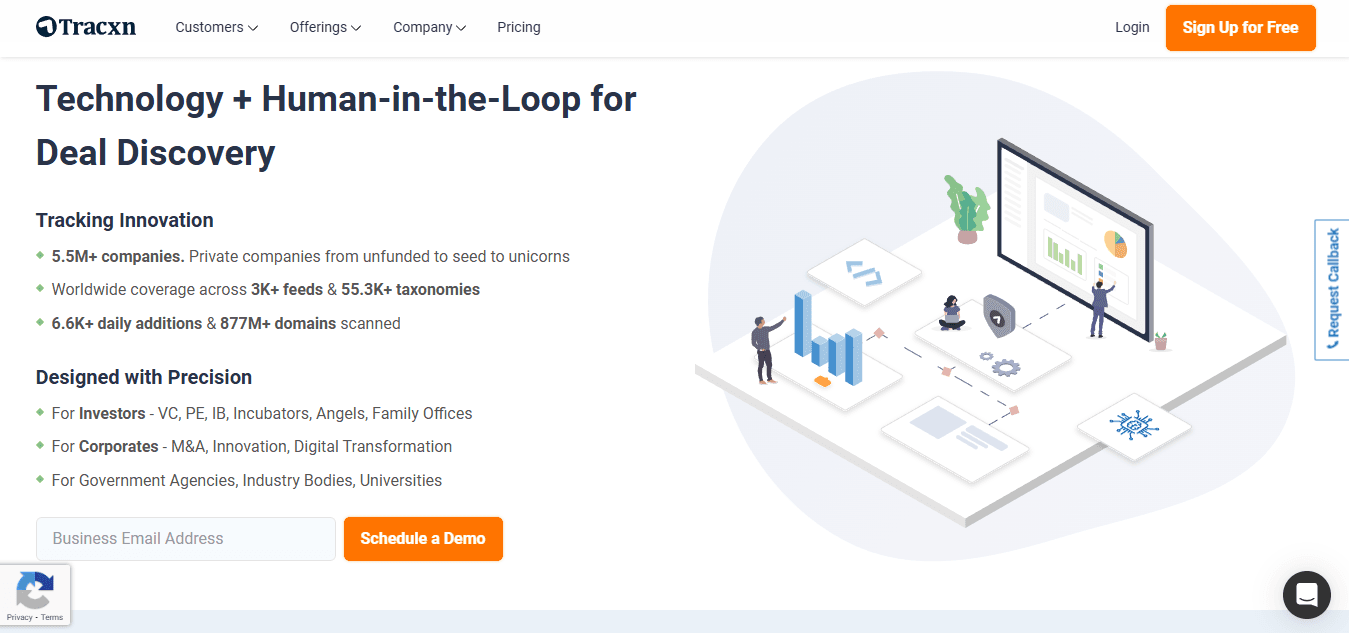
Tracxn specializes in structured taxonomies for emerging technologies, offering granular categorization across AI, SaaS, fintech, and other innovation-driven sectors. The platform provides particularly strong coverage in emerging markets where Western-focused databases show gaps. The tech classification system helps innovation teams and early-stage investors spot trends before they reach mainstream visibility. You can track which subsectors attract capital, identify competitive clusters, and monitor geographic expansion patterns across thousands of startups categorized by specific technology applications rather than broad industry labels.
Best use cases
Technology scouting for corporate innovation teams, early-stage venture capital research requiring detailed tech categorization, emerging market startup analysis, and competitive landscape mapping for specific technology applications.
Strengths
Deep technology classification beyond surface-level industry tags. Good global coverage, including India, Southeast Asia, and other emerging markets. Startup-focused data collection and categorization. Often more affordable than enterprise-grade alternatives.
Limitations
Less financial depth compared to PitchBook's modeling tools. The user interface feels dated compared to newer platforms. Smaller datasets in some sectors mean coverage gaps for niche markets.
8. AngelList
Founder, Talent & Early-Stage Investment Network
AngelList functions as a network first and a data platform second. The real value comes from direct access to startup founders, early-stage investors, and hiring data, particularly in AI and SaaS sectors, where the platform maintains strong community engagement. Most researchers struggle to quantify startup activity on research platforms. ZoomInfo reports that sales teams waste up to 10 hours per week on manual research tasks, a friction point that highlights how static data often misses the dynamic, relationship-driven nature of early-stage markets. AngelList addresses this by providing real-time ecosystem signals through founder profiles, job postings, and investor activity rather than retrospective funding announcements.
Best use cases
Angel investing requires direct founder connections, startup hiring and talent market analysis, founder outreach for partnerships or customer development, early-stage deal flow sourcing, and real-time signals about startup momentum before formal announcements.
Strengths
Direct connections replace static data with human access. Real-world early-stage insights from active participants rather than third-party aggregators. Strong presence in AI, developer tools, and SaaS communities. Job posting data signals growth and focus areas before funding rounds.
Limitations
Limited analytics and financial modeling capabilities. No deep historical datasets or standardized financial reporting. Not designed for formal research requiring cited sources and audit trails. Coverage skews heavily toward US tech ecosystems. Most researchers piece together workflows across multiple platforms, switching contexts every time a question crosses the boundary of what any single database covers. AI Research and Writing Partner like Otio changes that pattern by letting you pull reports, documents, and datasets from whichever platforms your questions demand, then synthesizing everything in one workspace where you can chat with materials, extract patterns, and draft analysis without rebuilding context each time you switch tools. Instead of memorizing which platform holds which data type, you focus on the synthesis work that turns scattered information into defensible conclusions. But knowing these alternatives exist only matters if you understand which specific capabilities each prioritizes.
Related Reading
• How to Improve Finance Processes
• Financial Reporting Challenges
• Financial Forecasting Techniques
• Financial Data Extraction
• Financial Statement Analysis Techniques
• How to Forecast Budget
• Market Research Challenges
• How to Do a Cost Analysis
• AI Financial Modeling
Supercharge Your Researching Ability With Otio — Try Otio for Free Today
Knowledge workers, researchers, and students today suffer from content overload and are left to deal with it using fragmented, complex, and manual tooling. Too many of them settle for stitching together complicated bookmarking, read-it-late, and note-taking apps to get through their workflows. Now that anyone can create content with the click of a button, this problem is only likely to worsen. Otio solves this problem by providing one AI-native workspace for researchers. It helps them:
Collect: a wide range of data sources, from bookmarks, tweets, and extensive books to YouTube videos.
Extract key takeaways: with detailed AI-generated notes and source-grounded Q&A chat.
Create: draft outputs using the sources you’ve collected.
Otio helps you transition from reading list to first draft more quickly. Additionally, Otio enables you to write research papers and essays more efficiently. Here are our top features that researchers love: AI-generated notes on all bookmarks (YouTube videos, PDFs, articles, etc.). Otio enables you to chat with individual links or entire knowledge bases, just like you chat with ChatGPT, as well as AI-assisted writing.
Our tool features web scraping capabilities that enable you to access a broad range of data sources, extending beyond traditional academic papers and search engines. This feature enables researchers to collect diverse information from sources such as bookmarks, tweets, books, and YouTube videos, streamlining the process of curating and analyzing data for research purposes. Let Otio be your AI research and writing partner — try Otio for free today!
Related Reading
• Alphasense Alternatives
• Financial Modeling Tools
• AI Budgeting Tools
• Crunchbase vs Pitchbook
• Pitchbook Competitors
• Grata vs Sourcescrub
• Ibm Watson vs Chatgpt
• Microsoft Dynamics 365 Alternatives