
Research Paper Sources
Elicit AI Review: Features, Benefits, Alternatives & Pricing
Get an overview of Elicit AI, its key features, benefits, use cases and pricing for 2025. See how this AI technology can enhance your operations.

Understanding the nuances of Elicit AI involves diving deep into the differences between primary vs secondary sources to enhance data integrity and decision-making. When it comes to Elicit AI, incorporating a versatile approach to data sources can help you unlock valuable insights. The strategic use of various data sources empowers businesses to make critical decisions with confidence.
Table of Contents
What Is Elicit AI?

Elicit AI is an incredible new tool that I believe will revolutionize the way we conduct research. Elicit is a research assistant utilizing artificial intelligence (AI) language models like GPT-3 to automate parts of researchers’ workflows.
It's designed to help researchers quickly and efficiently analyze research papers. The core workflow within Elicit at present is the Literature Review. By posing a query, Elicit can show relevant papers and summaries of key information about those papers in an easy-to-use table.
The Power of Elicit AI
Elicit AI has the remarkable capability to transform the way researchers work by automating many time-consuming tasks. This AI research assistant can assist in summarizing papers, extracting data, and synthesizing findings. It can also help in narrowing or adjusting research directions, exploring and brainstorming research questions, summarizing evidence from the most cited papers on a research topic, and more.
Elicit searches across a vast corpus of 200 million academic papers from the Semantic Scholar database, covering all academic disciplines. When extracting data from papers in Elicit, it uses the full text or abstract, depending on availability. This tool is incredibly versatile and can be a game-changer for researchers in all fields.
Related Reading
• How To Read Scientific Papers
• Research Notes
• How Many Sources Should A Research Paper Have
• How To Read A Research Paper
• Sources For Research Paper
• How To Find Sources For A Research Paper
• Google Scholar Search Tips
• Literature Synthesis
Key Features Of Elicit AI

AI-Powered Search: Finding Relevant Scientific Papers
I am a big fan of how Elicit AI leverages the power of artificial intelligence to streamline the search process for users. The AI-powered search feature allows users to find the most relevant scientific papers quickly without drowning in irrelevant documents.
Elicit AI uses AI to find scientific papers based on user queries, making it easier to discover and access the most relevant information. Accessing the most pertinent information has never been more effortless. This feature is a lifesaver for those who want to find valuable research without spending an eternity sorting through irrelevant papers.
Summarization: Understanding Complex Scientific Papers
The summarization feature is another favorite of mine in Elicit AI. By utilizing AI to summarize scientific papers, Elicit AI provides users with concise and easy-to-understand summaries of complex research papers.
This functionality is a time-saver for researchers who need key insights without wading through lengthy documents. This feature makes complex research more accessible and less time-consuming to digest.
Citation Analysis: Gaining Insights into Research Impact
The citation analysis feature in Elicit AI is a game-changer. By analyzing the citations of scientific papers, users can gain insights into the credibility and impact of research.
This feature helps researchers understand a paper's significance within its academic context and identify influential studies. Citation analysis also helps assess the authority of authors and publications, providing additional context to the research process.
Integration with Reference Management Tools: Streamlining Research Workflow
Elicit AI's integration with reference management tools like Zotero is a valuable asset for researchers. This integration makes it easier to manage and organize research sources by allowing users to import papers and citations directly into their preferred reference management software. This streamlines the research workflow, promoting better organization, collaboration, and citation tracking. It ultimately improves research productivity and efficiency.
Web Scraping: Accessing Diverse Data Sources
The web scraping feature in Elicit AI is a treasure trove for researchers. By scraping data from websites and documents, Elicit AI provides users with a wide range of data sources to analyze and summarize.
This capability expands the breadth of available data sources for analysis, enabling researchers to uncover valuable insights and trends across various sources. Web scraping empowers researchers to explore research materials comprehensively and gain a deeper understanding of their research topics.
Let Otio be your AI research and writing partner — try Otio for free today!
What Are The Benefits Of Using Elicit AI For Research?

Saving time is crucial in the fast-paced world of research. With Elicit AI, you can streamline your research process by leveraging AI-powered search and summarization features. This means finding relevant scientific papers quickly and obtaining concise summaries, saving you time and effort. Elicit claims to save researchers up to 5 hours a week – that's a whole lot of time you can spend on other aspects of your research or even enjoy a work-life balance.
Work Faster and More Efficiently with Elicit AI
When you have quick access to pertinent information and insights, you can work more efficiently. Elicit AI enables you to do just that. By streamlining workflows with citation analysis and integration with reference management tools, you can enhance productivity. Imagine breezing through your research tasks, thanks to Elicit AI's ability to help you work faster. It's like having a trusty research assistant by your side.
Get Comprehensive Insights with Elicit AI's AI-Powered Web Scraping Capabilities
Gone are the days of limiting your research to traditional academic papers and search engines. With Elicit AI's web scraping capabilities, you can access a wide range of data sources beyond the usual suspects. This comprehensive approach enables thorough exploration and analysis, leading to deeper insights and richer research outcomes. Imagine the possibilities when you have access to a wealth of data sources – your research could reach new heights.
Improve Decision-Making with Elicit AI's Easily Digestible Formats
Making decisions can be a daunting task, especially in the world of research. But with Elicit AI presenting key findings and highlights in easily digestible formats, decision-making becomes a breeze. You can quickly assess the significance and credibility of research papers, enabling informed choices in your academic pursuits. Imagine the peace of mind that comes with being able to make well-informed decisions – thanks to Elicit AI.
Unlock Collaboration Opportunities with Elicit AI's Features
Collaboration is key in research, and Elicit AI supports it in many ways. With features like summarization and integration with reference management tools, teams can easily share and discuss research findings. This fosters collaboration and knowledge exchange, leading to richer research outcomes. Imagine the synergy that comes from collaborating seamlessly with your team – all thanks to Elicit AI.
Elicit AI Pricing

Basic Subscription
I've always been a firm believer that the best things in life should come free. That’s why I’m excited to share that our Basic subscription is exactly that: free. This subscription includes the ability to search for papers, extract data from them (including those hidden nuggets of knowledge buried in tables), and even find common concepts across papers.
Also, with the Basic subscription you’ll be able to upload your own papers to the platform, and save your results for later. Plus, you’ll get a one-time credit of 5,000 to start you on your research journey.
Plus Subscription
If you’re ready to supercharge your research, the Plus subscription might be for you. The Plus subscription is just $10 per month billed annually at $120 per year. With this subscription, you’ll receive 12,000 credits each month to use as you see fit.
This subscription includes everything in the Basic subscription plus the ability to export results to RIS, CSV and BIB files, high-accuracy mode, and priority customer support. You can also buy more credits as needed to supplement your research.
Enterprise and Institutions Subscription
Of course, Elicit AI isn’t just for individuals; it’s also designed with teams, companies, and educational institutions in mind. For these groups, we offer the Enterprise and Institutions subscription. This subscription comes with custom pricing that will suit your organization’s needs.
With the Enterprise and Institutions subscription, you can have as many credits as you need to advance your research. Everything that comes with the Enterprise subscription is included, as well as the ability to share credits across your organization, invoice-based billing, and top-priority customer support.
Related Reading
• How To Tell If An Article Is Peer Reviewed
• Reliable Sources For Research
• Literature Search
• How To Summarize A Research Article
• Best Databases For Research
• Using Ai For Research
• Summarize Research Paper Ai
• How To Use Chat Gpt For Research
• How To Search For Research Articles
Elicit AI: Use Cases And Applications

Speed up Literature Review
Elicit AI significantly accelerates the literature review process by rapidly identifying scientific papers and extracting key insights. With its AI-powered search capabilities, researchers can efficiently navigate vast databases and repositories, saving valuable time and effort in literature discovery.
Find Papers They Couldn't Find Elsewhere
Elicit AI's comprehensive search functionality enables researchers to uncover papers and sources that may not be easily accessible through traditional search methods. By scraping data from various sources and documents, the platform offers access to a diverse range of information, including niche publications and research papers.
Automate Systematic Reviews and Meta-Analyses
Elicit AI automates the process of conducting systematic reviews and meta-analyses by streamlining data collection, synthesis, and analysis. This automation enables researchers to gather relevant studies, extract data, and perform statistical analyses, facilitating evidence-based decision-making and research synthesis.
Learn About a New Domain
Elicit AI is a valuable tool for professionals looking to expand their knowledge or explore a new domain. By summarizing complex research papers and analyzing citation networks, the platform helps users quickly grasp key concepts and trends in a specific field, supporting continuous learning and skill development.
Limitations of Elicit AI

Elicit is a powerful shortcut for initial literature triage, but it trades off completeness, traceable sourcing, and multimodal flexibility in ways that matter for rigorous reviews. Below, I list the key limitations, each paired with the practical upside or a way to mitigate the risk, so you can decide when Elicit is fit for purpose.
1. Accuracy hinges on the sources it ingests
What goes wrong
Elicit synthesizes patterns from whatever texts it can access, so if the input corpus contains low-quality, biased, or incomplete studies, the output will reflect those flaws and sometimes amplify them. This shows up as missed relevant items or summaries that lean on weak evidence.
Counterpoint or fix
Use Elicit as a first pass, then run targeted searches against curated databases and manual screening to catch gaps. A 2025 comparative study found that Elicit AI missed 15% of relevant studies in the systematic review process, which underlines why human verification is nonnegotiable for high‑stakes reviews.
2. Citations are useful but not always pinpoint precise
What goes wrong
References often point to the right paper, but they do not consistently tie to the exact sentence, figure, or page supporting a claim, forcing you back to the source for verification.
Counterpoint or fix
Treat Elicit’s references as index cards, not proof. Build a simple verification step into your workflow: only accept claims that you can locate in the original document, and log any ambiguous citations.
3. Primarily text‑only input and output
What goes wrong
Elicit handles prose and PDFs unevenly and lacks robust ingestion of images, diagrams, or raw datasets, so technical graphs, tables, and models are flattened into text summaries that lose nuance.
Counterpoint or fix
Combine Elicit with a multimodal tool or a dataset-aware platform when your work depends on figures, code, or raw data. For visual material, add a short human review pass focused exclusively on tables and methods.
4. Depth varies by specialty and niche
What goes wrong
For broad topics, Elicit gives solid overviews, but for dense, highly technical domains, it tends to offer surface summaries rather than specialist insight, because the model’s training signal is thinner in those corners.
Counterpoint or fix
When you need field‑level depth, pair Elicit with subject‑matter expert review or a domain‑trained model. Use Elicit to assemble an initial bibliography, then ask a domain expert to annotate the most consequential papers.
5. Not guaranteed to be current across paywalled literature
What goes wrong
Elicit does not continuously crawl every subscription database, so the freshest studies behind paywalls may be missing from its index, resulting in coverage lag.
Counterpoint or fix
Supplement Elicit with searches on institutional databases or preprint servers you subscribe to, and automate alerts for author names or keywords that matter to your review.
6. Summaries can reflect interpretation bias
What goes wrong
Because outputs mirror the distribution and tone of the source material, Elicit can produce unbalanced summaries in polarized topics or when the literature itself is skewed.
Counterpoint or fix
Run counterfactual prompts explicitly asking for contradicting evidence and methodological limitations, then surface those contrasts in your synthesis to reduce one‑sided framing.
7. Limited long‑form, multi‑turn reasoning
What goes wrong
Elicit refines results with follow‑ups, but it does not sustain complex, chained reasoning across many turns, as a dedicated academic assistant or human researcher can.
Counterpoint or fix
Use Elicit to generate candidate studies and questions, then hand the best candidates to a human researcher or a long‑context model for iterative, hypothesis‑driven analysis.
8. Interface and export features fall short for large reviews
What goes wrong
Users report friction with sorting, advanced filtering, batch exports, and audit trails needed for reproducible systematic reviews, which makes scaling cumbersome.
Counterpoint or fix
Integrate Elicit outputs into a review management tool or a spreadsheet pipeline that enforces inclusion criteria, tracks screening decisions, and preserves provenance.
This pattern appears consistently across academic reviews and product research: teams rely on Elicit because it accelerates work, but that shortcut creates hidden verification costs when studies are missing, or citations are fuzzy. At the same time, research shows a real-time benefit: a 2025 systematic comparison reported that Elicit AI reduced the time spent on literature searches by 30 hours compared to traditional methods, which helps explain why teams tolerate the trade-offs while they search for guardrails.
Most teams handle early literature triage with quick, familiar tools because speed matters and hiring specialists is expensive, which works until the project requires airtight completeness and traceability. That friction compounds into rework and delays in decision-making. Platforms like Otio provide a middle path, centralizing provenance, automated verification checks, and exportable audit trails so teams keep Elicit‑level velocity while reducing downstream validation work.
This is exhausting when you need confidence, and clarifying one thing usually reveals another fragile spot.
But the real break comes in the next section, where we compare those alternatives that solve these exact tradeoffs.
7 Best Alternatives To Elicit AI

7 Best Alternatives To Elicit AI
Choosing among alternatives to Elicit AI can be tiring when every option claims strengths but only shows promise on paper. Consider Aqua Funded, a funded trading program, if you want a practical way to test which tools actually move the needle. It helps you evaluate choices based on measurable performance, so your next pick is driven by results rather than promises.
1. Otio: Your AI Research and Writing Partner
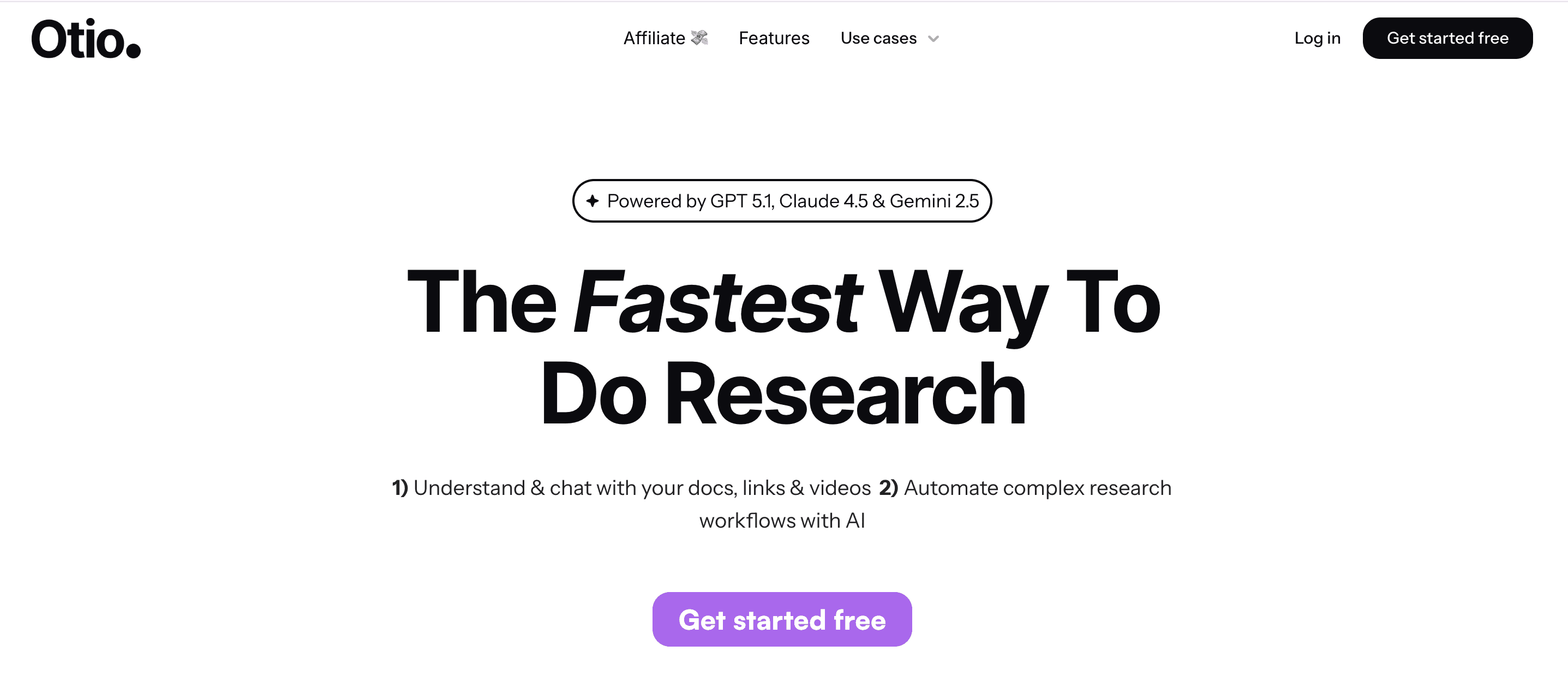
Otio is an AI-native workspace designed for knowledge workers, researchers, and students to manage content overload. It allows users to collect and organize data from multiple sources, including bookmarks, tweets, books, and videos. Otio can extract key insights, generate notes, and even create drafts using the collected information. Its AI-assisted writing tools simplify research workflows, enabling users to produce essays, papers, and reports efficiently.
Why Choose Over Elicit AI
Provides context-rich data from multiple sources, unlike Elicit’s sometimes limited dataset.
Supports AI-assisted writing and draft generation rather than just summarization.
An interactive workspace lets you link, reference, and engage with your sources, reducing manual effort.
Pros
Centralized platform for multiple content types.
AI-assisted writing speeds up draft creation.
Good for multimedia sources.
Cons
Paid plans may be costly.
Requires learning to use advanced features.
2. ResearchGPT: NLG for Academic Research
ResearchGPT uses GPT-3 fine-tuned for academic research to generate high-quality, plagiarism-free content. It can produce literature reviews, abstracts, summaries, and full research papers. The tool is tailored for research-focused content creation, allowing researchers to quickly turn ideas into structured outputs.
Why Choose Over Elicit AI
Generates full drafts and sections of papers, not just summaries.
Produces plagiarism-free content suitable for academic standards.
Reduces manual writing effort, which is a limitation of Elicit AI.
Pros
Tailored for academic writing.
Can create full-length content.
Reduces time spent writing and drafting.
Cons
Less helpful for discovering papers.
The output still requires verification of accuracy and citations.
3. ResearchRabbit: Citation-Based Literature Mapping
ResearchRabbit is a free tool that visualizes citation relationships to help researchers explore literature. By starting with a seed paper, users can discover connected research and emerging trends in a field.
Why Choose Over Elicit AI
Reveals related papers via citation mapping, which Elicit may miss.
Provides interactive visual exploration to discover hidden connections.
Expands understanding of the research landscape beyond basic summaries.
Pros
Free to use and easy to visualize research trends.
Helps uncover relevant but less obvious papers.
Cons
No content summarization or draft generation.
Limited AI-powered analysis.
4. Semantic Scholar: AI-Powered Academic Search
Semantic Scholar is an AI-enhanced search engine for academic literature across disciplines. It provides filtering, citation analysis, and paper summarization to streamline the discovery of relevant research.
Why Choose Over Elicit AI
Advanced search options and filtering outperform Elicit’s simpler queries.
Provides citation metrics and impact analysis to validate research credibility.
AI summarization helps users quickly understand papers and gain deeper insights.
Pros
Broad academic coverage.
Highlights influential and trending papers.
Free access with AI-powered search.
Cons
Limited interactive note-taking or drafting features.
May not cover subscription-only papers.
5. Google Scholar: Comprehensive Academic Search
Google Scholar indexes a wide variety of scholarly works, including articles, theses, books, and conference papers. It offers citation metrics, author profiles, and alerts for new research.
Why Choose Over Elicit AI
Provides broader coverage than Elicit, reducing missed sources.
Citation tracking ensures paper credibility.
Free and familiar platform for most researchers.
Pros
Extensive indexing and alerts.
Free and user-friendly.
Good for citation tracking.
Cons
No AI-powered summaries or insights.
Manual extraction of information needed.
6. Scopus: Comprehensive Abstract and Citation Database
Scopus is a paid abstract and citation database with robust search, citation tracking, and research trend analysis tools. It’s used by researchers, librarians, and institutions for deep academic insights.
Why Choose Over Elicit AI
Provides trend and citation analytics. Elicit lacks.
Covers a wide range of disciplines with more reliability.
Advanced metrics and author profiles support informed research decisions.
Pros
Comprehensive data and analytics.
Trend tracking and citation analysis.
Reliable and credible for academic evaluation.
Cons
Paid subscription required.
It can be overwhelming for beginners.
Limited AI-assisted writing.
7. Connected Papers: Visualizing Paper Connections
Connected Papers helps researchers explore literature visually by generating graphs of connected papers based on DOIs, titles, or arXiv IDs. Users can intuitively discover key papers and emerging trends.
Why Choose Over Elicit AI
Visualizes relationships between papers, unlike Elicit’s textual summaries.
Reveals hidden trends and connections that may be missed in automated summaries.
Supports exploratory research by showing context within the research network.
Pros
Interactive and intuitive visualization.
Helps uncover relevant literature efficiently.
Free to use.
Cons
Doesn’t generate summaries or drafts.
Limited citation and impact metrics.
Supercharge Your Researching Ability With Otio — Try Otio for Free Today
Otio is an innovative platform built to support knowledge workers, researchers, and students who find themselves overwhelmed by an abundance of information. As we navigate the vast sea of online content, we often resort to a hodgepodge of bookmarking applications and note-taking tools, struggling to synthesize the data we collect. Otio steps in to streamline this process, offering a single AI-native workspace for researchers.
1. Collect
With Otio, you can effortlessly gather data from a variety of sources, including bookmarks, tweets, books, and YouTube videos. This platform transforms the exhausting task of curating information into a seamless experience.
2. Extract Key Takeaways
Otio's AI generates detailed notes and provides Q&A-based insights grounded in your sources. This feature empowers you to distill the most critical information quickly and efficiently.
3. Create
Otio takes your collection of sources and helps you translate them into a draft output. By facilitating the transition from a mere reading list to a functional first draft, Otio significantly accelerates your research and writing process.
The platform's standout features include AI-generated notes for everything from YouTube videos to PDFs, the ability to engage in AI-assisted writing, and structured conversations with individual links or entire knowledge bases. Otio aims to be your indispensable AI research and writing partner, enhancing your productivity and efficiency as you navigate the ever-expanding world of online information.
Try Otio for free today and experience the future of research and writing.
Related Reading
• Best Reference Manager
• Chatpdf Alternative
• Ai Research Tools
• Consensus Ai
• Sematic Scholar
• Research Paper Writing App
• Research Paper Reader
• How Does Chatpdf Work
• Scholarcy Alternative