
Citation Tracking and Literature Discovery
Connected Papers for Literature Review: Discovery First, Synthesis Next
Use Connected Papers to expand from a strong seed paper, then move the resulting sources into a cited synthesis workflow. Covers discovery steps, blind spots, and the handoff to a permanent research workspace.

Connected Papers for literature review is useful when discovery is the bottleneck: it helps you start from a strong seed paper and find related papers through a visual map. Treat it as a discovery layer, not as the system that proves your search is complete or synthesizes the evidence.
The right workflow is simple: choose a defensible seed paper, inspect the map as a set of leads, verify each candidate in its source record, then move the retained papers into a permanent research workspace for reading, comparison, citation, and synthesis.
Updated October 20, 2026.
Connected Papers is best for finding related literature—not synthesizing the final evidence
Connected Papers describes itself as a visual tool for helping researchers and applied scientists find academic papers relevant to their field of work. University research guides describe it similarly: a visual literature-mapping tool that uses citation networks to find similar academic papers, starting from a paper rather than a broad keyword search (Connected Papers; Loyola Marymount University Library).
That makes it strongest at one stage of a literature review: finding candidates you may have missed. It can reveal adjacent terminology, clusters of work, earlier foundational studies, and papers that are connected by citation behavior even when they do not share obvious keywords.
It does not, by itself, answer the harder review questions:
Was the search strategy complete enough for the review type?
Are the included papers methodologically sound?
Do the populations, interventions, outcomes, or settings actually match?
Are there null, negative, or contradictory findings outside the visible cluster?
How strong is the final conclusion?
Those are synthesis and appraisal tasks. They require reading the full sources, comparing evidence fields, and preserving a traceable record from claim back to paper.
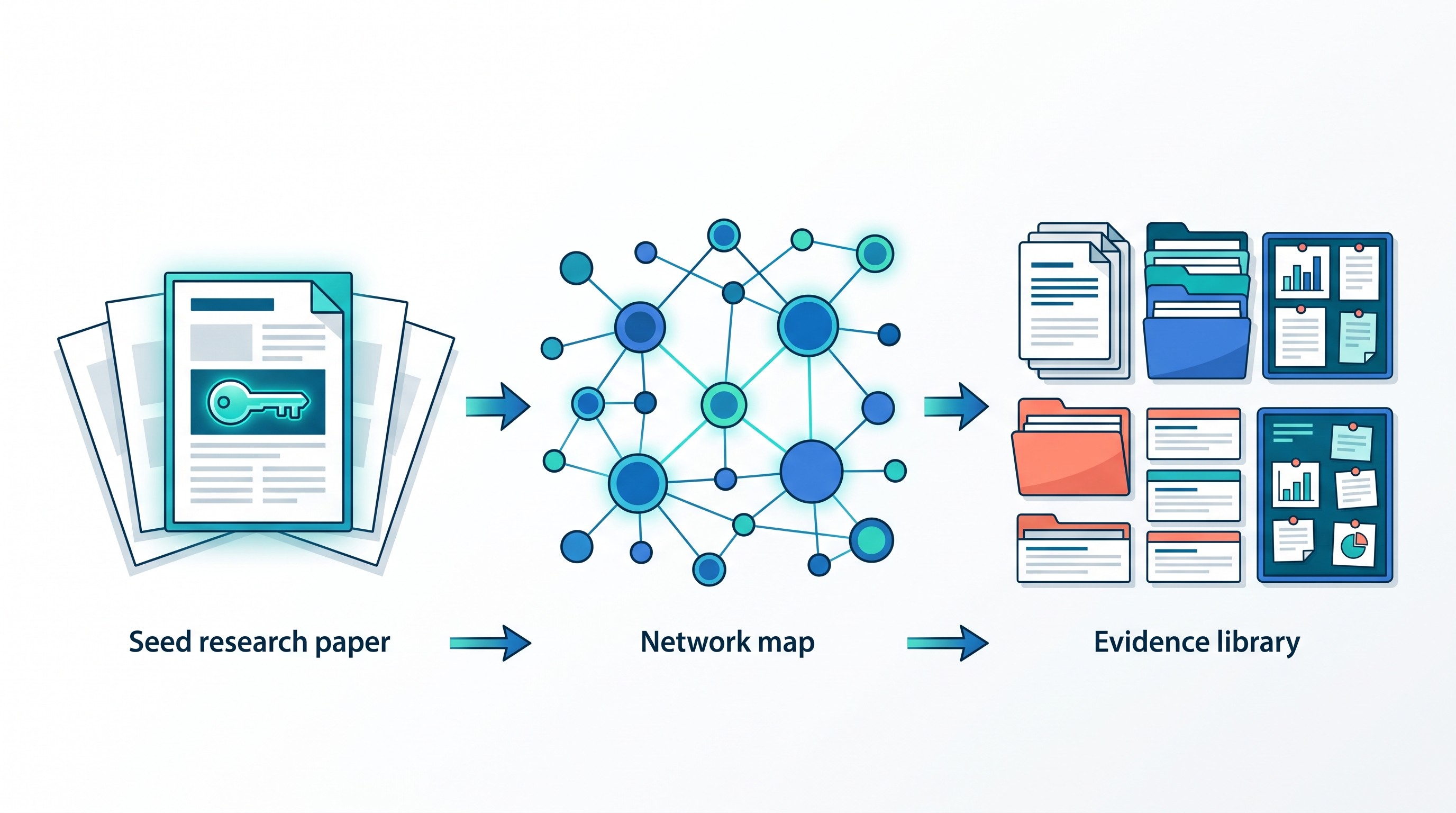
A clean operating model is:
Start with one highly relevant paper.
Use Connected Papers to identify nearby and connected work.
Verify each promising candidate in the publisher page, database record, or full text.
Retain only papers that serve a defined role in the review.
Move the verified corpus into a separate reading and synthesis workflow.
For the broader structure of the final review, use a full review process such as Otio’s guide to how to write a literature review. Connected Papers helps populate the evidence pool; it does not replace the review design.
How to use Connected Papers for research: start with a defensible seed paper
The seed paper determines the shape of the map. A poor seed produces a noisy graph. A famous but only partly relevant seed can pull the review toward the wrong field, geography, method, or vocabulary.
A useful seed paper should usually meet three tests:
Direct relevance: it addresses the same research question, population, mechanism, intervention, or phenomenon you care about.
Specificity: it is narrow enough that the map does not sprawl across a whole discipline.
Field position: it is a recent review, landmark study, or highly relevant primary paper that sits close to the center of the conversation.
Before opening the graph, write down what the seed represents. This takes five minutes and prevents the map from quietly changing the review scope.
Record:
Research question or subquestion
Population, setting, or jurisdiction
Method or study design
Intervention, exposure, technology, policy, or theory
Publication year
Key terms used by the authors
Terms the authors do not use but your field does
Why this paper is a valid seed
This note matters because citation maps are seductive. Once the network appears, every nearby paper feels important. The seed note gives you a way to say: relevant, background only, methodologically useful, or out of scope.
A clinical example makes the distinction clear. Suppose the review question is whether a digital intervention improves medication adherence in adults with hypertension. A strong seed might be a recent randomized trial or systematic review specifically about that intervention and population.
When the map appears, do not save every visible node. Sort candidates by research role:
Papers on efficacy: do outcomes improve?
Papers on safety or unintended effects: what harms or tradeoffs appear?
Papers on implementation: what happens in clinics, community settings, or low-resource systems?
Papers on competing interventions: what alternatives solve the same problem?
Papers on measurement: how is adherence defined and assessed?
Papers that are background only: useful for framing, not for answering the main question.
That discipline prevents a discovery session from becoming a hoarding session.
Connected Papers and similar tools can generate a map from an origin paper, but the exact interface and limits can change. Use the tool’s current documentation when entering a paper, DOI, title, or URL, and treat interface labels as operational details rather than permanent method.
The deeper methodological point is stable: one seed is rarely enough. A single famous paper can inherit the bias of its citation network. It may overrepresent one discipline, one country, English-language publishing, positive findings, or a dominant school of thought.
Use more than one seed when the topic crosses:
Disciplines
Methods
Populations
Geographic settings
Competing theories
Old and new terminology
Clinical, policy, or implementation contexts
If the first graph feels coherent, that is not proof of completeness. It may simply mean the seed sits inside a well-connected bubble.
Read the map as a set of leads, not as a ranked list of trustworthy papers
A Connected Papers graph is not a quality hierarchy. Proximity can be useful, but it is not evidence that two papers answer the same question or deserve the same weight.
The tool’s underlying value comes from relationships between papers. A guide to related-article searches notes that Connected Papers states its similarity measure is based on co-citation and bibliographic coupling: papers may be close because they cite similar work or are cited together, not because their designs, populations, outcomes, or conclusions are equivalent (Manuel García).
That distinction matters. Two papers can be close on a graph while differing in:
Study design
Sample size
Population
Setting
Intervention dose or implementation model
Outcome definition
Follow-up duration
Risk of bias
Conclusion strength
Read the map as a source of leads. Then run a triage pass.
Label each candidate as one of five things:
Directly relevant: likely belongs in the evidence base for the main question.
Context only: useful for background, definitions, or history, but not central evidence.
Methodologically useful: helps with design, measures, theory, or analytic framing.
Contradictory or complicating evidence: challenges the seed paper, shows null effects, or uses a different interpretation.
Out of scope: connected by citation pattern but not relevant to the review question.
The most common error is mistaking “near the seed” for “supports the seed.” A nearby paper may cite the same foundational work while reaching a different conclusion. It may study a different population. It may be a commentary, protocol, conference abstract, preprint, or methods paper rather than outcome evidence.
Verify every candidate before relying on it. At minimum, check:
Title and authors
Publication year
Journal, venue, or repository
Article type
Abstract and full-text availability
Retraction, expression of concern, or correction status
Whether the paper actually addresses your question
Whether it is a duplicate, earlier conference version, protocol, or later full study
Whether the result is positive, negative, null, or mixed
Citation-context checking answers a different question from graph discovery. Connected Papers helps you find related work; tools such as scite help you inspect how a paper has been cited and whether later papers appear to support, contrast, or mention it. Otio’s guide to scite AI for citation checking and literature reviews is a useful companion when the issue is citation context rather than discovery breadth.
Build a repeatable Connected Papers discovery loop
A professional literature review needs a repeatable trail. Not necessarily a full systematic-review protocol for every project, but enough structure that someone can understand how papers entered the review and why others were excluded.
Use this loop.
1. Write the inclusion question before browsing
Do this before the graph appears.
A useful inclusion question names the population or corpus, the phenomenon or intervention, the outcome or analytic focus, and the time or setting when relevant.
For example:
“Include empirical studies from 2016 onward that evaluate digital adherence interventions for adults with hypertension in outpatient or community settings.”
Also write exclusion rules:
Exclude pediatric populations.
Exclude studies where hypertension is not separately analyzed.
Exclude opinion pieces unless used for background.
Exclude intervention-design papers with no outcome data.
Defer conference abstracts unless no full paper exists.
Without this, the map expands the review scope for you.
2. Shortlist by research role, not visual appeal
Do not save every node because it appears central, large, or close. Save papers because they do a job.
A retained paper should usually fill one of these roles:
Core evidence for the main question
Evidence for a subquestion
Foundational theory or mechanism
Competing explanation
Method or measurement precedent
Contradictory finding
Background source needed for context
This is how you avoid ending up with fifty “interesting” papers and no synthesis plan.
3. Repeat with multiple seeds
Run additional maps when the first seed cannot represent the whole topic.
Use separate seeds for:
A recent review and a landmark older study
Quantitative and qualitative work
Clinical and implementation studies
Different countries or jurisdictions
Competing terms for the same concept
A paper that supports the dominant view and one that challenges it
If each seed produces a different cluster, that is useful information. The literature may be fragmented, interdisciplinary, or divided by vocabulary.
4. Record the decision for each paper
For each retained, rejected, or deferred paper, record a short decision note.
A practical note includes:
Source where you found it
Seed or map that surfaced it
Reason for inclusion, rejection, or deferral
Research role
Any uncertainty
Link, DOI, database record, or PDF location
This is not bureaucracy. It prevents re-reading the same paper three weeks later and wondering why it was in the pile.
5. Search outside the graph
Citation maps are not completeness checks. They can miss recent work, weakly connected work, papers using different terminology, literature outside the tool’s coverage, and studies that have not yet accumulated citation relationships.
Use at least one external completeness check:
Discipline-specific databases such as PubMed, PsycINFO, ERIC, IEEE Xplore, Scopus, Web of Science, HeinOnline, or SSRN, depending on field
Backward citation searching from key papers’ reference lists
Forward citation searching for newer papers that cite a key study
Keyword searches using alternate terminology
Hand-searching major journals, guidelines, policy repositories, or conference proceedings when relevant
For academic database selection, Otio’s guide to research websites and academic sources is a better fit than treating any one discovery graph as comprehensive.
6. Move the verified corpus into a durable library
Do not leave the evidence trail inside a browser session, screenshot folder, or export you may not revisit.
Before synthesis, store:
PDF or stable full-text link
Publisher or database record
Citation metadata
Notes
Quotations and page references
Inclusion decision
Research role
Caveats
Links to related web pages, reports, protocols, datasets, or guidelines
This is the handoff point. Discovery is over; synthesis begins.
[[OTIO_INLINE_PROMO:%7B%22title%22%3A%22Ready%20to%20log%20each%20paper%E2%80%99s%20role%20and%20decision%3F%22%2C%22description%22%3A%22Add%20verified%20PDFs%2C%20links%2C%20and%20notes%20to%20one%20library%2C%20then%20keep%20each%20inclusion%20decision%20and%20research%20role%20beside%20the%20source.%22%7D]]
Where Connected Papers stops: the discovery-to-synthesis handoff
The non-obvious failure mode is false confidence. A rich visual map feels comprehensive because it is dense, interactive, and internally coherent. But coherence is not completeness.
A map can underrepresent:
Very recent papers
Work with different terminology
Negative or null findings
Non-English literature
Interdisciplinary papers outside the seed’s citation neighborhood
Grey literature, policy reports, preprints, and trial registrations
Papers that address the same question but do not cite the same core work
Synthesis needs more than a list of titles. It requires comparing full sources across fields that matter to the question.
At minimum, synthesis should compare:
Research question
Study design
Population or corpus
Setting
Intervention, exposure, policy, theory, or method
Comparator or baseline
Outcomes
Findings
Limitations
Conflicts with other papers
Strength of evidence
Relevance to the final claim
This is where a permanent workspace matters. After discovery, Otio for academics can hold verified PDFs, web pages, notes, and related source material in one library, then let researchers ask cited questions across the corpus. Its value is not that it replaces a review protocol; it keeps the sources, notes, and cited answers together after discovery tools have done their job.
For medical or policy topics, the same handoff matters even more because source provenance and caveats change the interpretation. A clinical review might need PDFs, guidelines, trial records, safety updates, and implementation reports in one place. A policy review might need academic papers, agency reports, legislation, budget documents, and stakeholder submissions. Otio has dedicated pages for medical research workflows and policy research workflows, but the underlying principle is the same: keep the corpus traceable.
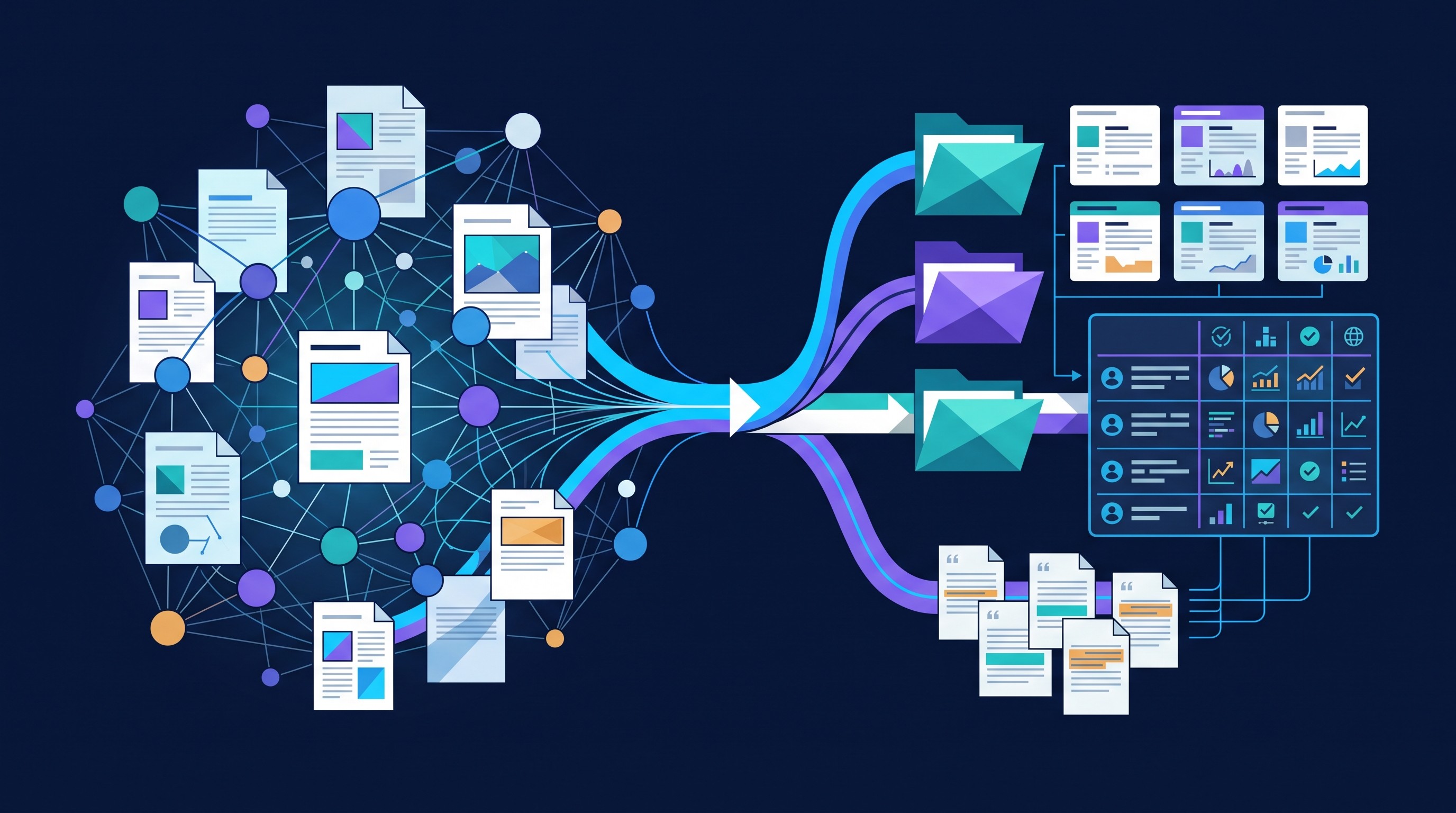
AI can help interrogate that corpus, especially when the project spans many documents. In Otio, the useful features here are concrete: a unified library for PDFs, web links, notes, media, and documents; reader views for PDFs and web pages; text selection actions for asking about a passage; and chat answers with inline citations. The multi-model setup also helps when a complex source set benefits from trying a question against different model families rather than being locked into one system.
The boundary still matters. AI output is not the review. It is an assistant for querying, summarizing, comparing, and drafting from sources that remain open to inspection.
If you already have a verified set of sources and need to compare findings, use a matrix-style workflow. Otio’s guide to how to compare sources in a literature review is closer to the synthesis stage than a discovery map.
A practical quality check before writing the literature review
Before drafting, freeze the corpus long enough to check whether it can support the argument.
Start with coverage. Do not ask, “Do I have enough papers?” Ask whether the corpus covers the major subquestions, populations, methods, settings, and time periods needed for the review.
A small, well-structured corpus may be stronger than a large pile of loosely related papers. The number of papers is a weak proxy for completeness.
Run these checks:
Coverage: Are the main subquestions represented?
Population fit: Do the papers study the population, setting, or corpus you claim to discuss?
Method spread: Are you overrelying on one method or study type?
Time period: Are there recent developments that citation maps may not have surfaced?
Contradictions: Are null, negative, and conflicting findings included?
Duplicates: Are preprints, conference versions, and full papers separated?
Article type: Are reviews, editorials, protocols, and empirical studies labeled correctly?
Corrections: Have you checked for retractions, corrections, or expressions of concern?
Traceability: Can every central claim be traced back to a source?
Quotation control: Can page numbers, figures, tables, and numerical findings be reopened?
Scope discipline: Are there papers that are interesting but not relevant enough to keep?
Then separate two things: what the map suggested and what the evidence supports. The map may suggest that a paper is central. The evidence may show that it is background only. The map may underplay a contradictory study because it is outside the seed’s citation neighborhood. The review still has to account for it.
A practical stopping rule is to freeze the verified corpus, build the evidence matrix, and draft only after the source-level record is usable. If a paragraph cannot point back to specific papers, pages, findings, or caveats, it is not ready.
Connected Papers is valuable when used at the right moment. It expands the search space. The literature review is built later, from verified sources and explicit comparisons.
FAQ
Q: Is Connected Papers enough for a literature review?
A: No. It is useful for discovering related papers, but a rigorous review also needs a defined search scope, additional discovery methods, source verification, documented screening, and structured synthesis.
Q: How many seed papers should I use in Connected Papers?
A: There is no universal number. Start with one highly relevant seed, then add seeds representing different methods, populations, subtopics, or terminology when the first graph appears narrow or biased.
Q: Does Connected Papers find every paper on a topic?
A: No. Citation-based discovery can miss very recent work, papers using different terminology, non-citing research, and literature outside the graph’s underlying coverage.
Q: What should I do with papers I find in Connected Papers?
A: Verify each paper, record why it matters, and move the retained sources into a durable research library or evidence matrix with citations, notes, and inclusion decisions before synthesis.
[[OTIO_FOOTER_PROMO:%7B%22title%22%3A%22Turn%20your%20verified%20corpus%20into%20a%20synthesis%20record%22%2C%22description%22%3A%22Add%20your%20own%20papers%2C%20reports%2C%20and%20notes%20to%20Otio%2C%20then%20compare%20methods%2C%20findings%2C%20limitations%2C%20and%20contradictions%20before%20drafting.%22%7D]]