
Updated November 27, 2026.
Scholarcy for research is a starting point, not the research record
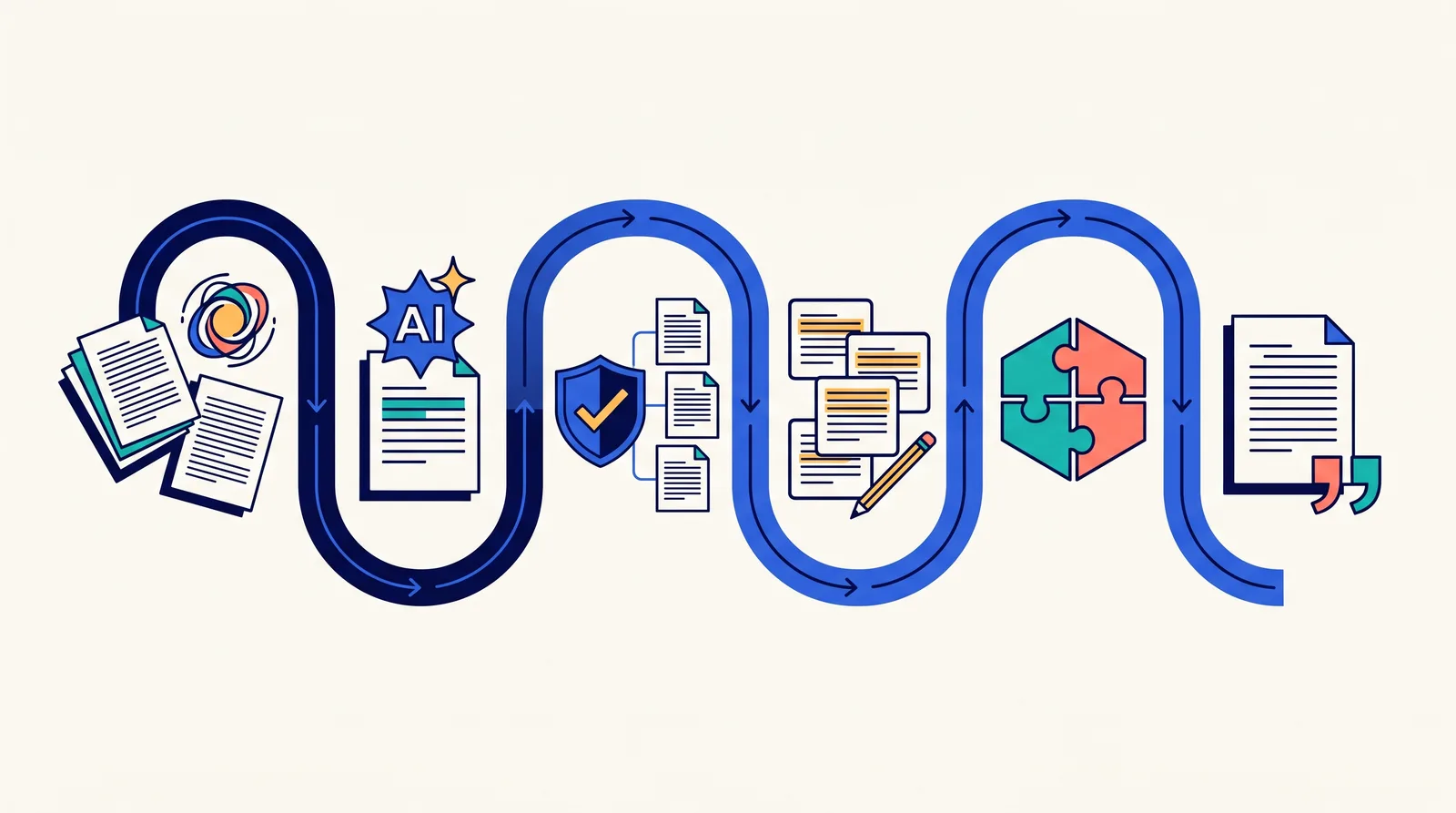
Scholarcy for research is best used as a first-pass reading aid: summarize papers to triage, orient yourself, and find the claims worth checking. The serious work starts after that: verify important claims in the original paper, extract comparable evidence, connect each claim to a source location, and draft only from checked notes.
Scholarcy says it can “summarize any paper, article or textbook” and turn long texts into interactive summary flashcards, which is useful when a reading list is too large to inspect line by line Scholarcy. But a summary is not the same thing as a literature review, evidence review, or defensible research brief.
A workable boundary looks like this:
- Summarization condenses one source so it is faster to inspect.
- Discovery finds potentially relevant sources.
- Screening decides whether a source belongs in the project.
- Synthesis compares sources against a research question.
- Drafting turns verified claims into a cited argument.
Scholarcy sits mostly in the first and sometimes second step. It can help you decide what deserves attention. It should not become the place where conclusions silently form without source checks.
The next step depends on the paper:
- Clearly irrelevant: reject it and record why.
- Possibly relevant: keep it for verification.
- Relevant but incomplete: open the original paper and extract the missing details.
- Important to the conclusion: capture the exact supporting passage, table, figure, or page.
If you are comparing paper-finding tools, the same handoff logic applies after discovery. See the related workflow on Elicit AI for literature reviews for the point where paper collection needs to become evidence work.
Step 1: Triage the summary against your research question
Start with a question narrow enough to screen against. “What does remote work do to productivity?” is too broad for reliable triage. “Among software teams, how do hybrid work policies affect measured output and retention compared with fully remote or office-first policies?” gives you something to judge.
For medical, policy, legal, market, and academic work, a focused question prevents reading momentum from turning into accidental inclusion. Systematic review guidance commonly begins with a focused research question, often framed through PICO: population, intervention or exposure, comparator, and outcome PMC. You do not need a full systematic review protocol for every project, but the discipline of asking “what decision does this paper inform?” matters.
Use Scholarcy’s summary to make an initial decision, not a final one. For each paper, label it:
- Keep: directly answers the research question or supplies necessary context.
- Verify: appears useful, but the summary omits details needed for confidence.
- Reject: wrong population, wrong method, wrong date range, weak relevance, or background only.
For each retained or “verify” paper, record the fields that matter to the project. In a clinical or policy review, that might include:
- Population
- Intervention, exposure, or policy
- Comparator
- Outcome
- Study design
- Sample size or source base
- Setting
- Date range
- Main result
- Limitation
- Relevance decision
In legal or regulatory research, the fields may shift: jurisdiction, authority type, procedural posture, statutory hook, agency, date, and holding or interpretation. In market or competitive research, you might track company, segment, geography, source type, metric, and time period.
The rule is simple: screen against shared fields, not vibes. If one paper summary gives methods and limitations while another gives only a broad conclusion, do not treat them as equally understood. Mark the vague one for verification.
A summary that sounds relevant but omits the population, method, or uncertainty is not yet useful evidence. It is a pointer.
Step 2: Verify important claims in the original paper
Open the original paper before any claim affects a conclusion. Check especially:
- Numerical results
- Causal language
- Sample characteristics
- Inclusion and exclusion criteria
- Limitations
- Subgroup findings
- Null findings
- Whether the authors are describing their own results or prior literature
- Whether the statement is a finding, interpretation, speculation, or consensus claim
This is where many summary-first workflows break. A summary may correctly identify the main point but flatten the conditions that make the point true. A “significant improvement” may apply only to a subgroup. A “negative finding” may be underpowered. A “policy effect” may be observational, not causal.
Good summary practice starts by deciding why you need the summary, according to the University of Connecticut Writing Center’s guidance on summarizing research articles UConn Writing Center. The same principle applies here: a summary for quick orientation can be looser than a summary that will support a professional conclusion.
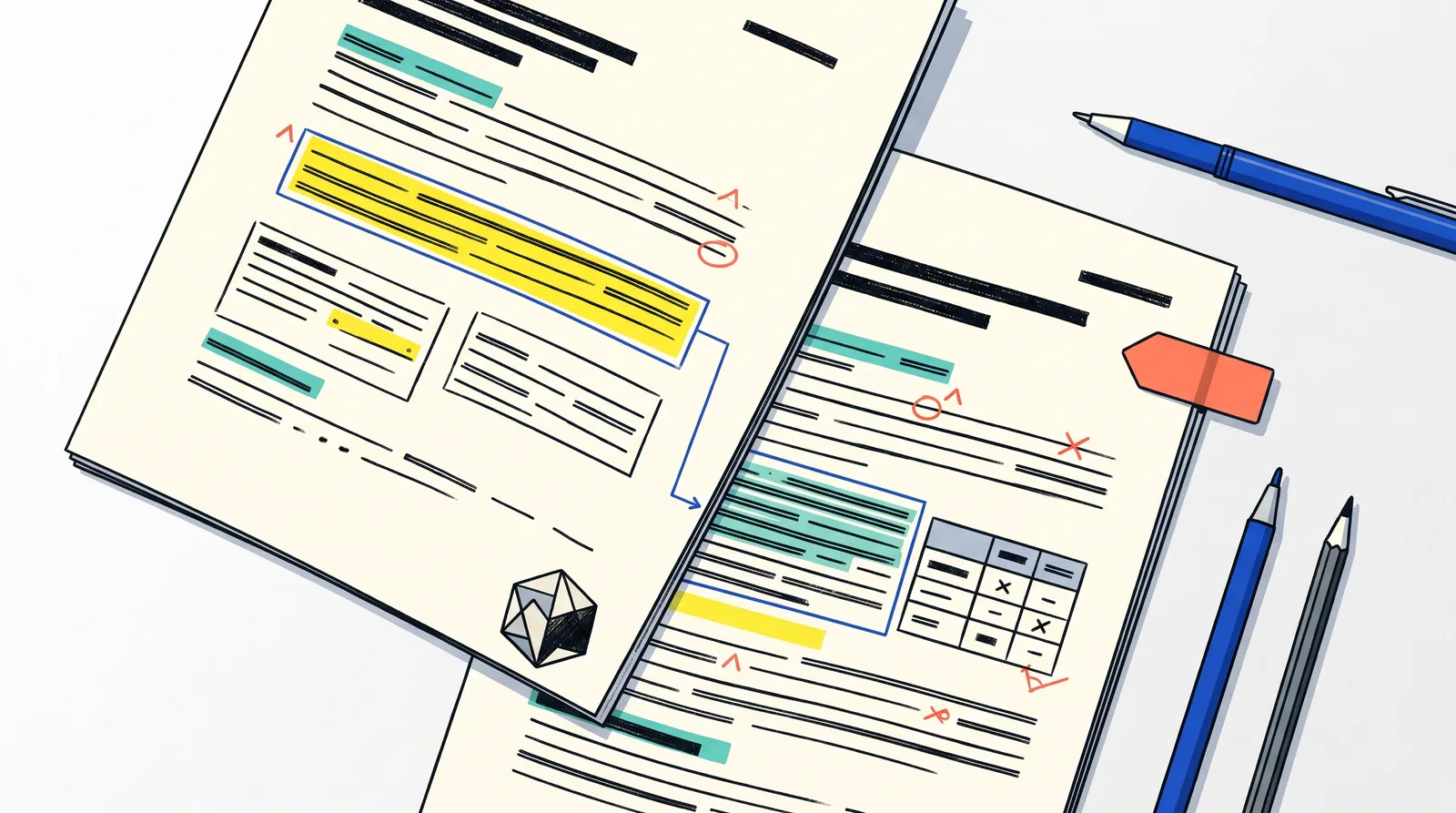
When a claim matters, capture four things together:
- The claim: what you may later say.
- The source passage: the exact sentence, table, figure, or section that supports it.
- The location: page, section, table number, figure number, or paragraph marker.
- The evidence status: primary finding, review conclusion, editorial claim, protocol, commentary, or cited background.
Preserve the distinction between three layers:
- What the authors found: “The intervention group had lower readmission rates at 30 days.”
- What the authors concluded: “The intervention may reduce short-term readmissions.”
- What you infer: “The evidence is promising but limited to one setting.”
Do not let a summary collapse those layers into one sentence.
Publication type also matters. A randomized controlled trial, systematic review, scoping review, editorial, protocol, preprint, and conference abstract do not carry the same evidentiary weight. Scholarcy can help you orient yourself, but the original document tells you what kind of source you are dealing with.
For multi-PDF work, the same verification burden applies across documents. The guide to summarizing multiple PDFs with citations and source context covers the source trail needed when more than one document feeds a conclusion.
Step 3: Convert individual summaries into comparable evidence
A folder of summaries is not synthesis. It is a faster pile of papers.
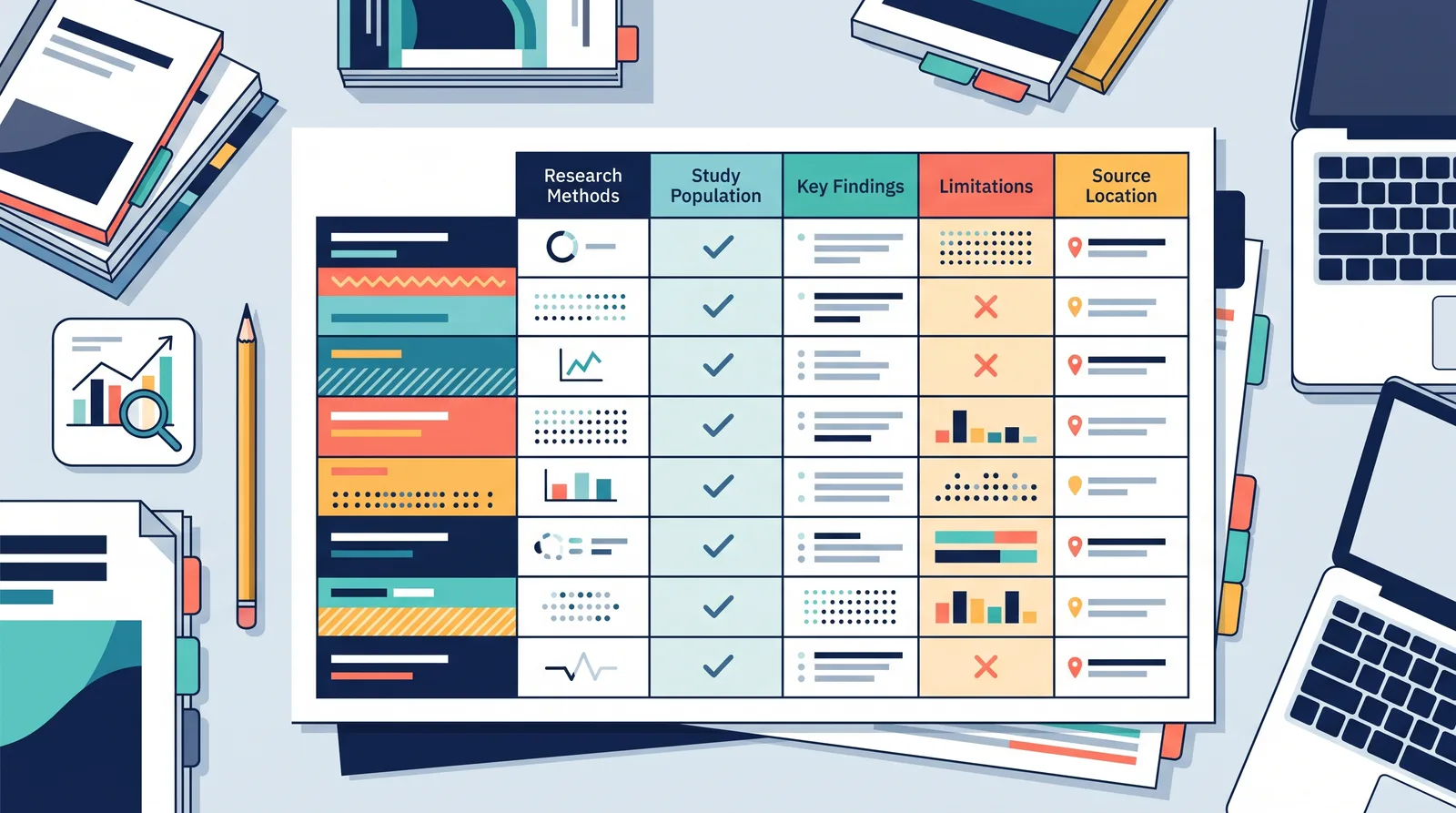
To compare papers, extract the same fields from each retained source. The fields can vary by domain, but the structure should be consistent enough that contradictions become visible.
For most research projects, start with:
- Research question or purpose
- Study design or method
- Population, corpus, or dataset
- Exposure, intervention, policy, or phenomenon
- Comparator, if any
- Outcome or metric
- Main result
- Limitation
- Applicability to your question
- Source location for the claim
- Your confidence level or caution note
This turns a summarized paper into a row of evidence. The difference is not cosmetic. A summary keeps the source in paragraph form; an evidence matrix makes sources comparable.
Separate three kinds of notes:
- Author-reported finding: what the paper says its data show.
- Your interpretation: what that finding means for the project.
- Unresolved question: what remains unclear, contested, or unsupported.
That separation prevents a common drafting error: turning your inference into a sourced fact.
For example:
- Author-reported finding: “The paper reports higher retention among hybrid teams in the observed firms.”
- Your interpretation: “The finding may not generalize to early-stage startups because the sample is mostly large firms.”
- Unresolved question: “Does retention differ by role, tenure, or labor market conditions?”
Now the later draft can say something defensible: “Several studies associate hybrid work with retention gains in large firms, but applicability to early-stage teams is uncertain.” That is stronger than stringing together three summaries that all say hybrid work is “beneficial.”
Record disagreements explicitly. Papers may conflict because they use different definitions, populations, methods, follow-up periods, or outcome measures. Those differences are not annoying details; they are often the synthesis.
Look for disagreement across:
- Definitions: “remote,” “hybrid,” “productivity,” “engagement,” or “adherence” may mean different things.
- Populations: findings from one country, age group, industry, or legal system may not transfer.
- Methods: randomized, observational, qualitative, and modeling studies answer different questions.
- Time horizons: short-term effects may differ from long-term outcomes.
- Outcome measures: self-reported satisfaction and audited performance are not interchangeable.
For a full structure, use an evidence matrix. The guide to building an evidence matrix from PDFs, web pages, and interviews gives a reusable format. If the project already spans databases, websites, reports, and PDFs, the guide to synthesizing research papers from different sources is the next step.
Step 4: Bring summarized papers together with the rest of the research corpus
Many real research questions cannot be answered from journal summaries alone.
A policy memo may need peer-reviewed studies, agency guidance, legislative text, stakeholder statements, datasets, and expert interviews. A market brief may need academic papers, SEC filings, analyst reports, product pages, transcripts, and news coverage. A medical or pharma review may need trials, reviews, regulatory documents, conference materials, and clinical guidance.
That is where the workflow needs a research corpus, not just summarized PDFs.
Keep every source attached to its claims and notes. Later, the draft must distinguish:
- Peer-reviewed evidence
- Background context
- Expert interpretation
- Regulatory or legal authority
- Primary data
- Anecdotal or stakeholder claims
- Unresolved disagreement
For a lasting multi-source workspace, Otio for academics can hold PDFs, web pages, notes, audio, video, and other research materials in one library. Its reader and library support mixed sources, while cited answers help keep claims tied to source material.
Position the handoff correctly: Otio is not a replacement for Scholarcy or a literature-discovery engine. Use Scholarcy to summarize and orient around papers. Use a workspace like Otio after that point to collect the material you need to compare, question, annotate, and cite.
A practical handoff might look like this:
- Export or save the original papers that survived screening.
- Add the full PDFs, not only summary text.
- Add relevant reports, web pages, transcripts, and notes.
- Put the project into one workspace or folder.
- Ask source-grounded questions across the retained material.
- Save verified claims into structured notes.
- Draft from the notes, with citations.
The key requirement is permanence. Long research projects break when the record is scattered across a summarizer, a PDF reader, browser tabs, a notes app, and a chat history. A durable workspace keeps the corpus available after the initial summary session ends.
Otio also supports multiple AI models, which matters when a research task benefits from model comparison: one model can propose an extraction schema, another can challenge causal language, and a third can help rewrite a brief. Agreement between models is not verification, but model switching can help expose weak reasoning before the final source check.
For academic workflows, the Otio for academics page is the best fit. For current plan details, check Otio pricing.
Step 5: Draft from verified claims, not from summary language
The draft should follow the research question and the evidence pattern, not the order in which papers were summarized.
A weak literature review often becomes one paragraph per paper:
- Paper A says X.
- Paper B says Y.
- Paper C says Z.
That is annotated bibliography logic. It may be useful early, but it rarely answers the question.
A stronger structure groups the evidence:
- Where studies agree
- Where they disagree
- Which methods are stronger or weaker
- Which populations or settings limit applicability
- Which claims are well supported
- Which questions remain unresolved
Nature’s guidance on critically analysing research papers frames the move from passive reading to active analysis as a skill in its own right Nature. The same applies to drafting: the work is not to restate the summaries. It is to judge what the evidence can support.
Before drafting, make sure each important claim has:
- A source
- A precise location
- A confidence level
- A limitation note
- A reason it belongs in the answer
Then draft with citation discipline. If a sentence changes scope, certainty, causality, or numerical meaning, re-check the original paper.
Watch for these dangerous shifts:
- “Associated with” becomes “caused.”
- “In this sample” becomes “in all patients.”
- “May improve” becomes “improves.”
- “No significant difference” becomes “no difference.”
- “Authors suggest” becomes “research proves.”
- “Review notes mixed evidence” becomes “the literature agrees.”
AI can help propose comparisons, identify missing support, and improve prose once the extraction fields are stable. It should not be the place where the evidence boundary is invented.
A cited brief is defensible because the reader can inspect the trail from conclusion to claim to source. A polished summary can sound confident while hiding that trail.
Common failure modes when using Scholarcy for research
The main failure is treating summarization as completion.
Scholarcy can reduce friction at the start of reading, but the project can still fail if the summary becomes the evidence record. These are the traps to avoid.
Treating a summary as a substitute for methods and results.
The methods section often contains the reason a claim should be weakened. Sample restrictions, recruitment methods, measurement choices, attrition, missing data, and analytical decisions can all change the meaning of a result.
Combining summaries written at different levels of detail.
One summary may include design and limitations; another may only provide a high-level takeaway. If you compare those summaries directly, you may create a false sense that the papers are equally understood.
Copying summary wording into notes without locations.
This saves time early and creates debt later. When the draft needs a citation, you have to rediscover where the claim came from. Worse, you may not notice that the summary phrasing is broader than the original paper.
Screening only the papers that passed through a summarization workflow.
Summaries help triage sources you already have. They do not prove the source set is complete or unbiased. Document how papers were found, which were excluded, and why.
Flattening evidence types.
A review, editorial, protocol, qualitative study, observational analysis, and randomized trial can all be valuable. They should not be treated as equivalent units of proof.
Losing non-paper sources.
A research question may need reports, webpages, transcripts, datasets, or policy documents. If the workspace only preserves paper summaries, the final synthesis may ignore relevant evidence.
Drafting too early.
If the source fields are inconsistent, the draft will smooth over contradictions. Synthesis should expose disagreement before the prose tries to resolve it.
A practical handoff checklist after Scholarcy
Use this checklist before scaling from five papers to fifty.
For each retained paper:
- Confirm the paper is relevant to the research question.
- Identify the publication type.
- Record the method or study design.
- Capture the population, corpus, jurisdiction, or setting.
- Extract the main result.
- Record the main limitation.
- Save the exact source location for each important claim.
For the research workspace:
- Move verified claims into structured notes or an evidence matrix.
- Keep summary text separate from original-source evidence.
- Add relevant non-paper sources.
- Label each source by evidentiary role.
- Record contradictions instead of smoothing them away.
- Preserve source links, page numbers, tables, figures, or sections.
For the draft:
- Organize by the research question, not by paper order.
- Compare claims across sources before writing.
- Attach citations while drafting.
- Re-check every generated or rewritten sentence that changes meaning.
- Keep the final claim-to-source trail available for review.
The next useful action is small: take one research question and process five Scholarcy-summarized papers through this checklist. If the fields work, scale the same structure to the full corpus. If they do not, fix the extraction schema before adding more papers.
FAQ
Q: Can Scholarcy summaries be used as citations?
A: Use the original paper as the citable source and verify the relevant claim there. A generated summary can help you find and understand the passage, but it should not replace the paper’s bibliographic and evidentiary context.
Q: Is Scholarcy enough for a literature review?
A: It can support first-pass reading and screening, but a defensible literature review also needs a documented search process, consistent extraction, source verification, comparison across studies, and citations tied to the original evidence.
Q: What should I save from a summarized research paper?
A: Save the paper’s bibliographic details, relevance decision, key claims, methods, results, limitations, and the exact page or section supporting each important claim.
Q: How can I compare Scholarcy summaries with other research sources?
A: Put the summaries alongside the original papers and other relevant sources in a structured evidence matrix, then compare methods, populations, outcomes, definitions, findings, and limitations rather than comparing summary wording alone.