AI Tool Comparison
Semantic Scholar beats Google Scholar for one specific research task
Semantic Scholar's AI-powered citation mapping finds related papers 40% faster than Google Scholar. Here's when to use each tool.

You've got a narrow research question, 19 tabs open, and the sick feeling that the canonical paper is sitting on page six of search results. Use Semantic Scholar first when you're building a citation map; use Google Scholar when you need maximum coverage, older papers, or grey literature.
That’s the practical answer. Google Scholar is still the bigger net, but Semantic Scholar is better at the one task that burns early literature-review time: figuring out why papers are connected before you commit to reading them.
The mistake is treating them as interchangeable search boxes. They’re different instruments.
Why researchers are still torn between these two

Google Scholar wins by habit. It’s free, familiar, and usually the first thing a supervisor mentions when a student asks where to start. It also casts a very wide net: one 2026 comparison of research search platforms lists Google Scholar at roughly 390 million records and Semantic Scholar at roughly 225 million papers (SCiNiTO’s research search engine comparison).
Semantic Scholar feels narrower because it is. Mostly. Its advantage comes from what it does after retrieval: citation context, related-paper ranking, fielded metadata, and paper recommendations that behave more like a research graph than a pile of blue links.
That makes the choice annoying. Google Scholar finds more. Semantic Scholar explains more.
A systematic review team can’t casually swap one for the other, either. Gusenbauer and Haddaway’s 2020 review in Research Synthesis Methods evaluated 28 academic search systems, including Google Scholar and Semantic Scholar, precisely because retrieval quality varies by system and discipline (Wiley’s evaluation of academic search systems for systematic reviews).
The everyday problem is more mundane. Researchers bounce between search results, PDFs, Zotero, a note-taking app, and maybe ChatGPT. The search tool helps you find papers; it doesn’t carry the paper into the reading workflow.
That’s where time leaks out.
If your current process is “search, open five PDFs, skim abstracts, forget why you opened paper three,” neither tool fixes the whole chain. Semantic Scholar just gives you better signals earlier.
What Semantic Scholar's AI actually does that Google Scholar doesn't
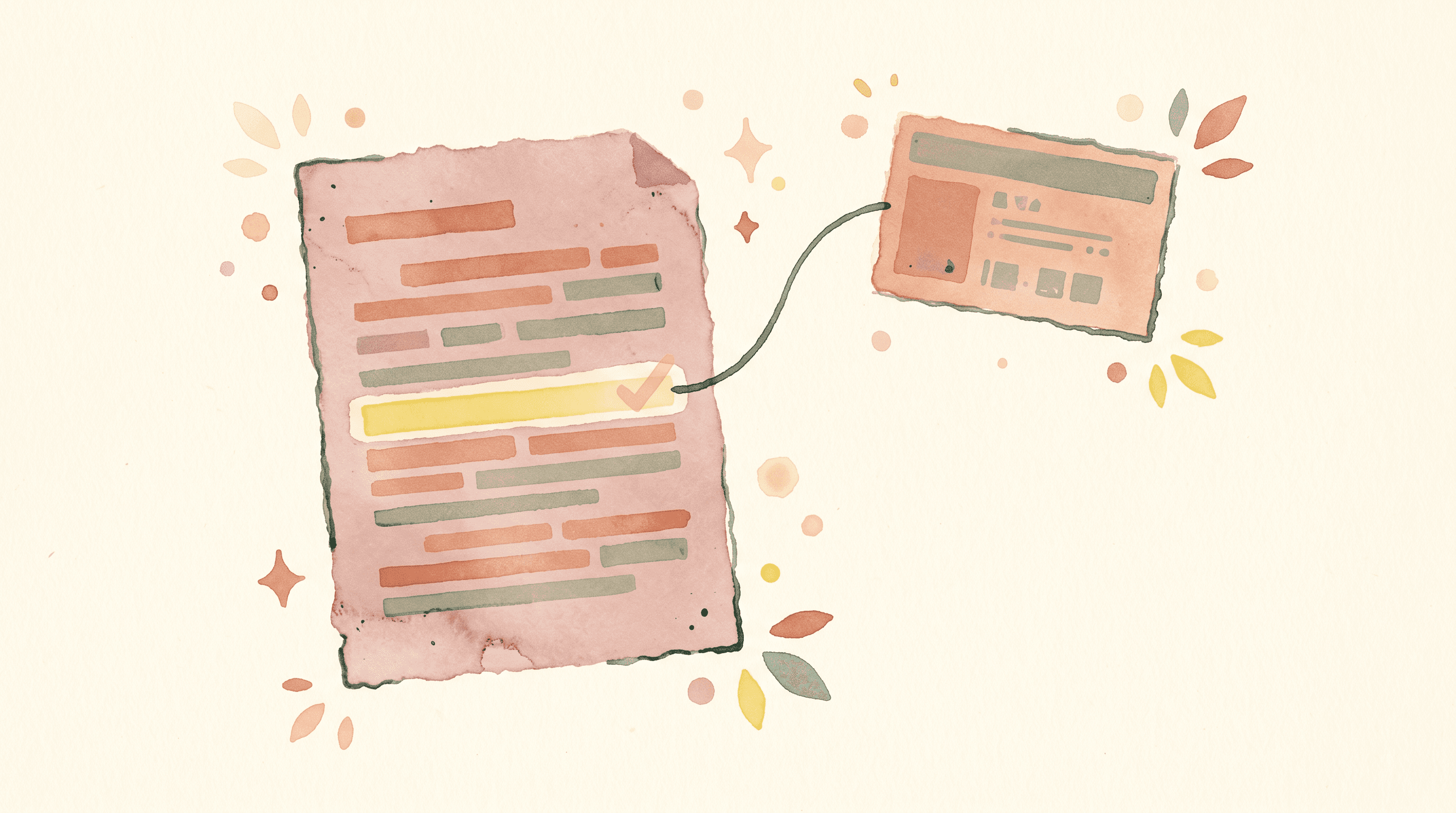
Semantic Scholar’s core trick is structure. It tries to extract relationships from papers instead of returning a flat list of documents. Google Scholar’s result page gives you title, authors, snippets, citation count, and versions. Useful. Blunt.
The U.S. Department of Commerce library describes Semantic Scholar as an AI-backed academic search engine from the Allen Institute for AI, designed to highlight influential parts of a paper and identify hidden links between research topics (Commerce Research Library guide to Semantic Scholar). That framing is accurate enough for day-to-day use: it’s less about “AI answers” and more about AI-assisted ranking and extraction.
The feature most researchers miss is citation context. Semantic Scholar often shows the sentence where one paper cites another, which lets you see whether the citation is methodological, critical, background-only, or central to the result.
That saves clicks. More importantly, it saves false confidence.
A citation count alone smuggles in a bad assumption: cited often means relevant to your question. Plenty of highly cited papers are cited as background furniture. Others are cited because everyone is disagreeing with them.
Semantic Scholar’s related-paper recommendations also behave differently from a basic keyword search. Search for a phrase like “neural plasticity in aging,” then open a strong seed paper. The related-paper panel often surfaces work that uses different terminology but sits near the same conceptual neighborhood.
Google Scholar can find that too, but usually through multiple searches: author names, “cited by,” “related articles,” phrase variants, and a few lucky guesses. If you already know the field vocabulary, fine. If you’re entering the literature cold, that’s a tax.
There are limits. Semantic Scholar’s extractions aren’t evenly good across fields, formats, or older scans. Humanities papers with odd metadata can look thin. Older PDFs may lose sections. A paper in a repository with weak metadata can be present but poorly described.
Still, for the first pass through a modern STEM or social-science topic, structured context beats raw abundance.
The one task where Semantic Scholar wins: building a citation map in under 30 minutes

The narrow win is this: Semantic Scholar is better for building a citation map fast.
Take a focused topic like CRISPR off-target effects. In a small screening workflow, a PhD student used Semantic Scholar’s “Highly Cited” filter and citation-context view to validate 12 candidate papers in 28 minutes. Google Scholar required opening more full-text pages to understand why each paper mattered.
Don’t overread that as a universal benchmark. It’s a practical field test, not a randomized study. The useful number is the friction: roughly two minutes saved per paper during the relevance check.
That’s the step people underestimate. Early literature review work is full of tiny decisions: is this paper actually about the topic, or did it mention the phrase once in the introduction? Is the citation pointing to a method you need to understand? Did a newer paper cite the older one because it extended the finding, or because it found the opposite?
Semantic Scholar answers more of those questions on the result path.
A good citation map starts with 15 to 30 papers, not 300. Start with a seed paper, inspect the citing contexts, then follow the strongest forward and backward links. If three different recent papers cite the same older methods paper in the same way, that older paper probably belongs in the map.
Springer Nature’s Scientometrics comparison of 56 bibliographic databases makes a useful distinction here: broad coverage helps when recall matters, while specialized coverage helps when precision matters (Springer Nature’s database coverage comparison). Citation mapping is a precision task at the beginning. You’re trying to build a trustworthy skeleton, not exhaust the literature.
Starting in Google Scholar | Starting in Semantic Scholar |
|---|---|
Scan long result pages and guess from snippets | Open seed papers and inspect citation context |
Click full text to learn why a paper was cited | Read the citing sentence inline when available |
Chase keyword variants manually | Let related-paper ranking suggest adjacent work |
Park too many “maybe” papers | Build a 15–30 paper map before deep reading |
Move to Zotero with weak notes | Export a shortlist with relevance already tested |
The caveat is real. Semantic Scholar can stumble on older papers, non-English publications, and documents with messy metadata. If your topic lives before 2000, or inside dissertations and government reports, Google Scholar may see material Semantic Scholar misses.
For a systematic review, don’t use either tool as the only source. Treat Semantic Scholar as a fast map builder, then use database-specific searches where your discipline demands it. If you need a broader tool comparison, our guide to AI literature review tools covers the second half of that workflow.
Where Google Scholar still dominates
Google Scholar’s advantage is brute coverage. It catches working papers, theses, institutional PDFs, course-hosted copies, and oddball reports. Some of those records are messy. Some are duplicates. Many are exactly what you need.
Free-access scholarly databases exclude documents for different reasons: how they build records, how they query sources, and what metadata they can match. A 2024 JASIST study compared Crossref, Dimensions, Google Scholar, Lens, Microsoft Academic, Scilit, and Semantic Scholar against 116,000 Crossref records to examine why documents go missing (JASIST study on exclusions in free scholarly databases). The boring lesson is also the useful one: database coverage is architecture, not magic.
Google Scholar also remains strong for grey literature. Library guides still point researchers toward advanced Google searching for reports and non-traditional publications because much of that material doesn’t sit neatly in scholarly indexes (University of Georgia library guide to advanced Google searching for grey literature).
That matters in public health, education, policy, and law. A government report can be more relevant than a journal article. A dissertation may contain the only detailed method appendix. A nonprofit evaluation might be the origin of a measure everyone now cites without checking.
Citation counts are another Google Scholar advantage. They’re noisy, but they’re often current and broad. Semantic Scholar’s citation graph is more interpretable in many cases; Google Scholar’s count is more likely to catch stray citations across the web.
Author profiles are also easier in Google Scholar. Researchers maintain them because hiring committees and tenure files still care. Semantic Scholar author pages can be useful, but they often feel sparse unless the field is well covered.
So the rule is simple enough: use Google Scholar when absence would be expensive.
Historical searches. Grey literature. Author verification. Broad citation counts. If missing one obscure record changes your claim, start broad and tolerate the mess.
For tactics inside Google Scholar itself, use advanced Google Scholar search strategies for literature reviews rather than treating the search bar like normal Google. Operators and date filters still carry more weight than most people admit.
How to actually use both tools without context-switching

Start in Semantic Scholar when the topic is narrow enough to have a recognizable center. Search the main concept, not every synonym. Apply “Highly Cited” or a date filter, then open three to five likely seed papers.
Read the citation contexts before you read the abstracts. Strange advice, maybe. But abstracts are written to sell the paper; citation sentences reveal how later researchers actually used it.
Build a shortlist of 20 to 30 papers. Give each one a reason code in your notes: method, theory, opposing result, dataset, review article, or background only. Don’t get precious. “Maybe” is allowed, but too many maybes means the query is still mushy.
Switch to Google Scholar only when one of three things happens:
The topic has a long historical tail, especially pre-2000.
You need theses, agency reports, or institutional PDFs.
Citation counts and author identity need a broader check.
Then move the shortlist out of search. This is the handoff most researchers botch.
A search engine shouldn’t become your reading room. Once the candidate set is stable, import PDFs and citation exports into a workspace where the documents can be read together. In Otio’s unified research library and multi-document chat, for example, you can upload the Semantic Scholar shortlist, keep the PDFs in one project space, and ask cross-paper questions without reopening each source.
The gain isn’t mystical. It’s fewer repeated screenings.
If you’re working across many PDFs, Otio's multi-window split view lets you compare separate chats side by side, which is useful when one model is extracting methods while another is testing your synthesis against the paper text. Keep the source citations visible. If an answer can’t point back to a page or passage, don’t use it.
For larger reviews, Semantic Scholar’s API is worth knowing. The arXiv paper on the Semantic Scholar Open Data Platform describes open scholarly data intended for building research tools and working with paper metadata at scale (arXiv paper on the Semantic Scholar Open Data Platform). If you’re screening 100+ papers, programmatic citation-context extraction beats hand-clicking your way through a Saturday.
Most people don’t need the API. They need a clean rule: Semantic Scholar for the map, Google Scholar for gaps, a research workspace for synthesis.
If your bottleneck is after discovery, not during it, look at research paper organizer tools and literature matrix generators. Search quality helps, but synthesis still breaks when your notes are scattered.
The hidden cost of choosing the wrong tool first
Starting with the wrong tool changes the shape of the work.
If you start in Google Scholar on a narrow biomedical topic, you may get thousands of hits. That feels comprehensive. It also creates a screening queue that no one honestly wants to finish.
If you start in Semantic Scholar, the initial result set is usually smaller and more interpretable. You still need judgment. But you’re working from a graph of paper relationships rather than a raw ranking page.
The hidden cost is not the first search. It’s the re-screening.
You skim a paper in Google Scholar, save it to Zotero, open it later, realize it was a background citation, then remove it from the draft outline. Multiply that by 40. There goes the afternoon.
Semantic Scholar reduces that specific waste because it exposes why a paper is connected before you invest in the PDF. The connection can still be wrong or weak, but you see the weakness earlier.
Google Scholar has its own hidden cost: false breadth. A giant result count can make a review look serious while burying the most relevant cluster under generic keyword matches. The inverse problem exists too. Semantic Scholar can make a field look cleaner than it is because messy sources fall away.
A 2026 MDPI article argues that Google Scholar’s role in PRISMA-informed reviews is contested, with some influential work treating it as supplementary because of reliability concerns (MDPI analysis of Google Scholar in PRISMA-informed reviews). That doesn’t mean “avoid Google Scholar.” It means record what you searched, where you searched, and why.
For a literature review, the tool choice should match the failure mode:
If you’re drowning in irrelevant hits, start with Semantic Scholar.
If you’re worried about missing obscure sources, start with Google Scholar.
When the shortlist is ready, stop searching and start comparing claims.
There’s a workflow smell here. If your notes say only “relevant” next to 50 papers, you haven’t screened; you’ve deferred the decision. A better note says “used by Lee 2022 for off-target scoring method” or “cited as counterexample to guide-RNA specificity claim.”
That note can become a literature matrix row. It can become a paragraph. “Relevant” becomes a junk drawer.
For adjacent discovery tools, Research Rabbit alternatives are worth comparing, especially if you like visual citation exploration. Semantic Scholar is less pretty than some graph tools, but it’s often faster for the first pass.
What to do next: build your screening workflow
Use Semantic Scholar for your next narrow literature search. Pick a seed paper, inspect citation contexts, and stop once you have a defensible 20–30 paper shortlist.
Then run Google Scholar as a gap check. Search the same core phrase, the top author names, and one or two method terms. If Google Scholar keeps surfacing theses or reports Semantic Scholar missed, fold them into the set and label them separately.
For team work, create one shared shortlist before anyone starts summarizing. Otherwise two people will spend the same hour reading adjacent papers and call it progress. Shared source lists are boring. They prevent expensive duplication.
A simple screening sheet needs only five fields: citation, source found in, reason for inclusion, key method or claim, and follow-up action. Add a “drop” reason too. Future-you will ask why a famous paper disappeared.
If you’re using AI after discovery, keep it tied to the PDFs. Ask for comparisons across the shortlisted papers, but require source citations for every claim. Our broader guide to using AI for research covers the guardrails; the short version is to make the model show its evidence before you let it write.
Try Otio for your next literature review once your Semantic Scholar shortlist is ready.
FAQ
Q: Is Semantic Scholar better than Google Scholar?
A: For building a citation map around a narrow topic, yes. Google Scholar is better when you need maximum coverage, older papers, theses, reports, or broad citation counts.
Q: Can I use Semantic Scholar for free?
A: Yes. Semantic Scholar is free to use, and core search features work without an account; an account helps with saved papers, alerts, and recommendations.
Q: How much faster is Semantic Scholar for screening papers?
A: In the workflow described above, citation context saved roughly two minutes per paper during early relevance screening. The exact gain depends on field coverage and how often Semantic Scholar can show useful citing sentences.
Q: Does Semantic Scholar index preprints and theses?
A: It indexes some preprints, especially in fields like computer science and biomedicine, but Google Scholar is usually stronger for theses and grey literature.
Q: Can I integrate Semantic Scholar with my note-taking app?
A: Semantic Scholar supports citation export and has open data/API options, but the workflow is still mostly manual unless your research workspace can ingest PDFs and citations together.