
AI Information Literacy
How to Fact-Check AI-Generated Information Before Using It in Research
Use a practical workflow to fact-check AI-generated information, trace claims to authoritative sources, verify quotations and numbers, and document what you checked before using it in research.

The safest answer to how to fact check AI-generated information is simple: treat every important AI statement as an unverified lead, not evidence. Before using it in research, break the answer into claims, trace each claim to its strongest source, compare the wording with the source, corroborate consequential points, and log what you checked.
This matters most when the output affects publication, clinical work, legal analysis, finance, policy, safety, or someone’s reputation. For low-stakes orientation, AI can help generate keywords and questions. For research claims, it needs an audit trail.
How to fact-check AI-generated information: the short workflow
Use this five-step workflow before you carry an AI-generated claim into notes, drafts, presentations, reports, or literature reviews:
Break the output into individual factual claims. Dates, statistics, quotations, causal statements, named entities, and conclusions should each stand alone.
Find the original source. Prefer primary research, official records, datasets, court documents, standards, government publications, or first-party institutional material.
Compare the AI claim with the source. Check whether the source exists, says what the AI says, and supports the same strength of conclusion.
Seek independent corroboration for consequential claims. Repetition is not corroboration if every page traces back to the same press release, abstract, or AI-generated summary.
Record the evidence and uncertainty. Keep enough detail that another researcher can reproduce the check.
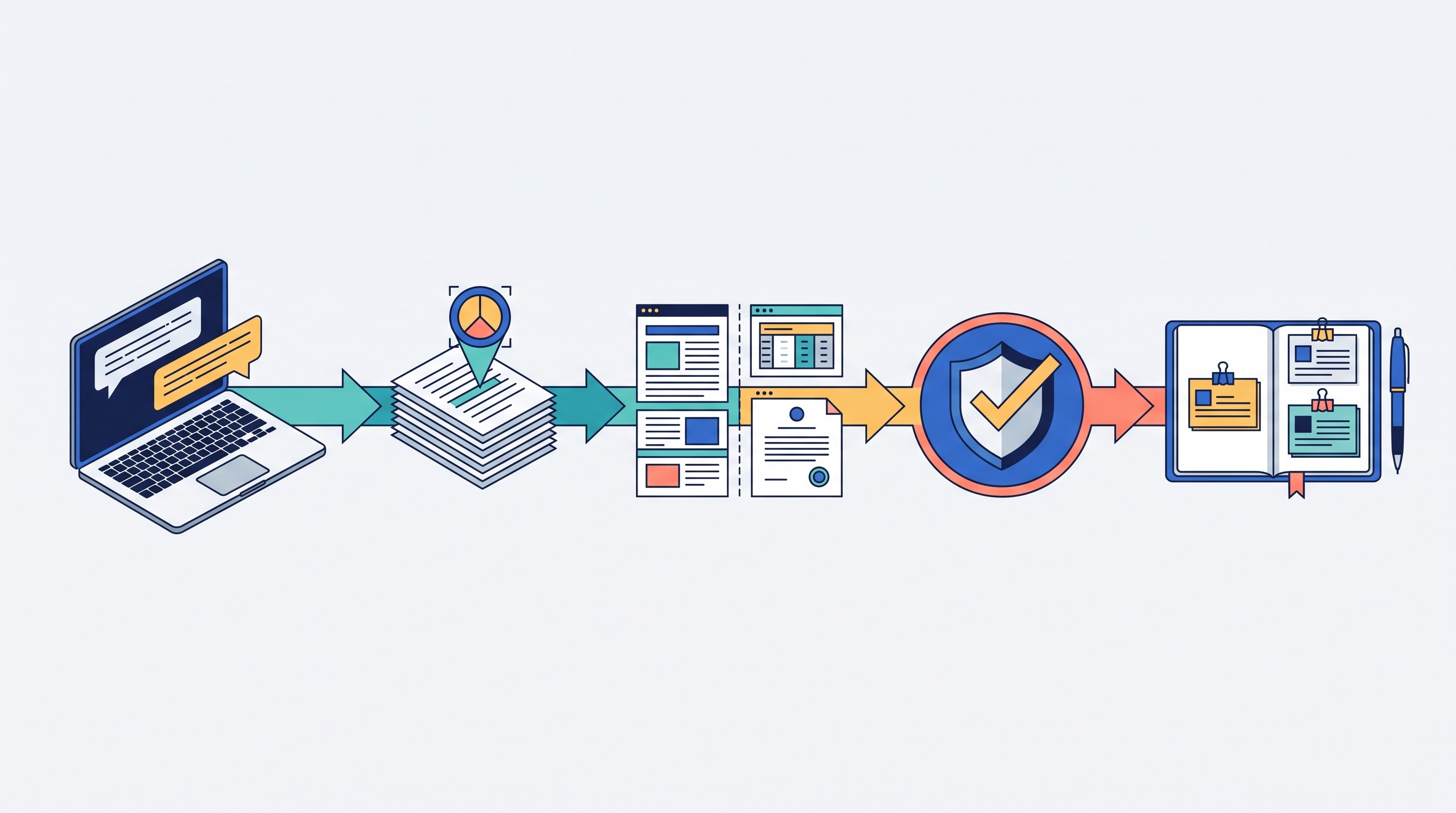
A useful rule: the more a claim matters, the closer you should get to the original evidence.
An AI-generated explanation of a field can be fine for orientation if it only shapes your search terms. A claim you will cite in a paper, submit to a supervisor, use in a clinical or legal setting, include in a grant application, or present as a factual recommendation needs verification.
Citation-context tools can help when the specific problem is whether a cited paper supports, disputes, or merely mentions a claim. This guide is broader: it covers factual claims, quotes, figures, summaries, dates, media, and evidence logs.
Start by turning an AI answer into individual claims
A fluent AI paragraph can hide ten separate claims. Do not verify the paragraph as a whole. Verify the pieces.
Suppose an AI system writes:
“Remote work increased productivity during the pandemic, especially among software engineers, according to a 2022 Stanford study. The study proved that hybrid work always improves retention and reduced attrition by 35% across all industries.”
That is not one claim. It includes several:
A study exists.
It was published or released in 2022.
It was associated with Stanford.
It studied remote or hybrid work.
It measured productivity.
It focused especially on software engineers.
It found improved retention.
It found a 35% reduction in attrition.
The finding applied across all industries.
The study “proved” hybrid work always improves retention.
Some of those may be true, some may be distorted, and some may be invented. The most dangerous errors are often not fake citations. They are scope errors: a real paper becomes too broad, too certain, or too clean.
Rewrite every important claim as a checkable sentence:
Weak: “AI improves diagnosis.”
Checkable: “In adults with suspected diabetic retinopathy, the named AI system achieved higher sensitivity than the comparison method in the cited validation study.”
Weak: “The law changed recently.”
Checkable: “The statute was amended on [date] in [jurisdiction], and the amendment changed [specific requirement].”
Add the missing boundaries:
Population: patients, students, firms, countries, cases, documents
Location: country, state, institution, court, dataset
Time period: study years, publication date, event date, access date
Method: experiment, survey, retrospective review, simulation, model, interview
Outcome: what was actually measured
Comparison: compared with what
Certainty: finding, estimate, association, claim, hypothesis, recommendation
Then rank the claims by risk.
High-risk claims need stronger verification:
Medical, legal, financial, safety, or policy claims
Claims about a person’s conduct, reputation, or identity
Numerical claims central to the argument
Claims used to justify a recommendation
Quotes attributed to a named person
Claims that sound surprising, definitive, or politically charged
Lower-risk claims may need lighter checking:
Background definitions
Search terms
Suggested databases
General orientation
Nonessential examples
Watch for language that is stronger than the evidence is likely to support: always, never, proves, the first, the only, guaranteed, settled, all, none, eliminates, causes. These words are verification alarms.
Trace each claim to the strongest available source
AI systems often sound source-aware even when they are not. A generated citation, link, or title is not evidence until it is checked against a real source.
For each important claim, look for the strongest available source:
Claim type | Stronger source | Weaker source |
|---|---|---|
Scientific finding | Original paper, dataset, trial registry, protocol | AI summary, press release, blog recap |
Government statistic | Official dataset, statistical agency table, report appendix | News article quoting the figure |
Legal claim | Statute, regulation, court opinion, docket, agency guidance | Legal blog or AI answer |
Company claim | Filing, annual report, official announcement, audited statement | Marketing page or article summary |
Historical event | Primary record, archive, authoritative timeline | Unsourced encyclopedia-style summary |
Standard or guideline | Standards body document, professional society guideline | Slide deck or secondary explanation |
Use source details that make the claim auditable:
Title
Author or institution
Publisher or venue
Publication date
DOI, PMID, docket number, report number, statute section, dataset ID
URL
Page, table, figure, section, line, timestamp, or paragraph
Access date for web material likely to change
Search with distinctive fragments, not just broad topics. Combine names, unusual phrases, exact numbers, and quoted terms. If the AI gives a suspiciously specific title, search the title in quotation marks, then search the first author and a distinctive noun phrase separately.
For academic source discovery, Google Scholar search strategies can help you find candidate papers faster. But search results only locate sources. They do not verify that the source supports the claim.
Flag sources with these problems:
The source cannot be found.
The title exists, but the authors, date, or venue differ from the AI output.
The source is paywalled and you cannot inspect the relevant passage.
The only copy is an unattributed upload or low-quality reproduction.
The page is undated or has no responsible author.
The work has a correction, expression of concern, retraction, or updated version.
The source is a preprint, abstract, poster, or press release being treated as settled evidence.
A source does not have to be perfect to be useful. It does have to be identified clearly enough that a reader can see what kind of evidence it is.
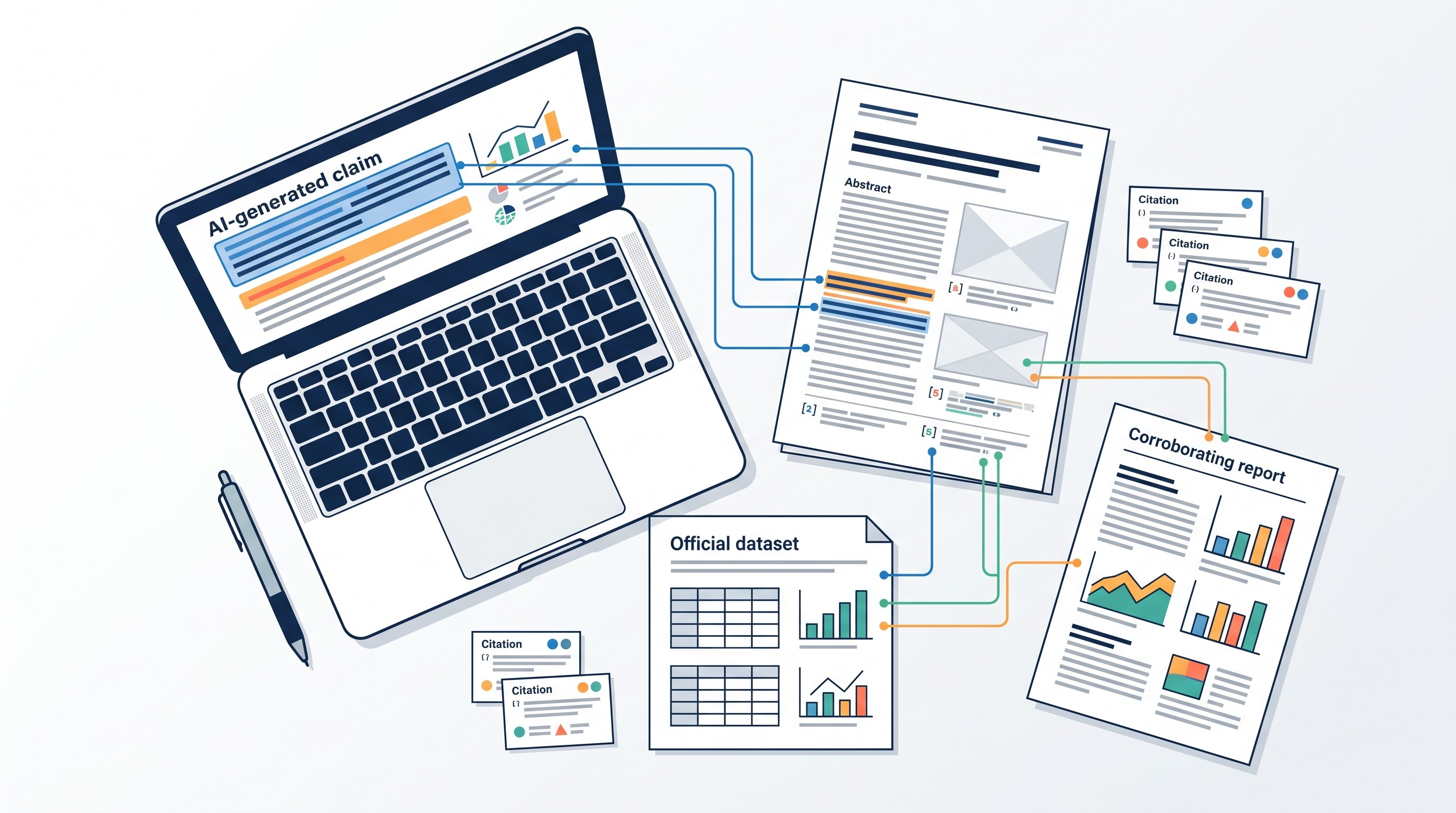
Compare the AI wording with what the source actually supports
This is where many AI-assisted research workflows fail. The user finds a real source, sees familiar keywords, and assumes the AI was right.
Do not stop at source existence. Read the relevant passage.
Check four things first:
Does the cited source exist?
Do the title, authors, date, and venue match?
Does the source contain the relevant material?
Does the source support the claim at the same strength and scope?
That fourth check is the hard one.
A source may say “X is associated with Y.” The AI may write “X causes Y.” A source may study 214 adults in one country. The AI may generalize to “people worldwide.” A source may be a narrative review. The AI may describe it as a randomized trial.
Common scope errors include:
Correlation becoming causation: “associated with” becomes “caused by.”
Early evidence becoming settled consensus: “preliminary findings suggest” becomes “research shows.”
Narrow samples becoming universal claims: one age group, country, disease subtype, or industry becomes “everyone.”
Model outputs becoming real-world outcomes: simulation results become observed results.
Review articles becoming original experiments: a review is treated as if it generated the evidence itself.
A source mentioning a claim becoming proof of the claim: the paper discusses a theory, but does not establish it.
Read the methods and limitations when the claim depends on study design. At minimum, check:
Sample size and sample definition
Study design
Inclusion and exclusion criteria
Comparison group
Outcome measure
Confidence intervals or uncertainty ranges where relevant
Limitations section
Funding or conflict disclosures if they bear on interpretation
Whether the paper’s conclusion is narrower than the AI wording
Distinguish these two statements:
“The source says this.”
“The source provides evidence for this.”
A court filing may contain an allegation. That does not make the allegation established fact. A paper’s introduction may summarize a contested view. That does not mean the paper proves it. A news article may quote a claim from a company. That does not make the claim independently verified.
When the source supports only part of the AI output, revise the claim instead of forcing the evidence to fit.
Too strong: “The intervention reduces anxiety in college students.”
Better: “In the cited small study, students assigned to the intervention reported lower anxiety scores than the comparison group at the measured follow-up.”
Too broad: “The regulation bans AI hiring tools.”
Better: “The rule requires covered employers in the named jurisdiction to meet specified notice or audit requirements for certain automated employment decision tools.”
The corrected version may be less dramatic. It will also be usable.
[[OTIO_INLINE_PROMO:%7B%22title%22%3A%22Have%20the%20source%20and%20AI%20wording%20diverged%3F%22%2C%22description%22%3A%22Select%20the%20relevant%20passage%2C%20quote%20it%20into%20chat%2C%20and%20compare%20its%20scope%20with%20the%20AI%20claim%20before%20revising%20your%20note.%22%7D]]
Verify quotations, numbers, dates, and references separately
Some claim types deserve their own checks because AI systems often get the shape right and the details wrong.
Quotations
Never put quotation marks around an AI-generated paraphrase unless you have found the exact wording in the original source.
For a quotation, verify:
Exact words
Speaker or author
Source document
Page, paragraph, timestamp, or line
Date and setting
Surrounding context
Whether the quote is translated, edited, excerpted, or reconstructed
Context matters. A sentence may be ironic, hypothetical, disputed by the next paragraph, or quoted from someone the author disagrees with.
If you cannot find the exact wording, use a paraphrase and cite the source that supports the paraphrase. Do not preserve quotation marks because the AI made the sentence sound polished.
Numbers
A number is not verified until you know what it counts.
For statistics, check:
Numerator
Denominator
Unit
Population
Geographic scope
Time period
Methodology
Whether it is a count, percentage, rate, estimate, projection, index, or model output
Whether the figure is rounded
Whether the AI confused relative change with absolute change
“Reduced by 20%” and “reduced by 20 percentage points” are different claims. “1 in 5” may refer to respondents, households, patients, papers, or cases. “Annual revenue” may mean fiscal year, calendar year, segment revenue, or company-wide revenue.
If the number comes from a chart, inspect the axis, units, scale, and notes. A chart can be visually persuasive while encoding a narrow or conditional measure.
Dates
AI systems often confuse nearby dates:
Event date
Publication date
Revision date
Access date
Effective date
Data collection period
Court filing date
Conference presentation date
For historical or legal claims, compare dates against primary records or authoritative timelines. If a policy was announced in one year and took effect in another, say so.
References
A reference can exist and still be wrong for your claim.
Check:
Authors
Title
Venue
Year
Volume, issue, pages
DOI or stable identifier
Whether the cited source contains the material
Whether the work has been corrected or retracted
Whether there is a newer edition, guideline, dataset, or statute
Do not use journal prestige as a substitute for claim-level checking. If an AI output leans on impact factor or journal rank as proof that a claim is true, use a broader publication-quality framework like journal metrics beyond impact factor. Venue-level metrics can inform where something was published. They do not validate an individual statement.
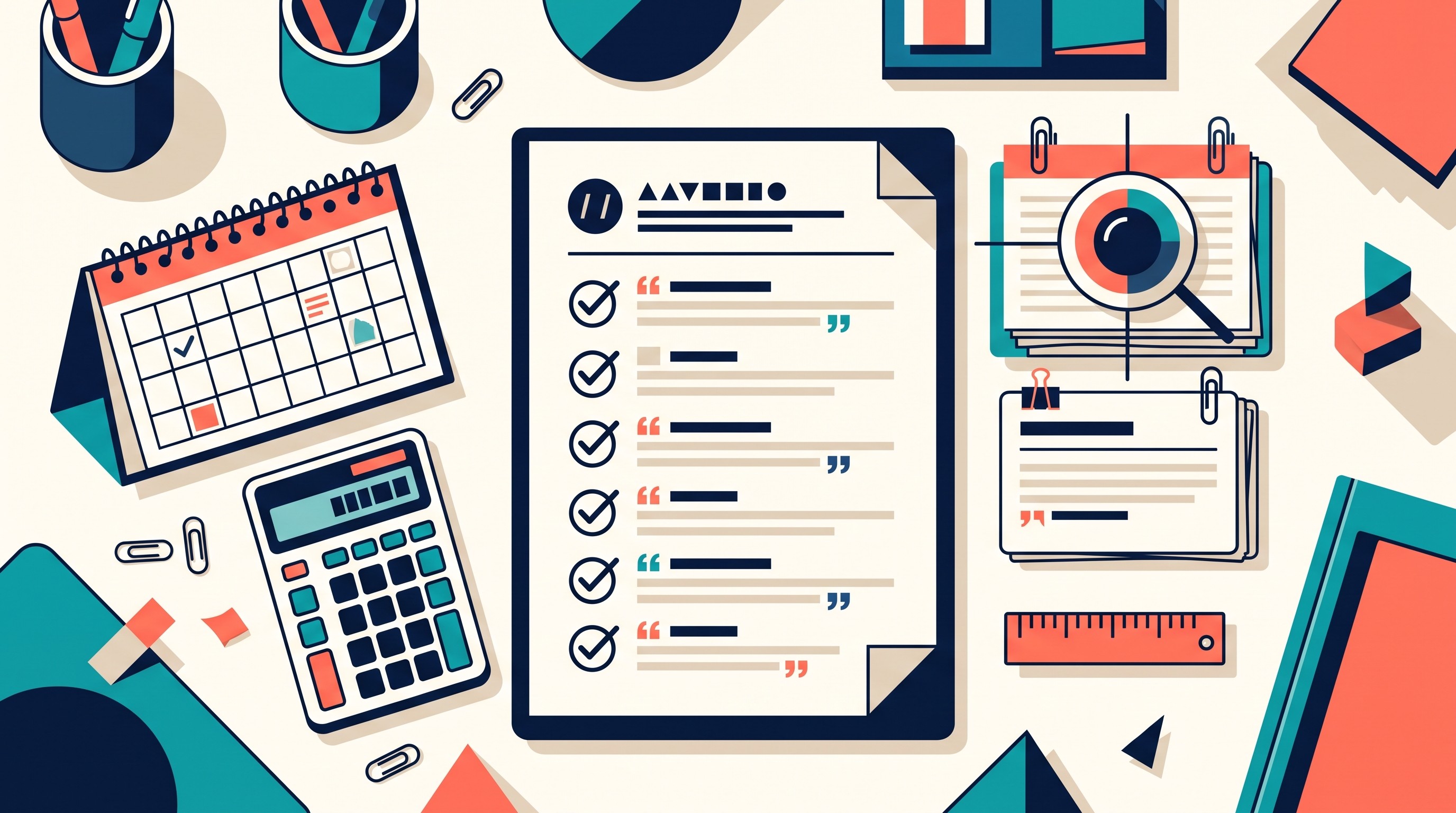
Use independent corroboration without confusing repetition for proof
For consequential claims, one source may not be enough. That is especially true when the first source is secondary, anonymous, commercial, advocacy-driven, or hard to audit.
Look for at least one independent, authoritative source. Independent means the second source did not simply copy the first.
These are not independent confirmation:
Five articles rewriting the same press release
A Wikipedia paragraph and several pages that cite the same paragraph
Multiple AI tools giving the same answer
Search snippets repeating the same phrase
Blog posts that all trace back to one abstract
News stories based on one company statement
Better corroboration comes from sources with different reporting chains, methods, or data:
Official dataset plus independent academic analysis
Court opinion plus docket document
Trial registry plus published paper
Agency report plus audited institutional data
Multiple studies using different samples
Primary interview transcript plus contemporaneous document
When sources disagree, do not average them into a false consensus. Record the disagreement.
Use categories like:
Established: supported by strong, consistent evidence
Partly supported: evidence supports a narrower version
Contested: credible sources disagree
Unknown: evidence is insufficient
Definition-dependent: answer changes based on scope or terms
Outdated: once true, but superseded by newer evidence
A good research note often says: “The broad AI claim is not supported. A narrower version is supported for [population] during [time period] under [method].”
Tools can speed parts of this work, especially search, transcription, document review, and source collection. For a task-based view of reporting tools, see AI tools for journalists for research, interviews, and fact-checking. The tool stack matters less than the standard: source judgment stays with the researcher.
Check AI-generated summaries, images, and other media for different failure modes
Not all AI-generated information is a sentence with a citation. Summaries, OCR text, charts, screenshots, and media claims create different risks.
Summaries
An AI summary can be accurate at the headline level and still unsafe for research.
Compare the summary against the full source for:
Omitted limitations
Reversed findings
Merged studies
Invented section headings
Unsupported causal language
Missing uncertainty
Missing comparison groups
Overstated practical implications
Ignored exclusions or caveats
A common failure: the summary extracts the conclusion but drops the conditions that make the conclusion true.
If a paper says, “These findings may not generalize beyond the sampled institutions,” and the AI summary says, “The intervention is effective across universities,” the summary is not merely compressed. It changed the claim.
OCR and extracted text
Text extracted from scans, photos, and PDFs needs spot-checking. Recognition errors often cluster around details that matter:
Names
Dates
Decimal points
Minus signs
Negations
Footnotes
Superscripts
Table headers
Page references
Legal citations
Medical abbreviations
If a scanned table says “0.05” and OCR reads “0.5,” the meaning changes. If “not associated” becomes “associated,” the conclusion reverses.
When working with scanned PDFs, an AI OCR for PDFs workflow can help extract text, but extracted text still needs verification against the image for high-risk passages.
Images, videos, and screenshots
For visual claims, verify provenance before interpretation.
Check:
Who created or captured it
Where it first appeared
Date and time
Location
Whether the caption matches the image
Whether it has been cropped, edited, staged, or reused
Whether it depicts the claimed event
Whether metadata exists and whether it is trustworthy
Whether older versions of the same image appear elsewhere
Reverse image search can help locate earlier uses, but it is not a final verdict. A search result can show where an image appeared, not necessarily where it originated or what it proves.
Charts and generated visuals
Treat an AI-generated chart as a new claim about data.
Check:
Underlying dataset
Filters applied
Calculation
Units
Axis labels
Time intervals
Missing values
Whether the chart type distorts the pattern
Whether the generated visual matches the source table
If the chart is built from AI-extracted data, verify the extraction first. A beautiful chart from bad data is bad evidence with better lighting.
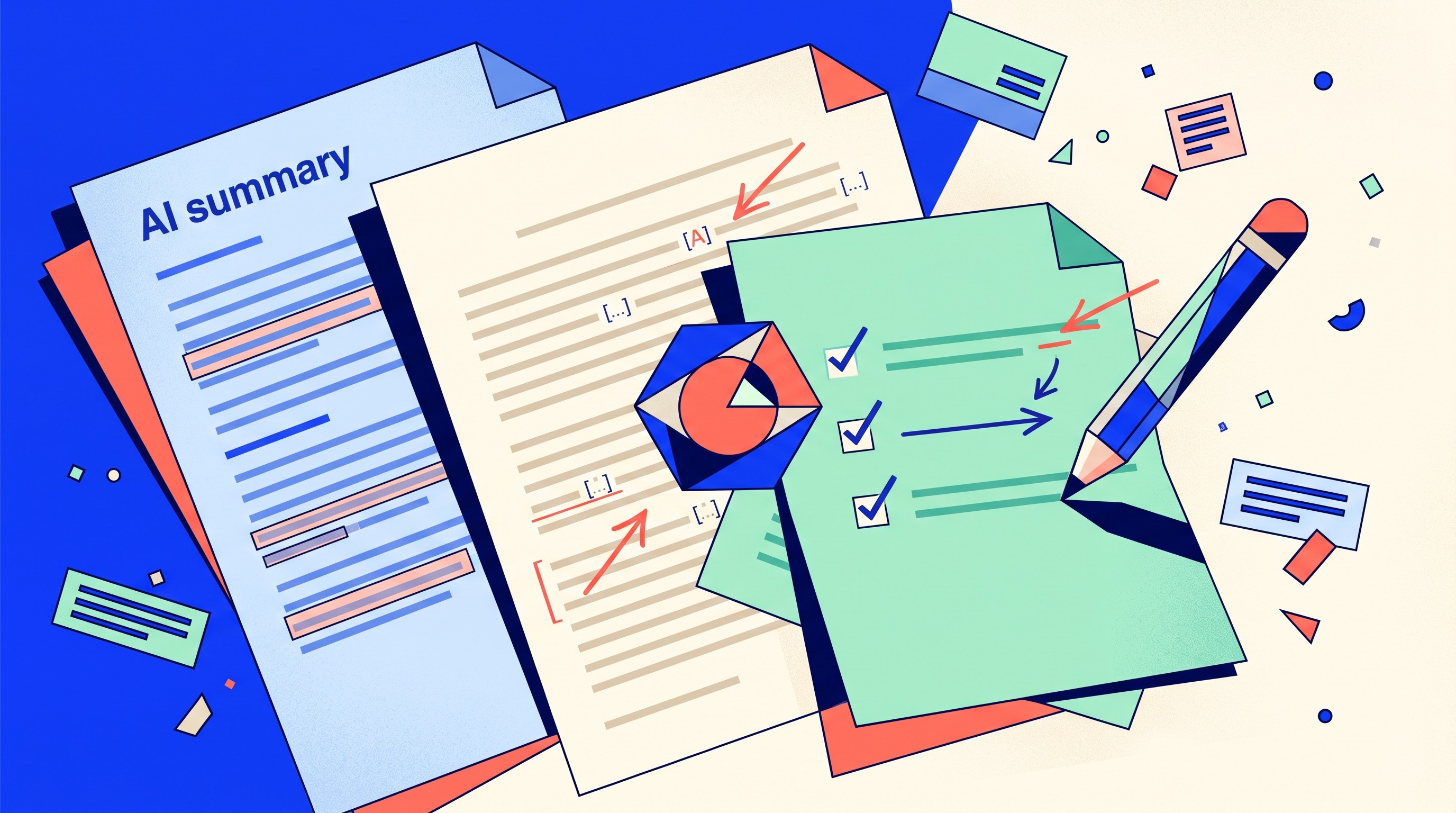
Keep an evidence log that another researcher can audit
Fact-checking gets weaker when it lives only in memory. Keep a compact evidence log for claims that matter.
Use this template:
Field | What to record |
|---|---|
Generated claim | The exact AI-generated statement or your extracted claim |
Risk level | Low, medium, high |
Source checked | Full citation, URL, dataset, record, or document |
Exact location | Page, table, figure, section, timestamp, paragraph, line |
Evidence passage | The supporting or conflicting text, paraphrased or quoted accurately |
Verification date | When you checked it |
Decision | Verified, partly supported, contradicted, unverifiable, not yet checked |
Revised claim | The version you can safely use |
Unresolved questions | Missing source, paywall, disputed definition, newer data needed |
Use more than one label. “Reliable” and “unreliable” are too blunt.
Better labels:
Verified: the source supports the claim as written.
Partly supported: the source supports a narrower version.
Contradicted: the source conflicts with the claim.
Unverifiable: no credible source found.
Not yet checked: do not use as evidence.
Outdated: superseded by newer source or correction.
Needs expert review: outside your competence or high stakes.
Save the original AI output and prompt if it materially shaped the research process. That helps collaborators understand where a claim came from.
Do not paste sensitive, unpublished, identifiable, confidential, or proprietary material into AI systems unless your institution, client, or project rules allow it. If you need to share an evidence log, remove sensitive details first.
For organization, Otio can hold source files, web links, notes, and generated responses in one research workspace. Its library, reader, text-selection toolbar, chat, and citation features can support review. They should not be treated as proof by themselves. The proof is still the source and the comparison you record.
A practical habit: when you correct an AI claim, save both versions.
Original AI claim
Source-backed revision
Why the revision changed
That small step prevents the original, more confident wording from creeping back into the draft later.
Know when to stop, escalate, or exclude the AI-generated claim
Not every claim deserves endless checking. Some should be escalated. Some should be excluded.
Escalate claims involving:
Medical care
Legal conclusions
Safety risks
Financial loss
Active emergencies
Institutional policy
Personal reputation
Allegations about identifiable people
High-impact public recommendations
Escalation means asking a qualified professional, responsible authority, supervisor, counsel, clinician, compliance officer, editor, or domain expert. It does not mean asking a second AI model.
Exclude a claim when:
No credible source can be found.
The source contradicts the claim.
The source exists but does not support the statement.
Provenance cannot be established.
The evidence is too weak for the intended use.
The claim depends on a definition you cannot defend.
The only support is circular repetition.
Do not treat any of these as validation:
Confident wording
Detailed citations
A polished explanation
Agreement between multiple AI tools
A high search ranking
A familiar-looking reference list
A chart that looks professional
A summary that sounds balanced
If the evidence supports only a narrower claim, use the narrower claim. If the evidence is mixed, say so. If the claim is not essential, cut it.
The next action is simple: choose the highest-risk unchecked claim in your AI output, locate the original source, compare the exact passage, and add the result to your evidence log before drafting further.
FAQ
Q: Can I use AI-generated information in a research paper?
A: You can use it as a starting point for questions, keywords, or source discovery, but verify substantive claims against authoritative sources and follow your institution’s disclosure and citation rules. Do not cite an AI response as evidence when the underlying source is available.
Q: How do I verify an AI-generated citation?
A: Search for the work in an authoritative database or the publisher’s site, then confirm the authors, title, venue, date, identifier, and exact passage that supports your claim. A citation that exists may still be misquoted, outdated, retracted, or irrelevant.
Q: What should I do if I cannot find the source behind an AI claim?
A: Mark the claim as unverifiable and do not use it as established evidence. Rephrase it as an open question only if it helps further investigation, then seek confirmation from primary or otherwise authoritative sources.
Q: Does using multiple AI tools make a claim more trustworthy?
A: No. Different tools can repeat the same error or draw from the same weak source. Trust comes from independently checked evidence, source quality, and a conclusion that matches the evidence’s scope.
[[OTIO_FOOTER_PROMO:%7B%22title%22%3A%22Apply%20the%20checklist%20to%20your%20research%20sources%22%2C%22description%22%3A%22Add%20the%20papers%2C%20datasets%2C%20reports%2C%20and%20links%20behind%20your%20next%20AI-assisted%20draft%2C%20then%20keep%20the%20checked%20claim%20and%20source%20passage%20together%20for%20review.%22%7D]]