Video and Audio Research
How to Take Notes From a Podcast for Research and Study
Learn how to take notes from a podcast using transcripts, timestamps, claim tracking, quotations, and source verification so episodes become searchable, reliable research notes.

If you’re searching for how to take notes from a podcast, the reliable method is simple: don’t write a passive summary. Start with the episode details, create or obtain a transcript, mark useful moments with timestamps, separate the speaker’s claim from your interpretation, and verify any important factual claim against the strongest source you can find.
A podcast can be useful research material, but only if your notes let you relocate the audio and audit the claim later. The finished note should answer three questions: who said what, where in the episode, and what evidence supports it?
How to take notes from a podcast: use a transcript, timestamps, and a claim-based note
The best podcast notes are not “Episode summary: good discussion of climate policy.” That may help memory, but it is weak for research. A research-grade podcast note preserves the speaker’s wording, the location in the audio, the claim being made, and the follow-up source you need to check.
Use this workflow:
Capture the episode details. Save the show name, episode title, host, guest, publisher, release date, URL, and access date.
Get a transcript. Use the official transcript if available. If not, use a platform transcript or generate one from the audio.
Listen with timestamps. Mark time ranges for useful moments rather than trying to take notes on everything.
Separate claim from interpretation. Record what the speaker said separately from what you think it means.
Verify important claims. Follow show notes, named papers, datasets, reports, or institutional pages before relying on factual claims.

Here is a compact structure worth copying into a note-taking app, spreadsheet, or research database:
Field | What to record |
|---|---|
Episode citation | Show, episode title, host, guest, publisher, release date, URL, access date |
Research question | The question this episode may help answer |
Timestamp | Exact time or time range |
Speaker | Host, guest, narrator, caller, or quoted source |
Wording | Exact quotation or faithful paraphrase |
Claim | The specific point being made |
Evidence mentioned | Paper, report, dataset, anecdote, case, experience, or none |
Follow-up source | Source to locate and verify |
Status | Verified, partly verified, unverified, contradicted, or context only |
Use | Background, quotation, example, lead to primary source, or not usable |
This structure matters because podcast audio is hard to audit. Unlike a journal article, you cannot scan a page and inspect the references at a glance. A timestamp becomes the locator that lets you return to the original passage.
For broader note organization after the episode is processed, use a consistent research-note system. Otio’s guide to how to effectively take research notes is a useful companion if the podcast is only one source among papers, books, reports, and interviews.
Prepare the episode before you listen
Before pressing play, create the citation shell. This prevents the common problem where a useful quote is trapped in a note called “podcast about education” with no way to cite or relocate it.
Record:
Episode title
Show name
Host
Guest or guests
Publisher or network
Release date as shown by the publisher
Episode URL
Date accessed
Transcript source, if known
Then write one sentence describing why the episode belongs in your research. For example: “This episode may help explain how emergency physicians describe burnout after the pandemic.” That sentence keeps listening focused.
Add two or three terms, names, or claims to listen for. These might be a person’s name, a technical term, a policy, a company, a study title, or a disputed claim. You are not trying to predict the whole episode. You are giving your attention a filter.
Also decide what kind of source the episode is. This affects how much weight the notes should carry.
Podcast role | How to use it |
|---|---|
Background explainer | Use for orientation, not as final evidence unless claims are verified |
Expert commentary | Use for interpretation or quotable perspective; verify factual claims |
First-person account | Use as testimony or lived experience, with context |
Journalism | Follow the reported evidence, documents, interviews, and corrections |
Source discovery | Treat the episode as a map to stronger sources |
A two-pass listening process works better than trying to transcribe the whole episode on the first run.
The orientation pass is quick. Listen at normal or slightly faster speed and map the episode: introduction, main topics, strongest sections, weak sections, ads, tangents, and moments worth revisiting.
The focused pass is slower. Return to the marked sections and create research-grade notes. This is where you replay lines, check the transcript, and record timestamps.
Create a searchable transcript without treating it as perfect evidence
A transcript turns audio into something searchable. That is its main value. It lets you find names, dates, repeated phrases, technical terms, and places where the speaker returns to the same claim.
But a transcript is not the original source. The audio is.
Use the best transcript available and record which version you used:
Transcript type | Strength | Risk |
|---|---|---|
Official transcript | Usually best for citation and speaker labels | May be edited for readability |
Platform transcript | Easy to access and search | May contain automated errors |
AI-generated transcript | Useful when no transcript exists | Needs careful checking against audio |
Search the transcript for names, dates, acronyms, and terms connected to your research question. Then return to the audio before quoting or citing. The transcript may get the gist right while still mishearing a number, collapsing two speakers, or missing the qualification that changes the meaning.
Common transcript failure modes include:
Misheard names
Incorrect acronyms
Wrong numbers or dates
Overlapping speech
Accent-related errors
Music or ads being interpreted as speech
Missing speaker changes
False punctuation that changes the sentence
Cleaned-up wording that removes hesitation or uncertainty

A practical AI-assisted workflow is to add the episode to a research workspace, use the transcript to search and locate passages, then save only the useful selections into notes. In Otio’s AI podcast summarizer, for example, you can work with podcast audio in the same library as PDFs, web links, videos, and notes; use the transcript and reader controls to find relevant moments; and save useful selections into a note.
Still treat the original episode as the authority. AI summaries and transcripts are accelerators, not evidence. If a quote matters, replay the audio.
[[OTIO_INLINE_PROMO:%7B%22title%22%3A%22Need%20to%20turn%20an%20episode%20transcript%20into%20research%20notes%3F%22%2C%22description%22%3A%22Add%20the%20podcast%20to%20Otio%20beside%20your%20PDFs%20and%20web%20sources%2C%20search%20its%20transcript%2C%20and%20save%20verified%20selections%20with%20timestamps%20into%20a%20note.%22%7D]]
Turn listening into timestamped research notes
For every useful moment, create one entry. Do not combine five loosely related claims into a paragraph called “good point.” That makes the note hard to verify later.
Use this structure:
Timestamp or range: 18:42–19:20
Topic: What the moment is about
Speaker: Who is speaking
Wording: Exact quote or faithful paraphrase
Claim: The specific research-relevant assertion
Why it matters: Connection to your question
Evidence named: Study, report, dataset, example, or none
Next action: Verify, cite, compare, ignore, or use as context
The most important distinction is between quotation, paraphrase, summary, and interpretation.
Quotation means the exact words heard in the audio. Use quotation marks only after replaying the passage and checking the transcript against the audio.
Faithful paraphrase means the same idea in your own words, without adding a stronger claim than the speaker made.
Summary compresses a longer section. It is useful for orientation, but it should not be mistaken for a precise statement.
Interpretation is your analysis. Label it clearly so it does not later appear to be the speaker’s claim.
Here is a hypothetical entry format:
Field | Example structure |
|---|---|
Timestamp | 27:14–28:05 |
Speaker | Guest |
Wording | Faithful paraphrase: the speaker argues that local clinics adopted the tool before formal training caught up |
Claim | Implementation moved faster than staff training |
Evidence named | Mentions a hospital survey but does not name it |
Follow-up | Search for the survey in show notes, hospital publications, or academic databases |
Status | Unverified |
Use | Possible context, not final evidence yet |
Do not capture more audio than you need. The best excerpt is the smallest passage that preserves the claim, plus enough surrounding context to avoid misrepresenting the speaker. Often that means the sentence before and after the key line.
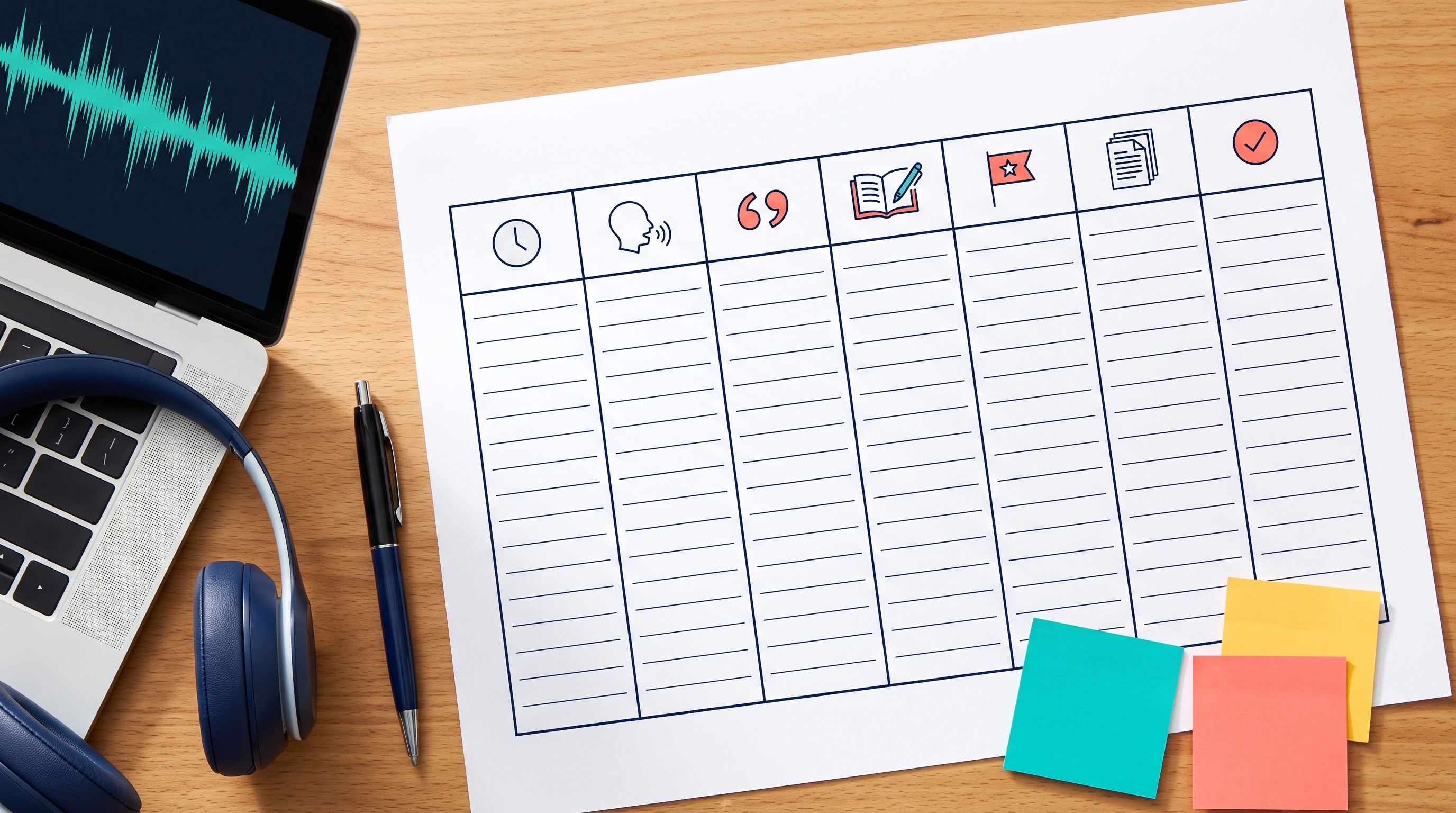
For podcasts, the timestamp usually functions like a page number. It tells another person where to find the passage. Citation rules differ by instructor, publisher, discipline, and style guide, so check the required format before submission. In working notes, preserve the timestamp even if your final citation format does not require it.
Timestamped sections also help when the podcast has a video version. If you are working with long video interviews, panels, or lectures, tools and workflows for YouTube chapter and video research can make recurring segments easier to revisit.
Separate podcast claims from evidence you can cite
The core problem with podcast research is that episodes mix evidence types. A guest may move from personal experience to expert interpretation to a factual claim to speculation in the same minute.
Your notes should not flatten those into one category.
Create a claim ledger:
Claim | Who made it | Timestamp | Evidence mentioned | Independent source to find | Status | Possible use |
|---|---|---|---|---|---|---|
Specific assertion | Speaker | Time range | Paper/report/anecdote/none | Primary source or stronger secondary source | Verified/unverified/etc. | Quote/context/evidence lead |
Then classify each note:
Direct observation: The speaker describes something they personally saw or did.
Expert interpretation: The speaker explains what a finding, event, or pattern may mean.
Anecdote: A story or example, useful but limited.
Opinion: A judgment, preference, or normative claim.
Factual claim: A checkable statement about events, numbers, dates, studies, policies, or outcomes.
Prediction: A claim about what will happen.
Unresolved question: Something the episode raises but does not answer.
These categories should not receive the same evidentiary weight. A first-person account may be valuable if your research concerns experience, memory, professional practice, or testimony. It is weaker if used to prove a broad statistical claim.
For consequential factual claims, follow the chain backward:
Check the episode show notes.
Look for linked papers, books, reports, legal documents, datasets, or official pages.
Search the guest’s publications or institutional profile.
Search for the exact phrase or statistic.
Compare the episode’s claim with the original source.
Mark the claim’s status in your ledger.
If an episode discusses a published study, cite the study for the study’s findings. Cite the podcast when the podcast itself matters: an interview answer, a public statement, a firsthand account, or a distinctive interpretation.
For the follow-up search step, use academic databases and search operators rather than general web searching alone. Otio’s guide to Google Scholar search tips covers the source-discovery part without turning the podcast note into a literature review by itself.
A useful rule: the podcast can point you to evidence, but it does not automatically become the evidence.
Verify, organize, and cite the finished podcast notes
After the focused listening pass, run a verification pass. This is the step that separates usable research notes from a polished summary.
Check:
Names are spelled correctly.
Dates match the original source or publisher record.
Numbers are replayed and verified.
Quotations match the audio.
Speaker attribution is correct.
The transcript did not merge two speakers.
A cited study or report actually supports the claim.
Your interpretation is labeled as interpretation.
Every important claim has a verification status.
Store the episode link or audio file beside the notes. Preserve timestamps even if the episode is later moved, edited, paywalled, or deleted. If your workspace supports folders, tags, or project spaces, keep the episode with related papers, reports, articles, and drafts rather than in a separate “podcasts” pile.
In Otio, that means placing podcast audio, PDFs, web sources, and notes in the same Library or project Space, then saving relevant transcript selections into a note. The benefit is not that AI replaces verification. It is that the episode sits next to the sources needed to verify it.
Handle messy cases explicitly:
Problem | What to do |
|---|---|
No transcript | Create one if possible, then verify key passages against audio |
Edited episode | Record access date and note that timestamps may differ |
Deleted episode | Keep available citation details and mark access limitation |
Paywalled source | Record what you accessed and what could not be checked |
Timestamps differ by player | Use time ranges and identify the version or platform |
Unclear speaker | Mark uncertain attribution rather than guessing |
Unverified claim | Label it as unverified and do not treat it as established evidence |
A final checklist:
Every important note has a timestamp or locator.
Every direct quote has been replayed.
Every major factual claim has a source or verification status.
Every paraphrase is faithful to the audio.
Every interpretation is visibly separate from reporting.
The episode citation details are complete enough to relocate the source.
Follow-up sources are linked or listed.
Weak claims are not promoted into strong evidence.
The next action is not to copy a podcast summary into an assignment. Convert the verified claim ledger into an outline, annotated bibliography entry, literature note, or research memo. That forces each podcast-derived idea to earn its place beside stronger sources.
If the project is large, a broader research paper organizer can help connect podcast notes to citations, drafts, and source groups.
FAQ
Q: Should I transcribe an entire podcast for research?
A: Usually no. Transcribe or retain the sections relevant to your research question, then keep timestamps and enough surrounding context to relocate and verify each passage.
Q: Can I cite a podcast as a research source?
A: Yes, when the podcast itself is the relevant source, such as an interview, public statement, or first-person account. For factual claims based on research discussed in the episode, locate and cite the original study or primary source when possible.
Q: How do I avoid misquoting a podcast?
A: Replay the passage, check the transcript against the audio, record the speaker and timestamp, and preserve enough context to show what the statement means. Mark uncertain wording instead of silently correcting it.
[[OTIO_FOOTER_PROMO:%7B%22title%22%3A%22Ready%20to%20check%20your%20own%20podcast%20claims%3F%22%2C%22description%22%3A%22Keep%20your%20episode%2C%20transcript%2C%20papers%2C%20reports%2C%20and%20follow-up%20links%20in%20one%20Otio%20Library%20or%20Space%20while%20you%20mark%20each%20claim%20verified%20or%20unverified.%22%7D]]