
Research Writing and Drafting
how to write a research abstract: A Step-by-Step Guide for Students and Researchers
Write a clear research abstract by stating the problem, method, key results, and conclusion in a precise structure. Follow a drafting and revision process that keeps every claim aligned with the full paper.

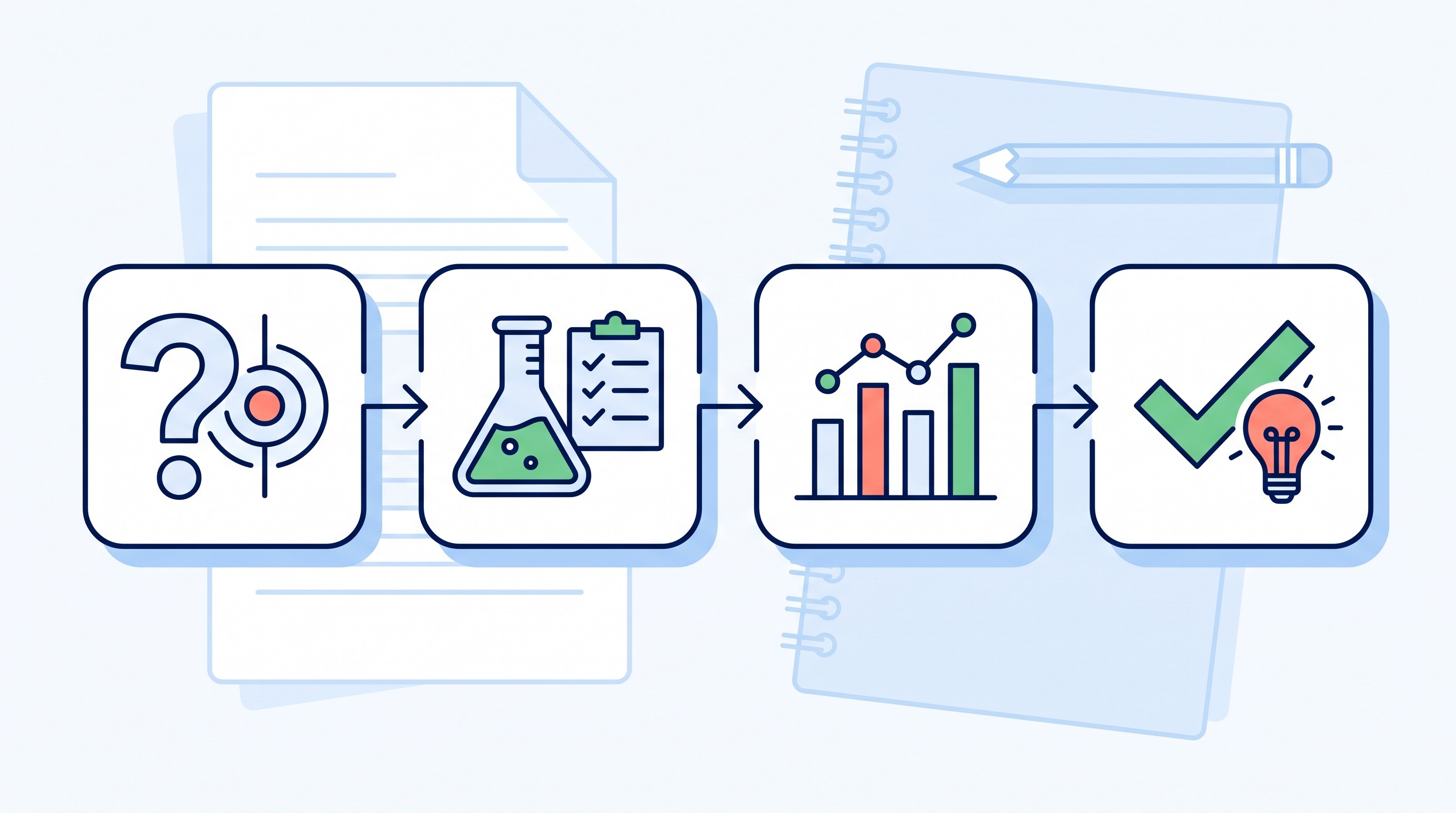
If you are figuring out how to write a research abstract, use this order: state the research problem, describe the method, report the main result, and end with the conclusion the evidence supports. Treat the abstract as a compressed version of the finished paper, not as a teaser, introduction, or broad summary of the topic.
The safest drafting method is to write two anchor sentences first: one for the study’s question and one for its main finding. Every other sentence should serve those two anchors.
A strong abstract lets a reader answer four questions quickly: What was studied? How was the evidence produced? What was found? Why does that finding matter within the limits of the study?
What a research abstract should contain
A research abstract briefly explains what the study investigated, how it was conducted, what it found, and why the findings matter. It is usually the first part people read, but it should be one of the last parts you finalize because it must match the completed paper.
Do not write the abstract like the opening paragraph of an essay. An introduction can spend space on background, motivation, and literature gaps. An abstract has less room. It needs to show the paper’s actual contribution.
The core structure is simple:
Part | What it answers | What to include |
|---|---|---|
Purpose | What problem did the study address? | Research question, objective, hypothesis, or gap |
Methods | How was the study conducted? | Design, data, participants, measures, procedures, analysis |
Results | What did the study find? | Main findings, comparisons, patterns, estimates, outcomes |
Conclusion | What do the findings mean? | Evidence-supported answer, significance, limits, implications |
Some journals, conferences, and instructors require labeled headings such as Background, Methods, Results, and Conclusion. Others want a single paragraph. The labels may change, but the logic stays the same.
The abstract must not promise work the paper does not contain. If the paper does not test causation, the abstract should not imply causal effects. If the sample is narrow, the abstract should not claim broad generalizability. If an analysis was planned but removed, it should not appear in the final abstract.
Research abstract structure: the four essential parts
The easiest way to draft a research abstract is to build it in four parts, then revise it into the format required by the assignment or journal.
1. Purpose: the research problem or objective
The purpose section tells readers what the paper is about and why the study exists. It can name the research problem, question, objective, hypothesis, or gap.
Keep the context narrow. One sentence is often enough. The purpose is not to review the field; it is to locate the study.
Weak purpose sentence:
This topic has become increasingly important in education, and many researchers have studied student learning.
Stronger purpose sentence:
This study examined whether weekly retrieval-practice quizzes were associated with higher final exam scores in an introductory biology course.
The second version gives the reader a clear population, intervention or exposure, and outcome. It also sets up the methods and results that must follow.
If the research question is still vague, fix that before polishing the abstract. Otio’s guide to how to write a research question walks through that earlier step.
2. Methods: how the evidence was produced
The methods section explains how the study generated evidence. Include only the details that affect how readers should interpret the findings.
Depending on the discipline, that may include:
Research design: experiment, survey, case study, content analysis, ethnography, systematic review, archival analysis
Participants, cases, texts, or data source
Setting or time period
Measures, variables, intervention, or phenomenon studied
Data collection method
Analysis approach, such as regression, thematic analysis, coding, comparison, or descriptive statistics
A methods sentence should be specific enough to establish credibility, but not so detailed that it turns into a procedure section.
Too thin:
Data were collected and analyzed.
Too procedural:
Participants opened the survey link, read the consent form, clicked next, completed demographic questions, responded to each item on a five-point scale, and submitted the form.
Better:
The study analyzed survey responses from 214 undergraduate students using multiple regression to examine the relationship between weekly quiz completion and final exam performance.
That sentence gives readers the design, data source, sample, and analysis approach. It leaves the routine procedure for the methods section.
3. Results: the main finding
The results section is where many abstracts fail. Writers often say the study produced “significant findings” or “important insights” without saying what those findings were.
The abstract should report the result that most directly answers the research question. If the paper includes a key number, comparison, effect estimate, or qualitative pattern, include it when the word limit allows.
Weak result sentence:
The results showed that retrieval practice had important implications for student learning.
Stronger result sentence:
Students who completed at least 80% of weekly quizzes earned higher final exam scores than students who completed fewer quizzes, even after controlling for prior GPA.
The second sentence tells readers what happened. The interpretation can come next.
For qualitative research, results can still be concrete:
Interviewees described three recurring barriers to telehealth use: unstable internet access, uncertainty about privacy, and difficulty explaining symptoms without physical examination.
That is more useful than saying the interviews “revealed several themes.”
4. Conclusion: the evidence-supported takeaway
The conclusion states what the findings support in relation to the research question. It should not outrun the design.
If the study is correlational, use association language. If the study is exploratory, say so. If the sample is narrow, avoid claims about all people, all schools, all hospitals, all markets, or all countries.
Overclaim:
Weekly quizzes improve exam performance for all biology students.
More defensible:
The findings suggest that frequent retrieval practice may support exam performance in introductory biology courses, though causal claims require experimental evidence.
A good abstract conclusion can also mention a limitation when leaving it out would mislead the reader. This is especially important for small samples, single-site studies, convenience samples, narrow corpora, and observational designs.
Structured vs. unstructured abstracts
A structured abstract uses labeled sections. For example:
Background
Objective
Methods
Results
Conclusion
An unstructured abstract presents the same information in one paragraph without labels.
The difference is format, not substance. A single-paragraph abstract still needs a clear purpose, method, result, and conclusion. A labeled abstract still needs concise writing and accurate claims.
Step 1: Start with the paper’s research question and main finding
Before drafting the abstract, write two sentences outside the abstract.
First, state the research question or objective:
This study examines whether [X] is related to, affects, explains, predicts, or changes [Y] among/in [population, setting, or dataset].
Second, state the main finding:
The main finding is that [specific result], based on [analysis or evidence].
These two sentences become constraints. The abstract should not wander into a broader version of the paper, a narrower version of the paper, or a different study altogether.
For example:
Research question: This study examines whether remote work frequency is associated with self-reported burnout among early-career software engineers.
Main finding: Engineers working remotely four or more days per week reported lower commute-related stress but higher social isolation than engineers working remotely one or two days per week.
Now the abstract has a spine. The methods need to explain how remote work frequency and burnout-related outcomes were measured. The results need to report the comparison. The conclusion needs to avoid saying remote work “causes” burnout unless the design supports that claim.
Avoid opening with broad background claims such as “Technology has changed the modern workplace” or “Education is important for society.” Those sentences consume space and usually do not help readers understand the study.
Step 2: Draft the methods without turning the abstract into a procedure section
The methods sentence should answer one question: What kind of evidence does this paper use?
For a quantitative study, that may mean naming the design, sample, measures, and statistical approach:
We analyzed survey data from 386 public-school teachers using logistic regression to examine whether administrative workload predicted intention to leave the profession.
For a qualitative study, that may mean naming the participants, data collection method, and analytic approach:
The study used semi-structured interviews with 32 first-generation college students and applied reflexive thematic analysis to identify perceived barriers to academic advising.
For a text or document analysis, it may mean naming the corpus and coding method:
The analysis examined 120 policy documents published between 2018 and 2026 and coded references to climate adaptation, infrastructure funding, and community consultation.
Match the level of detail to the field. A psychology abstract may need participants, measures, and statistical tests. A history abstract may need archives, period, and interpretive method. A legal research abstract may need the jurisdiction, case set, statute, or doctrinal method.
Remove details that do not change how the reader evaluates the evidence. Survey software, recruitment email wording, room setup, interview scheduling, and file naming rarely belong in the abstract.
Also watch the tense. If the paper is complete, do not write as if the study is still planned:
Weak:
This paper will survey students and will analyze the results.
Better:
This paper surveyed students and analyzed the results.
Do not imply a stronger design than you used. A convenience sample is not a representative sample. A cross-sectional survey does not establish causation. A case study can support rich interpretation, but it usually cannot support population-wide claims by itself.
If you are still shaping the methodology section, Otio’s guides to the methodology section of a research paper and the methods section are better next reads than trying to patch the abstract first.
Step 3: Compress the results while preserving evidence
The results section should not summarize every analysis in the paper. It should report the finding that answers the research question most directly.
A useful order is:
Identify the main result.
Add the most informative number, comparison, or pattern if available.
Remove secondary analyses unless they change the interpretation.
Keep interpretation out of the result sentence.
For example:
Result: Students in the peer-feedback condition revised more claims and added more source-based evidence than students in the instructor-feedback-only condition.
Interpretation: These findings suggest that peer feedback may improve revision quality when students are given clear evaluation criteria.
Those two ideas belong near each other, but they are not the same. The result says what the analysis found. The conclusion says what the finding may mean.
If the paper reports numerical findings, do not hide them behind vague wording. “There was a significant difference” is less useful than naming the direction and size of the difference, when your field’s conventions and word limit allow it.
If the paper is qualitative, preserve the specificity of the evidence. “Participants discussed challenges” is weak. “Participants described lack of childcare, unpredictable shift schedules, and fear of supervisor retaliation as barriers to attending training” is stronger.
Do not introduce new statistics, citations, or claims in the abstract. If a number is not in the paper, it does not belong in the abstract. If the paper does not make a comparison, the abstract should not invent one.
For longer work on reporting findings, see Otio’s guide to writing results in a research paper.
Step 4: Write a conclusion that does not overclaim
The conclusion should answer the research question at the same strength as the evidence allows.
Use careful verbs:
Shows when the evidence directly demonstrates the point
Suggests when the evidence supports but does not prove the claim
Is associated with for correlational findings
May indicate for exploratory or interpretive findings
Supports the need for when the paper justifies further research or practice changes but does not prove an intervention works
The biggest mistake is turning association into causation.
If the study found that students who used a tutoring center had higher grades, the abstract should not say the tutoring center caused higher grades unless the design ruled out plausible alternatives. Students who choose tutoring may differ in motivation, prior performance, time availability, or course load.
A defensible conclusion might be:
The findings suggest an association between tutoring-center use and course performance, but future experimental or longitudinal research is needed to assess causal effects.
Limitations matter when they change the meaning of the conclusion. A single-school study, small interview sample, narrow date range, or nonrepresentative dataset does not make the research worthless. It simply changes what can be claimed.
End with the most specific implication the paper supports. Avoid generic closers such as “This topic is important and should be studied more.” Better endings name the field, practice, theory, policy, or next research step.
Weak:
These findings have important implications for education.
Stronger:
These findings suggest that first-year writing programs should evaluate not only the amount of feedback students receive, but also whether feedback criteria are visible during revision.
For more help with the final section of a manuscript, see Otio’s guide to the conclusion section of a research paper.
How to revise an abstract for clarity, accuracy, and length
Revision is where the abstract becomes trustworthy. The goal is not just shorter writing. The goal is accurate compression.
Start by comparing every sentence in the abstract with the full paper. Each claim should trace back to a section, table, figure, result, or conclusion in the manuscript. If you cannot point to the supporting part of the paper, delete or rewrite the sentence.
Then make a reverse outline. Label each sentence:
Purpose
Method
Result
Conclusion
Background
Unnecessary
Most weak abstracts have too much background and not enough method or result. If the reader cannot tell how the study was conducted or what it found, the abstract is not doing its job.
A practical balance check:
Sentence type | Keep if it does this | Cut if it does this |
|---|---|---|
Background | Gives essential context for the research problem | Makes broad claims about the topic |
Purpose | States the objective or question | Repeats the title in different words |
Method | Identifies the evidence and analysis | Lists routine procedure |
Result | Reports the main finding | Says only that findings were “significant” |
Conclusion | States the supported implication | Makes a claim broader than the study |
Next, cut repetition. Abstracts often say the same thing twice: once in the background and once in the purpose, or once in the result and once in the conclusion. Keep the sharper sentence.
Replace long phrases with precise verbs:
“conducted an investigation into” → examined
“made a comparison between” → compared
“is indicative of” → suggests
“has the ability to” → can
“due to the fact that” → because
Check tense and terminology. Use the same terms for the population, variables, intervention, phenomenon, or dataset throughout the title, abstract, and paper. If the title says “first-generation college students,” the abstract should not drift into “underrepresented students” unless the paper actually studies that broader group.
Define abbreviations only if they are necessary. Avoid citations, quotations, references to figures or tables, and unexplained acronyms unless the required format explicitly allows them.
If you use Otio’s AI text editor to shorten a draft or improve wording, preserve the original version and compare every suggested change with the paper. The useful edit is the one that makes the abstract clearer without changing the evidence, tense, or claim strength.
An abstract is also different from a longer research summary. If the assignment asks for more context, critique, or explanation, Otio’s guide on how to write a research summary is the better model.
[[OTIO_INLINE_PROMO:%7B%22title%22%3A%22Does%20every%20abstract%20claim%20match%20your%20paper%3F%22%2C%22description%22%3A%22Add%20your%20paper%2C%20methods%20notes%2C%20and%20results%20to%20Otio%2C%20then%20ask%20it%20to%20flag%20claims%20that%20lack%20support%20or%20exceed%20the%20study%E2%80%99s%20evidence.%22%7D]]
Common research abstract mistakes and how to fix them
Mistake 1: Writing the final abstract before the results are stable.
A rough abstract can help you plan, but the submission version should wait until the paper’s findings and conclusion are settled. Early abstracts often contain promised analyses that later disappear.
Fix: Draft a placeholder early if needed, then rewrite it after the results and discussion are complete.
Mistake 2: Copying the introduction into the abstract.
The introduction usually has too much background and not enough method or result.
Fix: Build the abstract from the research question, methods, main result, and conclusion instead of copying existing paragraphs.
Mistake 3: Copying the conclusion into the abstract.
The conclusion may discuss implications, limitations, and future research, but it may not restate the methods and findings clearly enough.
Fix: Use the conclusion to inform the final sentence, not the whole abstract.
Mistake 4: Reporting vague results.
Phrases such as “the study found significant results” or “important themes emerged” do not tell readers what was found.
Fix: Name the direction, relationship, comparison, outcome, or theme.
Mistake 5: Inflating the claim.
Students often write stronger conclusions in the abstract than in the paper.
Fix: Match the claim to the design. Use causal language only when the study design supports causation.
Mistake 6: Adding citations or references to figures.
Most abstracts should stand alone. Readers may see the abstract in a database without the full paper in front of them.
Fix: Remove citations, quotations, and “see Table 2” references unless the target format requires them.
Mistake 7: Optimizing only for word count.
A short abstract can still fail if it omits the main result. A long abstract can still fail if it misrepresents the study.
Fix: Cut low-value background first, then compress methods, then tighten wording. Do not cut the finding.
Mistake 8: Treating a proposal abstract like a completed-study abstract.
A proposal or protocol abstract may describe intended methods and expected contribution. It should not present projected findings as completed results.
Fix: Use future-oriented or planned language for proposals: “This study will examine…” or “The project is designed to…” Save result claims for completed research.
A practical final checklist before submitting
Use this checklist after you have a complete draft.
Word limit: Does the abstract follow the required length, headings, formatting, and submission instructions?
Structure: Can a reader identify the purpose, methods, results, and conclusion?
Alignment: Do the title, research question, methods, results, and conclusion describe the same study?
Main result: Is the key finding visible, or is it buried behind background?
Evidence strength: Have you removed unsupported claims about causation, generalizability, novelty, or real-world impact?
Methods accuracy: Does the abstract describe the actual design, sample, data source, and analysis without exaggeration?
Terminology: Are populations, variables, interventions, themes, and datasets named consistently?
Tense: Does the abstract use completed-study language for completed research and planned-study language for proposals?
Abbreviations: Are acronyms defined or removed?
No loose claims: Can every sentence be traced to the full paper?
Readability: Have you read the abstract aloud once to catch dense sentences and missing transitions?
Human check: Has an instructor, supervisor, or coauthor reviewed whether the abstract matches the paper?
A final abstract should feel compressed, not thin. It should leave out detail, but not the study’s logic.
FAQ
Q: How long should a research abstract be?
A: Use the word limit specified by the assignment, conference, or journal. When no limit is given, keep it concise enough to cover the purpose, methods, main results, and conclusion without unnecessary background.
Q: Should a research abstract include citations?
A: Usually, no. An abstract normally presents the study itself rather than documenting the literature review, unless the target format explicitly requires citations.
Q: Should I write the abstract before or after the research paper?
A: Draft the final abstract after the research question, methods, results, and conclusion are stable. A rough early version can help planning, but it should not be the submission version.
Q: What is the difference between an abstract and an executive summary?
A: An abstract is a compact description of a research study, usually centered on purpose, method, results, and conclusion. An executive summary is generally longer and more decision-oriented, with more room for context, recommendations, and practical implications.
[[OTIO_FOOTER_PROMO:%7B%22title%22%3A%22Apply%20the%20checklist%20to%20your%20own%20sources%22%2C%22description%22%3A%22Keep%20your%20draft%2C%20PDFs%2C%20and%20notes%20in%20Otio%20and%20ask%20focused%20questions%20about%20whether%20the%20abstract%20matches%20your%20methods%2C%20results%2C%20and%20limits.%22%7D]]