
Research Writing and Drafting
how to write a research proposal: From Research Question to Methods and Timeline
Learn how to write a research proposal by moving from a focused research question to a defensible rationale, method, evidence plan, and realistic timeline.

If you need to know how to write a research proposal, the shortest answer is this: explain what you will study, why it matters, how you will investigate it, what evidence you need, and when the work will happen.
A proposal is not a miniature research paper. It is a plan for a study that has not been completed yet. The reader is judging whether the question is worth asking, whether the method can answer it, and whether the timeline is believable.
The safest way to draft one is to move in order: research question, problem and rationale, literature context, methods, ethics and limitations, timeline, references, and any required budget or appendices. Before writing, check the assignment brief, department handbook, supervisor guidance, or funder rules. Required headings, word limits, citation styles, and ethics forms vary more than students expect.
What a research proposal must accomplish
A strong research proposal has one job: persuade a reader that the proposed study is clear, justified, feasible, and methodologically sound.
That means every section should answer one of five questions:
What will you study?
The topic, research problem, research question, objectives, and scope.
Why is it worth studying?
The rationale, literature gap, scholarly contribution, practical value, or policy relevance.
How will you study it?
The design, evidence sources, participants or cases, data-collection procedure, and analysis plan.
What could go wrong or limit the study?
Ethics, access, bias, reliability, validity, missing data, consent, confidentiality, and feasibility constraints.
When will each stage happen?
A timeline with dependencies, milestones, deliverables, and room for review or delay.
A basic research proposal structure usually includes:
Title or working title
Introduction and rationale
Research problem
Research question, objectives, or hypotheses
Literature review or literature context
Methodology and evidence plan
Ethics, access, and limitations
Timeline
References
Budget, appendices, instruments, consent forms, or permissions if required
The key is alignment. A proposal fails when the question suggests one kind of study, the literature review argues for another, the method collects the wrong evidence, and the timeline pretends all of this can be done in two weeks.
Treat the proposal as a chain of decisions, not a form to fill in.
Start with a focused research question
Most weak proposals start too broad. “Social media and mental health” is a topic. It is not yet a study.
A usable research question names the population, setting, phenomenon or variables, and scope. It should give the method somewhere to go.
Compare these:
Topic: Remote work and productivity
Broad question: Does remote work affect productivity?
Focused question: How do early-career software engineers in fully remote teams describe the relationship between asynchronous communication and perceived productivity?
The focused version gives a reader enough to evaluate evidence. It names a group, a work arrangement, a communication pattern, and the kind of answer expected: descriptions of experience, not a universal productivity law.
If the hardest part is narrowing the question, use Otio’s separate guide on how to create a research question. For proposal writing, the main point is that the question determines almost every later section.
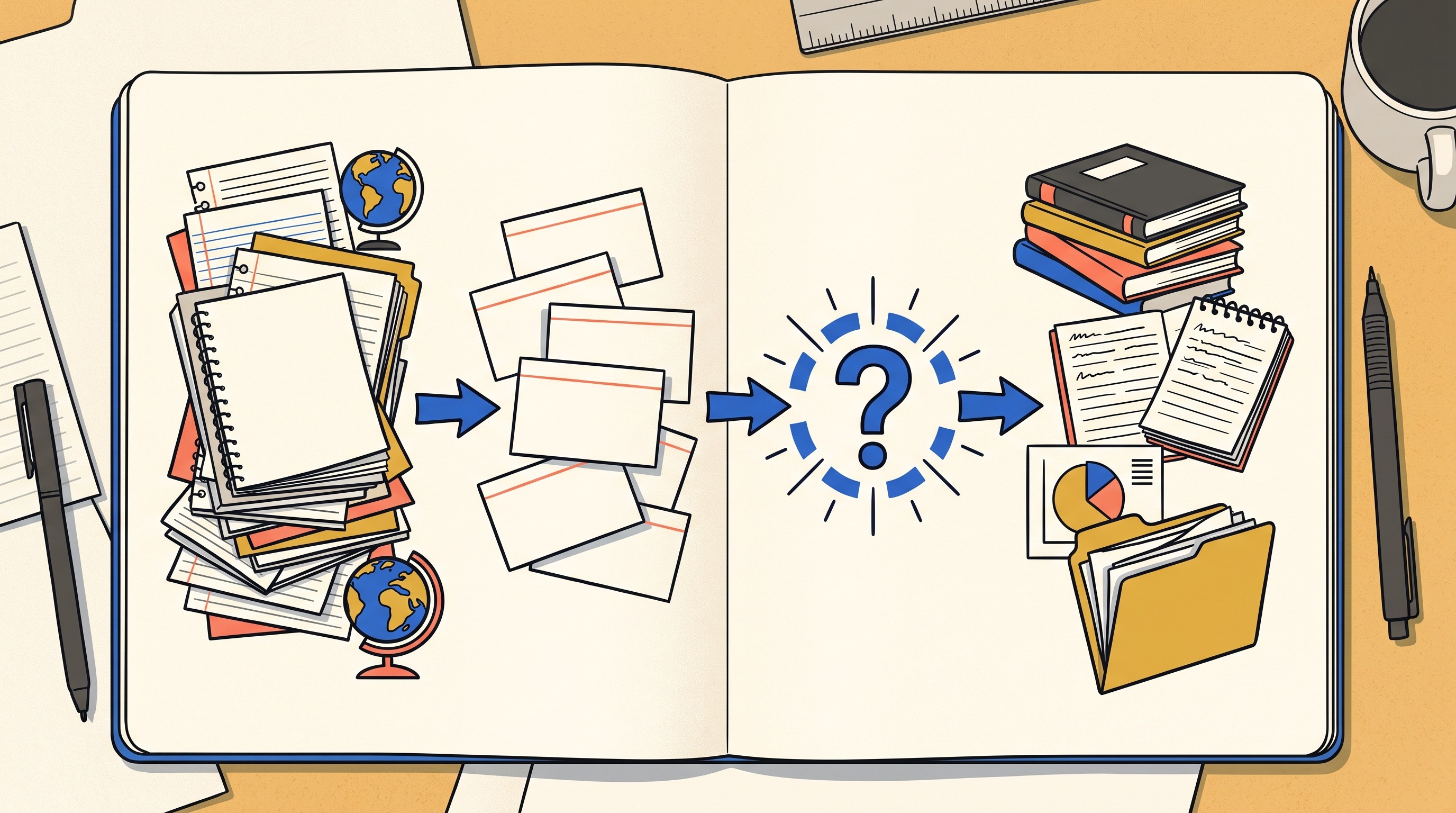
A question about relationships between measurable variables usually needs quantitative evidence. A question about lived experience, meaning, or process usually needs qualitative data. A question about policy change over time might need documents, archives, interviews, or a mixed-methods design.
Use this quick test before drafting the proposal:
Test | Ask this before writing |
|---|---|
Clarity | Can a reader tell exactly what is being studied? |
Answerability | Could evidence plausibly answer the question? |
Significance | Would the answer matter to a field, group, practice, or policy debate? |
Evidence access | Can the needed sources, participants, or data be obtained? |
Ethics | Can the study be done without unacceptable risk or privacy problems? |
Scope | Can the work fit the word limit, course timeline, degree stage, or funding period? |
Also keep the terms straight:
A topic is the general area.
A research problem is the specific issue, uncertainty, gap, or unresolved tension.
A research question is the question the study will answer.
An objective is a concrete task the study will complete.
A hypothesis is a predicted relationship or effect, usually tested in quantitative or experimental work.
A thesis claim is an argument made after evidence has been analyzed.
A proposal should not sound as if the findings are already known. If it promises conclusions before data collection, it reads like advocacy rather than research planning.
Build the introduction and rationale around a research problem
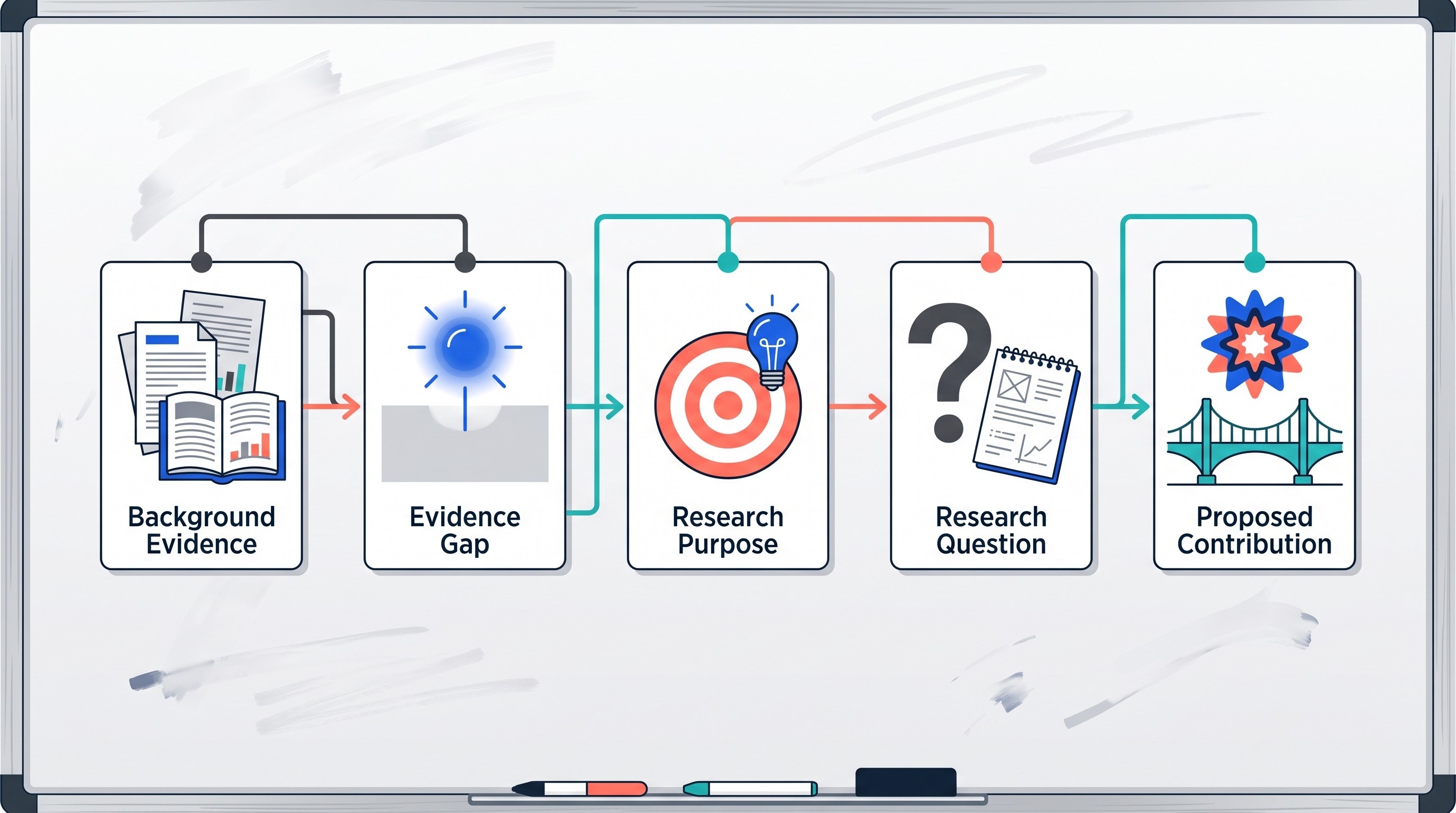
The introduction should not be a broad encyclopedia entry. It should move from context to problem to purpose.
A useful sequence looks like this:
Context: What is the relevant field, setting, population, debate, or practice area?
Problem: What is not known, not settled, not working, or not sufficiently explained?
Gap: What has existing research not answered, or what limitation in existing work creates room for the study?
Purpose: What will this proposed study investigate?
Contribution: What kind of understanding, evidence, clarification, or practical insight could it provide?
For example:
Weak rationale: “Artificial intelligence is becoming more common in education, and many students use it.”
Better rationale: “University writing instructors increasingly need policies for student use of generative AI, but existing guidance often treats AI use as either misconduct or productivity support. Less is known about how first-year students decide when AI assistance becomes inappropriate. This study will examine how students describe those boundaries in required writing courses.”
The second version identifies a problem. It also creates a path to a method: student accounts, decision-making, writing courses, and boundaries of use.
The rationale should separate three kinds of statements:
Established claims that need citations
Interpretive claims about patterns, gaps, or limitations in the literature
Your proposed contribution, which is not evidence yet
Do not bury the reader in background facts. If a fact does not help explain the problem, the gap, the question, or the design, cut it.
Define key terms early. If the proposal studies “academic success,” “digital literacy,” “burnout,” “access to care,” or “community participation,” say what those terms mean in this study. Also say what the proposal will not cover. Boundaries protect the project from scope creep.
For source gathering, use databases, library catalogues, citation trails, and official data sources rather than random web pages. Otio has a separate guide to finding reliable sources for research writing if the literature search itself is still messy.
Use the literature review to justify the proposed study
The literature review in a proposal is not a book report. Its job is to justify the study.
Organize it around the logic of your question:
Concepts the reader must understand
Debates or disagreements in the field
Findings that are relevant to your problem
Methods previous studies used
Limitations that motivate your design
Populations, settings, or cases that remain understudied
Avoid one-paragraph-per-source summaries. They make the proposal feel like an annotated bibliography.
A better pattern is synthesis:
“Several studies have measured X using survey instruments, but they define Y differently.”
“Qualitative studies agree that participants describe Z as important, but they focus mainly on graduate students rather than first-year students.”
“Prior work has examined outcomes after policy adoption; less attention has been paid to the implementation process.”
For each source, record four things while reading:
Source note | Why it matters |
|---|---|
Main claim | Prevents vague citation dumping |
Evidence used | Shows whether the claim is well supported |
Limitation | Helps identify the gap |
Relevance to your study | Keeps the literature tied to the proposal |
If you use AI to summarize papers, treat the summary as a reading aid, not evidence. Verify claims in the original article, book, dataset, statute, policy document, or report.
For a proposal workflow, Otio’s Zotero integration can help keep sources, notes, and citation context connected while you draft. The useful habit is not “summarize everything.” It is linking each citation to the exact claim it supports.
A literature review earns its place when it makes the proposed study feel necessary. By the end of the section, the reader should understand why this question, this population, this method, and this evidence plan belong together.
[[OTIO_INLINE_PROMO:%7B%22title%22%3A%22Ready%20to%20connect%20sources%20to%20your%20research%20gap%3F%22%2C%22description%22%3A%22Bring%20your%20papers%20and%20notes%20together%20in%20Otio%2C%20then%20compare%20each%20source%E2%80%99s%20claim%2C%20evidence%2C%20limitation%2C%20and%20relevance%20to%20your%20proposed%20study.%22%7D]]
Match the methods to the question and evidence plan
The methods section is where many proposals become vague. “This study will use interviews” is not enough. Neither is “data will be analyzed statistically.”
State the design first, then defend it.
Common design choices include:
Qualitative: interviews, focus groups, ethnography, observation, case studies, document analysis
Quantitative: surveys, experiments, quasi-experiments, correlational studies, secondary dataset analysis
Mixed-methods: a planned combination of qualitative and quantitative evidence
Archival or documentary: historical records, policy documents, institutional files, media archives
Theoretical or conceptual: argument-based research using concepts, frameworks, or texts rather than newly collected empirical data
The design should follow the question.
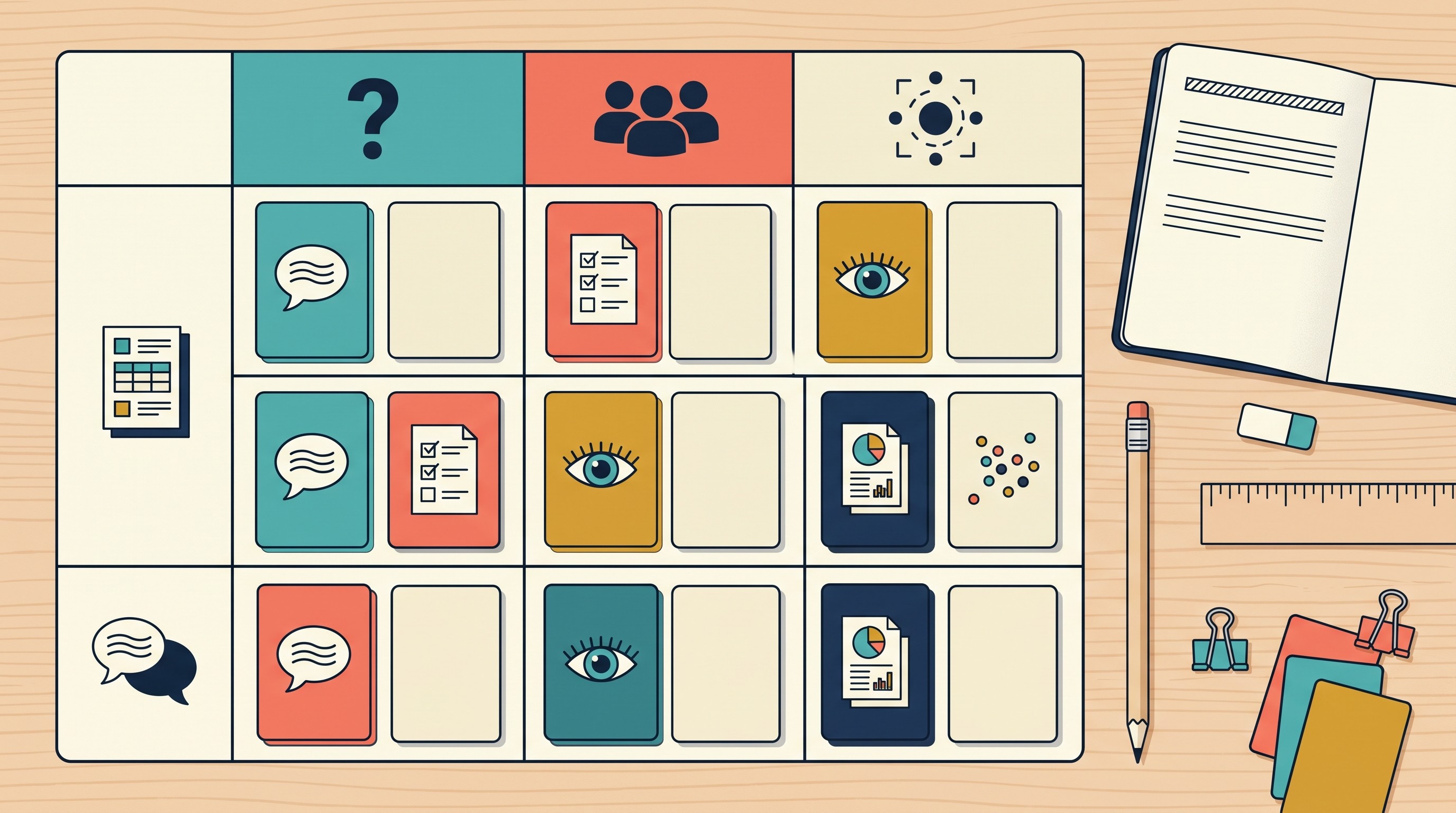
If the question asks... | Likely design | Evidence needed | Analysis approach |
|---|---|---|---|
How do people experience or interpret something? | Qualitative | Interviews, focus groups, diaries, observations | Coding, theme development, narrative or interpretive analysis |
Is there a relationship between variables? | Quantitative observational | Survey data, records, datasets | Descriptive statistics, correlation, regression, group comparisons |
Does an intervention produce an effect? | Experimental or quasi-experimental | Treatment and comparison data | Pre/post analysis, statistical testing, effect estimates |
How did a policy, concept, or institution change over time? | Historical, archival, documentary | Archives, policy documents, reports, media, correspondence | Chronological, thematic, or comparative document analysis |
How do two cases differ and why? | Comparative case study | Case records, interviews, documents, observations | Cross-case comparison and pattern matching |
What does existing scholarship imply about a concept? | Theoretical or conceptual | Books, articles, frameworks, primary texts | Conceptual analysis and argumentation |
Then specify the evidence plan:
Who or what will be studied?
How will participants, cases, documents, or datasets be selected?
What are the inclusion and exclusion criteria?
How many cases, participants, documents, records, or observations are realistic?
How will access be obtained?
What instruments, interview guides, measures, or protocols will be used?
What exactly will happen during data collection?
How will the evidence be analyzed?
Do not promise methods the study cannot support. A small interview study cannot establish population-level prevalence. A cross-sectional survey cannot prove a causal process by itself. A document analysis cannot make claims about private motivations unless the documents actually contain evidence for them.
The proposal should also name the quality criteria for the chosen method.
For quantitative work, that may include validity, reliability, measurement quality, sampling bias, missing data, and statistical assumptions.
For qualitative work, that may include credibility, transferability, reflexivity, positionality, triangulation, audit trails, and the relationship between researcher and participants.
For archival or document-based work, that may include source provenance, completeness, representativeness, interpretation limits, and gaps in the record.
If you need concrete combinations of variables, methods, and evidence, see these research design examples for thesis writers. For a broader explanation of why design controls what a study can validly claim, read how research design shapes methods, evidence, and validity.
A good methods section lets the reader imagine the study being carried out. A weak one asks the reader to trust that details will be figured out later.
Cover ethics, access, and feasibility before promising results
A proposal should not promise results. It should show that the study can be done responsibly.
Ethics belongs in the proposal because it changes the method. If the study involves people, sensitive information, private records, minors, patients, employees, marginalized groups, or risky disclosures, the design must account for that from the start.
Address the relevant issues directly:
Informed consent
Privacy and confidentiality
Anonymization or de-identification
Data security
Potential harm or distress
Vulnerable participants
Conflicts of interest
Incentives or compensation
Permission to access sites, organizations, archives, or datasets
Institutional review, supervisor approval, or ethics board requirements
If the proposal requires a data plan, say where data will be stored, who can access it, how identifying information will be handled, and when records will be deleted or retained.
Access is not an administrative detail. It is a methodological constraint.
A proposal that depends on interviews with senior executives, sealed court records, restricted clinical datasets, or an archive in another country may be interesting but infeasible. The reader needs to know that the evidence can actually be obtained.
Name the risks:
Recruitment may be lower than expected.
A gatekeeper may deny access.
An archive may have incomplete records.
A dataset may have missing variables.
An interview guide may need revision after piloting.
The scope may need narrowing after the first literature review.
Ethics review may take longer than the course schedule allows.
Then state the contingency plan. For example:
If recruitment is low, narrow the question to a smaller case study rather than pretending the sample is representative.
If interviews are not approved, use publicly available documents and reposition the study as document analysis.
If the dataset lacks a key variable, revise the objective instead of forcing an unsupported conclusion.
If the archive is incomplete, make the gaps part of the limitation section and avoid claims that require complete coverage.
If unpublished data, participant material, or original ideas are involved, be careful with AI tools. Do not paste confidential interviews, identifiable records, proprietary datasets, or unsubmitted research plans into systems unless the privacy and data-use terms are acceptable for your project. Otio has a separate guide on why researchers should protect unpublished research data and ideas from AI models.
Ethics and feasibility sections are not admissions of weakness. They show the reader that the proposal is grounded in real research conditions.
Turn the proposal into a realistic timeline
A timeline is not a decoration. It is a feasibility argument.
Bad timelines assign dates to headings. Good timelines show dependencies: one stage cannot start until a decision, approval, source set, dataset, or draft is ready.
The core sequence usually looks like this:
Refine the research question
Complete targeted literature review
Finalize research design
Prepare instruments, search strategy, coding frame, or data plan
Obtain supervisor, departmental, ethics, or site approval
Recruit participants or gather sources
Collect data
Clean, organize, or transcribe data
Analyze evidence
Draft findings or chapters
Revise after feedback
Check citations, formatting, appendices, and submission rules
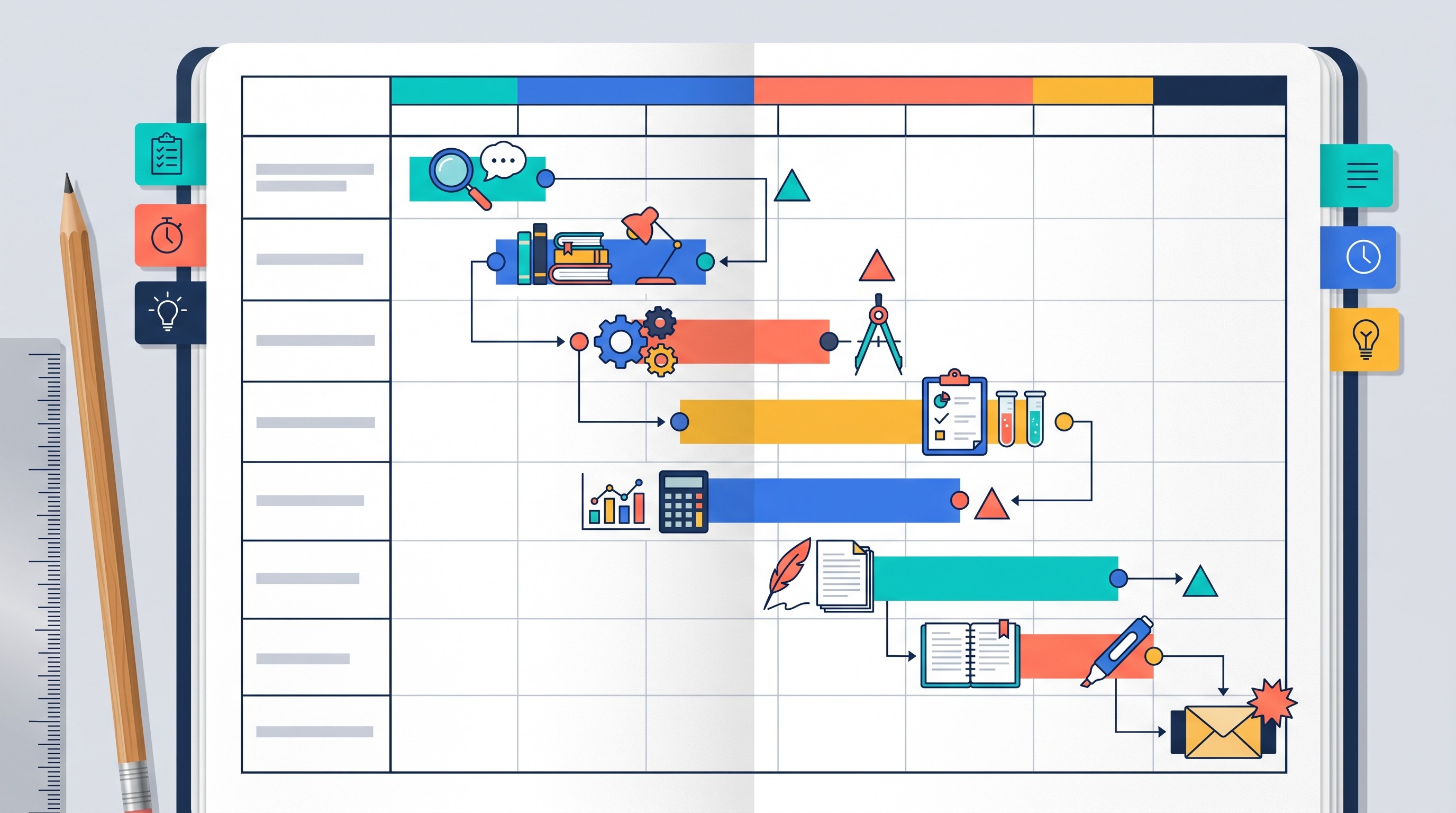
Use a simple table if a full Gantt chart is unnecessary:
Phase | Depends on | Deliverable | Risk to allow for |
|---|---|---|---|
Question refinement | Initial topic and supervisor feedback | Approved research question and objectives | Scope too broad |
Literature review | Search strategy and access to databases | Thematic source map and gap statement | Hard-to-find sources |
Design finalization | Question and literature gap | Method, sample, evidence plan | Method does not fit question |
Ethics or permissions | Draft instruments and data plan | Approval or permission confirmation | Review delays |
Recruitment/source gathering | Approval and access | Participant list, archive set, dataset, or document corpus | Low response or missing records |
Data collection | Recruitment or source access | Interviews, observations, survey responses, records, documents | Cancellations or incomplete data |
Analysis | Organized data | Coding, statistical output, case comparison, or analytic memo | Messy or insufficient evidence |
Drafting and revision | Preliminary analysis | Complete proposal-linked paper or thesis section | Feedback and citation errors |
Distinguish effort time from calendar time. Reading ten articles might take two focused days. Getting access to those articles, waiting for interlibrary loan, receiving supervisor comments, or securing ethics approval may take much longer.
Build in time for:
Ethics review
Recruitment delays
Source retrieval
Data cleaning
Transcription
Supervisor feedback
Citation checking
Formatting
Revision after critique
The literature review stage is often underestimated because it includes searching, screening, reading, note-making, synthesis, and citation management. If that part is hard to estimate, use this guide on how long a literature review takes as a planning reference, then adapt it to the scale of your proposal.
A proposal timeline should look slightly conservative. If it only works when every participant replies immediately, every source is available, and every draft is accepted on first pass, it is not a plan. It is wishful scheduling.
Revise the proposal as an argument, not just a completed template
Once every heading has text under it, the real revision starts.
Read the proposal as a chain:
Does the title match the actual study?
Does the introduction lead to one specific problem?
Does the rationale make the study worth doing?
Does the literature review justify the question and method?
Does the research question match the evidence plan?
Do the objectives describe observable work?
Does the method produce evidence that can answer the question?
Do the ethics and limitations fit the design?
Does the timeline match the workload?
Do citations support the claims they are attached to?
Then remove overclaiming. A proposal should not say the study “will prove,” “will demonstrate,” or “will solve” unless the design can actually support that level of claim.
Safer verbs include:
examine
investigate
compare
describe
analyze
explore
estimate
test
evaluate
interpret
Ask a supervisor or peer to identify the least clear decision in the proposal. Not the weakest sentence. The weakest decision.
That decision might be the sample, the case selection, the analysis method, the evidence source, the scope, the ethical risk, or the claimed contribution. Fixing that usually improves the whole proposal more than polishing the introduction.
Use this final compliance pass before submission:
Required headings are present
Word count or page limit is met
Citation style is correct
References match in-text citations
Appendices are included if required
Instruments, consent forms, or permissions are attached if required
Ethics language matches institutional expectations
Timeline is realistic
Budget is included if required
File format and submission instructions are followed
The next action is simple: write five lines before drafting paragraphs.
Problem: This study addresses...
Question: It asks...
Evidence: It will use...
Method: It will analyze that evidence by...
First milestone: The next step is...
If those five lines do not fit together, the proposal is not ready for full drafting. If they do, turn each line into the relevant section and keep the chain intact.
FAQ
Q: How long should a research proposal be?
A: There is no universal length. Follow the assignment, department, supervisor, or funder requirements, and prioritize a complete, feasible argument over a target word count.
Q: What is the difference between a research proposal and a research paper?
A: A proposal explains what you plan to investigate and how you will do it. A research paper reports and interprets work that has already been completed, including its findings.
Q: Should a research proposal include a hypothesis?
A: Include a hypothesis when the design tests a predicted relationship or effect. Exploratory, interpretive, and many qualitative studies may use research questions or objectives instead.
Q: Can AI help write a research proposal?
A: AI can help organize notes, compare drafts, or clarify wording, but the writer must verify sources, protect unpublished research information, and make the methodological and ethical decisions themselves.
[[OTIO_FOOTER_PROMO:%7B%22title%22%3A%22Apply%20this%20workflow%20to%20your%20own%20sources%22%2C%22description%22%3A%22Add%20your%20articles%2C%20reports%2C%20notes%2C%20and%20links%20to%20Otio%2C%20then%20use%20chat%20to%20check%20whether%20your%20evidence%20supports%20the%20question%2C%20method%2C%20and%20contribution.%22%7D]]