
Study Guides
16 Top Anatomy Textbooks Ranked for Medical Training
Discover the 16 best anatomy textbooks ranked for medical training, grouped by use case with specific book recommendations and pairing tips.

You've got anatomy lab, lecture slides, Anki cards, and a shelf exam calendar all pulling on the same week. The answer is simple: buy one main textbook, one atlas, and one fast-review resource; skip the fantasy that a single anatomy book will do every job.
For most medical students, the best core stack is Gray's Anatomy for Students + Netter's Atlas + either Moore's Clinically Oriented Anatomy or Essential Clinical Anatomy. Add Rohen or a photographic atlas only if your course is cadaver-heavy or you're heading into surgery, radiology, anesthesia, or emergency medicine.
Who this list is for
This ranking is for medical trainees who need anatomy to survive contact with real exams and real bodies. First-year students need enough structure to pass gross anatomy without drowning in 1,200-page reference books. Upper-year students need clinical correlation, imaging, and fast retrieval.
It also fits residents who keep forgetting a regional relationship at exactly the wrong moment. Brachial plexus. Inguinal canal. Pelvic floor. The usual suspects.
If you're still comparing general med-school resources, start with our broader guide to the best resources for medical students. If your problem is specifically how to read dense anatomy chapters without wasting three hours per session, the separate guide on how to efficiently read anatomy textbooks is the better companion.
Here’s the ranked list before the commentary.
Rank | Anatomy resource | Best use case | Buy if... |
|---|---|---|---|
1 | Gray's Anatomy for Students | Core first-year study | You want the clearest all-around textbook |
2 | Moore's Clinically Oriented Anatomy | Clinical correlation | Your course emphasizes applied anatomy |
3 | Netter's Atlas of Human Anatomy | Visual memorization | Pictures carry your recall |
4 | Essential Clinical Anatomy | Condensed review | Moore feels too big |
5 | Grant's Atlas of Anatomy | Lab dissection | Your course is cadaver-heavy |
6 | Rohen's Anatomy: A Photographic Atlas | Cadaver recognition | You struggle translating drawings to lab |
7 | Snell's Clinical Anatomy by Regions | Regional anatomy | Your curriculum moves by body region |
8 | Netter's Clinical Anatomy | Rotations and procedures | You want surface anatomy with clinical framing |
9 | Gray's Anatomy for Students Clinical Cases | Case-based study | You learn by vignettes |
10 | Thieme Atlas of Anatomy | Clean tables and compact visuals | You like precise plates and summaries |
11 | Netter's Anatomy Flash Cards | Portable review | You need five-minute drill sessions |
12 | Clinical Anatomy Made Ridiculously Simple | Mnemonics | You need a rescue book before exams |
13 | Netter's Concise Radiologic Anatomy | Imaging correlation | You want anatomy matched to scans |
14 | BRS Gross Anatomy | Board-style review | You need questions more than prose |
15 | Lippincott Illustrated Reviews: Anatomy | Integrated review | You want short explanations plus clinical questions |
16 | Acland's Video Atlas of Human Anatomy | Dynamic dissection review | Your school provides access and you learn from motion |
How we picked these 16 textbooks
We weighted books that keep recurring in three places: medical school library guides, student recommendation threads, and actual anatomy study workflows. That last category matters. A book can be famous and still sit unopened after week three.
Medical school libraries still treat anatomy as a mixed-media subject. Duke's medical library guide, for example, points students toward Acland's narrated cadaver videos, describing nearly 330 real-life 3D anatomy videos for gross anatomy and self-directed learning via Duke University Medical Center Library's anatomy resources. That lines up with what students discover the hard way: plates help, but motion helps when a nerve disappears behind a muscle belly.

We also checked the titles against uploaded anatomy PDFs and notes in Otio-style study libraries. The pattern is boring in the best way. Students keep one big explanatory text, one atlas, and a short review aid. When the library gets messier than that, study time starts leaking.
A medical student research workspace like Otio helps only if the underlying stack is sane. Uploading six overlapping atlases doesn't make you organized. It gives you six places to misremember the same branch of the facial nerve.
We treated required-reading lists as signal, not gospel. Drexel's medical library frames first-year resources as material that guides students from foundational science into clinical training, with emphasis on anatomy useful for physical diagnosis, imaging, emergency medicine, and surgery in its Year 1 medical student reading guide. That’s the filter we used here: does the book help you connect structure to clinical work, or does it mostly make your backpack heavier?
The ranking also avoids one common trap: pretending atlases and textbooks compete directly. They don't. Netter wins at labeled visual recall. Moore wins at “why does this matter in a patient?” Gray’s sits between them. Rohen fixes the lab translation problem drawings can’t solve.
How to choose the right anatomy textbook
Pick based on the job you need done this semester. Not your identity as a “visual learner,” not the book your roommate bought, and definitely not the thickest volume on the shelf.
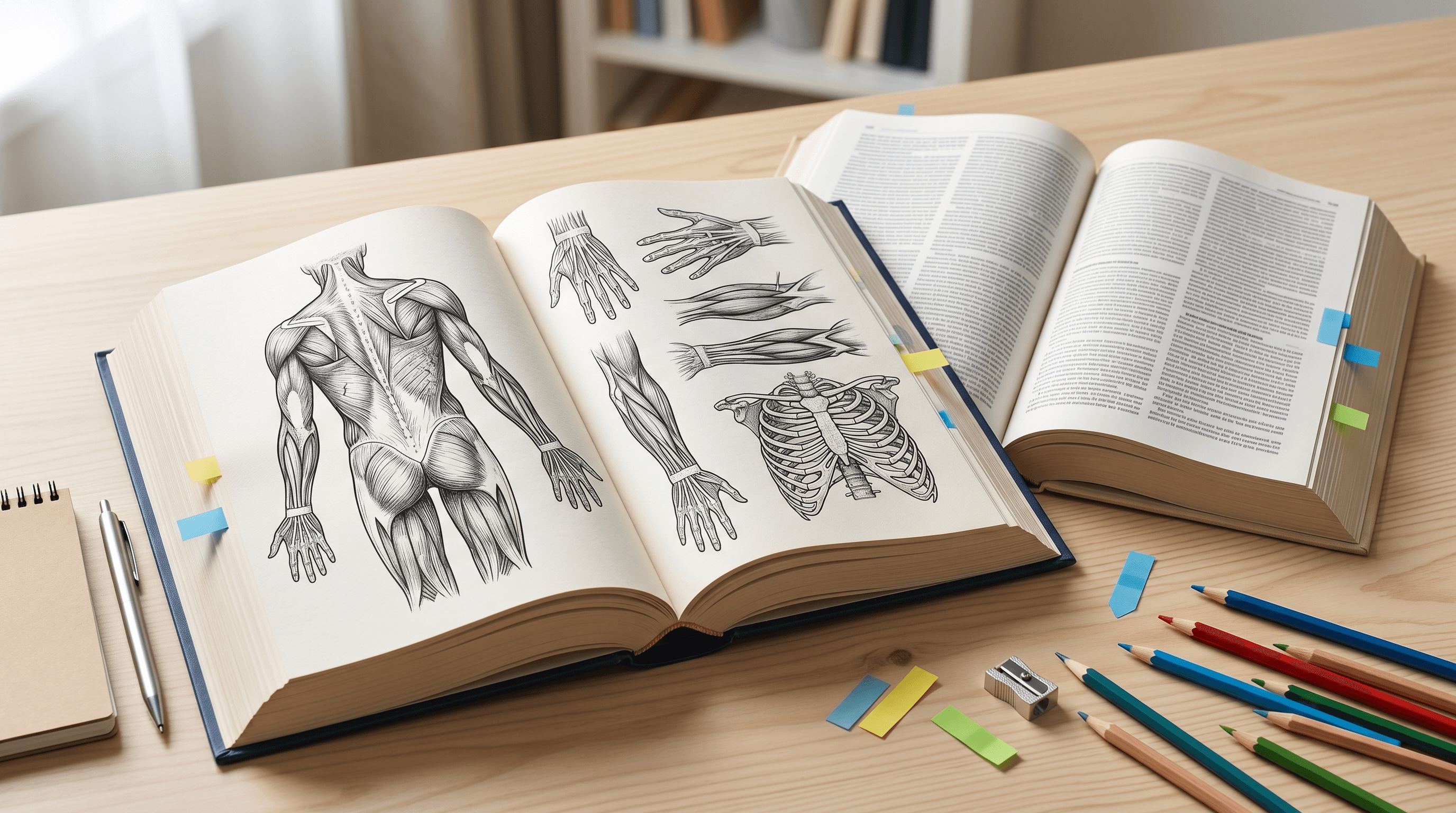
Use this as the decision grid.
If your main problem is... | Start with... | Add... |
|---|---|---|
Understanding lecture content | Gray's Anatomy for Students | Netter for plate review |
Remembering clinical relevance | Moore's Clinically Oriented Anatomy | BRS Gross Anatomy questions |
Identifying structures in lab | Rohen or Grant's Atlas | Acland videos if your school has access |
Fast pre-exam review | Essential Clinical Anatomy | Netter Flash Cards |
Imaging and procedures | Netter's Clinical Anatomy | Netter's Concise Radiologic Anatomy |
The atlas/textbook pairing is the main move. An atlas gives you the map; the textbook explains why that map behaves the way it does during an exam, an injury, or a procedure. When students try to use Netter alone, they often memorize labels without relationships. When they use Moore alone, they can explain a lesion but fumble the image.
Edition year matters, but not equally for every book. Anatomy drawings age slowly. Clinical boxes, terminology, imaging correlations, and board-style questions age faster. Elsevier describes Gray's Anatomy for Students as the go-to medical student text in the current Gray's student line through its top anatomy books guide, and that’s the kind of publisher context worth checking before buying a used copy.
Don't ignore your curriculum. If your school tests from lecturer slides, the textbook becomes a clarification tool. If your school uses practicals with pinned cadavers, Rohen and Grant's move up the list. If Step-style questions dominate assessment, Moore plus BRS becomes more attractive than a beautiful atlas you rarely query under pressure.
A small warning from real study rooms: students overbuy anatomy books because anatomy feels infinite. It isn't infinite on your exam. It’s bounded by your lab list, your lecture objectives, and the clinical patterns your faculty keep repeating.
Best for foundational study
The foundational books should build a mental scaffold. You want regions, relationships, innervation, blood supply, lymphatics, and clinical consequences to sit in one connected frame. Slow at first. Faster by week six.
1. Gray's Anatomy for Students
Best overall anatomy textbook for first-year medical students.
Gray’s wins because it explains without turning into an encyclopedia. The prose is cleaner than most anatomy texts, the clinical boxes are useful, and the illustrations are strong enough that you don't always need to flip to an atlas mid-paragraph.
It works especially well in systems-based curricula. Read the section before lecture, annotate only the relationships your professor emphasizes, and then use Netter to drill visual recall. That three-pass rhythm beats passive rereading.
Gray's isn't perfect. Students who want dense clinical pearls may prefer Moore. Lab-heavy courses may expose its biggest weakness: idealized drawings can feel too tidy once you're staring at fascia.
2. Moore's Clinically Oriented Anatomy
Best for clinical correlations and board-style thinking.
Moore is the book students recommend when the question is, “Why does this nerve lesion produce this sign?” The blue clinical boxes do real work. They connect anatomy to injuries, procedures, imaging, congenital problems, and physical exam findings.
It’s also more demanding than Gray’s. Moore can feel wordy if you’re behind. If your exam is in four days, Essential Clinical Anatomy gives you the Moore DNA without the full load.
Pair Moore with a question resource. Otherwise you may nod along to clinical explanations and discover, too late, that recognition under exam conditions is a separate skill. For board prep strategy beyond anatomy, our guide to shelf exams in medical school covers how to turn resources into a weekly plan.
3. Netter's Atlas of Human Anatomy
Best visual atlas for memorization.
Netter is the anatomy book almost everyone knows for a reason. The plates are clear, the labeling is sane, and the style makes complicated regions feel learnable. It’s the fastest way to build a visual index of the body.
Use it actively. Cover labels. Redraw rough relationships. Ask what passes through each opening, which structures share a sheath, and what would fail if one vessel or nerve were injured. Pretty plates can lull you into recognition without recall.
Netter's main limitation is also its strength: it simplifies. The cadaver won't look that clean. Add Rohen or Grant's if your practical exams punish students who only know polished illustrations.
4. Essential Clinical Anatomy
Best concise foundation text.
Essential Clinical Anatomy is the leaner Moore. It keeps the clinical orientation and trims the sprawl. For students who want the concepts without a doorstop, this is often the better semester companion.
It’s also useful after you've already taken anatomy once. If you're prepping Step 1 or coming back to anatomy during surgery, the shorter format makes review less painful.
The tradeoff is depth. When a topic doesn't click, you may still need Moore, Gray's, or a professor's explanation.
5. Grant's Atlas of Anatomy
Best atlas for dissection-based courses.
Grant's feels more lab-facing than Netter. The plates are detailed, the organization supports regional dissection, and the accompanying dissection resources have a long foothold in anatomy departments.
If your course includes cadaver lab practicals, Grant's deserves a look. It helps bridge the gap between “I know the drawing” and “I can find the structure when tissue planes are messy.”
For most students, Grant's and Netter together are overkill. Choose Grant's if lab identification is your weak point. Choose Netter if your problem is quick visual memory.
Best for clinical rotations
Anatomy changes shape in the clinical years. You stop needing every branch for its own sake and start asking where to place a needle, how to read a scan, what could be injured during a procedure, and why a symptom pattern lands in one dermatome instead of another.

6. Rohen's Anatomy: A Photographic Atlas
Best for cadaver realism and OR prep.
Rohen uses photographs of real dissections, which makes it less pretty and more useful for certain jobs. It’s excellent when drawings have trained your eye too cleanly. The body in lab has variation, texture, shadow, and connective tissue that refuses to behave.
This book earns its keep before anatomy practicals and surgical rotations. If you're about to scrub into cases involving the neck, axilla, abdomen, or pelvis, Rohen can make the operative field feel less alien.
Use it after Netter, not before. Starting with photos can overwhelm a beginner. Drawings give you the grammar; photographs make you fluent.
7. Snell's Clinical Anatomy by Regions
Best regional anatomy text for rotation-style learning.
Snell is organized in the way clinicians often think: region first, then relationships. That makes it a good fit for students rotating through surgery, emergency medicine, orthopedics, anesthesia, and radiology.
The writing is direct. Clinical notes appear close to the anatomy they explain, which reduces the flip-flopping that kills study momentum. If your curriculum goes thorax, abdomen, pelvis, limb, head and neck, Snell tracks well.
Some students find Moore stronger for richer clinical correlations. Fair. Snell wins when regional structure matters more than exhaustive explanation.
8. Netter's Clinical Anatomy
Best clinical companion to a visual atlas.
Netter's Clinical Anatomy takes the visual logic of Netter and aims it at clinical use. Surface anatomy, procedures, imaging, and common clinical patterns get more attention than they do in the standard atlas.
This is the book to keep around when you need a compact explanation before rounds or a procedure. It won't replace Gray’s or Moore for a full course. It isn't trying to.
For students choosing between the standard Netter atlas and this, pick the atlas first. Add Clinical Anatomy later if you keep wanting applied context beside the images.
9. Gray's Anatomy for Students Clinical Cases
Best for learning anatomy through vignettes.
Clinical cases force retrieval. That’s why this book works. You see a symptom pattern, decide what anatomy is involved, and then check whether your reasoning survives contact with the answer.
It pairs well with Gray’s Anatomy for Students because the language and emphasis are familiar. Use it after reading, not during first exposure.
Case books also reveal false confidence. If you can recite the brachial plexus but miss the lesion level in a vignette, you don't know it in the way exams care about.
10. Netter's Concise Radiologic Anatomy
Best for matching anatomy to imaging.
This is a narrower book, but a useful one. Quinnipiac's anatomy resources describe Netter's Concise Radiologic Anatomy as a companion to Netter's Atlas that matches radiologic images to anatomic images in a visual guide via Quinnipiac University Libraries' anatomy guide.
Students aiming for radiology, surgery, emergency medicine, neurology, anesthesia, or orthopedics should care about this earlier than they think. Cross-sectional anatomy is where many strong textbook students suddenly slow down.
Don't buy it as your first anatomy resource. Buy it when imaging starts appearing in exams or clinical teaching.
11. Acland's Video Atlas of Human Anatomy
Best non-book companion for 3D anatomy.
Acland's isn't a textbook, but it belongs in a medical training list because it solves a textbook failure: static pages don't show spatial movement well. For muscles, joints, compartments, and layered dissections, video can save a miserable afternoon.
Many students get access through their institutions. Harvard Library's anatomy guide points medical and dental students toward digital anatomical resources through its anatomy atlases and textbooks guide, and Acland-style tools often sit in that bucket.
Use it surgically. Watch the segment that matches tomorrow’s lab. Then close it and test yourself with an atlas. Passive anatomy video bingeing is still passive.
Best as quick reference
Quick-reference anatomy books are for retrieval, not first learning. They compress, cue, and quiz. They also expose whether the “I read the chapter” feeling has turned into usable memory.
12. Thieme Atlas of Anatomy
Best compact visual set with clean tables.
Thieme is polished, organized, and unusually good at making complex regions feel navigable. The tables help when you need origins, insertions, innervation, and blood supply without combing through paragraphs.
It’s more compact than many all-in-one texts, especially if you use the regional volumes selectively. Some students prefer its visual style to Netter's. Others find Netter more memorable. That choice is personal.
If you already own Netter and Gray's, Thieme may be redundant. If you're starting fresh and love table-driven review, it can replace Netter as your atlas.
13. Netter's Anatomy Flash Cards
Best portable drill tool.
Flash cards work when you use them for recall rather than recognition. Netter's cards are good because the images are familiar, the prompts are focused, and the deck can travel between commute, lunch, lab hallway, and the twenty minutes before a quiz.
The danger is false productivity. Flipping cards while exhausted can feel like studying and produce very little. Mark misses. Retire cards you know. Keep the deck lean.
Students who already use Anki may not need the physical cards. Still, some people remember plates better on paper. Weirdly old-school. Effective.
14. Clinical Anatomy Made Ridiculously Simple
Best rescue book for mnemonics and last-mile recall.
This book is for when the formal explanation hasn't stuck. It uses cartoons, memory hooks, and simplified clinical framing to make anatomy less stiff.
Use it as a supplement. If it becomes your main textbook, you'll get clever mnemonics without enough anatomical depth. That can backfire on lab practicals and harder clinical questions.
It shines in the last week before an exam, especially for students who need a different route into stubborn material.
15. BRS Gross Anatomy
Best question-driven anatomy review.
BRS Gross Anatomy is a review book, and that’s the correct way to use it. Read a section after you’ve learned the topic elsewhere, then do the questions cold.
Its value is diagnostic. You find out whether you can apply anatomy under pressure. Missed questions tell you what to reread in Gray's, Moore, or Netter.
For Step 1 and shelf prep, question-based review should enter earlier than students expect. If anatomy is one piece of a broader exam plan, pair this with our medical school note-taking strategies so your missed questions turn into reviewable notes.
16. Lippincott Illustrated Reviews: Anatomy
Best integrated short review.
Lippincott's review format suits students who want summaries, illustrations, and application without the density of a full text. It’s especially useful when anatomy is competing with physiology, pathology, and pharmacology in the same week.
It won't replace a real atlas. It also won't teach cadaver anatomy from scratch.
But as a bridge between foundational reading and board-style recall, it’s a solid late-stage resource. If you're building a whole basic-science shelf, compare it with our guides to biochemistry textbooks for med students, pharmacology textbooks and study resources, and microbiology textbooks for medical students.
How to use this list with Otio
The cleanest workflow is boring: create one anatomy Space, upload your chosen PDFs, and keep every lecture note, lab list, and clinical correlation in that same project. Don't scatter anatomy across downloads, browser tabs, screenshots, and a half-dead Notes app folder.
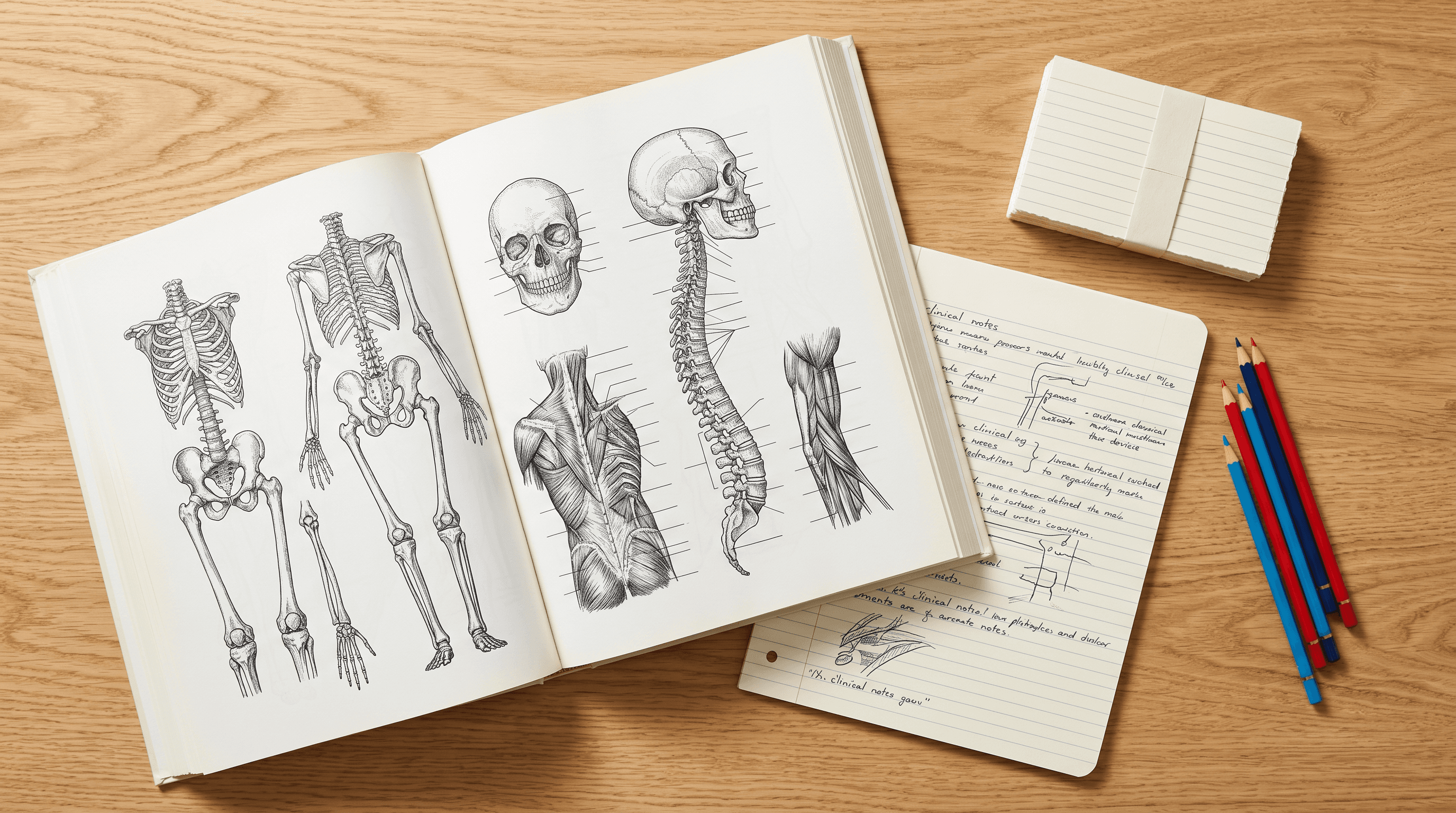
Use Otio's multi-window split view when two books answer the same question differently. Put Moore on one side and Netter on the other. Ask for the clinical significance of the pudendal nerve, then check the visual route in the atlas before saving the answer to your notes.
The better prompts don't ask for a generic summary. Ask for a table with structure, location, function, blood supply, innervation, common injury, and one exam-style clue. Require citations back to the uploaded pages. If the answer can't cite the book, don't trust it.
The text-selection toolbar is useful during chapter reading. Highlight a confusing paragraph on the femoral triangle, ask for a one-minute explanation, then save only the clarified version. No giant AI notes dump. Those rot fast.
For board review, create a note called “Anatomy misses.” Every missed question gets one row: topic, why you missed it, corrected rule, source page, retest date. This works better than rewriting the textbook in prettier language.
The edge case: AI can flatten anatomical uncertainty. Variant anatomy, disputed emphasis between books, and vague clinical wording need human judgment. If Moore and Gray's disagree in phrasing, treat that as a reason to check your course objectives, not as a fight for the model to referee.
Try Otio for your next anatomy block if your current setup is three PDFs, five browser tabs, and no memory of where you saw the clinical box.
FAQ
Q: What is the best anatomy textbook for first-year medical students?
A: Gray's Anatomy for Students is the best starting point for most first-year medical students because it balances clear explanation, useful illustrations, and clinical context.
Q: Should I buy Netter's Atlas or Moore's Clinically Oriented Anatomy?
A: Buy both if your budget allows: Netter is for visual recall, while Moore explains the clinical significance behind the anatomy.
Q: Which anatomy book is best for USMLE Step 1?
A: Pair Moore's Clinically Oriented Anatomy or Gray's Anatomy for Students with BRS Gross Anatomy and a visual atlas like Netter.
Q: Are older editions of anatomy textbooks still useful?
A: Older editions are usually fine for core illustrations and basic relationships, but newer editions are safer for updated terminology, imaging, and clinical correlations.
Q: Is Rohen better than Netter?
A: Rohen is better for cadaver recognition; Netter is better for clean visual memorization. Most students should start with Netter and add Rohen if lab practicals are hard.
Q: Do I need a separate anatomy atlas if my textbook has pictures?
A: Yes, for most courses. Textbook images explain concepts, but a dedicated atlas is faster for repeated visual drilling.