
Research Methodology
what is a scoping review? A Practical Guide to Scope, Search, and Synthesis
A scoping review maps the available evidence on a broad or emerging topic rather than answering one narrow effectiveness question. Learn when to use one and how to plan the scope, search, screening, charting, and synthesis.

A scoping review is a structured way to map what research exists on a broad, complex, or emerging topic. It is the right method when the first problem is not “does this intervention work?” but “what has been studied, how, with whom, and where are the gaps?”
The output is usually an evidence map, chart, table, or thematic synthesis. It should not pretend to be a pooled estimate of effectiveness unless the review design actually supports that claim.
The practical test is simple: if the topic is too broad, diverse, or conceptually messy for a conventional systematic review, a scoping review can define the terrain before a narrower review, trial, or policy decision follows.
What is a scoping review?
A scoping review is a form of evidence synthesis used to identify, organize, and describe the range of available evidence on a topic. It maps the field rather than answering one tightly framed cause-and-effect question.
Good scoping reviews usually ask questions like:
What concepts, definitions, or terms are used in this area?
What populations, settings, or contexts have been studied?
What research designs and evidence types exist?
What outcomes or measures appear in the literature?
Where are the gaps, inconsistencies, or under-studied areas?
The method is structured. A scoping review should have a clear objective, preplanned eligibility criteria, a reproducible search strategy, transparent screening, documented data charting, and a synthesis that matches the review question.
That is what separates it from “I searched some papers and summarized what I found.”
Established guidance matters here. The Joanna Briggs Institute, often shortened to JBI, provides widely used guidance for scoping-review methodology. PRISMA-ScR, the PRISMA extension for scoping reviews, is commonly used as the reporting framework. The point of both is the same: make the review traceable enough that another researcher can understand what was searched, what was included, what was excluded, and how the conclusions were drawn.
A scoping review is not the same as a systematic review, narrative review, or literature search:
A systematic review usually answers a focused question, often about effectiveness, diagnosis, prognosis, or association.
A narrative review may synthesize a topic interpretively but often does not use a fully reproducible search and screening process.
A literature search is the act of finding sources. It is one part of a review, not the review itself.
A scoping review maps what exists across a broad evidence base using explicit methods.
The output should look like a map: categories, distributions, methods, populations, concepts, gaps, and patterns. It should not read like a verdict unless the design includes the appraisal and synthesis needed to support one.
When should you use a scoping review?
Use a scoping review when the field itself needs definition.
That happens often in areas where research is growing faster than terminology can stabilize: digital health, AI in education, implementation science, climate adaptation, legal technology, nursing practice innovation, public-health interventions, and interdisciplinary topics.
A scoping review is useful when the goal is to:
Map concepts and terminology. For example, one field may use “remote monitoring,” another “telemonitoring,” and another “digital surveillance” for overlapping practices.
Identify evidence types. The literature may include randomized trials, qualitative studies, protocols, case reports, policy documents, guidelines, and technical reports.
Examine how a topic has been studied. You may need to know which methods dominate and which are missing.
Locate research gaps. A gap can be a missing population, setting, outcome, geography, method, or theory.
Test whether a systematic review is feasible. If enough comparable intervention studies exist, a later systematic review may be possible.
Clarify boundaries before a dissertation, grant, or research proposal. A scoping review can prevent a project from being built on a false assumption about the field.
It is a poor fit when the real question is narrow and evaluative.
If the question is “Does intervention A improve outcome B compared with usual care in population C?”, a systematic review is usually the better design. If the project needs a pooled effect estimate, certainty assessment, or formal risk-of-bias comparison, a scoping review alone is not enough.
There is also a tradeoff that gets missed: broad scope improves coverage but increases screening burden and heterogeneity. A review that includes every population, every country, every publication type, and every adjacent concept may produce a shallow catalog rather than a useful map.
The better move is to define the review through population, concept, and context:
Population: Who or what is being studied?
Concept: What idea, intervention, phenomenon, exposure, or practice is being mapped?
Context: In what setting, sector, geography, discipline, or time period?
This framework keeps the review broad without forcing every project into a strict intervention-versus-control format.
For example, “AI in education” is too broad for consistent screening. “AI-supported formative assessment in higher education” is still broad enough for a scoping review, but bounded enough to search and chart.
If the task is a narrower synthesis for a class paper or thesis chapter, this guide on how to write a literature review is a better fit. A literature review can overlap with scoping-review practices, but it is not a substitute for a formal scoping-review protocol.
How is a scoping review different from a systematic review?
A scoping review prioritizes breadth and mapping. A systematic review usually prioritizes focused answering.
The methods can look similar: both may use protocols, database searches, screening, extraction, and transparent reporting. The difference is the job they are hired to do.

Feature | Scoping review | Systematic review |
|---|---|---|
Main purpose | Map the range, type, and characteristics of evidence | Answer a focused research question |
Question breadth | Broad or exploratory | Narrow and specific |
Common framework | Population, concept, context | Often population, intervention, comparator, outcome |
Evidence types | Often mixed: qualitative, quantitative, grey literature, protocols, guidelines | Usually defined by the question; may focus on comparable study designs |
Search strategy | Comprehensive and often iterative | Comprehensive and predefined |
Critical appraisal | Optional, but must be justified | Usually expected, especially for effectiveness questions |
Synthesis | Descriptive, categorical, thematic, evidence mapping | Narrative synthesis, meta-analysis, certainty assessment, or structured comparison |
Typical output | Evidence map, chart, taxonomy, gap analysis | Answer about effect, association, diagnostic accuracy, or other focused outcome |
Example of a scoping-review question:
What types of digital-health interventions have been studied to support medication adherence among adults with chronic disease, and in what settings?
Example of a systematic-review question:
Do SMS reminder interventions improve medication adherence among adults with hypertension compared with usual care?
Those are different questions. The first maps the landscape. The second tests a more focused claim.
Critical appraisal is the main point of confusion. Many scoping-review approaches do not require formal quality appraisal, because the purpose is to map evidence rather than judge whether a specific intervention works. But the decision should be explicit.
If a scoping review does not appraise study quality, it should not conclude that an intervention is effective simply because several studies mention positive findings. It can say evidence exists, describe how it is distributed, and identify where stronger evaluation is needed.
The same distinction separates a scoping review from an informal literature review. A scoping review should have:
A protocol or planned method
A reproducible search
Transparent title, abstract, and full-text screening
Documented inclusion and exclusion decisions
A charting form
A synthesis tied to the objective
Without those, the work may still be useful, but it is not really a scoping review.
How to plan the scope and review question
Start with the objective, not the databases.
A scoping review objective should state what the review will map. That may be concepts, populations, settings, methods, interventions, outcomes, definitions, evidence gaps, or all of those.
Weak objective:
To review technology in education.
Better objective:
To map how AI-supported formative assessment has been studied in higher education, including learner populations, assessment practices, AI functions, study designs, outcomes, and reported gaps.
That version tells you what belongs in the review and what does not.
Use population, concept, and context to define eligibility:
Element | Example |
|---|---|
Population | Undergraduate and postgraduate students |
Concept | AI-supported formative assessment |
Context | Higher education settings |
Evidence types | Empirical studies, design studies, evaluation reports, relevant protocols |
Possible exclusions | K-12 education, purely summative grading tools, opinion pieces without described implementation |
Keep the research question and inclusion criteria related but separate.
The research question can stay broad:
What evidence exists on AI-supported formative assessment in higher education?
The inclusion criteria should be more operational:
Include studies involving higher-education learners or instructors.
Include tools or systems using AI to support feedback, quizzes, adaptive practice, assessment generation, or learner-performance interpretation.
Include empirical studies and documented implementations.
Exclude studies focused only on administrative analytics, admissions, plagiarism detection, or summative grading without formative feedback.
That separation matters. The question gives direction. The criteria make screening consistent.
Be careful with limits. Date, language, geography, publication type, and database restrictions should be defensible. A date limit may make sense if the technology or policy environment changed sharply. A language limit may be unavoidable for team capacity, but it should be reported as a limitation rather than hidden.
Write a protocol before searching. It does not need to be elaborate for every student project, but it should record:
Review objective
Research question
Population, concept, context
Inclusion and exclusion criteria
Databases and supplementary sources
Screening process
Data-charting fields
Planned synthesis
Whether critical appraisal will be performed
Once searching starts, do not silently change the question to match what you found. Scoping reviews can be iterative, but iteration should be documented. If early searches reveal that “AI-supported formative assessment” is indexed under “automated feedback,” “learning analytics,” or “intelligent tutoring systems,” add those terms transparently and record the change.
How to search and screen evidence systematically
A scoping-review search should be broad enough to capture the topic’s vocabulary and structured enough to be reproducible.
A practical sequence looks like this:
Identify seed concepts. Start with the population, concept, and context.
List keywords and synonyms. Include spelling variants, older terminology, and discipline-specific terms.
Find subject headings. In health databases this may mean controlled vocabulary such as MeSH or CINAHL headings; in other fields, use the database’s indexing terms where available.
Search multiple relevant databases. Choose based on the field, not convenience.
Search supplementary sources. Reference lists, citation chasing, organizational repositories, thesis databases, trial registries, and targeted websites may matter depending on the question.
Export and deduplicate records.
Screen titles and abstracts.
Screen full texts.
Record reasons for full-text exclusion.
Report the flow from identified records to included sources.
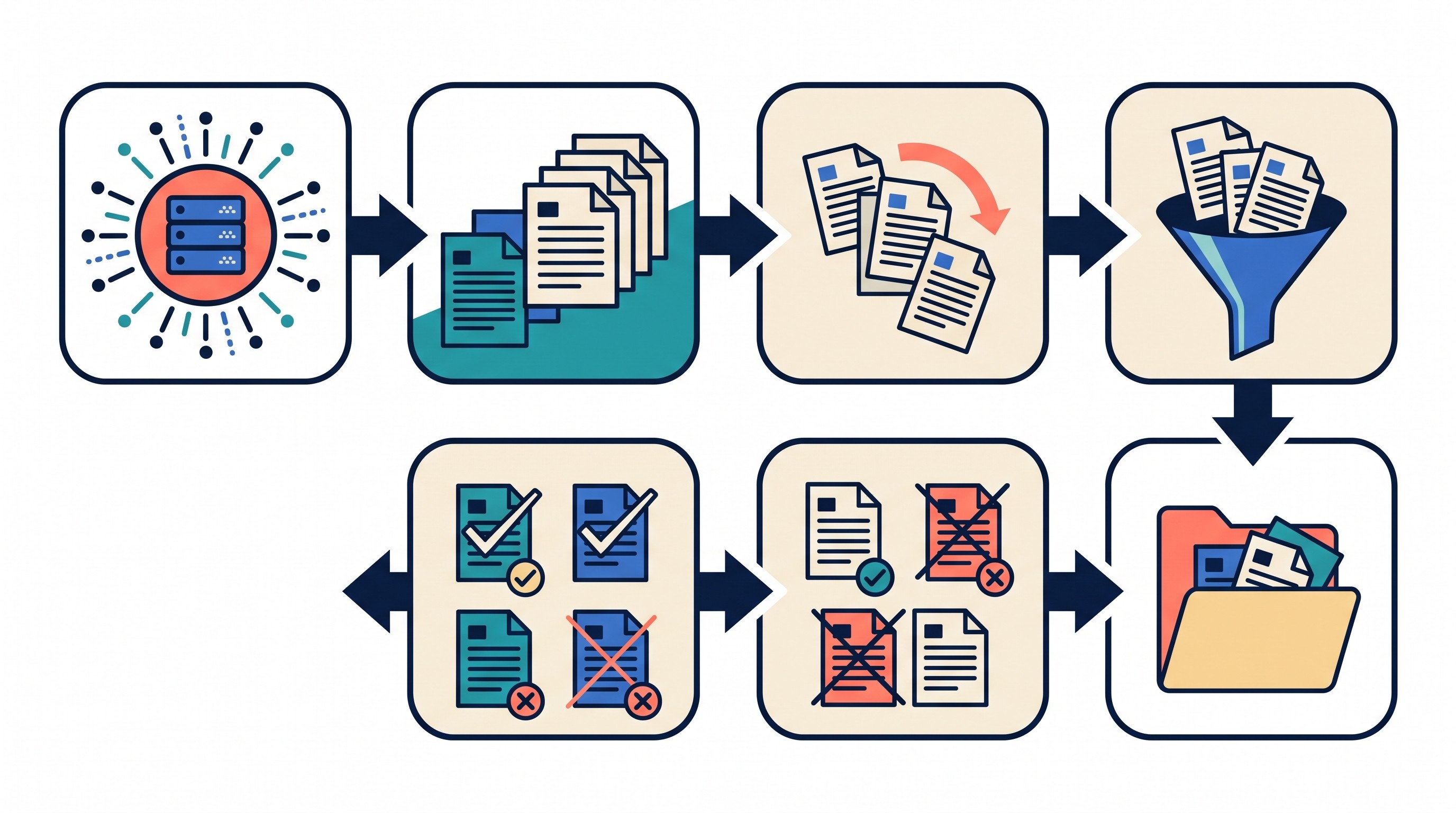
Scoping reviews often need an iterative search. That does not mean making it up as you go. It means early results can reveal missing language.
For example, a review on “AI-supported formative assessment” may discover that many relevant papers never use that exact phrase. They may use “automated feedback,” “intelligent tutoring,” “adaptive learning,” “learning analytics dashboards,” or “generative feedback.” A good scoping review updates the strategy and reports the update.
Screening should also be planned.
For a serious review, at least a sample of records should be screened by more than one reviewer to calibrate eligibility decisions. Teams often pilot the criteria on a subset of records, compare disagreements, revise unclear rules, and then continue. If only one reviewer screens, report that as a limitation.
At title-and-abstract screening, the question is usually: could this source meet inclusion criteria? Do not exclude aggressively unless it is clearly out of scope.
At full-text screening, apply the criteria more strictly and record the reason for exclusion. Common reasons include wrong population, wrong concept, wrong context, wrong evidence type, no full text, or not enough information to chart.
Use a PRISMA-style flow diagram to report:
Records identified from databases
Records identified from other sources
Duplicates removed
Records screened
Records excluded at title and abstract
Full-text sources assessed
Full-text sources excluded, with reasons
Sources included in the review
Do not invent these numbers in advance. The flow diagram is a record of what happened, not a decorative figure.
For source discovery, databases should be the core. Credible websites can supplement, especially for policy, grey literature, or organizational guidance, but they do not replace database searching. For a broader list of places to find academic and credible sources, see Otio’s guide to good websites for research papers and academic articles.
Reference managers and research tools help with deduplication and organization, but they do not decide eligibility for you. A tool can flag duplicates, store PDFs, and preserve notes. The researcher still decides whether a source meets the protocol.
[[OTIO_INLINE_PROMO:%7B%22title%22%3A%22Ready%20to%20test%20your%20search%20terms%3F%22%2C%22description%22%3A%22Add%20your%20protocols%2C%20database%20guidance%2C%20and%20seed%20papers%20to%20Otio%2C%20then%20compare%20synonyms%20and%20inclusion%20rules%20in%20one%20cited%20chat.%22%7D]]
How to chart and synthesize scoping-review results
Data charting is the scoping-review version of extraction. It means pulling consistent information from each included source so the evidence can be compared and mapped.
A charting form might include:
Citation details
Year of publication
Country or region
Population
Setting
Concept or intervention
Study design
Data sources
Methods
Outcomes or phenomena studied
Key findings
Definitions used
Limitations noted by authors
Relevance to the review question
Do not build an extraction form that collects everything. The form should serve the objective.
If the review asks how AI-supported formative assessment is studied in higher education, charting should capture educational level, discipline, AI function, assessment type, feedback mechanism, study design, outcomes, and implementation context. It probably does not need every statistical result from every paper unless those results are central to the map.
Pilot the charting form on a small sample before full extraction. This is where many weak scoping reviews fail. The team discovers halfway through that the form does not capture the important distinctions, or that it collects so much detail that charting becomes unmanageable.
A good pilot asks:
Can two reviewers interpret each field the same way?
Are any fields too vague?
Are important concepts missing?
Are some fields rarely useful?
Does the form support the planned synthesis?

Separate description from interpretation.
First, report what the evidence base looks like:
Number and types of included sources
Publication years
Countries or regions
Populations
Settings
Study designs
Evidence types
Concepts or interventions
Outcomes or measures
Terminology patterns
Then interpret the map:
Which clusters dominate?
Which populations are missing?
Which settings are overrepresented?
Which definitions conflict?
Which outcomes are measured inconsistently?
Where is the evidence too thin for a systematic review?
Where does the field appear ready for narrower synthesis?
Suitable outputs include:
Evidence tables
Concept maps
Timelines
Geographic summaries
Taxonomies
Thematic narratives
Gap maps
Methodological maps
Population-by-concept matrices
Be careful with counts. A large number of studies does not prove effectiveness or quality. It may only prove that a topic is popular, easy to study, or repeatedly studied with weak methods.
For example, if 40 studies examine AI feedback tools but use different populations, platforms, outcomes, and designs, the review can say the area is active and heterogeneous. It cannot responsibly say AI feedback works across higher education unless the review has assessed study quality and synthesized comparable outcomes.
When the source set gets large, organization becomes part of the method. A research workspace such as Otio’s AI PDF reader can keep PDFs, web sources, notes, and cited AI-assisted summaries in one place while you screen and chart. That helps with retrieval and source tracing, but it does not remove the need to check every extracted claim against the original source.
How to report a scoping review clearly
Report the review so another researcher can understand what was done and judge whether the map is trustworthy.
Use PRISMA-ScR as the reporting checklist. At minimum, a clear scoping-review report should cover:
Title identifying the work as a scoping review
Rationale for using a scoping-review design
Review objective and question
Eligibility criteria
Information sources
Complete search strategy
Search date
Selection process
Data-charting process
Charting fields
Synthesis approach
Results of the search and screening process
Characteristics of included sources
Mapped findings
Limitations
Implications for research, policy, practice, or future reviews
The methods section should be specific. Name the databases. Report the date searched. Show the full search strategy for at least one database, and explain how it was adapted for others. State whether limits were applied. Describe supplementary searching.
Also report how duplicates were removed, who screened records, whether screening was independent or single-reviewer, how disagreements were resolved, and why full-text sources were excluded.
The conclusion should match the design.
Strong scoping-review conclusion:
The evidence on AI-supported formative assessment in higher education is concentrated in undergraduate STEM settings, uses inconsistent definitions of feedback, and relies heavily on short-term learner-performance measures. Few studies examine accessibility, instructor workload, or long-term learning transfer. These gaps suggest priorities for future evaluation and may support a narrower systematic review of automated feedback tools in undergraduate STEM courses.
Weak conclusion:
AI-supported formative assessment improves student outcomes.
The second conclusion may be true, false, or partly true. A scoping review that did not appraise quality or synthesize comparable outcomes has not earned it.
Report limitations plainly. Common scoping-review limitations include:
Database coverage
Language limits
Date restrictions
Missing unpublished or grey literature
Inconsistent terminology
Single-reviewer screening
Single-reviewer charting
Limited stakeholder involvement
No critical appraisal
Heterogeneity that prevents stronger claims
The practical next action is simple: write the objective and population-concept-context framework first. Then test the search and screening criteria on a small sample before committing to the full review.
That small pilot will reveal whether the scope is workable, whether the search terms are catching the right literature, and whether the charting form produces a useful map.
FAQ
Q: Does a scoping review assess the quality of included studies?
A: Not always. Critical appraisal is optional in many scoping-review approaches, but researchers should state whether they performed it because omitting appraisal limits conclusions about evidence quality and effectiveness.
Q: How broad should a scoping-review question be?
A: It should be broad enough to map the range of evidence but bounded by a clear population, concept, and context. If the question cannot produce consistent inclusion decisions, the scope is probably too broad.
Q: Can a scoping review include qualitative and quantitative studies?
A: Yes. Scoping reviews commonly include multiple study designs and evidence types when they are relevant to the mapping objective, provided the eligibility criteria explain how each type will be handled.
Q: What should I do before starting a scoping review?
A: Write the objective, define the population-concept-context boundaries, draft inclusion and exclusion criteria, and pilot a search and screening process. Check existing reviews and register or publish a protocol when appropriate.
[[OTIO_FOOTER_PROMO:%7B%22title%22%3A%22Turn%20your%20sources%20into%20a%20review%20map%22%2C%22description%22%3A%22Upload%20the%20papers%20and%20reports%20you%20plan%20to%20include%2C%20then%20ask%20Otio%20to%20summarize%20patterns%2C%20gaps%2C%20and%20conflicting%20definitions%20with%20citations.%22%7D]]