Personal Knowledge Management
Zettelkasten Method: How to Build a Connected Research Note System
Understand the Zettelkasten method and use it to turn scattered sources into atomic, linked research notes that develop into stronger ideas, questions, and writing.

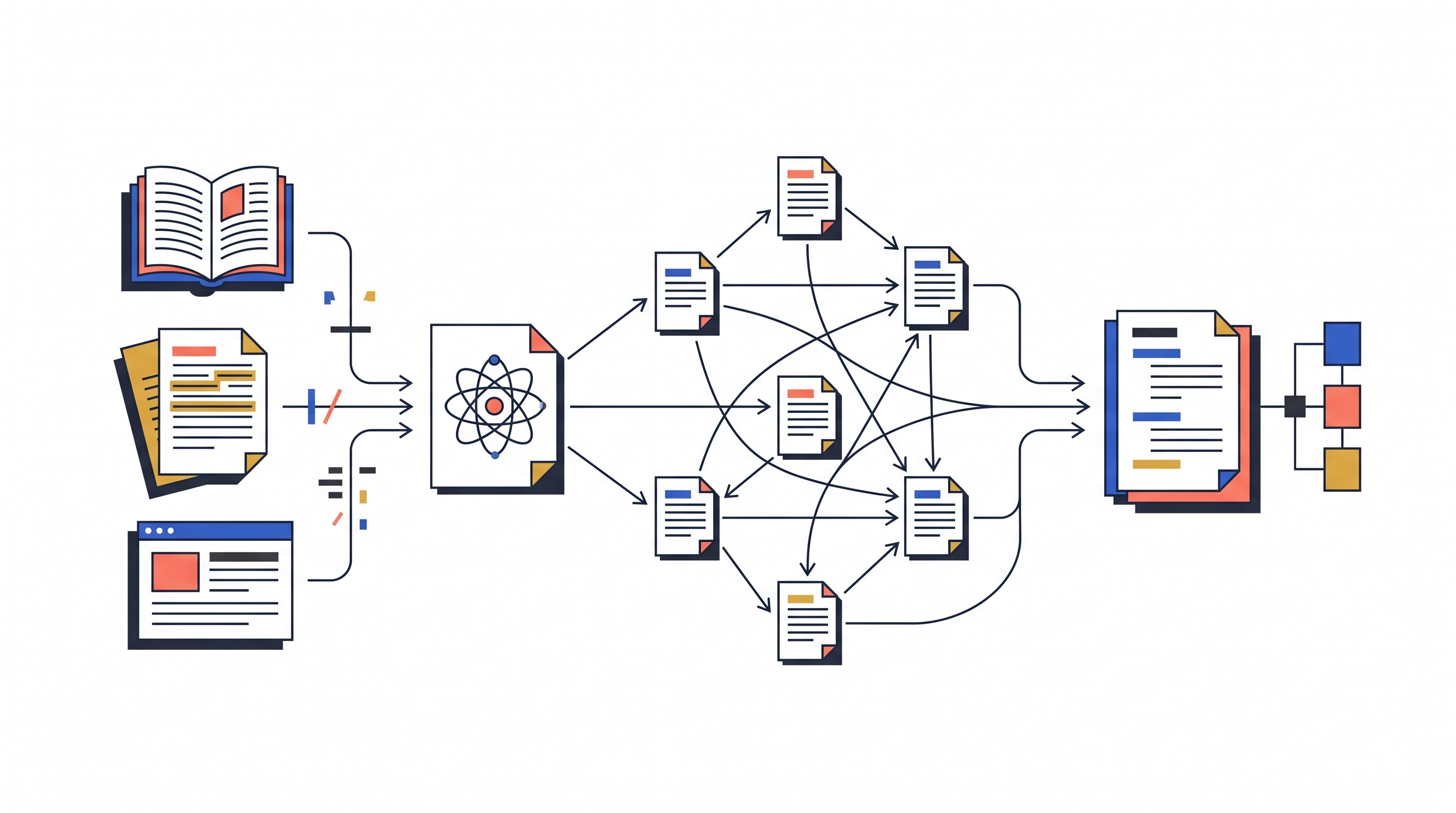
You do not need a prettier notes app; you need a way to stop losing the relationships between ideas. The Zettelkasten method is a connected research note system built from small, self-contained notes linked by meaningful relationships, so reading can compound into arguments, questions, and drafts.
The practical version is simple: process one source, write the idea in your own words, turn it into an atomic note, connect it to related notes, and revisit those connections when writing. The hard part is not the software. It is deciding what each note means and why it belongs near another one.
What the Zettelkasten method is and how it works
The Zettelkasten method is a note-taking system for building a network of ideas. Each useful note captures one idea clearly enough to stand on its own, then links to other notes that support it, challenge it, explain it, apply it, or raise a question about it.
A working Zettelkasten has a loop:
Read or observe something.
Interpret the useful idea in your own words.
Create a focused, atomic note.
Connect it to existing notes with a meaningful relationship.
Return to the network when developing a question, paper, chapter, memo, or argument.
That makes it different from a folder archive. Folders usually ask, “Where should this source go?” A Zettelkasten asks, “What idea does this source change, support, or complicate?”
It is also not a quotation bank. Saved highlights are raw material. A Zettelkasten starts to work only when those highlights are processed into claims, distinctions, questions, and connections.
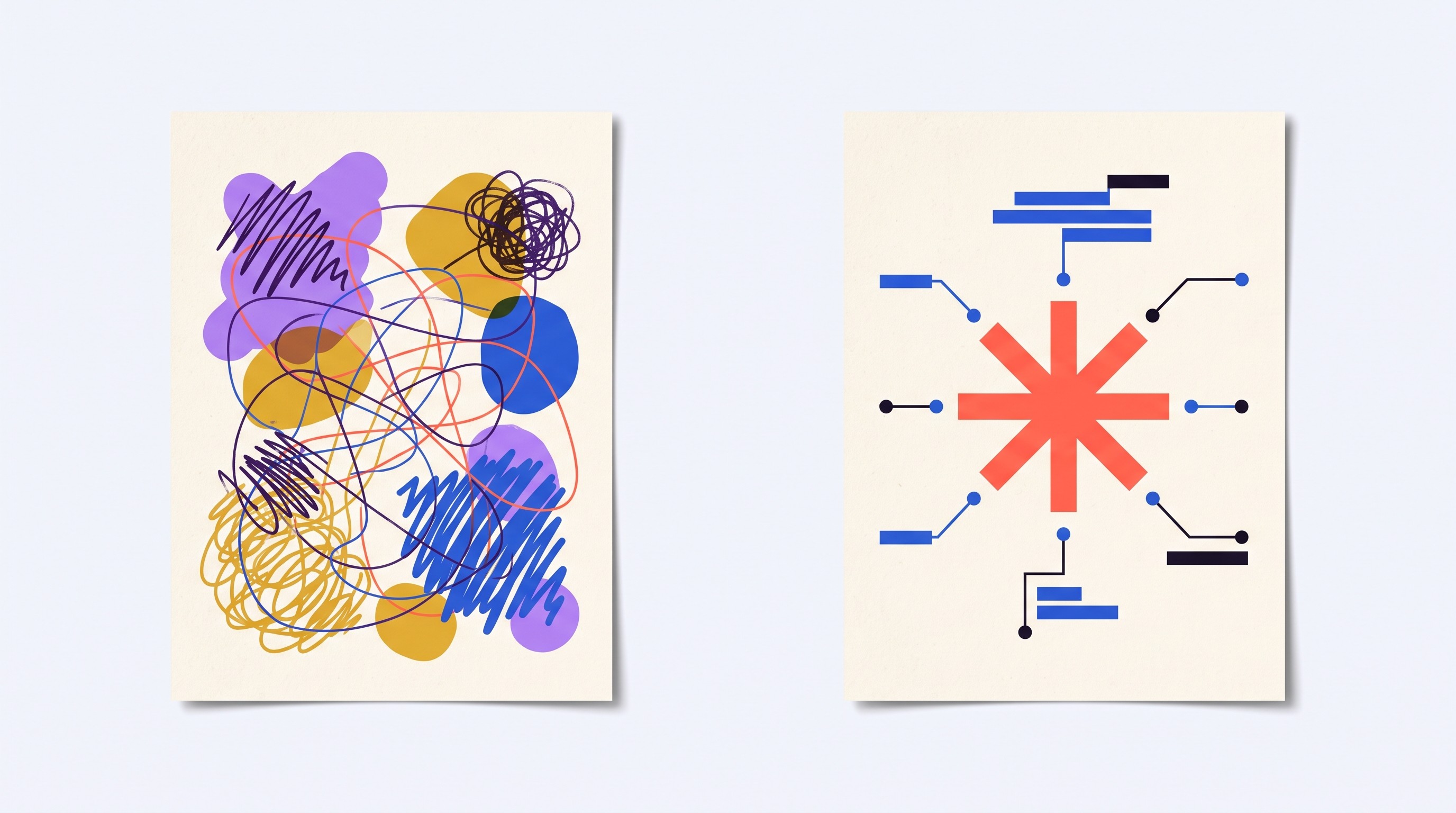
The value comes from preserving relationships over time. A note written during one project can become relevant months later because it links to a method, concept, counterexample, or unresolved question in another area.
The method can work on paper, in Markdown files, in Obsidian, Logseq, Roam Research, Tana, Notion, Apple Notes, or another system. Backlinks and graph views help, but they are not the method. The method is the discipline of making ideas small, clear, and connected.
The three note types that make a Zettelkasten useful
A useful Zettelkasten usually separates three kinds of notes: fleeting notes, literature notes, and permanent notes. The names matter less than the distinction. Each type has a different job.
Note type | Job | Keep it? |
|---|---|---|
Fleeting note | Capture a thought, question, or reminder before it disappears | Only until processed |
Literature note | Record what a specific source says, with citation context | Yes, tied to the source |
Permanent note | State a reusable idea in your own words | Yes, linked into the network |
Fleeting notes are temporary captures. They might be a question during reading, a sentence fragment after a meeting, or a reminder to compare two studies. They are not meant to be polished. They exist so the idea is not lost before processing.
Literature notes are source-specific records. A good literature note includes a concise paraphrase, the relevant quotation only when wording matters, page or location details, and enough source information to verify the claim later.
Permanent notes are durable ideas. They should make sense outside the original reading session. A permanent note does not merely say, “Smith argues X.” It states the reusable idea: “A measurement tool can be reliable without being valid when it produces consistent results for the wrong construct.”
Mixing all three into one undifferentiated note creates problems later. If highlights, personal reactions, paraphrases, quotations, and claims all live in the same place, it becomes hard to tell what the source said, what you inferred, and what you can safely cite.
If you want ready-made structures rather than a method explanation, use these Zettelkasten and atomic note templates as starting points. Templates help most after the distinction between note types is clear.
How to write an atomic note without making it too vague
An atomic note should express one claim, question, distinction, or useful observation. It should also include enough context to make sense when encountered months later.
A weak note is usually just a topic label:
Weak note | Stronger atomic note |
|---|---|
“Social media and attention” | “Intermittent rewards may make social media harder to disengage from because users cannot predict which refresh will produce a meaningful response.” |
“Research design” | “A strong research question can still produce weak evidence if the method cannot observe the proposed relationship.” |
“AI summaries” | “A source summary is useful for triage, but citation decisions require checking the source text because summaries compress uncertainty.” |
The stronger versions work because they state a relationship. They tell the future reader what is being claimed, not just what subject area the note belongs to.
A practical test: if the note title could be a folder name, it is probably too broad. “Attention” is a topic. “Scarcity of attention changes which messages are worth sending” is an idea.
A good atomic note usually has four parts:
A title that states the idea. Not “Validity,” but “Validity depends on whether the method measures the intended construct.”
A short explanation. One to three sentences is often enough.
Source context when needed. Include author, title, page, paragraph, timestamp, or URL if the claim may need verification.
Links to related notes. Add the relationship, not just the destination.
The tradeoff is real. Notes that are too broad become miniature essays and are hard to recombine. Notes that are too small become fragments: definitions, isolated quotes, or clever lines with no argument around them.
The goal is not to make every note tiny. The goal is to make each note reusable.
A source-to-note workflow for research reading
For research work, the Zettelkasten method is strongest when it starts before highlighting. If the question is vague, the notes will be vague too.
Step 1: Define the question or project
Start with the question you are reading for. It can be provisional.
Examples:
“How do citation practices affect evidence quality in literature reviews?”
“What makes AI-generated summaries risky for legal research?”
“Which mechanisms explain why feedback improves learning?”
If the question itself is weak, fix that first. This guide on how to write a research question is useful when the project is still too broad.
Step 2: Capture the source identity before extracting ideas
Before taking notes, record the source details:
Author
Title
Publication or publisher
Year or version, when relevant
URL, DOI, file name, or database record
Page, section, paragraph, figure, or timestamp
This prevents a common failure: useful notes with no traceable source. That is fine for private reflection. It is a problem for academic writing, legal analysis, clinical review, or any work where claims need to be checked.
For broader source and citation organization, pair the Zettelkasten workflow with a research paper organizer for sources, notes, and citations. Zettelkasten handles idea relationships; citation workflows handle bibliographic accuracy.
Step 3: Read selectively
Do not convert every highlight into a note. Look for material that can do work later:
Claims
Definitions
Evidence
Counterarguments
Methods
Limitations
Mechanisms
Examples
Questions
If a passage is interesting but does not affect a question, argument, or future reading path, it may not deserve a permanent note.
Step 4: Convert excerpts into literature notes
A literature note should separate the source’s claim from your reaction.
Bad version:
“This is important because platforms destroy attention.”
Better version:
“The author argues that variable rewards encourage repeated checking behavior. My reaction: this may help explain why users continue refreshing even when the expected value of each refresh is low.”
That distinction matters. Later, you can cite the first sentence as the source’s claim and treat the second as your interpretation.
Step 5: Write permanent notes as independent claims
After processing the source, create permanent notes for ideas worth reusing.
A literature note might say:
“Author A describes interviews in which participants checked messaging apps during moments of uncertainty.”
A permanent note might say:
“Uncertainty can be a stronger driver of repeated checking than expected usefulness.”
Now the note can connect to behavioral design, attention, notification systems, habit formation, or research methods. It is no longer trapped inside one source.
Step 6: Review what the new note changes
For each permanent note, ask:
What does this support?
What does this contradict?
What does this explain?
What question does this raise?
What broader concept does this belong under?
What narrower example does it provide?
This is where the Zettelkasten becomes more than storage.

[[OTIO_INLINE_PROMO:%7B%22title%22%3A%22How%20will%20you%20turn%20this%20source%20into%20linked%20notes%3F%22%2C%22description%22%3A%22Review%20the%20source%20in%20Otio%2C%20ask%20about%20key%20claims%2C%20and%20save%20useful%20selections%20to%20a%20note%20for%20processing.%22%7D]]
How to link notes so the network produces new ideas
A link should explain why two notes belong together. If the only reason is that they share a topic, use a tag instead.
Good links describe a relationship:
Supports: Note A provides evidence for Note B.
Contradicts: Note A challenges Note B.
Extends: Note A adds a condition, mechanism, or implication.
Example of: Note A gives a concrete instance of Note B.
Applies to: Note A transfers an idea into another domain.
Raises a question about: Note A exposes an uncertainty in Note B.
Suppose you have three notes:
“Interview data can reveal mechanisms that surveys miss.”
“Small interview samples limit generalizability.”
“Participants describe notification checking as a response to uncertainty, not usefulness.”
Linked well, those notes produce a possible argument:
The empirical finding gives an example of a mechanism.
The method note explains why interviews are useful for discovering that mechanism.
The limitation note prevents the argument from overclaiming.
That cluster can become a paragraph, a literature review subsection, or the basis for a follow-up study.
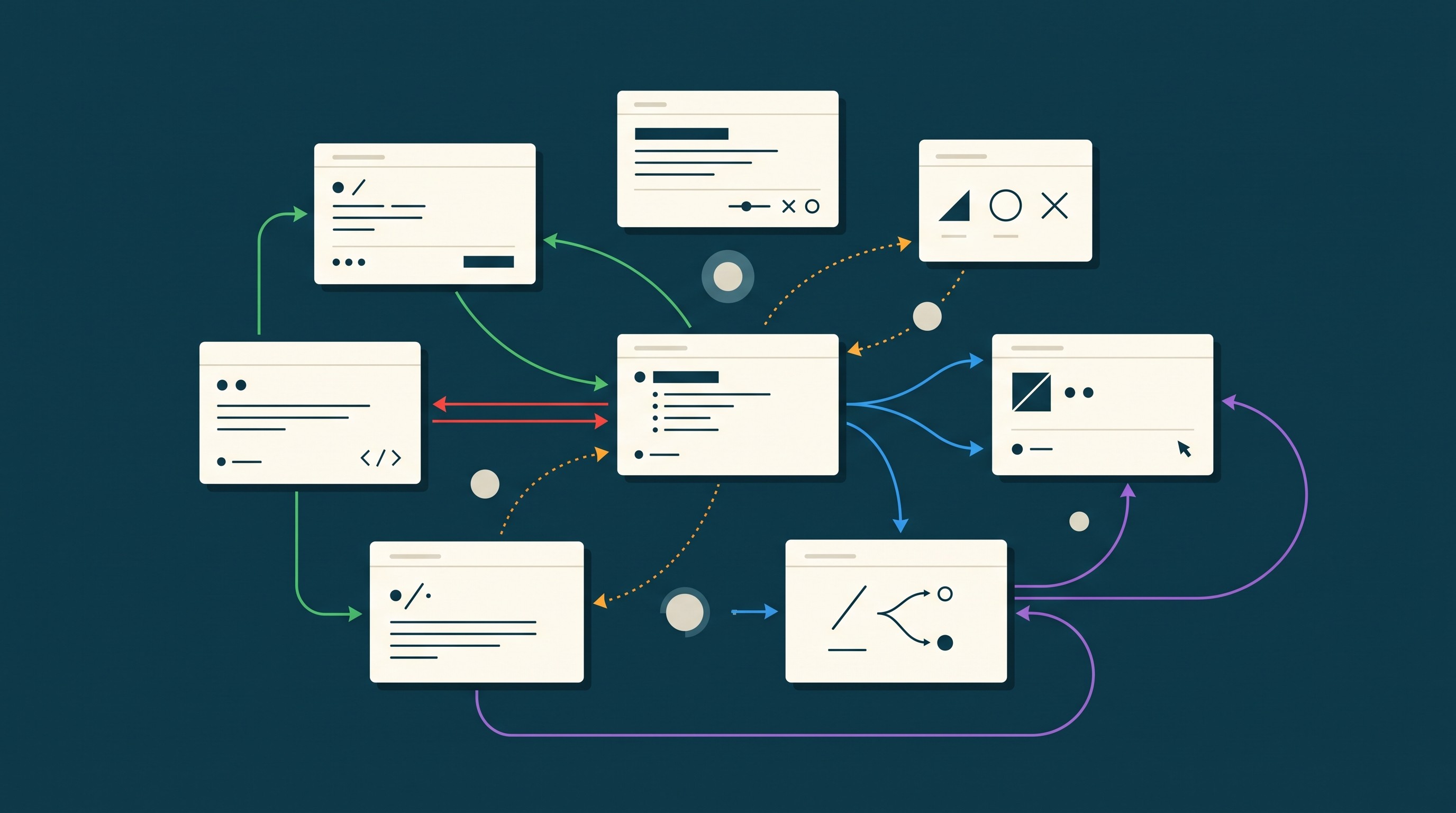
Tags and links do different jobs. A tag like attention groups notes by attribute. A link says, “This note explains why intermittent rewards may affect attention differently from predictable rewards.”
Do not link every note to everything. A dense graph can look impressive while becoming useless. If every note has twenty weak links, the network stops telling you which relationships matter.
The best links make future thinking easier. They reduce the cost of rediscovering why two ideas belong in the same conversation.
How to use the Zettelkasten method to develop a paper or research project
Do not start by trying to outline the entire archive. Start with a question, tension, or cluster of notes.
A useful cluster often contains different kinds of notes:
Definition: What key terms mean
Background: What the reader needs before the claim makes sense
Evidence: What supports the claim
Mechanism: Why the relationship may occur
Counterargument: What challenges the claim
Limitation: What the evidence cannot show
Implication: What follows if the claim is true
Then arrange the claims into a provisional sequence. Each transition should be supported by a link or made explicit in prose.
For example:
Define the problem.
Show the recurring pattern in the literature.
Explain the mechanism.
Present evidence.
Address a limitation.
State the implication or next research question.
Before writing final prose, return to the literature notes and original sources. Check quotations, page references, methods, sample descriptions, and the strength of the evidence. A clean note network is not a substitute for source verification.
There is also a non-obvious limitation: a Zettelkasten can generate many possible directions, but it does not decide which question is methodologically sound. Connected ideas still need appropriate evidence, design, and validity checks. For that layer, use this guide to the importance of research design.
If you are comparing Zettelkasten with broader knowledge systems, the difference is mostly scope. Zettelkasten is a method for connected idea development. A broader personal knowledge management workflow for researchers also includes source discovery, storage, citation management, reading queues, project planning, and output production.
Choosing a tool without letting the tool become the method
The method can work with index cards, plain text files, or a digital notes app. The tool matters only insofar as it lowers friction and preserves context.
Use these criteria before choosing software:
Reliable search: Can you find old notes by title, phrase, source, or concept?
Durable export: Can you leave without losing your notes?
Fast capture: Can you record a thought without breaking reading flow?
Linking or cross-references: Can notes point to one another?
Source metadata: Can you preserve citation context?
Privacy and control: Does the tool fit the sensitivity of the material?
Low maintenance: Does the setup make writing notes easier, or does it create another system to manage?
The failure mode is choosing software first. People spend days designing folders, tags, dashboards, icons, and templates before writing a single useful permanent note.
For source-heavy research, Otio’s AI PDF reader can support the front half of the workflow: collecting PDFs, web links, EPUBs, videos, audio, notes, and other research materials in one library; reading sources; summarizing; and using text selections to ask questions, quote into chat, or save material into notes.
That does not automate judgment. Otio can help collect, read, summarize, and draft notes from sources, but the researcher still has to decide what an idea means, how it connects, and whether the evidence supports the claim.
If your main question is which software to use, compare tools separately. This guide to note-taking apps for researchers beyond Obsidian is a better place for app selection than a method guide.
Common Zettelkasten mistakes and how to correct them
Mistake: Saving highlights without interpretation.
Correction: Add a plain-language explanation of why the passage matters. If you cannot explain the importance, keep it as a literature note or discard it.
Mistake: Writing broad topic pages.
Correction: Split distinct claims into atomic notes. “AI and education” is too broad; “Automated feedback can improve revision only when students understand the criterion being applied” is workable.
Mistake: Copying source language too closely.
Correction: Paraphrase first. Preserve quotations only when the wording itself matters, then keep page or location details with the note.
Mistake: Creating links only after the project is finished.
Correction: Link during processing. Each new permanent note should enter the network while the source and your interpretation are still fresh.
Mistake: Overusing tags and folders.
Correction: Use a small set of stable categories. Let descriptive links carry the intellectual structure.
Mistake: Expecting the graph to produce ideas automatically.
Correction: Revisit notes with a concrete question, comparison, contradiction, or writing goal. The network becomes useful when interrogated.
Mistake: Treating every note as permanent.
Correction: Let weak captures expire. A Zettelkasten improves when unprocessed fragments do not flood the system.
Mistake: Separating notes from source context.
Correction: Keep enough bibliographic information to return to the original. This matters most when moving from thinking to publishable writing.
A practical first session for building your Zettelkasten
Do not migrate your entire archive. That is how the method turns into a filing project.
Start with one active research question and one manageable source.
For a first session:
Choose one question. Make it specific enough to guide reading.
Choose one source. A single article, chapter, lecture, report, or case is enough.
Create one source record. Capture bibliographic details and location information.
Write three to five literature notes. Paraphrase the source’s useful claims, definitions, evidence, or limitations.
Create at least one permanent note. State a reusable idea in your own words.
Add meaningful links. Identify whether the note supports, contradicts, extends, exemplifies, or questions another note.
Record unresolved questions. If no meaningful link exists, do not invent one.
Review after a short gap. Fix vague titles, missing context, unsupported claims, and unclear relationships.
Use the cluster. Draft a paragraph, sharpen the research question, compare two positions, or decide what to read next.
A successful first session might produce only one permanent note. That is fine. The point is not volume. The point is to create a note that can survive beyond the source and reappear in future thinking.
The next action is simple: process one source and produce a small set of connected notes before choosing a new tool, template, or organizational scheme.
FAQ
Q: What is the main purpose of the Zettelkasten method?
A: Its purpose is to turn reading and observations into reusable, connected ideas that support future thinking and writing. It emphasizes relationships between notes rather than simply storing information.
Q: How long should a Zettelkasten note be?
A: A note should be long enough to express one idea clearly and independently, but short enough to remain focused. Length matters less than whether the note has a clear claim, enough context, and a useful connection.
Q: Is Zettelkasten the same as an atomic note system?
A: Atomic notes are a central building block of Zettelkasten, but the full method also includes source processing, note links, references, and regular reuse of the network for thinking and writing.
Q: Do I need a special app to use the Zettelkasten method?
A: No. You can use cards, plain text, or a notes application. A tool is useful only if it makes capturing, finding, linking, and preserving source context easier without adding unnecessary maintenance.
[[OTIO_FOOTER_PROMO:%7B%22title%22%3A%22Apply%20this%20workflow%20to%20your%20next%20research%20source%22%2C%22description%22%3A%22Bring%20your%20PDF%2C%20webpage%2C%20or%20video%20into%20Otio%2C%20then%20use%20its%20reader%20and%20cited%20AI%20answers%20to%20separate%20source%20claims%20from%20your%20own%20notes.%22%7D]]