
Bar Exam Prep
20 Best Bar Exam Study Resources for Law Students
Compare 20 bar exam study resources by exam stage, budget, and learning need, from official NCBE materials and question banks to essay feedback and study-planning tools.

If you are choosing bar prep resources, the right answer is not “buy the biggest course and add five supplements.” Start with your jurisdiction’s official requirements, pick one structured content system, then spend most of your remaining time on timed practice and feedback for the exact exam components you will face.
The MBE, essays, and performance test punish different weaknesses. Multiple-choice work needs rule precision and answer-choice discipline; essays need issue spotting and organized rule application; performance tests need file-and-library execution under time pressure. Build your stack around the weakest component, not around whatever resource has the loudest discount.
The best bar exam resource stack depends on your jurisdiction and weakest exam component
Before paying for anything, confirm five things from your jurisdiction’s official bar admissions or bar examiner site:
Current exam components
Tested subjects and subject scope
Filing deadlines and character-and-fitness requirements
Permitted materials, laptop rules, and exam-day policies
Scoring rules, passing score, and any component weighting
Then check current NCBE materials where they apply. Law libraries routinely point students to official NCBE materials, state bar examiner resources, commercial courses, study aids, and practice questions because “bar prep” is not one product category. Emory Law’s guide, for example, notes that bar prep materials can include techniques, stress-management resources, practice sets, and resources focused on specific exam portions such as the MBE, MPT, or MEE (Emory University Libraries).
Here is the smallest useful map of the 20 resources covered below.
# | Resource | Best use | Cost | Stage | Main limitation | Official or supplemental |
|---|---|---|---|---|---|---|
1 | NCBE official exam information | Confirm components and policies | Free/low | Before buying | Not a full curriculum | Official |
2 | NCBE subject matter outlines | Build a coverage checklist | Free/low | Start and review | Outline, not instruction | Official |
3 | NCBE sample questions and explanations | Learn official style | Free/low | Diagnostic and calibration | Limited volume | Official |
4 | State bar examiner materials | Verify local rules and past questions | Free/low | Before and throughout | Quality varies by jurisdiction | Official |
5 | Full-service commercial course | Structured full curriculum | High | Main study period | Expensive; can encourage passive watching | Supplemental |
6 | Self-paced/on-demand course | Flexible instruction | Medium/high | Main study period | Weak accountability | Supplemental |
7 | Condensed outline or lean review program | Final review and rule consolidation | Low/medium | After first pass | Too thin for many first-time takers | Supplemental |
8 | MBE question bank | Timed multiple-choice practice | Medium/high | Weeks 2 through final | Quality depends on questions and explanations | Supplemental |
9 | Official/licensed MBE practice sets | Calibrate against official style | Medium | Midpoint and final weeks | Limited compared with large banks | Official/licensed |
10 | Jurisdiction-specific essay bank | Practice local essay style | Free/low/medium | Throughout | Model answers may not explain grading fully | Official/supplemental |
11 | Performance-test library | Train file-and-library execution | Free/low/medium | Early and final weeks | Often underused until too late | Official/supplemental |
12 | Subject-specific attack outlines | Rapid rule review | Low/medium | Review phase | Can oversimplify | Supplemental |
13 | Rule flashcards | Memorize missed rules | Low/medium | Throughout | Weak if detached from practice | Supplemental |
14 | Spaced-repetition software | Schedule recurring recall | Free/low | Throughout | Card completion is not exam readiness | Supplemental |
15 | Visual maps and checklists | See rule relationships | Free/low | Review phase | Not enough for application | Supplemental |
16 | Study calendar | Control daily workload | Free/low | Before study begins | Breaks if not updated | Supplemental |
17 | Diagnostic/performance tracker | Identify error patterns | Free/low | Weekly | Useless if it tracks only completion | Supplemental |
18 | Essay and PT feedback service | Improve written answers | Medium/high | Midpoint onward | Limits and grader quality vary | Supplemental |
19 | Accountability group | Maintain pace and solve planning issues | Free/low/medium | Throughout | Can become social or unfocused | Supplemental |
20 | Document and study workspace | Organize sources, notes, and feedback | Free/medium | Throughout | Cannot replace licensed practice or grading | Supplemental |
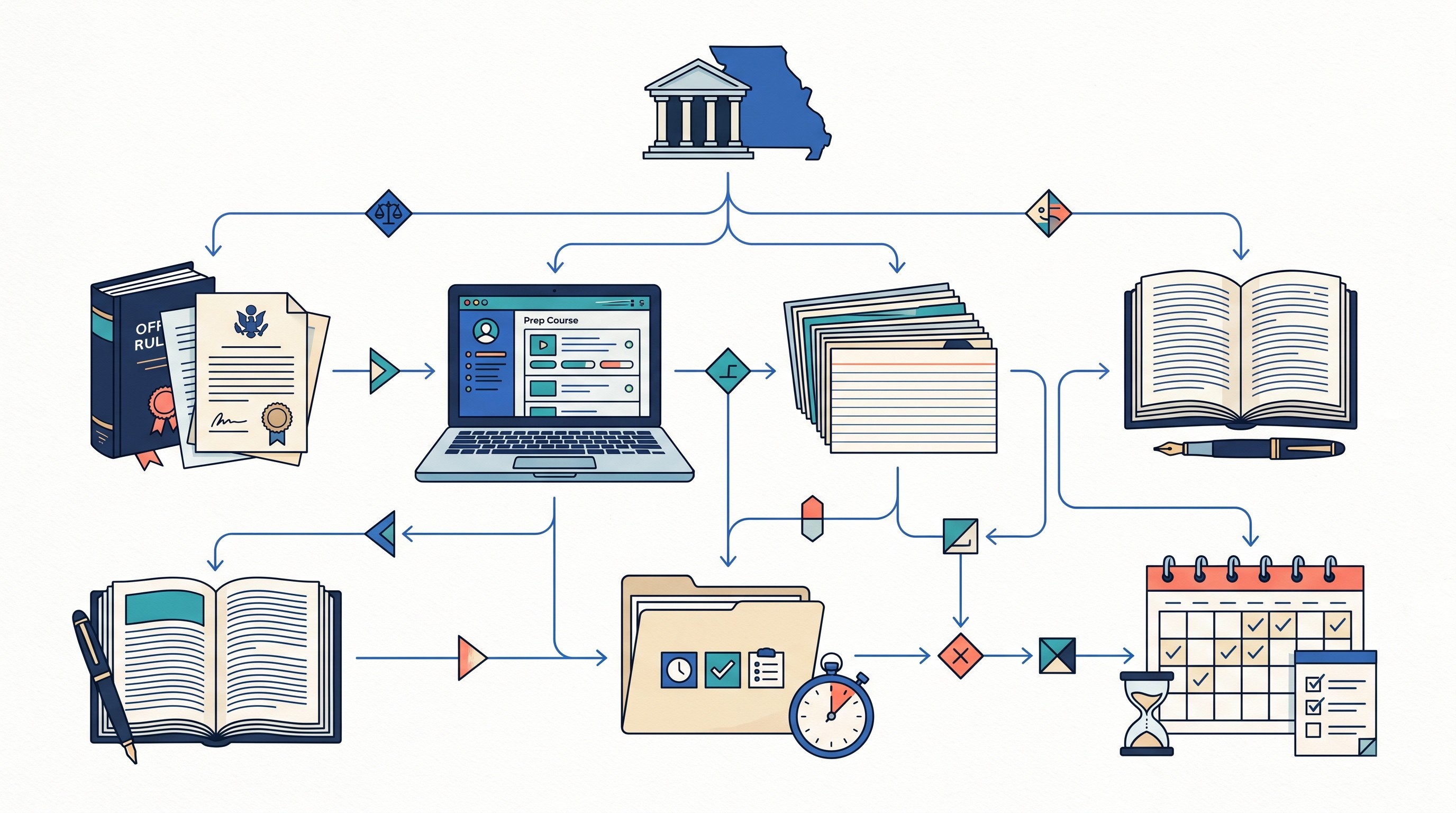
Start with these official and jurisdiction-specific bar exam resources
1. NCBE official exam information
Use current NCBE pages and jurisdiction links to verify the exam components you will take. This is the first stop, not an afterthought after buying a course.
The important point is not that NCBE materials teach everything. They define the exam architecture that every supplement should serve. If your course schedule, outline, or flashcard deck does not match your jurisdiction’s current exam, the course is not your source of truth.
The University of Miami Law Library’s bar preparation guide collects resources from the NCBE, Florida Board of Bar Examiners, law school sources, and additional study aids, which is the right model: official rules first, study aids second (University of Miami School of Law Library).
2. NCBE subject matter outlines
Subject matter outlines are the easiest way to stop studying from an outdated commercial syllabus. Turn each outline into a checklist:
Subject
Subtopic
Confidence level
Practice completed
Common missed rule
Source to review
This is especially useful when a commercial outline is hundreds of pages. The official scope tells you what belongs in the plan; the course materials teach it.
Fordham Law’s guide notes that NCBE has made some Uniform Bar Exam preparation materials, including subject outlines and sample questions, available for free (Fordham Law School). Check publication dates before relying on any downloaded copy.
3. NCBE sample questions and explanations
Official sample questions are for calibration. They show question style, distractor design, and the level of reasoning expected in explanations.
Do not treat a small set of sample questions as enough practice volume. Boston College Law Library’s guide describes MBE sample questions as similar to those on the MBE while noting that they do not represent all covered material (Boston College Law Library). That is the right way to use them: representative, not exhaustive.
A good workflow is:
Do a small untimed set.
Write why each wrong answer is wrong.
Compare your reasoning with the official explanation.
Convert the missed rule or reasoning error into a flashcard or tracker entry.
Repeat later under time.
4. State bar examiner materials
Your state bar examiner or admissions office may provide past essay questions, selected answers, applicant notices, grading information, filing instructions, laptop rules, and performance-test guidance.
This material matters even if you are using a national course. Jurisdiction-specific essay phrasing, answer expectations, local subjects, and exam logistics can be the difference between “I know the law” and “I wrote the answer this grader expected.”
Verification rule: replace any saved PDF, outline, or checklist that no longer matches the current jurisdiction page. Do not rely on a classmate’s old packet without checking dates.

Choose one structured course or content system for learning the law
5. Full-service commercial bar review course
A full-service course is the default choice for many first-time takers because it supplies structure: lectures, outlines, practice questions, essay prompts, performance-test materials, and often some grading.
Compare courses by what you will actually use:
Lecture format and length
Adaptive schedule quality
Number and source of practice questions
Essay grading volume and turnaround
Performance-test training
Jurisdiction coverage
Instructor access or office hours
Accessibility features
Refund or repeat-course terms
Colorado Law’s comparison page frames the decision around practical facts such as cost, style, and resources rather than brand familiarity alone (University of Colorado Law). That is the right lens.
The failure mode is passive completion. Watching every lecture and clicking every assignment complete is not the same as becoming faster and more accurate under exam conditions.
6. Self-paced or on-demand bar review course
Self-paced courses work well for students balancing work, caregiving, remediation, health constraints, or a nonstandard study window. They also help repeat takers who do not need the same daily march through every lecture.
The tradeoff is accountability. If no one notices when a student slips three days behind, the course can become a library of good intentions.
Use self-paced instruction only with a hard weekly plan:
Fixed practice blocks
A weekly diagnostic review
Required essay or PT submission dates
Catch-up days
One accountability check-in
7. Condensed outline or lean review program
Condensed programs and attack outlines are useful when the goal is fast rule retrieval after the law has already been learned. They are not automatically a complete first-pass curriculum.
Use a lean review system when:
You have already taken a full bar course or strong doctrinal classes.
Your main problem is recall, not comprehension.
You need a final-review bridge between long outlines and timed practice.
You can identify which omitted details are still tested.
Do not combine several full courses unless there is a specific gap. Overlapping lectures consume the time needed for questions, essays, rewrites, and performance tests.
Format | Flexibility | Instructor access | Feedback | Typical price | Planning burden |
|---|---|---|---|---|---|
Live course | Lower | Higher | Often included | High | Lower |
On-demand course | Higher | Varies | Varies | Medium/high | Medium |
Self-directed outlines | Highest | Low | Usually separate | Low/medium | High |
Use targeted practice resources for MBE questions, essays, and performance tests
8. MBE question bank
An MBE question bank is the engine of multiple-choice preparation. Evaluate it by:
Number of questions
Whether questions are licensed, official, simulated, or mixed
Explanation quality
Subject and subtopic filters
Timed and untimed modes
Analytics by subject and rule
Ability to review wrong answers
Whether the style resembles the current exam
The goal is not to finish the largest possible number. The goal is to reduce repeat errors.
A strong review note for each missed question should identify the cause:
Did not know the rule
Knew the rule but missed a fact
Chose a true but irrelevant answer
Misread the call of the question
Ran out of time
Narrowed to two and guessed wrong
9. Official or licensed MBE practice sets
Use official or licensed MBE sets for calibration. They help you test whether your timing, rule knowledge, and answer-choice reasoning transfer to official-style questions.
Avoid the marketing claim that any third-party question bank “exactly” reproduces the exam. The safer distinction is between official/licensed questions and simulated practice questions. Both can be useful, but they serve different jobs.
A good sequence:
Untimed subject-specific sets early.
Timed subject-specific sets after review.
Timed mixed sets once major subjects are covered.
Official or licensed mixed sets for calibration.
Full simulated sessions in the final weeks.
10. Jurisdiction-specific essay bank
For essays, generic legal knowledge is not enough. Use past questions, model answers, issue checklists, and grading explanations from your target jurisdiction when available.
The essay bank should answer four questions:
What issues are repeatedly tested?
How much rule detail appears in strong answers?
How are facts woven into analysis?
What does a passing but imperfect answer look like?
Many students only read model answers. That is weaker than writing first, comparing second, and rewriting the weakest paragraph.
11. Performance-test library
The performance test is trainable, but only if you practice the full task: reading the file, extracting rules from the library, organizing the assignment, and writing under time.
Look for a PT resource with:
Complete files and library materials
Multiple task types, such as memos, briefs, letters, or objective analyses
Model answers
Timing guidance
Early shorter drills and full-length practice
The University of Colorado Law library guide highlights PT-focused resources that include practice performance tests and training materials, including examples from multiple exam contexts (University of Colorado Law Library). That reflects the key point: PT skill improves by doing the format, not by reading about it once.

Add review tools that turn missed rules into long-term recall
12. Subject-specific attack outlines
Attack outlines are short, structured rule summaries designed for fast recall. Use them after learning the subject, not as a substitute for learning it.
The best attack outline is usually one you modify. Start from a commercial or school-provided outline if allowed, then add:
Frequently missed rules
Element lists
Common exceptions
Jurisdiction-specific distinctions
Essay trigger facts
Timing reminders
Keep checking the outline against official scope and current course materials. A beautiful outline that tracks last year’s assumptions is a liability.
13. Rule flashcards
Flashcards work best when they come from mistakes. Prewritten cards can cover broad doctrine, but self-made cards capture the exact rules you keep missing.
A useful bar flashcard is narrow:
Weak: “Explain hearsay.”
Better: “What makes a statement non-hearsay as an opposing party statement?”
Better still: “What facts should trigger an opposing-party-statement analysis on an MBE question?”
Convert missed MBE rules and recurring essay issues into cards the same day you miss them. Otherwise, the error disappears into a completed-question percentage.
14. Spaced-repetition flashcard software
Spaced-repetition software schedules cards for review at increasing intervals. It is useful for bar prep because forgotten rules reappear before they vanish from memory.
Use tags aggressively:
Subject
Subtopic
Source
MBE vs essay
“Missed twice”
“Needs rewrite”
“Jurisdiction-specific”
The risk is false confidence. A completed flashcard pile does not prove you can spot the issue in a messy fact pattern. Pair spaced repetition with mixed questions and essays.
For broader tool comparisons, Otio’s guide to flashcard apps for medical and exam prep is not bar-specific, but the spaced-repetition criteria transfer well.
15. Visual maps, charts, and one-page checklists
Visual tools help when rules are relational: civil procedure timelines, evidence admissibility paths, property interests, secured transactions priority, or constitutional scrutiny.
Use them for distinctions that are easy to confuse. Do not spend days making perfect diagrams.
A good one-page checklist should support action:
What question am I answering?
What rule path applies?
What exceptions might change the result?
What facts should I mention?
What conclusion format will I use?
Visual tools are review aids. They do not replace timed writing or mixed multiple-choice practice.
Use planning and feedback resources to control the final weeks
16. Bar exam study calendar
A bar calendar should allocate learning, practice, review, rest, catch-up time, and jurisdiction tasks. It should not be a fantasy schedule with twelve perfect hours every day.
Build it backward from exam week:
Full simulations
Final memorization
Essay rewrites
PT practice
Mixed MBE sets
Catch-up and rest days
Administrative deadlines
Students preparing for other high-stakes exams face the same planning problem: the resource list matters less than the schedule that forces active practice. The same principle appears in Otio’s LSAT resource guide for law students, where practice and review have to be matched to the test’s actual tasks.
17. Diagnostic and performance tracker
A tracker should record why performance is changing. Completion percentages alone are nearly useless.
Track:
Date
Subject
Question type
Timed or untimed
Score
Error reason
Missed rule
Essay/PT feedback
Corrective action
Retest date
Weekly review is where the tracker earns its place. Look for patterns, then assign a narrow remediation task.
Example weekly loop:
Identify the top two recurring errors.
Pick one rule or skill to remediate.
Review the source material.
Complete a timed set or prompt.
Review every mistake.
Rewrite or redo the weakest work.
Update next week’s plan.
18. Essay and performance-test feedback service
Written feedback can come from a commercial course, instructor, law school program, bar coach, rubric-based software, peer review, or disciplined self-grading.
Before paying, verify:
Number of graded essays or PTs
Whether feedback is individualized
Turnaround time
Rubric or grading basis
Jurisdiction coverage
Whether rewrites are reviewed
Who grades the work
Limits during the final weeks
Feedback is most valuable when it changes the next answer. A margin note that says “needs more analysis” is not enough unless you know what to do differently.
19. Bar association, law-school, or commercial accountability group
Accountability resources solve a different problem from content resources. They help students who know what to do but are drifting.
Useful formats include:
Law school bar-prep office hours
Faculty or academic-support check-ins
Bar association mentoring
Small study groups
Commercial coaching
Scheduled essay review sessions
Keep groups small and task-based. “Let’s study together” is vague. “Everyone writes the same 30-minute essay, self-grades with the checklist, and discusses missed issues for 20 minutes” is useful.
For repeat takers, begin with a diagnostic analysis of the prior attempt if score details are available. Do not automatically repeat the same full course. Identify whether the failure was MBE accuracy, essay coverage, PT execution, timing, anxiety, incomplete study, or jurisdiction-specific gaps.
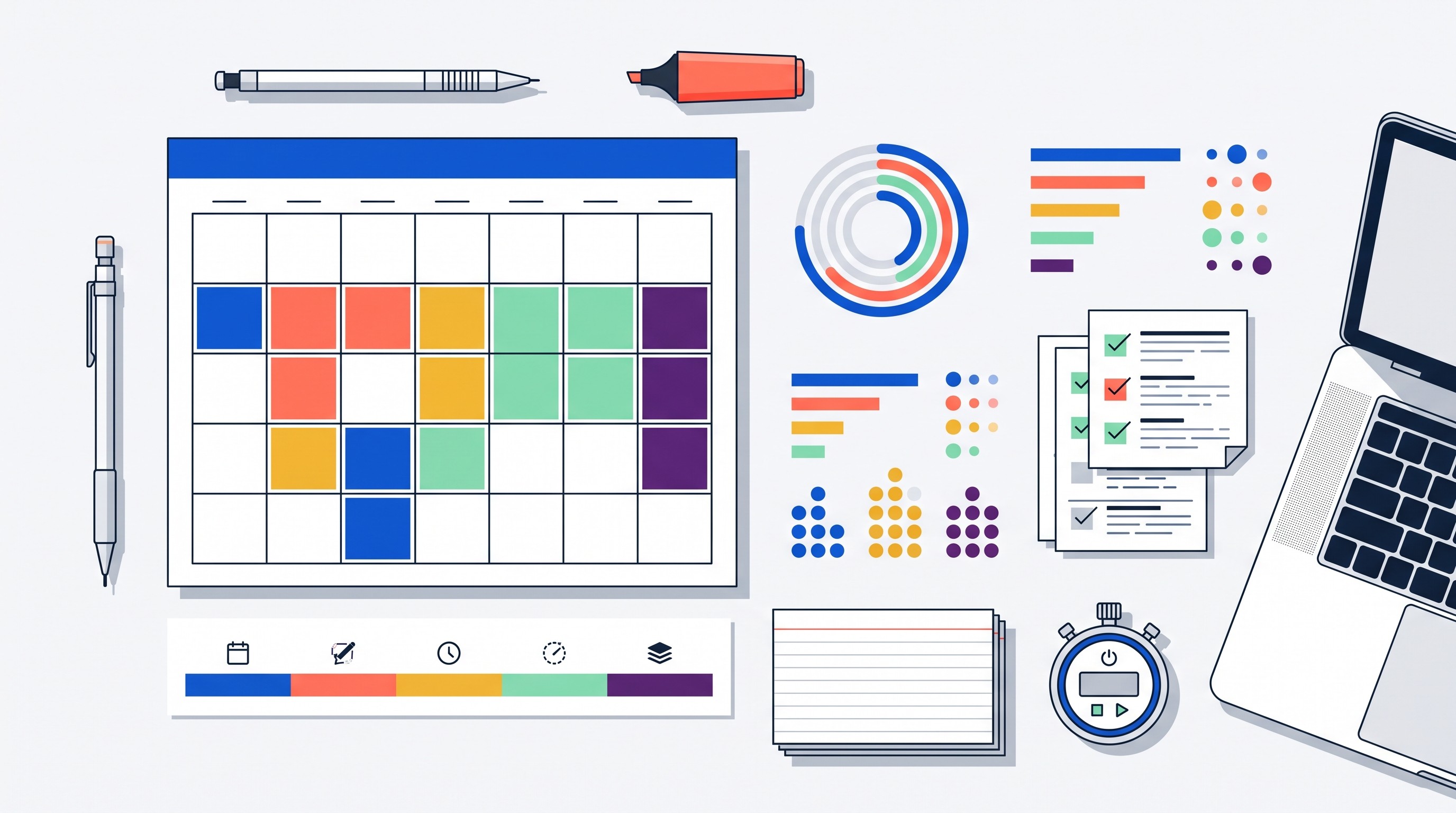
Use a research workspace to organize authorities, notes, and practice feedback
20. Document and study workspace such as Otio
A document workspace is not a bar review course. It is a way to reduce source fragmentation when official notices, course PDFs, essay prompts, notes, feedback, and checklists are scattered across downloads, email, LMS folders, and cloud drives.
In Otio’s AI workspace for legal research, you can upload or link documents, organize materials into folders or Spaces, ask questions across saved sources, summarize long readings, and save useful excerpts into notes. For bar prep, that can mean one searchable library for jurisdiction notices, essay prompts, performance-test instructions, lecture handouts, and your own rule notes.
A practical workflow:
Create one Space for your bar jurisdiction.
Add official exam notices, subject outlines, past essays, and PT instructions.
Add course PDFs and personal notes where permitted by license terms.
Keep separate folders for MBE, essays, PT, logistics, and feedback.
Ask source-bound questions such as “Which saved documents mention laptop registration deadlines?” or “Summarize the performance-test instructions from these materials.”
Save corrected rule statements and grader comments into review notes.
Use AI conservatively in bar prep. Check every generated rule summary against the official source and current course materials. Do not upload confidential client information. Do not rely on a summary when exact wording matters, such as exam instructions, filing rules, accommodations policies, or a black-letter rule you will memorize.
If your main bottleneck is reading and marking dense PDFs, a dedicated AI PDF reader can help you search, summarize, and ask questions inside documents. It still cannot replace licensed bar questions, jurisdiction-specific grading, legal advice, or a study plan.
[[OTIO_INLINE_PROMO:%7B%22title%22%3A%22How%20will%20you%20organize%20your%20bar%20prep%20sources%3F%22%2C%22description%22%3A%22Add%20current%20NCBE%20and%20state%20materials%2C%20course%20notes%2C%20and%20missed-question%20notes%20to%20Otio%20so%20you%20can%20search%20and%20compare%20them%20in%20one%20workspace.%22%7D]]
How to choose the smallest effective bar exam resource stack
The best stack is the smallest one that covers official requirements, content learning, practice, feedback, and review. More resources often create less study because every new tool adds setup time.
For a first-time taker with a typical schedule, start with:
Official NCBE and jurisdiction materials
One structured course or outline system
One MBE question source
One jurisdiction-specific essay bank
One performance-test bank
A calendar and tracker
A feedback source for essays and PTs
For a tight budget, prioritize:
Official materials
Law library and school-provided resources
Free or low-cost past essays where available
A focused question source
Feedback from a qualified instructor, academic-support office, mentor, or bar-prep program
Law school libraries often collect print and online bar study aids, commercial prep information, and exam-specific resources. The University of Minnesota Law Library, for example, lists bar exam materials alongside study aids and subject resources (University of Minnesota Law Library).
For a repeat taker, spend first on diagnosis and feedback:
Which component cost the most points?
Were misses caused by knowledge, timing, writing, or execution?
Did the prior schedule leave enough time for active practice?
Were essays and PTs reviewed by someone qualified?
Did you practice under exam-like timing?
For a student working full time, favor:
On-demand instruction
Smaller daily practice sets
Weekend simulations
A realistic calendar
Early essay and PT exposure
Scheduled accountability
The buying checklist before paying for any bar resource:
Does it match your jurisdiction?
Is the edition or update current?
Does it cover your exam components?
Are questions official, licensed, simulated, or mixed?
How many essays or PTs receive feedback?
Who gives feedback, and how fast?
Is the format usable on your schedule?
Are accessibility features adequate?
What are the refund, repeat, or guarantee terms?
How many total study hours does the resource assume?
Does it duplicate something you already own?
What exact weakness will this purchase fix?
A disciplined stack beats a large stack. Official rules tell you what matters; one course teaches the law; practice resources expose weaknesses; feedback fixes written performance; planning tools keep the work honest.
FAQ
Q: What is the most important bar exam study resource?
A: The most important resource is the current official material for your jurisdiction, paired with a reliable way to practice the exam components you will take. One complete, well-used resource stack is usually more useful than several overlapping courses.
Q: Do I need a commercial bar review course?
A: Not every student needs a commercial course, but many use one for structure, lectures, practice, and feedback. A self-directed plan can work when you can reliably schedule study, obtain current questions, and get meaningful essay and performance-test review.
Q: How should I divide time between MBE questions, essays, and the performance test?
A: Match practice time to your jurisdiction’s exam components and your diagnostic weaknesses. Do not postpone essays or performance tests until the end; begin with untimed work and build toward timed, mixed, full-length practice.
Q: Are old bar exam study materials still useful?
A: Older materials can help with foundational concepts and extra practice, but verify that subject coverage, exam format, rules, and jurisdiction requirements remain current. Official updates and current jurisdiction instructions should take priority.
[[OTIO_FOOTER_PROMO:%7B%22title%22%3A%22Apply%20this%20resource%20plan%20to%20your%20own%20materials%22%2C%22description%22%3A%22Bring%20your%20jurisdiction%20rules%2C%20essay%20prompts%2C%20PT%20files%2C%20and%20feedback%20into%20Otio%20to%20keep%20your%20study%20decisions%20grounded%20in%20current%20sources.%22%7D]]