
Nursing Exam Prep
22 Best NCLEX Pharmacology Resources for Nursing Students
Compare 22 NCLEX pharmacology resources by question practice, drug references, memory aids, and clinical accuracy. Build a focused study stack for your preparation stage and budget.

If pharmacology feels impossible, the problem is usually not effort. It is trying to memorize hundreds of drugs without a system for safety, adverse effects, interactions, monitoring, and patient teaching.
The best NCLEX pharmacology stack is small: one NCLEX-style question bank, one nursing drug guide, one concise review source, and one retrieval tool such as flashcards, mnemonics, or short videos. The 22 resources below are worth knowing, but most nursing students should not use all of them at once.
Use this list to build a focused stack for your stage, budget, and weak spots. Then confirm current pricing, editions, access periods, app features, and NCLEX alignment on each provider’s official site before buying.
The best NCLEX pharmacology study stack at a glance
NCLEX pharmacology is not a drug-name spelling test. Good practice should force decisions about medication safety, adverse effects, contraindications, interactions, prioritization, delegation, calculations, monitoring, and patient education.
That is why a balanced stack beats a pile of disconnected resources. A question bank teaches application. A drug guide checks details. A review book or course gives structure. A memory aid helps recall under pressure.

Resource type | Best use | NCLEX pharmacology coverage | Free or paid access | Main limitation |
|---|---|---|---|---|
NCLEX question bank | Applying drug knowledge in patient scenarios | Medication safety, adverse effects, prioritization, clinical judgment | Usually paid | Can feel predictive rather than educational if you skip rationales |
Nursing drug guide | Checking details before and after practice | Administration, monitoring, contraindications, patient teaching | Usually paid; some school access | Too dense to memorize cover to cover |
Comprehensive review book/course | Building a study map | Core drug classes, test-taking patterns, integrated nursing content | Usually paid | May not be current enough for detailed medication safety checks |
OER/free reference | Filling gaps on a budget | Foundational pharmacology and patient-friendly teaching language | Free | Often needs NCLEX-style questions added |
Videos and mnemonics | First pass or weak-area recall | Drug classes, prototypes, adverse-effect patterns | Free and paid | Unsafe if used as the only source |
School materials and policies | Course expectations and clinical procedures | Dosage conventions, local medication administration rules | Included in program | May not be designed as a full licensure review tool |
Study resources support preparation; they do not replace your nursing program’s medication-safety instruction, clinical policies, current prescribing information, or instructor guidance. When sources conflict on a safety detail, do not average them. Verify the current label, institutional policy, or assigned clinical reference first.
NCLEX pharmacology question banks for application practice
A question bank should do more than ask, “What class is this drug?” It should make you decide what to hold, what to monitor, what to teach, what to report, and what matters first.
The best use is targeted practice followed by mixed practice. First, drill weak classes such as anticoagulants, insulin, cardiac meds, antibiotics, psych meds, and opioids. Then mix them into broader medical-surgical, maternal-child, mental health, and priority questions so pharmacology stops feeling isolated.
1. UWorld NCLEX question bank
UWorld is a strong fit for students who learn by reading detailed rationales and connecting pharmacology to broader clinical judgment. Its biggest value is not the score report; it is the explanation after each question.
Use it when you need to understand why a medication answer is safe or unsafe in context. A good UWorld session should end with an error log entry such as “ACE inhibitors: monitor potassium and cough/angioedema; missed because I focused on blood pressure only,” not just “got it wrong.”
Before subscribing, verify current access length, question volume, reset rules, NGN-style item availability, and whether the package includes the level of pharmacology coverage you need. UWorld also publishes a 2026 NCLEX-RN test plan guide explaining how students can use the exam blueprint for preparation.
2. Archer Review
Archer Review is useful for students who want repeated readiness assessments, CAT-style practice, and a lower-friction way to build question volume. Its nursing pharmacology guidance emphasizes drug classes, NCLEX prep, and applying knowledge in clinical settings, according to Archer’s own study guide.
The main decision is whether the rationales are enough for your remediation needs. If you miss questions because you do not know the drug class, you need content review before more prediction-style testing. If you know the content but panic in NCLEX-style scenarios, Archer’s repeated exam format may help.
Do not treat any readiness assessment as a guarantee. Use it as a signal for what to review next.
3. Kaplan NCLEX Qbank
Kaplan is best for students who want a strategy-oriented approach. Its pharmacology materials frame the subject around what is tested and how to study, including must-know drug areas and NCLEX preparation tactics.
That can be helpful if you tend to over-study obscure details. Kaplan-style frameworks can teach you to look for safety language, expected versus unexpected effects, and priority cues.
The limitation is obvious: strategy cannot replace pharmacology knowledge. A decision tree will not save you if you do not know that grapefruit juice can matter, that potassium changes can be dangerous, or that a “hold and notify” answer may be safest.
4. ATI Comprehensive NCLEX Review and pharmacology materials
ATI is often the best option when your nursing program already uses ATI testing, remediation, and content modules. In that case, the advantage is alignment: your school may already expect you to complete ATI pharmacology assignments, focused reviews, and predictor remediation.
The distinction matters. ATI as a school-linked system is different from buying an independent prep tool on your own. If your program has ATI access, start there before paying for overlapping content.
Use ATI pharmacology reports to identify weak drug classes and nursing-process steps. Then reinforce those areas with a drug guide and targeted questions from your chosen bank.
5. BoardVitals NCLEX-RN question bank
BoardVitals is a good fit if you want customizable quizzes and focused practice by topic. For pharmacology, customization matters because you can isolate weak areas instead of doing random sets and hoping the right meds appear.
Use it for short, targeted blocks: antihypertensives, anticoagulants, endocrine meds, antimicrobials, pain meds, and psych meds. After each block, write down the nursing action you missed, not just the drug.
Before buying, check current NCLEX-RN alignment, question volume, access length, and whether explanations are detailed enough for your learning style.
6. NurseAchieve
NurseAchieve is worth considering if you want computer-adaptive testing practice and exam-like pacing. Adaptive practice can be useful late in prep because it forces you to tolerate uncertainty and move through mixed content.
For pharmacology, its value depends on how consistently you review the explanations after each attempt. CAT practice without review can become a confidence ritual rather than learning.
Use NurseAchieve when you are close enough to test day that stamina, timing, and mixed-topic reasoning matter. If you are still shaky on core drug classes, pair it with a content source before relying on adaptive exams.
Nursing pharmacology textbooks and drug guides
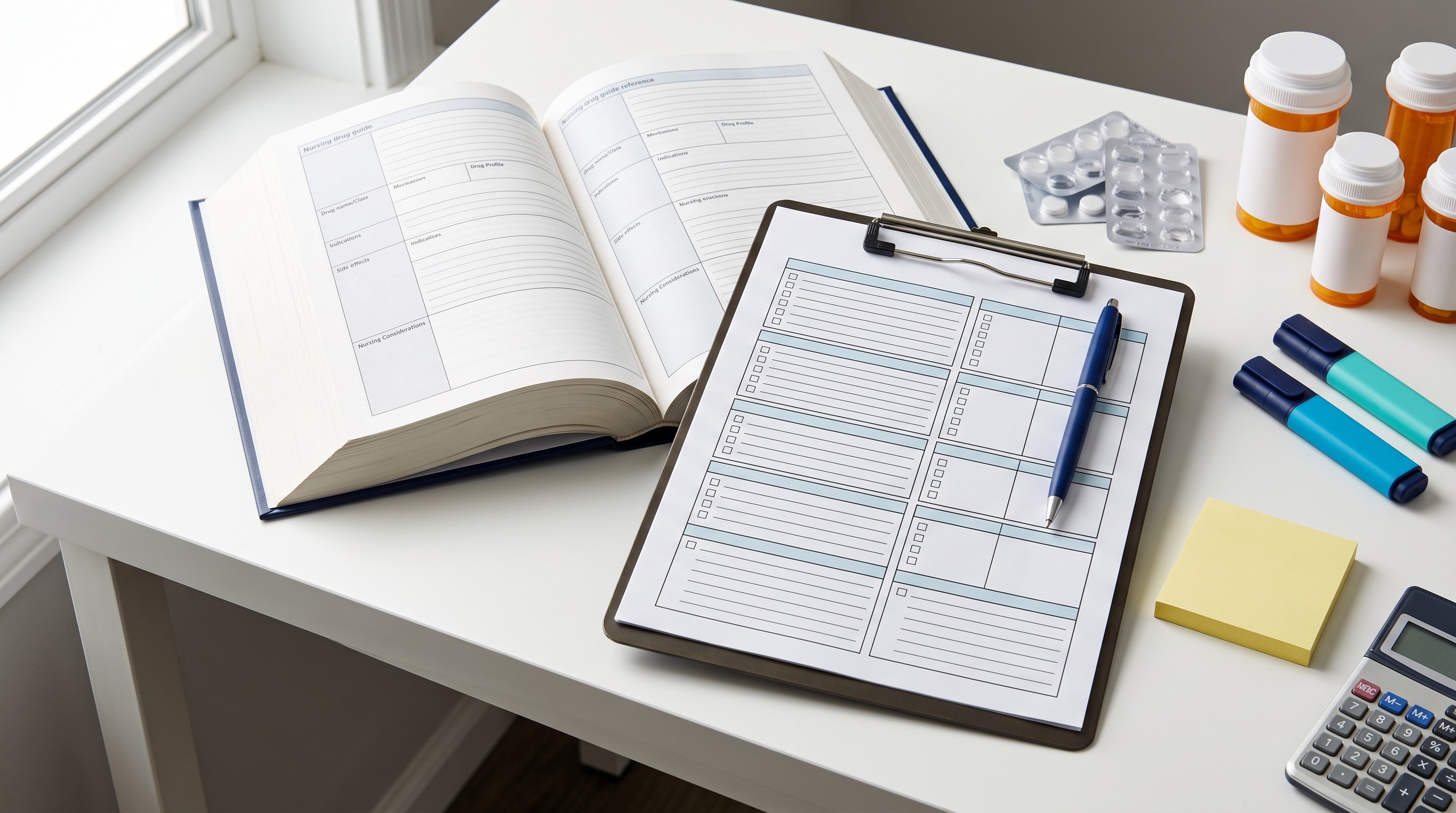
A drug guide and an NCLEX review book are not interchangeable. A review book teaches what is likely to be tested. A drug guide helps you check medication details safely.
The mistake is trying to memorize every line in a drug guide. Instead, learn class patterns and prototype drugs, then use the guide to verify exceptions, warnings, monitoring, and patient education.
7. Saunders Comprehensive Review for the NCLEX-RN
Saunders is a broad NCLEX review source with pharmacology integrated into the larger nursing curriculum. It is best for students who want one main review book rather than separate books for every subject.
Retail descriptions of Saunders emphasize coverage across NCLEX content areas and large sets of NCLEX-style questions; Barnes & Noble’s listing describes a current edition with thousands of exam-style questions. That makes it useful for students who need structure and repetition.
Its limitation is that it is not a bedside drug guide. Use Saunders to understand what NCLEX tends to ask, then verify medication-specific safety details in a current nursing drug guide or official source.
8. Lippincott Nursing Drug Guide
Lippincott Nursing Drug Guide is best used as a nursing-focused medication reference. Look for entries that help with administration, adverse effects, interactions, contraindications, monitoring, and patient teaching.
It is especially useful when a practice question rationale says something brief like “monitor for toxicity” or “teach the client to report bleeding.” The drug guide can turn that into concrete nursing implications.
Do not use it as your only NCLEX resource. It answers “What do I need to know about this medication?” better than “How will NCLEX test this concept?”
9. Davis’s Drug Guide for Nurses
Davis’s Drug Guide is another common nursing reference for checking nursing implications, monitoring, contraindications, interactions, and patient education. Nurse.org specifically mentions Davis Drug Guide as a trusted option in its pharmacology study tips.
The safest way to use Davis’s is lookup-based. When you miss a question on warfarin, digoxin, lithium, insulin, or an antibiotic, check the relevant entry and add only the testable safety point to your notes.
Do not copy entire entries into flashcards. That creates a huge deck and teaches recognition, not judgment.
10. Mosby’s Nursing Drug Reference
Mosby’s Nursing Drug Reference is useful if its organization matches how you search. Some students prefer one drug guide over another simply because the layout is easier to scan under time pressure.
That matters. A drug guide you actually use is better than a more detailed one you avoid.
Compare Mosby’s against Lippincott and Davis’s by checking the same five medications: insulin regular, warfarin, digoxin, furosemide, and lithium. Choose the format that makes administration, monitoring, adverse effects, and patient teaching easiest to find.
11. Nursing Central
Nursing Central is best for students who prefer a searchable digital reference workflow. It can be useful when you want drug information alongside broader nursing references on a phone, tablet, or laptop.
The advantage is speed. Instead of flipping between a paperback drug guide, a review book, and lecture slides, you can search terms quickly and check related nursing information.
Before subscribing, verify current databases, mobile access, offline availability, renewal terms, and whether your school already provides access.
12. OpenStax Pharmacology / open nursing pharmacology texts
Free open educational resources are useful when you need foundational explanations of pharmacokinetics, pharmacodynamics, receptors, drug classes, and therapeutic effects. They are especially helpful early in a nursing program, before NCLEX practice questions start to make sense.
One relevant open resource is the Open RN Nursing Pharmacology OER textbook, which PubMed describes as a free online textbook for prelicensure nursing students with CC-BY 4.0 licensing and updates aligned to recent NCLEX-PN and NCLEX-RN plans.
The limitation: open texts are not enough by themselves for NCLEX prep. Pair them with application questions and a nursing drug guide.
How to use a drug guide without drowning in details
For each prototype drug or missed-question medication, check the same categories every time:
Generic name and major brand names
Drug class
Indication
Mechanism or action in plain language
Expected therapeutic effect
Serious adverse effects
Contraindications and precautions
Major interactions
Required monitoring
Administration considerations
Patient teaching
That checklist keeps you from studying randomly. It also mirrors how medication questions are usually tested: not “recite the entry,” but “what should the nurse do next?”
For broader medical and pharmacology resource comparisons, see Otio’s guides to pharmacology textbooks and study resources for medical students and MCAT and USMLE study resources.
[[OTIO_INLINE_PROMO:%7B%22title%22%3A%22Can%20you%20turn%20your%20drug%20guide%20into%20an%20error%20log%3F%22%2C%22description%22%3A%22Upload%20lecture%20PDFs%2C%20drug-guide%20excerpts%2C%20and%20missed%20rationales%20to%20Otio%2C%20then%20ask%20cited%20questions%20about%20monitoring%2C%20interactions%2C%20and%20patient%20teaching.%22%7D]]
Pharmacology memory techniques and visual review resources
Memory aids are useful when they compress a pattern. They are dangerous when they replace verification.
A good mnemonic might help you remember that a drug class can cause cough, bleeding, ototoxicity, hypoglycemia, or serotonin syndrome. It should never be the sole basis for a dose, contraindication, interaction, or urgent clinical decision.
13. SimpleNursing pharmacology videos and study aids
SimpleNursing is best for a first pass through difficult drug classes. Its pharmacology page offers nursing study guides, NCLEX practice questions, medication cheat sheets, and drug-card style resources.
This format helps when textbook prose feels too dense. A short visual explanation can make beta blockers, ACE inhibitors, anticoagulants, insulin types, and psych meds less abstract.
The limitation is simplification. After learning a mnemonic or shortcut, verify the medication point in a reliable drug guide before trusting it in practice questions or clinical settings.
14. Level Up RN pharmacology videos and notes
Level Up RN is useful for concise, class-by-class review. It tends to fit students who already had the lecture but need a cleaner explanation before practice questions.
Use it for weak-area refreshers: diuretics, cardiac meds, endocrine drugs, antibiotics, pain meds, and psychiatric medications. Watch actively by pausing to recall adverse effects and nursing actions before the instructor says them.
The limitation is coverage depth. Short lessons cannot include every exception, rare adverse effect, or institution-specific administration rule.
15. RegisteredNurseRN pharmacology lessons
RegisteredNurseRN is a strong budget-friendly supplement because many lessons are free and designed for nursing students. It is useful when you need another explanation of a drug class after lecture.
Use these videos to clarify concepts, then test yourself with NCLEX-style questions. Passive watching is not enough.
Like other free lessons, it should not be treated as the final authority for current medication guidance. Use it as a teaching layer, not the reference layer.
16. Picmonic nursing pharmacology
Picmonic is best for visual mnemonic learning. Its NCLEX pharmacology review materials are explicitly designed around nursing pharmacology study strategies, drug review, and memory support.
This is most helpful for classes that blur together: antibiotics, antivirals, antifungals, antipsychotics, antidepressants, and seizure medications. Visual hooks can make recall faster.
The follow-up is non-negotiable: after a Picmonic, close the screen and retrieve the class pattern without looking. Then apply it to a safety vignette.
17. Quizlet nursing pharmacology flashcard sets
Quizlet can support active recall, especially for prototype drugs, suffixes, antidotes, and high-yield adverse effects. It is also easy to use in small pockets of time.
The risk is quality control. Many decks are student-created, outdated, incomplete, or worded in a way that teaches trivia rather than nursing judgment.
If you use Quizlet, build or edit your own deck from your course materials, question rationales, and a drug guide. Keep cards short:
“Loop diuretics: key electrolyte risk?”
“Warfarin: antidote?”
“ACE inhibitors: adverse effect to report?”
“Digoxin: check before administration?”
A safer memory method for NCLEX pharmacology
Use this four-step loop:
Learn the prototype and class pattern. Example: furosemide as a loop diuretic.
Connect the class to indications and major risks. Fluid overload, hypertension, potassium loss, dehydration, ototoxicity risk.
Retrieve without notes. Say the class, action, monitoring, adverse effects, and teaching out loud.
Apply it to a vignette. Decide what lab, symptom, or nursing action changes the answer.
This approach works better than memorizing isolated drug names because NCLEX often tests patterns. If you can reason from the class, you can survive unfamiliar medication names more often.
For more memory-focused approaches, Otio has a separate guide to pharmacology mnemonics and memory techniques, written for USMLE Step 1 but still useful for understanding how retrieval systems work.
Free and authoritative medication resources for NCLEX review
Free resources are not automatically weaker. Some are more authoritative than paid review materials for safety details.
The trick is knowing each source’s job. A test plan tells you what the exam covers. A drug label tells you official medication information. A patient education site helps with plain-language teaching. A review book helps you understand what NCLEX is likely to ask.
18. NCSBN NCLEX-RN Test Plan
The NCSBN test plan should be your map for the exam framework. Use it to connect pharmacology to client-needs categories, clinical judgment, safety, and nursing process rather than treating meds as a separate memorization unit.
A practical use: take your pharmacology error log and label each miss by the nursing decision involved.
Did you miss an adverse effect?
Did you fail to recognize a contraindication?
Did you choose the wrong monitoring parameter?
Did you miss patient teaching?
Did you answer the drug fact but not the priority?
That classification tells you what to fix.
19. DailyMed
DailyMed is useful for verifying official medication labeling: indications, warnings, contraindications, interactions, dosage forms, and administration details. It is especially helpful when a medication-safety point seems unclear or conflicting across study tools.
The limitation is readability. Label language can be technical and more detailed than what you need for NCLEX.
Use DailyMed as a verification source, not your first-pass study guide. Start with a nursing explanation, then check the label when safety details matter.
20. MedlinePlus Drugs, Herbs and Supplements
MedlinePlus is useful for patient-friendly medication explanations. It can help you practice teaching language: what the patient should know, what symptoms to report, and how to explain a medication without jargon.
This matters because NCLEX frequently tests patient education. The safest answer is often the one that gives clear, actionable teaching.
MedlinePlus is not a replacement for professional labeling, a nursing drug guide, or institutional policy. It is best for translating medication knowledge into patient-centered language.
21. FDA drugs and medical product safety communications
FDA safety communications are useful when a question or class discussion involves a serious warning, medication recall, boxed warning, contamination issue, or major safety update.
Use them selectively. Most NCLEX pharmacology study does not require reading safety communications every day.
When you do consult one, check the date, medication, formulation, population, and relevance. A warning about one product, route, or patient group may not apply broadly.
22. Your nursing school’s medication handbook, lecture materials, and clinical policies
Your school’s assigned materials should come first for course exams, dosage-calculation conventions, clinical paperwork, and local medication-administration procedures. They define what your instructors expect.
They are also the safest source for skills-lab and clinical rules: what must be checked, documented, co-signed, held, or reported in your program.
For general pharmacology claims, cross-check with a current drug guide or official medication reference. For local procedures, follow institutional policy and instructor direction.
How to reconcile conflicting medication information
Use a source ladder:
Current institutional policy for clinical procedures
Current official medication labeling for drug-specific safety details
Assigned nursing drug guide or school-approved reference
NCLEX review book or question-bank rationale
Videos, mnemonics, and student flashcards
If a mnemonic conflicts with a drug guide, trust the drug guide. If a question-bank rationale conflicts with current policy in clinical, follow policy and ask your instructor to clarify the exam context.
How to choose the right pharmacology resources for your study stage
Resource choice should change as your exam gets closer. Early study needs structure. Mid-prep needs questions and error correction. Final review needs retrieval and mixed practice.
First pass: build the map
Choose one concise content source plus one searchable drug guide. Focus on:
Prototype drugs
Common classes
Indications
Major adverse effects
Contraindications
Monitoring
Nursing interventions
Patient teaching
Do not start by memorizing hundreds of individual medications. Learn class patterns first, then add exceptions.
Active NCLEX prep: question bank plus error log
Once you know the basics, prioritize NCLEX-style questions with detailed rationales. Keep an error log organized by:
Drug class
Safety issue
Missed clue
Reasoning mistake
Correct nursing action
Example entry:
Drug class | Missed issue | Why I missed it | Fix |
|---|---|---|---|
Anticoagulants | Bleeding precautions | Focused on pain instead of safety | Review warfarin/heparin teaching and antidotes |
Cardiac glycosides | Check apical pulse | Jumped to administer | Practice “check before giving” meds |
Loop diuretics | Hypokalemia | Forgot electrolyte monitoring | Review potassium-altering drugs |
The error log is where learning happens. The question bank only reveals the gaps.
Final review: retrieve, do not reread
In the final stretch, short videos and flashcards should be used for weak areas and recall checks. Do not replace mixed practice with passive rereading.
A good final-review session might look like this:
Recall one drug class from memory.
Do 10–20 mixed questions.
Review every rationale.
Verify one uncertain safety point.
Retest missed concepts two days later.
Limited budget: use free resources deliberately
If money is tight, start with school materials, open pharmacology texts, official test-plan guidance, DailyMed, MedlinePlus, reputable free nursing videos, and free practice questions.
If you buy one thing, prioritize question practice with explanations. Free references can help verify medication details, but NCLEX-style rationales are harder to replace.
If organization is the real problem
Many students do not lack resources. They lose time because lecture PDFs, drug cards, question rationales, screenshots, bookmarks, and handwritten notes live in six places.
A workspace like Otio’s AI PDF reader can help organize source files, lecture slides, drug-guide excerpts, and notes in one library, then let students ask questions with citations from uploaded materials. Treat that as an organization and synthesis layer, not as the medication authority.
For students comparing broader study systems, see Otio’s guides to AI tools for college students and note-taking AI for students.
A seven-day NCLEX pharmacology study cycle
Use this cycle for one or two drug classes at a time.
Day | Task | Output |
|---|---|---|
1 | Review one drug class and prototype drugs | One-page class map |
2 | Check key meds in a nursing drug guide | Safety and teaching notes |
3 | Do targeted questions | Error log entries |
4 | Review missed concepts and verify uncertain details | Corrected notes |
5 | Retrieve from flashcards or blank paper | Weak-point list |
6 | Do mixed NCLEX questions | Priority and safety practice |
7 | Retest missed concepts | Updated confidence rating |
Repeat with the next class. Keep the system boring. Boring systems are easier to follow when test anxiety rises.
FAQ
Q: What is the best way to study pharmacology for the NCLEX?
A: Use one reliable content or drug-reference source with an NCLEX-style question bank, then review rationales and keep an error log. Focus on medication safety, adverse effects, interactions, monitoring, and patient teaching rather than memorizing isolated drug names.
Q: Are pharmacology mnemonics enough to pass the NCLEX?
A: No. Mnemonics can improve recall, but NCLEX questions require application, prioritization, and safe nursing judgment. Verify memory aids against current references and practice using the information in patient scenarios.
Q: Should nursing students use a drug guide or an NCLEX review book?
A: Most students benefit from both because they serve different purposes. An NCLEX review book explains tested concepts and provides questions, while a nursing drug guide supports detailed checking of administration, monitoring, interactions, and patient education.
Q: How can I study NCLEX pharmacology without spending much money?
A: Start with your school’s materials, the NCSBN test plan, open pharmacology texts, DailyMed, MedlinePlus, and reputable free nursing lessons. If you buy one resource, prioritize question practice with explanations and use free references to verify medication details.
[[OTIO_FOOTER_PROMO:%7B%22title%22%3A%22Apply%20this%20stack%20to%20your%20own%20study%20sources%22%2C%22description%22%3A%22Bring%20your%20school%20slides%2C%20question%20rationales%2C%20drug%20cards%2C%20and%20trusted%20references%20into%20one%20library%20to%20organize%20weak%20areas%20and%20verification%20notes.%22%7D]]