
Essay Revision
30 Essay Revision Checklists for College Writers
Use 30 copy-ready essay revision checklists to improve your thesis, structure, evidence, citations, clarity, and final submission before you turn in college writing.

Revision works best when you stop treating your essay as one document and start treating it as three problems: argument, evidence, and sentences. Use these 30 checklists in that order, because polishing weak paragraphs only makes weak thinking harder to spot.
If the deadline is close, do not run every checklist. Start with the whole-essay diagnosis, thesis strength, evidence integration, citation completeness, and final submission check. Those catch the mistakes most likely to change the grade.
Start with a three-pass essay revision workflow
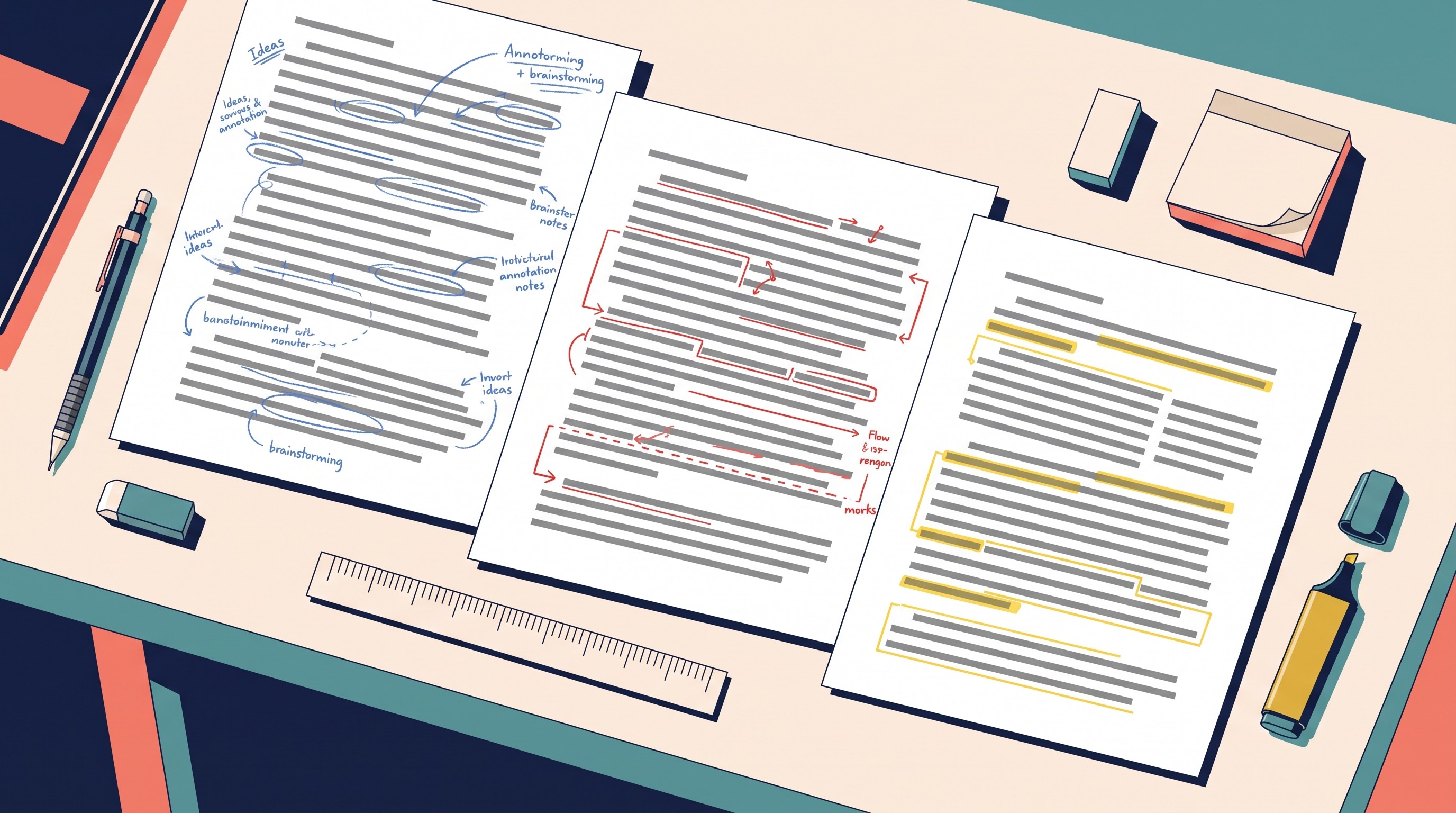
A good revision pass has a job. First, fix what the essay says. Second, fix how it proves the point. Third, fix how it reads.
That order matters. If the thesis changes after sentence editing, much of the polishing becomes wasted work.
1. Whole-essay diagnosis
Use this before touching individual sentences. The goal is to find the biggest structural problems while the draft is still easy to move around.
[ ] Write the assignment’s main question in your own words.
[ ] Identify your current thesis.
[ ] Summarize each paragraph’s job in one sentence.
[ ] Mark sections that do not support the thesis.
[ ] Choose the three highest-impact revisions before editing.
A useful test: if the paragraph summaries do not form a clear chain of reasoning, the essay probably needs reorganization before proofreading.
2. Reverse outline
A reverse outline shows what the draft actually does, not what the original plan said it would do.
[ ] List every paragraph.
[ ] Record each paragraph’s main claim.
[ ] Note the evidence it uses.
[ ] Explain how it connects to the next paragraph.
[ ] Flag missing, repetitive, or misplaced content.
If two paragraphs make the same claim with similar evidence, combine them or make their purposes distinct. If a paragraph has evidence but no claim, it is probably summary rather than analysis.
For longer research papers, pair this checklist with a full college research paper outline so the revised structure matches the assignment’s expectations.
3. Rubric alignment
A strong essay can still lose points if it answers a different version of the assignment.
[ ] Read the rubric or prompt beside your draft.
[ ] Highlight where each requirement is met.
[ ] Identify requirements with no clear evidence.
[ ] Check required length and format.
[ ] Prioritize revisions that affect graded criteria.
Do this early. Rubric problems often require new paragraphs, new sources, or a narrower thesis, not just better wording.
4. Reader test
This checklist catches the gap between what the writer means and what the reader can infer.
[ ] Ask what a classmate would think the essay is arguing after reading only the introduction and topic sentences.
[ ] Check whether key terms are defined.
[ ] Mark places where context is missing.
[ ] Remove assumptions your reader may not share.
The reader does not need every detail you know. They need enough context to understand the claim, the stakes, and the evidence.
5. Revision priority list
A draft with 40 possible edits needs triage. This checklist keeps revision from becoming random tinkering.
[ ] Separate must-fix problems from optional polish.
[ ] Fix unsupported claims before word choice.
[ ] Combine repetitive revisions.
[ ] Assign a realistic order to the work.
[ ] Reread the revised section after every major change.
A simple priority order works for most essays:
Priority | Fix first | Why it matters |
|---|---|---|
1 | Prompt, thesis, structure | Determines whether the essay answers the assignment |
2 | Evidence, analysis, citations | Determines whether the argument is credible |
3 | Clarity, grammar, formatting | Determines whether the reader can follow and trust it |
6. Revision record
Version control sounds excessive until a paragraph you deleted becomes useful again.
[ ] Save the original draft.
[ ] Date each major version.
[ ] Record why you made substantial changes.
[ ] Keep useful deleted passages separately.
[ ] Confirm that the final version answers the prompt rather than merely sounding smoother.
A revision record also helps if an instructor asks what changed between drafts. Save old versions with clear names: essay-draft-1, essay-revised-structure, essay-final-submit.
Revise your thesis, argument, and organization
The thesis is not a sentence you decorate at the end of the introduction. It is the control system for the whole essay.
Every paragraph should either build, qualify, test, or complicate that central claim. If it does not, it needs a new role or it needs to go.
7. Thesis strength
A thesis should answer the prompt, take a position, and set up the essay’s logic.
[ ] Make the thesis answer the prompt directly.
[ ] State a specific position or interpretation.
[ ] Avoid simply announcing the topic.
[ ] Include the main reason or analytical direction.
[ ] Check that the body can actually prove it.
Weak: “This essay will discuss social media and political participation.”
Stronger: “Social media expands political participation for first-time voters, but its effect is uneven because platform design rewards fast emotional responses more than sustained civic action.”
The stronger version gives the essay something to prove.
8. Argument map
Use this when the essay feels scattered or when the thesis changed during drafting.
[ ] Write the thesis at the top of a page.
[ ] List each major claim below it.
[ ] Connect every claim to the thesis.
[ ] Remove claims that do not advance the argument.
[ ] Identify the claim that needs the most support.
If a major claim cannot be connected to the thesis in one sentence, it may belong in a different essay. If it can be connected but lacks evidence, it needs development.
9. Introduction
The introduction should give the reader enough context to understand the argument, then move quickly to the thesis.
[ ] Provide only background relevant to the argument.
[ ] Establish the problem, text, event, or question.
[ ] Avoid broad clichés.
[ ] Introduce necessary terms.
[ ] End with a thesis that prepares the reader for the essay’s direction.
Cut openings like “Since the beginning of time” or “Society has always debated.” They delay the actual subject and signal that the essay has not found its angle.
10. Paragraph purpose
A paragraph is not a container for everything related to a topic. It should do one main job.
[ ] Give each paragraph one dominant purpose.
[ ] Place its main claim near the beginning.
[ ] Support that claim with relevant material.
[ ] Explain its significance.
[ ] Remove sentences that belong in another paragraph.
A paragraph can include context, evidence, and analysis, but those parts should serve the same claim. If a paragraph has two competing claims, split it.
11. Transitions and progression
Transitions are not just words like “furthermore” and “therefore.” The real transition is the logic between ideas.
[ ] Check how each paragraph follows the previous one.
[ ] Use transitions that show logic rather than decoration.
[ ] Order points from background to analysis or from weaker to stronger evidence when appropriate.
[ ] Add signposts for major turns.
[ ] Eliminate abrupt jumps.
Useful transitions often name the relationship: contrast, cause, example, consequence, exception, or escalation.
Example: “While the first policy reduced short-term costs, the second changed the incentives that produced those costs.” That transition tells the reader what changed and why the next paragraph matters.
12. Conclusion
A conclusion should not simply repeat the introduction. It should show what the essay has clarified.
[ ] Restate the argument without copying the thesis.
[ ] Synthesize the main findings rather than listing them.
[ ] Explain why the argument matters.
[ ] Avoid introducing a major new claim.
[ ] End with a specific implication, consequence, or answer to the broader question.
If the conclusion introduces a fascinating new idea, decide whether it belongs in the body. New arguments need evidence, not a final-paragraph cameo.
For more structure options, use these essay structure templates for graduate students and adapt them to the level of your course.
Check evidence, analysis, and source use
Evidence does not speak for itself. The writer’s job is to select it, introduce it, interpret it, and connect it back to the claim.
This is where many college essays fall short. They quote accurately but explain too little, or they summarize sources without showing what the evidence proves.
13. Evidence relevance
Before improving quotation style, ask whether the evidence belongs at all.
[ ] Confirm that every quotation, statistic, example, or observation supports the paragraph’s claim.
[ ] Remove interesting but unnecessary material.
[ ] Replace vague examples with precise ones.
[ ] Check that evidence represents the source accurately.
A good piece of evidence does not merely relate to the topic. It helps prove the paragraph’s specific claim.
14. Evidence integration
Dropping a quotation into a paragraph is not integration. The reader needs context before the evidence and interpretation after it.
[ ] Introduce each quotation or data point.
[ ] Include enough context to understand it.
[ ] Format it correctly.
[ ] Explain the important words or pattern.
[ ] Connect the analysis back to the paragraph and thesis.
A reliable structure is claim, context, evidence, analysis, connection. Not every paragraph needs all five in the same order, but missing analysis is the usual failure.
15. Analysis depth
Analysis answers the question “so what does this evidence show?”
[ ] Ask what each piece of evidence shows.
[ ] Explain how it supports the claim.
[ ] Identify implications or assumptions.
[ ] Avoid stopping after summary.
[ ] Add interpretation wherever the reader would otherwise have to make the connection.
Watch for paragraphs that end right after a quote. That usually means the evidence is doing the writer’s work.
A quick fix is to add one sentence beginning with a specific analytical verb: “This suggests,” “This complicates,” “This limits,” “This reveals,” or “This shifts.”
16. Source balance
A research essay should not depend so heavily on one source that it becomes a summary of that source.
[ ] Check whether one source carries too much of the argument.
[ ] Distinguish primary from secondary material.
[ ] Compare sources when useful.
[ ] Include opposing or complicating evidence where the assignment requires it.
[ ] Explain why each source belongs.
Balance does not mean every source gets equal space. It means each source has a clear role: background, theory, method, example, counterargument, or evidence.
If you are managing PDFs, notes, and source excerpts across a project, Otio’s AI essay workspace can keep research materials and drafting notes in one library, with chat and reader tools beside the documents. The important rule still holds: verify source context yourself before citing.
17. Paraphrase and quotation audit
Paraphrasing is not swapping a few words. It means restating the idea in your own wording and structure while crediting the source.
[ ] Put quoted language in quotation marks.
[ ] Verify every quotation against the original.
[ ] Make paraphrases genuinely your own wording and structure.
[ ] Cite paraphrased ideas.
[ ] Replace quotations that do not receive analysis.
If a source’s sentence structure still controls your paraphrase, revise again. For practice, compare your draft to these academic paraphrasing examples for ESL writers, which show how meaning can be preserved without copying syntax.
18. Citation completeness
Citation errors are easy to miss because they often survive multiple rounds of content revision.
[ ] Match every in-text citation to a reference-list entry.
[ ] Check author names, dates, titles, page numbers, and URLs where required.
[ ] Apply the assigned style consistently.
[ ] Cite borrowed ideas as well as exact words.
[ ] Verify uncertain references against the original source.
Citation software can help with formatting, but it cannot always tell whether the source actually supports your sentence. For a more detailed audit, use this guide to citation checking tools for academic writers.
[[OTIO_INLINE_PROMO:%7B%22title%22%3A%22Need%20to%20audit%20evidence%20across%20your%20source%20notes%3F%22%2C%22description%22%3A%22Keep%20your%20PDFs%2C%20links%2C%20notes%2C%20and%20excerpts%20in%20Otio%E2%80%99s%20library%2C%20then%20use%20chat%20and%20reader%20tools%20to%20review%20context%20before%20citing.%22%7D]]
Improve clarity, style, and sentence-level control
Sentence-level editing comes after argument and evidence revision. Otherwise, you risk making sentences elegant before you know whether they belong.
The aim is not to make the essay sound more “academic” in a vague way. The aim is to make the argument easier to follow without flattening its meaning.
19. Clarity
Clarity usually improves when nouns, verbs, and relationships become more specific.
[ ] Replace vague pronouns with specific nouns.
[ ] Define ambiguous terms.
[ ] Remove unnecessary abstract language.
[ ] Make cause-and-effect relationships explicit.
[ ] Read difficult sentences aloud and rewrite them in plain language.
Vague: “This shows that it was important because it affected them.”
Clearer: “The policy mattered because it shifted childcare costs from employers to hourly workers.”
20. Concision
Concise writing is not short writing. It is writing without waste.
[ ] Delete repeated ideas.
[ ] Remove filler openings and empty intensifiers.
[ ] Shorten wordy phrases.
[ ] Eliminate sentences that do not change the argument.
[ ] Preserve necessary qualification instead of cutting meaning.
Cut phrases such as “it is important to note that” unless they actually mark a necessary qualification. Keep words like “often,” “partly,” and “in this sample” when they protect accuracy.
21. Sentence variety
Sentence variety should serve emphasis and rhythm, not decoration.
[ ] Check for repeated sentence openings.
[ ] Combine choppy sentences when the ideas belong together.
[ ] Split overloaded sentences.
[ ] Vary sentence length deliberately.
[ ] Ensure each sentence has a clear subject and main verb.
A paragraph with only long sentences becomes hard to track. A paragraph with only short sentences can feel blunt and underdeveloped. Mix them according to the complexity of the point.
22. Academic tone
Academic tone is precise, fair, and controlled. It does not require inflated vocabulary.
[ ] Replace conversational phrasing when it weakens precision.
[ ] Avoid inflated vocabulary.
[ ] Remove unsupported exaggeration.
[ ] Use first person only when appropriate for the assignment.
[ ] Maintain a confident but appropriately qualified voice.
Weak tone: “This totally proves the author is wrong.”
Stronger tone: “This evidence challenges the author’s conclusion because it shows the pattern was limited to one subgroup.”
If your instructor allows AI-supported editing, an AI text editor can help flag awkward wording, shorten sentences, or suggest cleaner phrasing. Treat suggestions as edits to evaluate, not instructions to accept.
23. Grammar and mechanics
Grammar checks are useful, but they miss meaning problems and sometimes introduce new ones.
[ ] Check subject-verb agreement.
[ ] Review sentence boundaries and comma splices.
[ ] Verify pronoun references.
[ ] Check verb tense consistency.
[ ] Proofread apostrophes, capitalization, spelling, and commonly confused words.
Proofread slowly. Reading backward sentence by sentence can help because it prevents you from getting pulled into the argument and skipping surface errors.
24. Inclusive and precise language
Precision includes how you describe people, groups, and evidence.
[ ] Use people-first or identity-affirming language when appropriate to the context.
[ ] Avoid stereotypes and generalizations.
[ ] Identify who a claim applies to.
[ ] Replace loaded terms with accurate descriptions.
[ ] Check that examples do not imply more than the evidence supports.
Instead of “students are addicted to technology,” write what the evidence actually shows: “In the survey sample, students reported checking course messages outside class more often than they expected.”
Use assignment-specific revision checklists
Different essay types fail in different ways. A literary analysis often drifts into plot summary. A compare-and-contrast essay often becomes two separate mini-essays. A research essay often reports sources without synthesis.
Choose the checklist that matches the assignment, then combine it with the core thesis, evidence, and clarity checks above.
25. Literary analysis essay
A literary analysis should interpret the text, not retell it.
[ ] Name the text and author.
[ ] Make an interpretive claim rather than a plot summary.
[ ] Analyze specific language, form, imagery, or structure.
[ ] Embed short quotations.
[ ] Explain how the textual detail supports the interpretation.
A useful question: what does the text do, and how does it do it? That pushes the essay toward analysis of choices rather than description of events.
26. Argumentative essay
An argumentative essay needs a position that could reasonably be challenged.
[ ] State a defensible position.
[ ] Define the issue and scope.
[ ] Support major claims with credible evidence.
[ ] Address a relevant counterargument fairly.
[ ] Answer the counterargument instead of mentioning it without analysis.
Do not choose a thesis so obvious that no one would disagree. “Pollution is bad” is not an argument. “A city should prioritize congestion pricing over parking minimums because it targets traffic demand directly” is.
If you are still choosing a topic, this list of argumentative essay topics for students can help you find a claim with real tension.
27. Compare-and-contrast essay
Comparison needs shared criteria. Without them, the essay becomes two summaries placed side by side.
[ ] Use the same comparison criteria for both subjects.
[ ] Choose point-by-point or subject-by-subject organization intentionally.
[ ] Explain why the similarities and differences matter.
[ ] Avoid two disconnected summaries.
[ ] Make the thesis comparative.
Point-by-point organization works best when the comparison criteria are the main focus. Subject-by-subject works better when each subject needs substantial context before comparison.
28. Research essay
A research essay should synthesize sources into your own answer to a research question.
[ ] Narrow the research question to a manageable scope.
[ ] Distinguish your analysis from source summaries.
[ ] Synthesize multiple sources.
[ ] Check source credibility and relevance.
[ ] Ensure the conclusion answers the research question.
A good synthesis sentence puts sources into relationship: agreement, disagreement, extension, limitation, or method difference. If every source appears in isolation, the essay is still in note-taking mode.
29. Personal or reflective essay
A reflective essay is not a résumé with paragraphs. It needs insight.
[ ] Center the essay on a meaningful insight.
[ ] Include concrete scenes or details.
[ ] Show change, tension, or realization.
[ ] Avoid turning the draft into a résumé.
[ ] Connect the experience to the stated purpose or prompt.
Specific scenes usually carry reflection better than broad claims. Instead of saying an experience “taught responsibility,” show the moment when your understanding changed.
30. Lab, policy, or evidence-based essay
Evidence-based writing has a special burden: it must distinguish what happened from what you think it means.
[ ] Follow the required section structure.
[ ] Define the method, case, or policy context.
[ ] Report results or evidence accurately.
[ ] Distinguish observation from interpretation.
[ ] State limitations and recommendations only when supported.
Be careful with verbs. “Shows,” “suggests,” “is associated with,” and “causes” make different strength claims. Use the one your evidence can support.
Complete the final submission check
Use a separate final pass after substantive revision. Formatting and proofreading require attention, but they should not distract from argument-level decisions.
The final pass is about preventing avoidable losses: wrong file, broken formatting, missing citation, leftover comment, or a conclusion that no longer matches the revised thesis.

Check the assignment requirements
[ ] Confirm file type.
[ ] Verify word count.
[ ] Apply required font, spacing, margins, and heading format.
[ ] Include your name, course, instructor, and date if required.
[ ] Use the requested citation style.
Do not assume “PDF is fine” or “Word is fine.” Some learning management systems preserve comments, metadata, or formatting differently depending on the upload type.
Check document integrity
[ ] Open the submitted file after exporting.
[ ] Inspect page breaks.
[ ] Confirm headings and tables display correctly.
[ ] Test links if included.
[ ] Make sure no comments, tracked changes, or placeholder text remain.
This step catches problems that are invisible inside your drafting app. Export, close the file, reopen it, and inspect the version the instructor will see.
Check the opening and ending
[ ] Read the introduction alone.
[ ] Read the conclusion alone.
[ ] Confirm both match the final argument.
[ ] Remove promises the essay does not fulfill.
[ ] Ensure the last paragraph gives the reader a clear sense of significance.
Introductions often become outdated after revision. If the body changed, the opening and ending need to change too.
Check for accidental changes
[ ] Compare key quotations with sources.
[ ] Verify numbers and names.
[ ] Inspect citations after moving paragraphs.
[ ] Check that edits did not delete qualifications.
[ ] Confirm that every heading and reference is still accurate.
This matters most after heavy restructuring. Moving a paragraph can separate a citation from its source or make a transition point to the wrong idea.
Read aloud or use text-to-speech
[ ] Listen for missing words.
[ ] Mark awkward transitions.
[ ] Notice repeated phrases.
[ ] Pause at punctuation.
[ ] Revise sentences that are difficult to read smoothly.
Reading aloud slows the eye. Text-to-speech is useful because it refuses to “fix” sentences in your head.
Submission readiness
[ ] Run the final checklist once.
[ ] Ask a peer to identify one unclear section if time allows.
[ ] Save a final backup.
[ ] Rename the file clearly.
[ ] Submit the correct version before the deadline.
Use a file name that makes the version obvious: Lastname_Course_EssayFinal.pdf. Avoid names like finalfinal2_real.docx.
FAQ
Q: What should I revise first in a college essay?
A: Revise the argument and structure first: confirm the essay answers the prompt, strengthen the thesis, and make sure every paragraph supports the main claim. Edit grammar and wording only after those higher-impact changes are complete.
Q: How is essay revision different from proofreading?
A: Revision improves the essay’s ideas, evidence, organization, and reasoning. Proofreading corrects surface errors such as grammar, spelling, punctuation, and formatting.
Q: Can I use an AI text editor when revising my essay?
A: You can use an AI editor for unclear sentences, grammar, or shorter wording if your course policy allows it. Keep control of the argument, verify every suggestion, and reject changes that alter your meaning or add unsupported claims.
[[OTIO_FOOTER_PROMO:%7B%22title%22%3A%22Apply%20the%20final%20checks%20to%20your%20own%20sources%22%2C%22description%22%3A%22Gather%20your%20essay%E2%80%99s%20PDFs%2C%20links%2C%20notes%2C%20and%20excerpts%20in%20Otio%2C%20then%20verify%20quotations%2C%20context%2C%20and%20citations%20against%20the%20original%20sources.%22%7D]]