
Literature Review Synthesis
How to Synthesize Research Papers From Different Sources
Learn how to synthesize research papers by extracting comparable evidence, grouping findings by themes, explaining disagreements, and auditing citations before drafting.

If you want to know how to synthesize research papers, the core move is this: stop writing one-paper summaries and start extracting comparable evidence against one focused question. A synthesis explains how papers relate to one another, where they agree, why they disagree, and what the combined evidence can and cannot support.
The reliable workflow is: define the synthesis question, set inclusion criteria, extract the same fields from every paper, compare methods before conclusions, group findings by agreement and disagreement, then draft around claims with citations tied to specific evidence. AI can speed up the organizing work, but every important claim still needs to be checked against the original paper.
Updated October 15, 2026.
How to synthesize research papers: start with a focused question
Synthesis is not a more polished summary. Purdue OWL draws the basic distinction clearly: a summary restates information from one or more sources, while a synthesis uses multiple sources to create a new understanding or conclusion about a research focus (Purdue OWL).
That distinction matters because the unit of work changes. In a summary, the paper is the unit. In a synthesis, the question is the unit.
A broad topic such as “remote work and productivity” is too loose. It invites a pile of loosely related findings: software engineers, call-center workers, hybrid teams, self-reported productivity, output metrics, job satisfaction, and attrition all mixed together.
A workable synthesis question narrows the comparison:
Population or setting: Among software engineers in large technology firms
Intervention or phenomenon: Hybrid work policies after widespread remote-work adoption
Outcome: Measured productivity, collaboration, and retention
Context: Post-pandemic workplace studies in North America and Europe
That becomes: What does recent evidence suggest about how hybrid work affects productivity, collaboration, and retention among software engineers in large North American and European technology firms?
Not every synthesis needs a formal PICO structure, but the same logic helps: define who or what is being studied, what phenomenon matters, what outcome is being judged, and what context makes the evidence relevant.
Before reading deeply, set inclusion criteria. That prevents the synthesis from becoming a tour of whatever papers were easiest to find.
Useful criteria include:
Publication context: peer-reviewed articles, working papers, policy reports, conference papers, preprints, or grey literature
Study population: demographic group, profession, institution type, country, sector, species, intervention group, or sample frame
Date range: especially when policy, technology, clinical practice, or market conditions change quickly
Language: and whether language limits could exclude important evidence
Study design: qualitative interviews, randomized trials, cohort studies, surveys, experiments, case studies, ethnographies, modelling papers
Evidence needed: measured outcomes, reported experiences, causal estimates, theoretical arguments, implementation evidence, or methodological critique
This is not the same as writing a systematic-review protocol or running a meta-analysis. A systematic review aims to identify and appraise all relevant evidence through a reproducible protocol. A meta-analysis statistically combines quantitative results when studies are sufficiently comparable. Cornell’s evidence synthesis guide defines evidence synthesis broadly as methods for identifying, selecting, and combining results from multiple studies (Cornell University Library). This article focuses on a defensible qualitative synthesis across a relevant paper set.
If the paper set is not assembled yet, solve discovery first. Use academic databases, citation chasing, library guides, and search tools before synthesis; Otio’s guide on how to find sources for a research paper covers that stage separately.
The key test: every paper included should help answer the same synthesis question. If a paper is interesting but not comparable, park it.
Build a consistent extraction framework for every paper
Once the paper set exists, create one extraction record per paper. The goal is not to capture everything. The goal is to capture the same decision-relevant evidence from each source so later comparisons are fair.
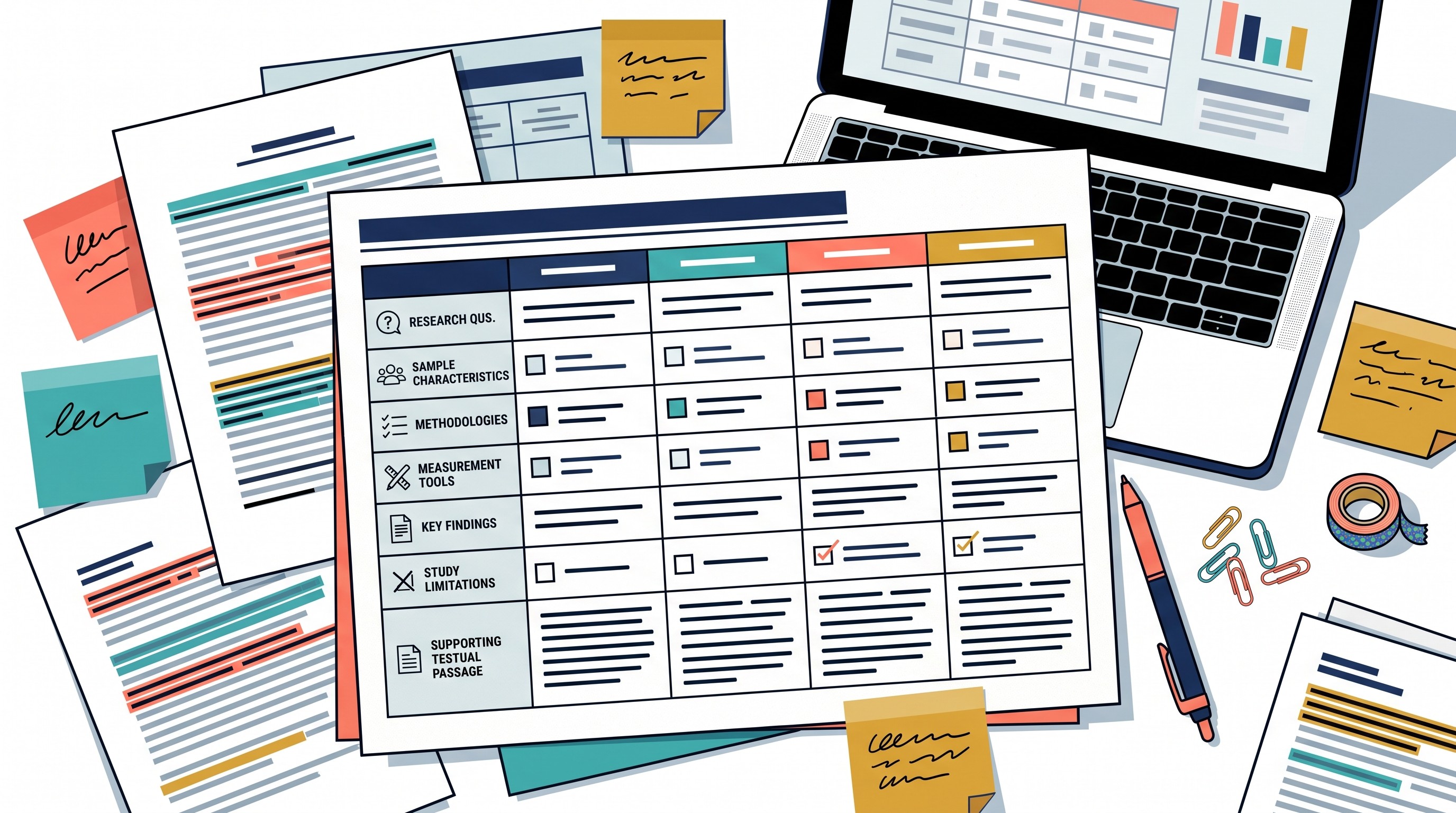
A good extraction record includes:
Citation details: author, year, title, journal or venue
Research question or aim: what the study set out to examine
Population or sample: who or what was studied, including sample size and relevant characteristics
Setting: country, institution type, clinical setting, market, platform, organization, time period
Study design: experiment, observational study, qualitative study, survey, case study, review, model, mixed methods
Methods: recruitment, data collection, analysis method, comparison groups
Measures: what the study actually measured, not just what it claims to study
Key findings: findings relevant to the synthesis question
Limitations: stated limitations and obvious constraints
Publication context: peer review status, funding, conflicts, disciplinary lens, dataset provenance where relevant
Supporting passages: exact page, section, quote, figure, or table behind any claim you may cite
Data extraction guidance for formal reviews makes the same underlying point: plan what will be extracted before extraction begins. A 2023 article on data extraction for complex systematic reviews emphasizes planning and creating structured databases for comparing studies (Afifi et al., 2023). The University of Pennsylvania’s evidence synthesis guide similarly recommends creating instructions so extractors know what data to capture and how to present it (University of Pennsylvania Libraries).
Even when you are not doing a systematic review, the discipline is useful. If one paper gets detailed notes on sample selection and another gets only a conclusion, your notes will create false differences. The synthesis will reflect uneven extraction rather than real variation in the evidence.
Be especially careful with similar-looking terms. Two studies may both discuss “engagement,” but one measures employee survey responses, another measures clickstream activity, and another measures interview themes. Treating those as the same outcome will distort the synthesis.
The same applies to populations. “Older adults,” “Medicare beneficiaries,” “patients over 65 with two or more chronic conditions,” and “retirement-community residents” may overlap, but they are not interchangeable.
A simple extraction framework can live in a spreadsheet, notes app, reference manager, or research workspace. For large or mixed-source projects, an evidence matrix helps because it makes comparability visible: papers down one side, shared fields across the top, and exact supporting passages attached to each claim.
A practical extraction rule: write findings as “study-specific claims,” not as final conclusions.
Weak extraction note:
“Hybrid work improves productivity.”
Better extraction note:
“In a survey of software engineers at large firms, self-reported productivity was higher among employees with two to three remote days per week, but the study did not measure code quality or long-term team coordination.”
The second note is longer because it preserves the conditions under which the finding is true. That is what lets you synthesize rather than flatten.
Compare methods, assumptions, data, and evidence strength
Many weak syntheses compare conclusions too early. They line up Paper A says X, Paper B says Y, Paper C says X, then declare a majority view.
That fails because papers often disagree at the level of design before they disagree at the level of conclusion.
Compare these features first:
Study design: Is the paper causal, descriptive, interpretive, theoretical, experimental, observational, or exploratory?
Assumptions: What does the paper assume about the mechanism, population, or outcome?
Sample selection: Who was included, who was excluded, and how were cases recruited?
Data source: Administrative data, survey data, interviews, lab measurements, field observations, claims data, scraped data, archival sources
Measures: Are the outcomes direct measures, proxies, self-reports, coded themes, or composite scores?
Comparison group: What is the paper comparing against?
Time period: Does the study capture short-term adaptation, long-term outcomes, or a specific policy window?
Analytical approach: Regression, thematic analysis, randomized assignment, matching, simulation, descriptive statistics, doctrinal analysis
Limitations: What can the design not establish?
Only after that should you compare findings.
Two papers can reach similar conclusions but provide different levels of support. A randomized field experiment and a cross-sectional survey may both report that an intervention improves retention. The experiment may support a stronger causal claim; the survey may still add useful external context or explain mechanisms the experiment did not measure.
The reverse is also true. A small qualitative study may not estimate population-wide effects, but it may explain implementation barriers that a large administrative-data study cannot see. Evidence strength is not the same as sample size alone.
Assess strength by asking:
Does the method fit the research question?
Is the sample appropriate for the claim being made?
Are the measures valid for the outcome?
Is the analysis transparent enough to evaluate?
Are plausible alternative explanations addressed?
Do the authors’ conclusions stay within the data?
Are limitations acknowledged and relevant to your use of the paper?
If methodology is the weak point in the paper set, pause before drafting. Otio’s guide to different types of research methods is a useful refresher for distinguishing designs before comparing conclusions.
A common synthesis failure is giving every paper equal weight because every paper has a citation. Citations are not votes. A strong synthesis explains why one paper speaks directly to the question while another offers background, mechanism, boundary conditions, or a competing interpretation.
[[OTIO_INLINE_PROMO:%7B%22title%22%3A%22Ready%20to%20compare%20your%20papers%20fairly%3F%22%2C%22description%22%3A%22Bring%20your%20paper%20set%20into%20one%20workspace%2C%20extract%20the%20same%20fields%2C%20and%20ask%20cross-source%20questions%20before%20weighing%20competing%20findings.%22%7D]]
Identify agreement, disagreement, and apparent contradictions
After extraction and method comparison, group findings into four categories.
Genuine agreement means studies answer similar questions, examine comparable populations or settings, use reasonably aligned measures, and point in the same direction.
Qualified agreement means studies broadly align but differ in scope, strength, mechanism, or context. This is common. For example, several papers may suggest that an intervention helps, but only in high-resource settings or only when implementation support is present.
Disagreement means studies appear to support different conclusions after accounting for design and context.
Unresolved evidence means the paper set does not support a clear conclusion, often because studies are too heterogeneous, too thin, or too indirect.
Do not force every paper into a verdict. Many useful syntheses are valuable because they show exactly where the evidence stops.
When findings differ, check for these causes before calling them contradictory:
Population differences: adults vs adolescents, urban vs rural, early-career vs senior professionals, high-risk vs general population
Setting differences: country, institution type, regulatory environment, platform, clinical site, organizational structure
Definition differences: what counts as “success,” “engagement,” “adherence,” “productivity,” “risk,” or “access”
Time-period differences: pre-policy vs post-policy, early adoption vs mature implementation, before vs after a market or regulatory shift
Intervention differences: similar label, different actual treatment or program
Comparison-group differences: compared with no intervention, standard practice, alternative intervention, historical baseline
Measure differences: direct outcome, proxy measure, self-report, administrative record, coded qualitative theme
Sample-size differences: underpowered estimates, rare outcomes, subgroup instability
Analytical choices: controls, model specification, coding framework, exclusion rules, robustness checks
Contradictory findings may reflect real effect variation across contexts. One study may be “right” for one population and misleading for another. The synthesis should identify that boundary rather than erase it.
Here is a useful sentence pattern:
“The studies agree that [claim], but the strength and scope of that claim differ because [study A] measures [outcome] in [population], while [study B] examines [different outcome or setting]. The evidence therefore supports [qualified conclusion], not [overbroad conclusion].”
Another pattern for disagreement:
“The apparent disagreement is partly methodological: [study A] estimates [effect] using [design], while [study B] analyzes [different data or measure]. The available evidence does not establish whether the difference reflects [possible explanation] or [alternative explanation].”
The non-obvious failure mode is averaging unlike studies too early. If five papers examine different populations, outcomes, and designs, a “most studies found X” sentence may create a false consensus. It is better to say: “Across studies, evidence for X is strongest in [context], weaker or indirect in [context], and unresolved for [population/outcome].”
Scientific disagreement is not noise to remove. It is often where the synthesis earns its value. Work on scientific disagreement has treated disagreement as something that can be systematically identified and studied rather than dismissed as a defect in the literature (eLife).
Organize the synthesis around claims, themes, or research questions
The draft should not follow the order in which papers were found. It should follow the logic of the synthesis question.
Useful structures include:
By claim: each section tests one claim against the relevant papers
By theme: each section covers a recurring theme, mechanism, or pattern
By outcome: each section compares evidence for one outcome
By population or setting: useful when effects vary sharply by context
By competing explanation: useful when the literature disagrees about why something happens
By research question: useful for multi-part reviews or reports
The basic paragraph structure is:
Start with the claim or theme.
Name the studies that bear on it.
Compare their methods, populations, measures, and findings.
Explain what the combined evidence supports.
State limitations or unresolved questions.
Attach citations to the specific claims they support.
Do not write paragraphs like this:
“Smith found X. Jones found Y. Patel found Z. Lee discussed a related issue.”
That is an annotated bibliography in paragraph form.
A synthesized version looks more like this:
“Evidence for X is strongest in studies that measure [specific outcome] in [specific population]. Smith and Patel both find [pattern], though Smith uses administrative data while Patel uses interviews to explain the mechanism. Jones reaches a weaker conclusion because the study measures [proxy] rather than [outcome]. Taken together, the papers suggest [qualified claim], but they do not establish [stronger claim].”
Citations should sit next to the claim they support. Avoid a long citation cluster at the end of a paragraph that contains several unrelated assertions. Readers should be able to tell which paper supports which sentence.
Use cautious language when the evidence calls for it:
“The evidence suggests…”
“In this population…”
“Across the included studies…”
“The studies differ on…”
“This finding is strongest when…”
“The available evidence does not establish…”
“A plausible explanation is…”
The University of Illinois Springfield describes synthesis as combining assertions, evidence, and commentary: the claim, the proof from sources, and the writer’s explanation of how the evidence connects (University of Illinois Springfield). That is a useful drafting standard. A synthesis paragraph needs all three.
Keep four things visibly distinct:
Summary: what a paper reports
Comparison: how papers align or differ
Interpretation: what the combined evidence means
Limitation: what the evidence cannot show
If those blur together, the synthesis starts making claims the papers may not support.
For a narrower guide to comparing sources inside a literature review, use Otio’s broader guide on how to synthesize sources. For this workflow, keep the focus on moving from a paper set to extraction, comparison, disagreement analysis, and cited drafting.
Use a multi-source workspace, then verify before drafting
The practical problem in synthesis is not just reading. It is keeping PDFs, database exports, web pages, notes, quotes, and draft claims connected long enough to reason across them.
A fragmented workflow creates avoidable errors. One paper sits in a PDF reader. Another is in Zotero. Notes are in a document. A few passages are pasted into a chat tool. A draft lives somewhere else. By the time you write, the citation trail is already weak.
A better workflow is to collect the relevant material in one multi-source library after discovery. Otio for academic research fits here as a permanent research workspace: PDFs, web pages, notes, video or podcast material, and other source files can sit in one project instead of being scattered across tabs and temporary uploads.
Use the workspace in stages.
1. Build the paper collection around the synthesis question
Create a project or space named after the synthesis question, not just the broad topic. Add the included PDFs, key web pages, relevant notes, and any supplementary material.
If sources came from a reference manager, cloud folder, or database export, preserve enough bibliographic information to trace each paper later. Renaming files consistently helps: author-year-short-title is boring but effective.
2. Read and inspect each source before asking cross-source questions
Use an AI PDF reader to inspect individual papers, search within PDFs, and ask source-specific questions. The goal is not to outsource judgment. The goal is to speed up orientation: locate methods, outcomes, limitations, and relevant passages.
Good source-specific questions include:
“What population and setting does this paper study?”
“What outcome measures are used?”
“What are the main limitations stated by the authors?”
“Which passage supports the finding about [specific outcome]?”
“Does the paper distinguish correlation from causation?”
Save useful excerpts with the source attached. A quote without source context becomes a liability during drafting.
3. Ask cross-source questions only after extraction is underway
Once each paper has a basic extraction record, ask questions across the collection:
“Which studies measure the same or similar outcomes?”
“Which papers study the same population but reach different findings?”
“Where do the papers define the key term differently?”
“Which findings are supported by experimental designs versus observational designs?”
“Which studies mention implementation barriers?”
“What limitations recur across the paper set?”
“Which sources support the claim that [specific claim]?”
These questions are useful because they operate on a structured collection. They are much weaker when thrown at a random pile of uploads with no extraction framework.
4. Use multiple models to challenge drafts, not to certify truth
Different AI models may catch different issues in a comparison. Otio’s multiple AI models can be useful for asking one model to generate a synthesis outline, another to critique overclaims, and another to identify missing comparisons.
But model agreement is not evidence. If three models say the same unsupported thing, it is still unsupported. Treat models as reading and drafting aids, not arbiters of study quality.
A useful model-checking workflow:
Ask one model to produce a theme-based synthesis outline.
Ask another to identify where the outline overstates causality or generalizability.
Ask a third to list claims that require passage-level verification.
Return to the original papers for every important claim.
5. Verify passages before drafting final claims
Before relying on an AI-generated comparison, open the original paper and check the relevant passage. Confirm five things:
The paper actually says what the note says.
The cited passage supports the specific sentence in the draft.
The finding is not limited to a subgroup you omitted.
The method supports the strength of the claim.
The citation points to the correct source, not merely a related one.
This is where many AI-assisted syntheses fail. The language sounds plausible, the citation looks scholarly, and the claim is close enough to the source to pass a quick glance. But “close enough” is not the standard for research synthesis.
6. Audit citations at sentence level
At the end, audit every important sentence. For each claim, ask:
Which paper supports this?
Is the claim descriptive, comparative, causal, or interpretive?
Does the cited source support that type of claim?
Is the citation attached to the right sentence?
Is a limitation missing?
Have I combined studies that measured different things?
Have I implied consensus where the evidence is mixed?
For longer projects, keep a source-to-claim checklist. Each row should contain the draft claim, supporting source, supporting passage, page or section, and any qualification that must stay with the claim.

This workflow keeps the human researcher in charge of the method. AI can help organize, retrieve, compare, and draft. It cannot guarantee that the paper set is complete, that the synthesis is unbiased, or that every citation supports every sentence.
Build your paper collection in Otio, extract comparable evidence, ask cross-source questions, verify the passages, and draft the cited synthesis from the same research workspace.
FAQ
Q: What is the difference between summarizing and synthesizing research papers?
A: A summary reports what one paper says. A synthesis connects multiple papers by comparing their methods, findings, limitations, contexts, and implications for a shared research question.
Q: How many research papers are needed for a synthesis?
A: There is no universal number. Use enough relevant papers to represent the main methods, populations, findings, and disagreements in the question, while keeping the inclusion criteria and comparison framework consistent.
Q: How should I handle papers that reach different conclusions?
A: First compare their populations, definitions, methods, measures, data, and time periods. Then explain whether the disagreement reflects different contexts, different evidence strength, or a genuinely unresolved question.
Q: Can AI synthesize research papers accurately without human checking?
A: AI can help organize sources and identify possible patterns, but it can omit qualifications, misread passages, or attach unsupported citations. Verify important claims against the original papers before using the synthesis.
[[OTIO_FOOTER_PROMO:%7B%22title%22%3A%22Apply%20this%20workflow%20to%20your%20own%20sources%22%2C%22description%22%3A%22Collect%20your%20PDFs%2C%20web%20pages%2C%20notes%2C%20and%20supporting%20passages%20in%20Otio%2C%20then%20verify%20each%20cross-source%20claim%20before%20drafting.%22%7D]]