
Document Review
How to Summarize Multiple PDFs With Citations and Source Context
Summarize multiple PDFs without losing source context. Follow a repeatable workflow for cross-document questions, traceable citations, contradiction checks, and human verification.

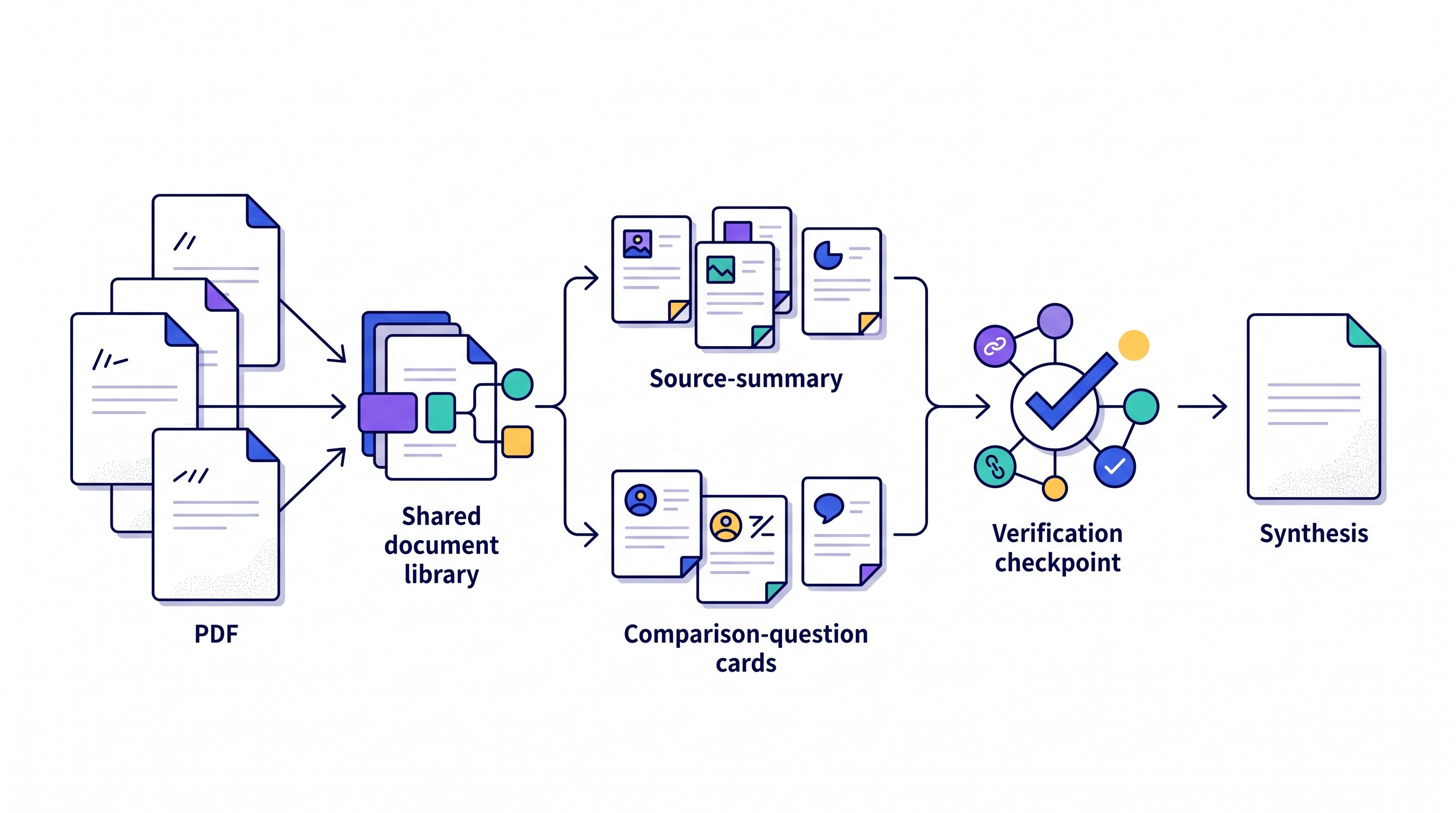
To summarize multiple PDFs without losing source context, put the files in one library, define one synthesis question, ask cross-document questions in stages, then verify every important claim against the cited passage. The output should not just be “a summary.” It should show which PDF supports which claim, where the support appears, and where the documents disagree.
There are two different jobs here. A document-by-document summary explains each PDF separately. A synthesis compares the set: shared findings, conflicting claims, limits, methods, populations, dates, and evidence gaps.
AI can help organize and draft that synthesis. It cannot make citations automatically trustworthy, and it cannot replace the researcher’s final judgment.
Updated October 13, 2026.
What a cited summary of multiple PDFs should contain
A useful cited summary has four parts:
A direct answer to the research question. Start with what the collection appears to show, not a tour of every document.
Source context. Each material claim should identify the source title or stable identifier, the relevant page or passage where available, and enough surrounding context to check whether the claim is fair.
Cross-document comparison. The summary should distinguish agreement, disagreement, partial overlap, different definitions, and evidence gaps.
A verification trail. A reader should be able to open the cited PDF passage and see why the sentence was written that way.
This is why “summarize these PDFs” is usually too broad. It encourages a model to compress everything into a single smooth answer, which is exactly where errors hide.
Academic writing centers make the same distinction in human terms: summarizing reports what a source says; synthesis uses sources together to support a larger claim or analysis. Southern Utah University’s writing guidance describes synthesis as drawing conclusions from evidence and considering how sources support a claim, rather than merely listing what each source says (Southern Utah University).
For document-level reading, search, and passage inspection, an AI PDF reader is most useful when it keeps the source visible while you ask questions. The summary is only as good as the trail back to the PDF.
1. Collect, name, and organize the PDFs before summarizing
Start by deciding which PDFs belong together. A stack of randomized documents produces a randomized synthesis.
Good collections usually share one research question, policy issue, legal matter, clinical topic, investment question, or analytical brief. Mixing background reports, empirical studies, slide decks, appendices, and outdated versions can be useful, but only if those roles are labeled.
Use filenames that preserve useful identifiers:
Author_2026_Method_Paper.pdfAgency_2026_Final_Report_Geography.pdfTrialName_Protocol_Version3.pdfCompany_Q2_2026_Investor_Deck.pdfCaseName_Expert_Report_Defendant.pdf
Before asking for a synthesis, record basic scope information for each file:
Publication or release date
Source type
Author, organization, or jurisdiction
Population, geography, or entity studied
Method or document purpose
Outcome, issue, claim, or recommendation examined
Version, supplement, appendix, or translation status
This prep work feels clerical. It prevents the common failure where a model treats a preprint, a regulator’s final guidance, a consultant report, and a supplementary appendix as if they carry the same evidentiary weight.
Import the files into one library rather than uploading them one at a time into disconnected chats. Otio’s workspace for academic research is built around this source-library model: PDFs can sit alongside notes, web pages, and other research materials so later questions preserve the relationship between the source set and the answer.
Check the PDFs before relying on summaries. Scanned documents, image-heavy reports, badly formatted files, tables, footnotes, equations, and two-column layouts can parse imperfectly. If the extracted text looks incomplete, inspect the original page rather than assuming the missing material is absent.
2. Define the synthesis question and scope
A multiple-PDF summary should answer a question, not compress a folder.
Write one primary question before prompting. For example:
“What do these studies conclude about intervention X, for which populations, and with what limitations?”
That question tells the system what to compare. Without it, the output tends to overrepresent abstracts, executive summaries, and repeated keywords.
Set inclusion boundaries before the first synthesis request:
Which PDFs count as evidence?
Which are background or context only?
Which dates, jurisdictions, populations, or versions are in scope?
Which outcomes matter?
Should older documents be treated as historical context or as current evidence?
Are methods and limitations part of the answer, or only findings?
Separate descriptive questions from evaluative questions. First ask, “What does each source report?” Then ask, “Where do the sources agree, differ, or support a stronger conclusion?” If you skip the descriptive pass, the synthesis may sound confident before the underlying source map is clear.
Add a scope statement to the final output. A professional reader should know what the summary includes, excludes, and cannot establish.
For example:
“This synthesis covers eight PDFs supplied in the project library: four empirical studies, two policy reports, one methods paper, and one appendix. It focuses on adult populations in the US and UK from 2020 onward. It does not include unpublished data, non-English sources, or formal risk-of-bias appraisal.”
That last sentence matters. This workflow supports synthesis, but it is not a systematic-review protocol, a formal evidence appraisal, or a substitute for subject-matter expertise.
3. Ask focused cross-document questions before requesting a final summary
Do not ask for the final synthesis first. Build it in passes.
Start with a source-by-source pass:
“Summarize each PDF separately. For each source, identify the research question or document purpose, population or subject, method, main findings, limitations, and the most relevant page or passage for the question.”
Then ask for a theme pass:
“Group the findings by recurring themes, outcomes, mechanisms, recommendations, or risks. Do not treat repeated keywords as proof of agreement. Preserve differences in definitions and scope.”
Then ask for agreement and disagreement:
“Identify which sources make compatible claims, which use different definitions, and which findings conflict. For each point, cite the source title or identifier and page or passage where available.”
Then ask for an evidence-gap pass:
“What questions do these PDFs not answer? Identify underrepresented populations, missing outcomes, inconsistent terminology, claims supported by only one source, and areas where the evidence is too heterogeneous to combine.”
The key is to force the model to preserve comparison variables:
Population
Method
Date
Geography
Sample
Intervention or exposure
Comparator
Outcome measure
Document type
Version or publication status
A strong bounded prompt looks like this:
Using only the PDFs in this collection, summarize each source separately, then compare their findings on [question]. For every material claim, provide the source title or identifier, page or passage when available, and enough context to verify the wording. Separate agreement, disagreement, limitations, and unresolved gaps. Do not infer a consensus where the documents differ.
That prompt is not magic. Its value is that it sets a contract: use the collection, preserve source identity, cite material claims, and keep disagreement visible.
If the PDFs are research articles, it also helps to decide the purpose of the summary before reading. The University of Connecticut Writing Center advises summarizers to determine their focus first because a summary written for notes is different from one written for critique or literature review work (UConn Writing Center).
[[OTIO_INLINE_PROMO:%7B%22title%22%3A%22Ready%20to%20map%20agreement%20and%20disagreement%3F%22%2C%22description%22%3A%22Put%20your%20PDFs%20in%20one%20Otio%20library%2C%20then%20ask%20for%20source-by-source%20findings%20before%20comparing%20themes%2C%20conflicts%2C%20limitations%2C%20and%20evidence%20gaps%20with%20citations.%22%7D]]
4. Build citations that preserve source context
A useful citation does more than decorate a sentence.
It should give the reader enough information to find the support:
Source title or stable identifier
Page number, section, table, figure, or passage where available
Relevant surrounding context
Any qualifier that changes the claim’s meaning
Whether the sentence is a direct finding, a cross-source comparison, or the researcher’s interpretation
Attach citations to individual claims, not to the end of a paragraph containing several different assertions. A paragraph that says “all studies found improvement, older adults benefited most, and adverse events were rare” may need three different citations, and perhaps three different caveats.
Texas A&M’s University Writing Center gives the basic rule: cite ideas, conclusions, information, words, visuals, or data derived from someone else, including paraphrases and summaries (Texas A&M University Writing Center). In a multiple-PDF synthesis, that rule becomes more demanding because several sources may support different parts of the same sentence.
Watch for citation drift. A citation may be generally relevant but fail to support the precise wording written in the summary.
For example:
The source says an association was observed.
The summary says the intervention caused the outcome.
The citation is real, but the claim is too strong.
Page numbers also need care. PDFs often have front matter, printed page numbers that differ from PDF page numbers, irregular pagination, appendices, or supplemental numbering. If the page number is ambiguous, include the section, table, figure, quote fragment, or other locator that makes the passage findable.
Keep source identity visible when documents have similar titles. Version differences matter: draft guidance, final guidance, revised appendices, translated editions, and supplemental materials may not support the same claims.
For readers who also need a broader summarization workflow beyond PDFs, Otio’s AI summarizer can sit in the same source-to-summary process. The main rule remains the same: the summary is not finished until the cited passages have been checked.
5. Handle difficult PDFs and non-comparable evidence
The hardest PDFs are not always the longest ones. They are the ones where important evidence lives in forms that text extraction handles poorly.
Scanned PDFs need special attention. Check whether the text is searchable. Check whether footnotes, captions, tables, equations, and marginal notes were captured. If the answer ignores a table that drives the conclusion, the summary may be clean but incomplete.
For tables and charts, ask for locators rather than free-floating numbers:
“Identify the table or figure number and describe only values you can locate clearly. For every numerical claim, cite the table, figure, page, or passage that supports it.”
Then verify against the original visual. Numbers are easy to distort when a table has subgroups, confidence intervals, excluded cases, footnotes, or multiple time points.
Terminology is another common trap. Two PDFs may use different labels for the same concept, or the same label for different concepts. Create a terminology map instead of silently normalizing the language.
For example:
“Treatment completion” in one study may mean attending all sessions.
In another, it may mean achieving a measured outcome.
In a policy report, it may mean administrative closure.
Those are not interchangeable. The synthesis should say how the terms differ.
Separate evidence that is genuinely comparable from evidence that only looks comparable. Apparent contradictions may be explained by:
Different populations
Different measurement instruments
Different time periods
Different endpoints
Different comparator groups
Different geographies
Different source purposes
Different study designs or document types
Treat conflicts as findings to investigate, not errors for the model to resolve. A single consensus paragraph requested too early can erase outliers, negative results, methodological differences, and uncertainty.
If the project depends heavily on scanned material, see Otio’s page on AI OCR for PDFs for the document-processing side of the workflow. OCR can help make image-based text usable, but it still needs inspection when the claim matters.
6. Draft the final professional summary in layers
A professional synthesis should be easy to audit. Use a structure that lets a reader move from scope to evidence to conclusion without guessing where claims came from.
A reliable structure is:
Scope and inclusion criteria
- What the collection includes
- What it excludes
- Which documents are evidence-bearing versus contextual
- Any parsing or source-quality issues
Document-by-document context
- Source purpose
- Date and version
- Method or document type
- Population, geography, or subject
- Main relevant finding
- Major limitation
Cross-source synthesis
- Themes organized by research question or issue
- Agreement and partial agreement
- Conflicting findings
- Terminology differences
- Source-specific caveats
Limitations and evidence gaps
- Limits inside the source documents
- Limits created by heterogeneous evidence
- Missing populations, outcomes, or time periods
- Ambiguous passages or incomplete extraction
- Claims supported by only one PDF
Cited conclusion
- What the collection supports
- What remains uncertain
- What should be checked, appraised, or researched next
Begin with the short answer. Then qualify it.
For example:
“The included PDFs suggest that intervention X is associated with improved short-term outcome Y in adult outpatient populations, but the evidence is uneven. Two randomized studies report positive effects, one observational study reports no significant association after adjustment, and the policy reports rely mainly on implementation data rather than outcome measurement.”
That paragraph is useful because it preserves both the answer and the conditions around the answer.
Give each document enough context to prevent detached findings. A result from a small pilot study should not sit next to a national administrative report as if the two have the same purpose. A legal memorandum, policy consultation, clinical trial, and market report can all be relevant, but they answer different kinds of questions.
The literature review handout from San José State University frames a literature review as a demonstration of research ability and expertise on a chosen topic, not a list of readings (SJSU Writing Center). That is the standard to aim for here: a synthesis that shows judgment, not just coverage.
For citation style, use the format required by your field or deliverable. For working research notes, the most important thing is traceability: source, location, and context. Formatting can be cleaned later; unsupported claims are harder to repair.
7. Run a human verification pass before using the summary
The verification pass is where a draft becomes usable.
Open every cited passage behind a consequential claim. Check whether the source supports the sentence’s wording, population, direction, strength, and scope.
Ask five questions for each important claim:
Does the cited passage actually say this?
Is the population or setting the same as the summary states?
Is the causal language too strong?
Are numbers, dates, and outcome definitions copied correctly?
Does another PDF in the collection complicate or contradict the sentence?
Pay special attention to words like “proves,” “demonstrates,” “all,” “none,” “significant,” “effective,” “safe,” “best,” and “consensus.” These often need softer language.
Replace overstatements with evidence-matched wording:
“The included sources report…”
“The available documents suggest…”
“Two studies found…, while one report states…”
“The evidence is mixed because…”
“The PDFs do not establish…”
Mark claims that require expert interpretation or formal appraisal. If a clinical, legal, policy, or financial conclusion depends on source quality, methodology, or professional standards, do not ask the summary to settle it automatically.
Keep the original PDFs and the verified draft together. A collaborator, reviewer, client, or future researcher should be able to retrace the reasoning without rebuilding the source set from scratch.
If the project grows beyond a summary, an evidence matrix can help. Otio’s guide to building an evidence matrix from multiple sources is the better next step when you need row-by-row comparisons across PDFs, web pages, and interviews.
Use Otio as the workspace after PDF discovery
The right place for Otio is after the PDFs have been found.
Discovery tools, databases, citation maps, and search engines help build the source set. Then the work changes: keeping the PDFs together, asking questions across them, inspecting cited context, saving useful excerpts, and drafting a synthesis that can be checked.
In Otio, the workflow looks like this:
Import the PDFs into one library or project space.
Add related notes, web pages, or supporting documents if they belong to the same question.
Ask a source-by-source question first.
Ask cross-document questions about themes, agreement, disagreement, methods, and evidence gaps.
Inspect inline citations and source context before relying on an answer.
Save useful answers, excerpts, or draft language into notes.
Retry ambiguous questions with another model when interpretation matters, then verify against the original PDF.
Model choice can help when a passage is ambiguous. Otio’s multiple AI models let a researcher compare how different systems interpret the same source set. But disagreement between models is not evidence that one answer is correct. It is a signal to reopen the source.
Otio does not replace discovery engines, systematic-review platforms, formal evidence appraisal, or subject-matter expertise. Its job is the multi-source workspace: PDFs, notes, and other materials in one place, cited answers across the collection, source-context inspection, and a durable record of the work.
Bring the PDFs you need to compare into Otio and ask a cited question across the collection.
FAQ
Q: Can AI summarize several PDFs into one answer with citations?
A: Yes, a research workspace can summarize several PDFs and attach citations or source references. The citations still need review: open the cited passages and verify the wording before relying on the synthesis.
Q: How should I prompt an AI to compare multiple research papers?
A: Ask for a source-by-source summary first, then request themes, agreement, disagreement, methods, limitations, and evidence gaps. Require the source title or identifier, page or passage where available, and surrounding context for every material claim.
Q: What should I do when two PDFs contradict each other?
A: Do not ask the AI to choose a winner without analysis. Compare the populations, methods, dates, definitions, outcome measures, and source quality, then report the disagreement and why it may exist.
Q: Can scanned PDFs be summarized reliably?
A: Sometimes, but scanned, image-heavy, and poorly formatted PDFs may produce incomplete or inaccurate text extraction. Check whether the relevant pages, tables, figures, and footnotes were parsed, and verify important claims against the original page images.
[[OTIO_FOOTER_PROMO:%7B%22title%22%3A%22Apply%20this%20workflow%20to%20your%20own%20sources%22%2C%22description%22%3A%22Import%20your%20PDF%20collection%20into%20Otio%2C%20ask%20a%20focused%20cross-document%20question%2C%20and%20verify%20each%20cited%20passage%20before%20using%20the%20resulting%20synthesis.%22%7D]]