
Qualitative Research
How to Analyze Interview Transcripts: A Source-to-Evidence Workflow
A rigorous workflow for analyzing interview transcripts: clean and anonymize data, build a codebook, code consistently, develop themes, compare participants, triangulate sources, and write traceable findings.

To answer how to analyze interview transcripts rigorously: clean and anonymize the transcripts, define the research question, build a codebook, code excerpts consistently, consolidate codes into themes, compare participants, triangulate with other sources, and write findings that link every claim back to evidence.
That is different from summarizing. A summary compresses what people said; analysis explains patterns, contrasts, conditions, meanings, and implications while preserving the trail back to the original words.
Interviews are also situated accounts. They are not automatically representative, causal, or objectively true. The defensibility of your findings depends on sampling, interview design, context, triangulation, and how clearly you state limits.
Updated October 12, 2026.
Start with the transcript-to-evidence workflow
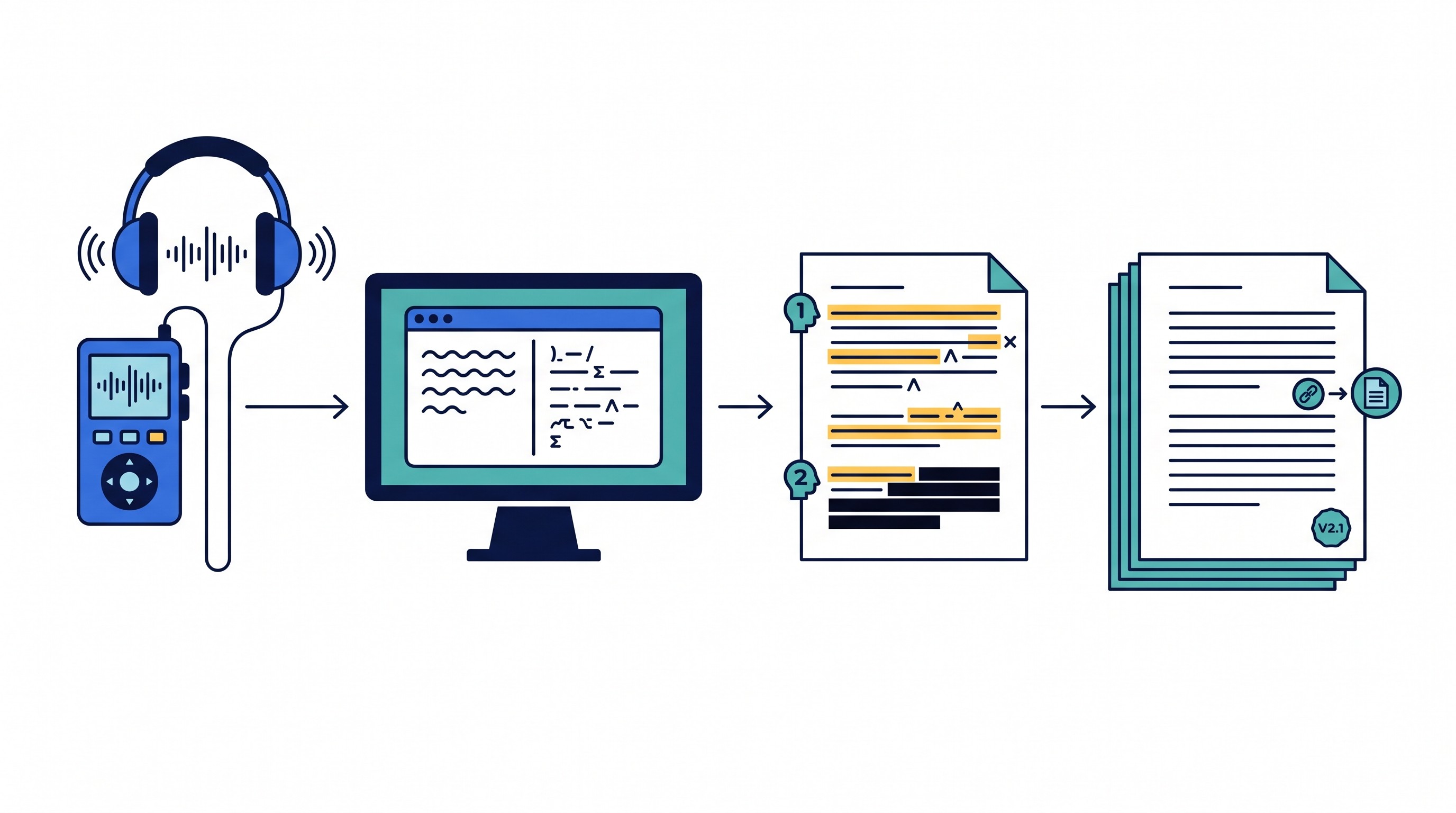
A useful interview transcript analysis workflow has seven outputs:
A cleaned, anonymized transcript corpus with speaker labels, timestamps or page references, and stable participant IDs.
A focused research question that defines the population, phenomenon, setting, timeframe, and analytic relationship.
A codebook with deductive codes from the study design and inductive codes from the data.
Coded excerpts tied to transcript locations, codebook versions, and analytic memos.
Themes that explain patterns across excerpts rather than merely naming topics.
Cross-case comparisons that show where participants converge, differ, contradict each other, or remain silent.
Written findings that distinguish participant claims, researcher interpretation, and support from external evidence.
A practical example: suppose interviews with frontline staff suggest that a new hospital discharge policy fails because staff “do not buy in.” That is not yet a finding. The analysis might show that buy-in varies by role, training access, shift pattern, local manager behavior, and conflict between policy language and actual patient-flow constraints.
The finding becomes stronger when interview excerpts are compared against the policy document, staff-training materials, administrative data, and published implementation research. The work moves from “people complained” to a qualified explanation of why implementation breaks under specific conditions.
Prepare and clean transcripts without losing context
Transcript preparation is not clerical cleanup. It shapes what can be interpreted later.
A typical interview can generate a substantial amount of text; Pope, Ziebland, and Mays note that transcribing one interview can take several hours and produce 20–40 pages of single-spaced text in qualitative health research (NIH/PMC). That volume makes early decisions about labeling, anonymization, and version control matter.
Start by checking the transcript against the recording or source file where appropriate. Correct obvious transcription errors. Mark uncertain words with a consistent convention rather than silently guessing.
Preserve context that affects interpretation:
Speaker labels: interviewer, participant, translator, observer, or group member.
Turn-taking: especially where interruptions, hesitation, or interviewer prompts shape the answer.
Timestamps or page references: enough to locate the excerpt again.
Interview prompts: so an answer is not mistaken for a spontaneously raised issue.
Pauses, laughter, emphasis, or nonverbal notes: only when they matter to the method and research question.
Links to source files: recording, transcript version, consent restrictions, field notes, or interview memo.
Digital transcription does not remove the need for checking. Eftekhari and colleagues’ discussion of digital-age transcription practice states plainly that transcripts required checking and cleaning (NIH/PMC). Treat automated transcripts as draft data, not final analytic material.
Anonymize identifying details according to the approved protocol. That may include names, employers, locations, patients, clients, job titles, rare events, or combinations of details that make a person identifiable. If a controlled re-identification key is required, store it separately with restricted access.
Use stable names from the start:
P01_frontline_nurse_v1_rawP01_frontline_nurse_v2_checkedP01_frontline_nurse_v3_anonymizedP01_memo_post_interviewcodebook_v0.3_2026-10-12
The point is not bureaucratic neatness. It is auditability. If a quotation appears in a report six weeks later, you should be able to identify the transcript version, speaker, page or timestamp, code, and analytic memo that led to the claim.
For source-heavy projects, transcripts rarely sit alone. A permanent workspace such as Otio for academics can keep interview transcripts, field notes, PDFs, policy documents, case materials, and web sources in the same project library. That matters once analysis depends on comparing what participants said with what documents and prior research show.
Define the research question and unit of analysis
Do not start coding before you know what question the codes serve.
A broad aim like “understand staff experiences with the new discharge policy” is too loose for reliable analysis. Turn it into an analytic question:
Population: Which staff, patients, clients, institutions, or communities?
Phenomenon: What experience, process, decision, barrier, practice, or meaning?
Setting: Which organization, region, ward, market, court, program, or policy context?
Timeframe: Before implementation, during rollout, after review, post-crisis?
Relationship or process: What are you trying to explain, compare, or interpret?
For example:
“Among emergency department nurses in two urban hospitals, how do shift patterns and discharge-planning responsibilities shape perceived barriers to implementing the 2026 discharge policy?”
A clear question governs the rest of the study. Guidance on research questions, aims, and objectives notes that subsequent research steps develop from the question and that it shapes choices about population, setting, data, and time period (University of the West Indies). For more general examples, see Otio’s guide to research questions examples, but keep the transcript analysis anchored to the specific study.
Next decide the unit of analysis. Coding every sentence with the same rule can produce false precision. The unit should fit the question.
Possible units include:
Phrase: useful for repeated terms, metaphors, or emotionally charged language.
Sentence: useful for concise claims or explanations.
Speaking turn: useful where question-and-answer structure matters.
Episode or story: useful when sequence and meaning unfold over several turns.
Case: useful for comparing whole participants, teams, organizations, or sites.
Interaction: useful for focus groups or interviews where co-construction matters.
A participant-by-participant implementation study may treat the whole interview as the case, but code excerpts within each case. A discourse-oriented study may treat the speaking turn or interaction as the unit. A policy evaluation may code episodes where participants describe breakdowns in the implementation process.
Record the study design before interpretation: sampling logic, recruitment method, interview conditions, researcher role, relationship to participants, and relevant context. Without that record, it becomes too easy to overread patterns that come from who was interviewed, how questions were asked, or what participants believed the interviewer wanted to hear.
Build a codebook that combines deductive and inductive coding
A codebook is the bridge between raw transcript and defensible analysis. It tells the research team what counts as evidence for a concept.
Start with deductive codes from the research question, conceptual framework, interview guide, prior literature, policy categories, or operational definitions. In the discharge-policy example, deductive codes might include “training access,” “role clarity,” “handoff process,” “policy awareness,” and “time pressure.”
Then add inductive codes that emerge from the transcripts. These may capture unexpected practices, recurring language, tensions, workarounds, emotions, explanations, or experiences. Examples might include “informal shadow systems,” “fear of readmission blame,” “workarounds through senior staff,” or “policy as paperwork.”
Hybrid coding is normal. Qualitative content analysis commonly uses deductive, inductive, or combined approaches, as Kaur and colleagues describe in their discussion of hybrid coding and reflexivity (NIH/PMC). The rigor comes from documenting how codes were created, revised, and applied.
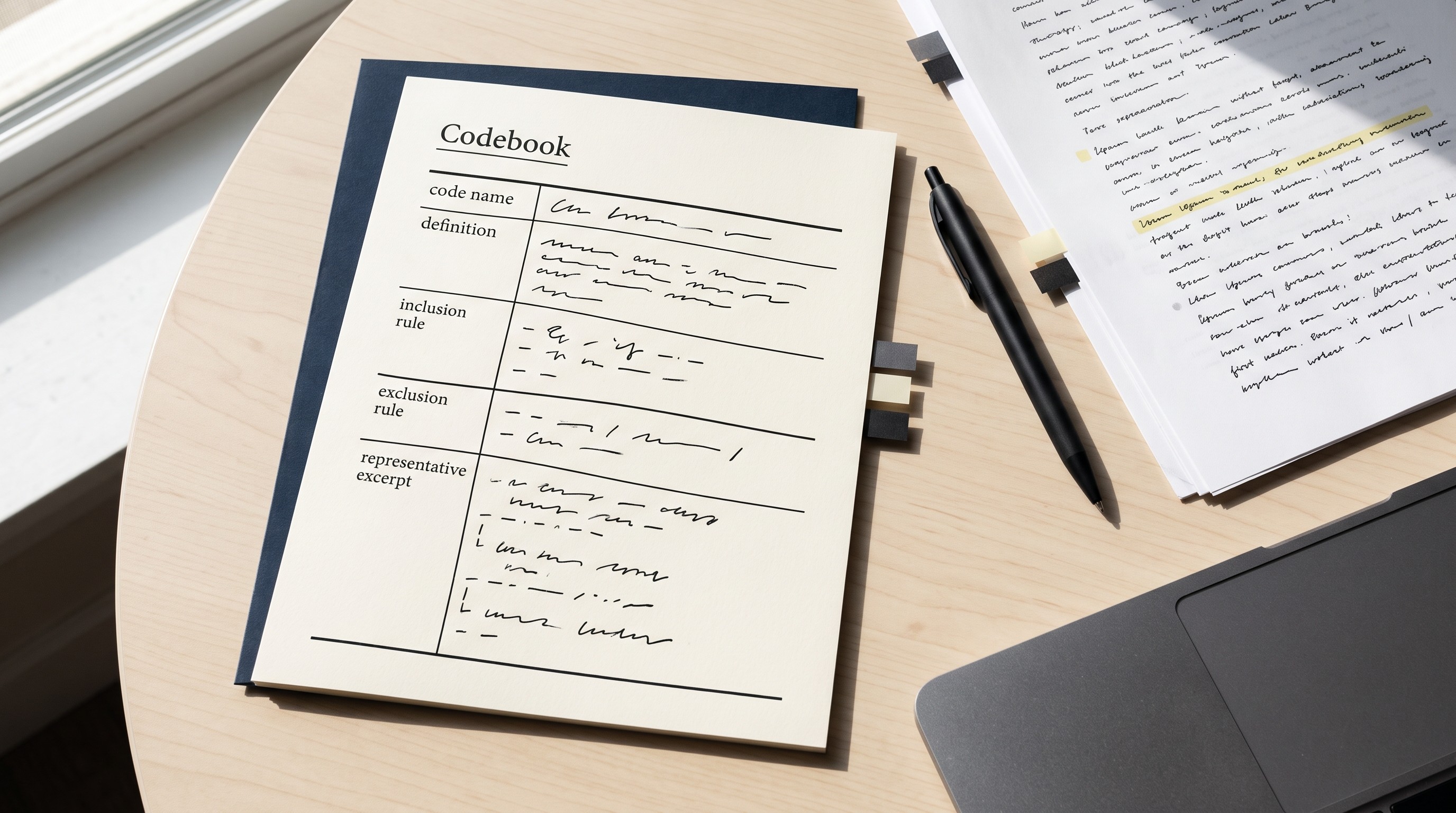
For each code, include:
Code name: short and stable.
Definition: what the code means in this study.
Inclusion criteria: what should be coded here.
Exclusion criteria: what belongs elsewhere.
Example excerpt: a representative passage.
Related codes: overlapping or adjacent concepts.
Ambiguities: common edge cases and how to handle them.
Distinguish descriptive codes from interpretive themes. The University of Illinois guide defines coding as assigning a descriptive label to aspects of qualitative data so related content can be identified (University of Illinois Library). A theme goes further: it explains a meaningful pattern or relationship across coded material.
Example:
Descriptive code: “Training not received”
Category: “Implementation support gaps”
Theme: “The policy was experienced as mandatory accountability without operational preparation”
Pilot the codebook on a small, varied sample of transcripts. Choose interviews that differ by participant type, setting, and expected perspective. Record disagreements, uncertainty, and proposed changes in a memo.
Revising the codebook is not a flaw. It is part of rigorous qualitative work if you retain dated versions, explain why definitions changed, and revisit earlier transcripts when needed.
Code consistently while writing analytic memos
Coding is not just tagging. It is repeated comparison.
Apply codes to relevant excerpts consistently. Allow overlapping codes when a passage addresses more than one analytic idea. A participant describing “no training, no time, and managers only checking forms” may reasonably receive codes for training, time pressure, managerial accountability, and implementation burden.
Write memos while coding. Do not wait until the end.
Good memos capture:
Hypotheses forming during analysis.
Contradictions between participants.
Tensions between interview accounts and documents.
Positionality and possible researcher assumptions.
Contextual conditions that may explain a pattern.
Questions for later checking.
Reasons for changing a code definition.
Candidate negative cases.
Compare similar passages across participants. The first vivid quotation is not proof of a general pattern. It is a lead to test.
If the project supports it, use a second researcher, peer debrief, or structured self-audit. In practical public-health guidance, Michelen and colleagues recommend paired indexing, where two coders independently index the same transcript and assess intercoder agreement (NIH/PMC). Not every qualitative design treats agreement statistics the same way, but the broader principle is durable: expose coding decisions to disciplined checking.
Do not claim software or AI establishes reliability by itself. Tools can help organize, search, and compare excerpts. They do not decide whether an interpretation is valid for the research design.
Maintain an audit trail connecting:
Transcript ID
Transcript version
Speaker
Timestamp or page
Excerpt
Code
Codebook version
Memo
Candidate theme
Final claim
That trail is what lets a reader, supervisor, reviewer, or client see how the analysis moved from source material to interpretation.
Consolidate codes into themes and test rival interpretations
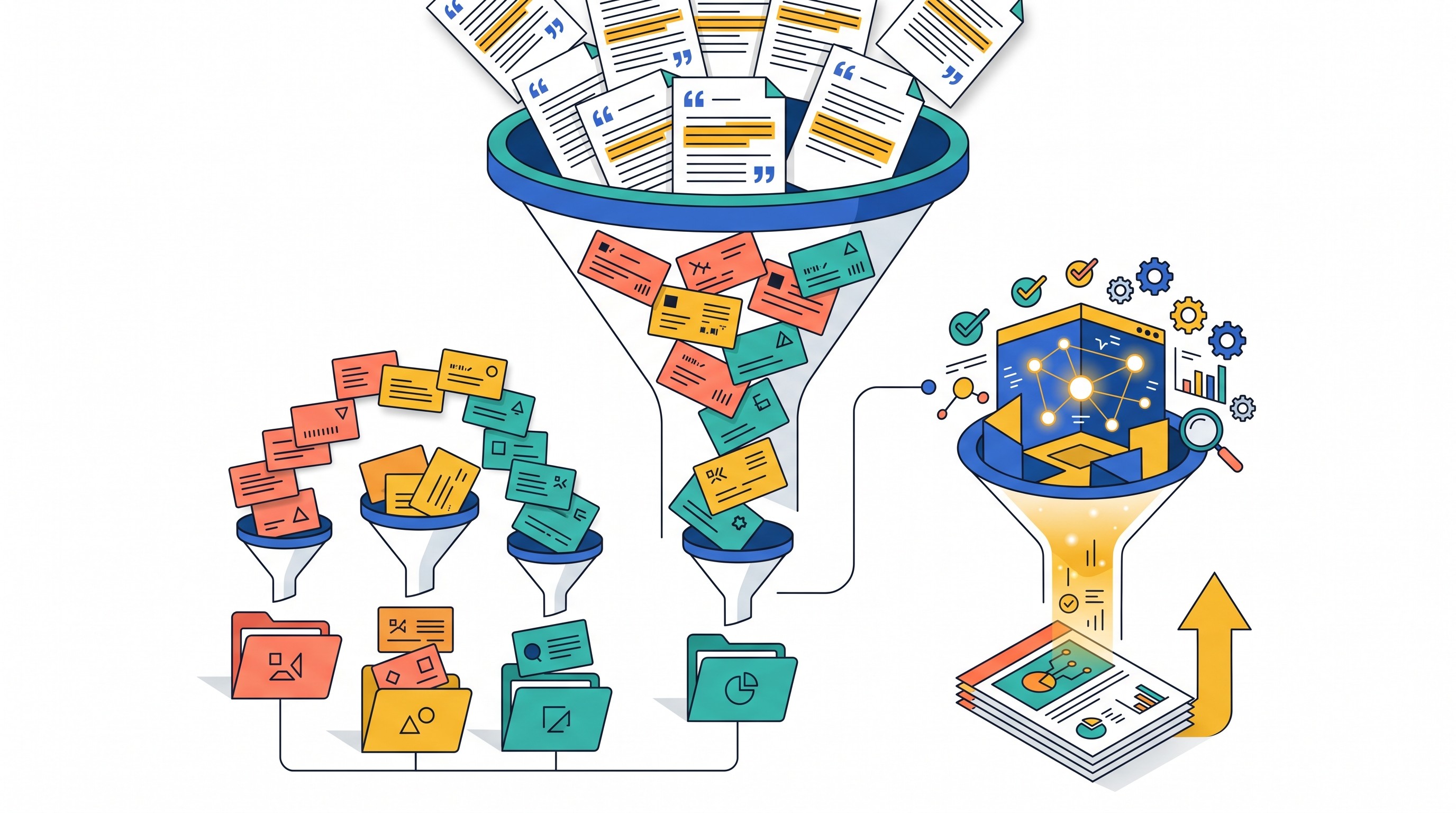
Once coding stabilizes, step back from individual tags. Cluster related codes into candidate themes.
A weak theme names a topic: “communication problems.” A stronger theme explains a pattern: “Communication failures occurred at role boundaries where formal policy assigned responsibility but local workflow left no clear owner.”
For each candidate theme, write one sentence that states:
What the theme explains.
Whom it applies to.
Under what conditions it appears.
What evidence supports it.
What evidence complicates it.
Then test the theme.
Ask:
Internal coherence: Do the excerpts grouped under this theme actually belong together?
Boundary clarity: Is this theme distinct from adjacent themes?
Evidence sufficiency: Are there enough relevant excerpts, or just one striking case?
Fit to question: Does it answer the research question?
Variation: Does it appear differently by role, site, time period, or case type?
Negative cases: Which participants contradict it?
Actively search for deviant, contradictory, and outlier cases. They are not nuisances to hide. They often reveal boundary conditions.
A contradiction might mean:
The theme applies only to one subgroup.
The interview guide prompted different evidence across participants.
A site-level factor changes the mechanism.
The interpretation is too broad.
The sample is missing a relevant perspective.
The participant’s account conflicts with documentary evidence.
Preserve the distinction between participant language, researcher interpretation, and external evidence. If participants say “management never trained us,” that is an interview claim. If training records show a one-hour online module was assigned but not completed, the finding may become: “Staff experienced the training regime as absent or unusable, despite formal documentation that a module existed.”
Compare interviews across participants and groups
Cross-case comparison is where many transcript analyses become either powerful or sloppy.
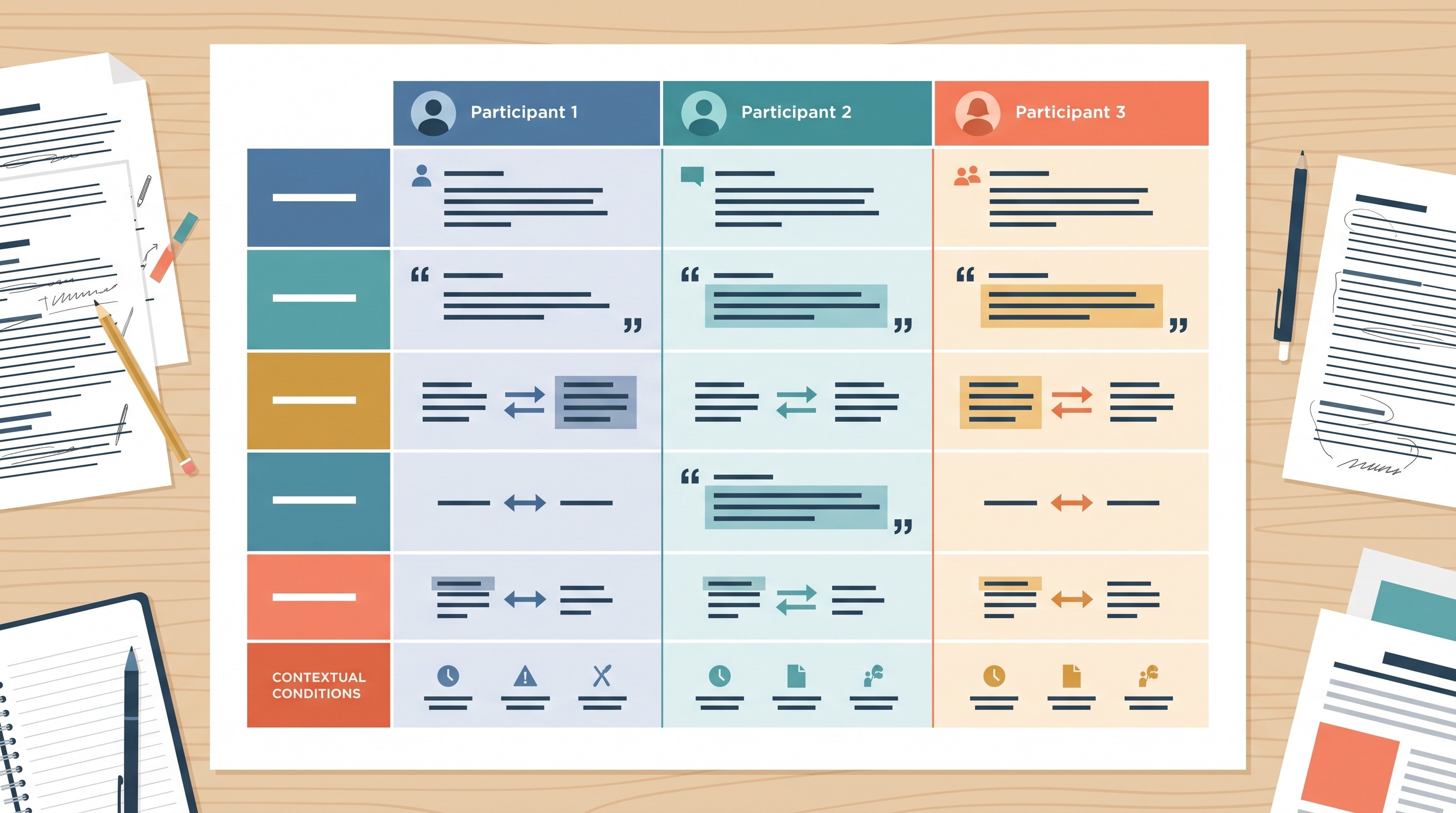
Create a participant-by-theme matrix or structured evidence map. Rows can be participants, cases, teams, institutions, or sites. Columns can include themes, conditions, supporting excerpts, contradictions, missing data, and follow-up questions.
A useful matrix cell does not need to be long. It should preserve enough evidence to support interpretation:
Participant ID or case.
Relevant role or group.
Theme or code cluster.
Short paraphrase.
Key excerpt location.
Contextual condition.
Contradiction or uncertainty.
Memo link.
Compare within cases before comparing across cases. Each participant’s account has sequence and internal logic. If you flatten all excerpts into themes too early, you may miss that a participant first endorsed a policy, then described workarounds that undermine it, then blamed resource constraints rather than the policy itself.
Use group comparisons only when sampling and interview design support them. If you interviewed two nurses, one administrator, and one patient advocate, do not write “nurses differed from administrators” as if you had sampled groups adequately. Write the narrower claim: “In this sample, the two nurse interviews emphasized time pressure, while the administrator interview emphasized compliance documentation.”
Track missing data explicitly. A blank matrix cell can mean several different things:
The topic was not asked.
It was asked but not mentioned.
The answer was unclear.
The participant had no relevant experience.
The transcript section was unusable.
The topic was genuinely absent from that case.
Do not fill gaps with assumptions. In qualitative analysis, “not mentioned” is not always evidence of absence.
For larger multi-source projects, the same logic extends beyond interviews. Otio’s guide to building an evidence matrix from multiple sources covers the broader evidence-mapping structure; for transcript analysis, keep the matrix close to participant context and excerpt-level traceability.
[[OTIO_INLINE_PROMO:%7B%22title%22%3A%22Ready%20to%20map%20convergence%20and%20contradiction%3F%22%2C%22description%22%3A%22Keep%20each%20participant%E2%80%99s%20excerpt%2C%20case%20label%2C%20and%20transcript%20reference%20together%2C%20then%20compare%20the%20matrix%20with%20policy%20and%20literature%20sources%20in%20Otio.%22%7D]]
Triangulate interview findings with other sources
Interview findings get stronger when they are compared with other evidence. That does not mean treating documents or quantitative data as automatically truer. It means examining how different sources relate.
Possible sources include:
Academic literature
Policy documents
Internal guidance
Case files
Administrative records
Quantitative survey data
Observations or field notes
Meeting minutes
Public reports
Legal or regulatory materials
Classify relationships between sources:
Convergence: interviews and other sources point to the same pattern.
Complementarity: sources describe different parts of the same process.
Contradiction: sources make claims that are in tension.
Silence: one source type says nothing about an issue raised elsewhere.
A policy document may describe formal expectations while interviews reveal informal implementation practices. Neither source automatically cancels the other. The analytic task is to explain the relationship.
For every cross-source claim, record:
Source type
Source date
Scope
Authority
Limitation
Exact supporting passage or data point
Relationship to interview evidence
Researcher inference
Example:
Interviews: frontline staff describe discharge planning as “owned by whoever is on shift.”
Policy: formal document assigns responsibility to a named discharge coordinator.
Administrative data: coordinator coverage exists only weekdays.
Finding: “The formal ownership model breaks down during weekend shifts, where staff accounts and staffing data indicate responsibility shifts informally to available nurses.”
For literature-heavy projects, see Otio’s guide to comparing sources in a literature review. The transcript-specific version should keep participants’ accounts separate from documentary claims and researcher inference until the final finding is written.
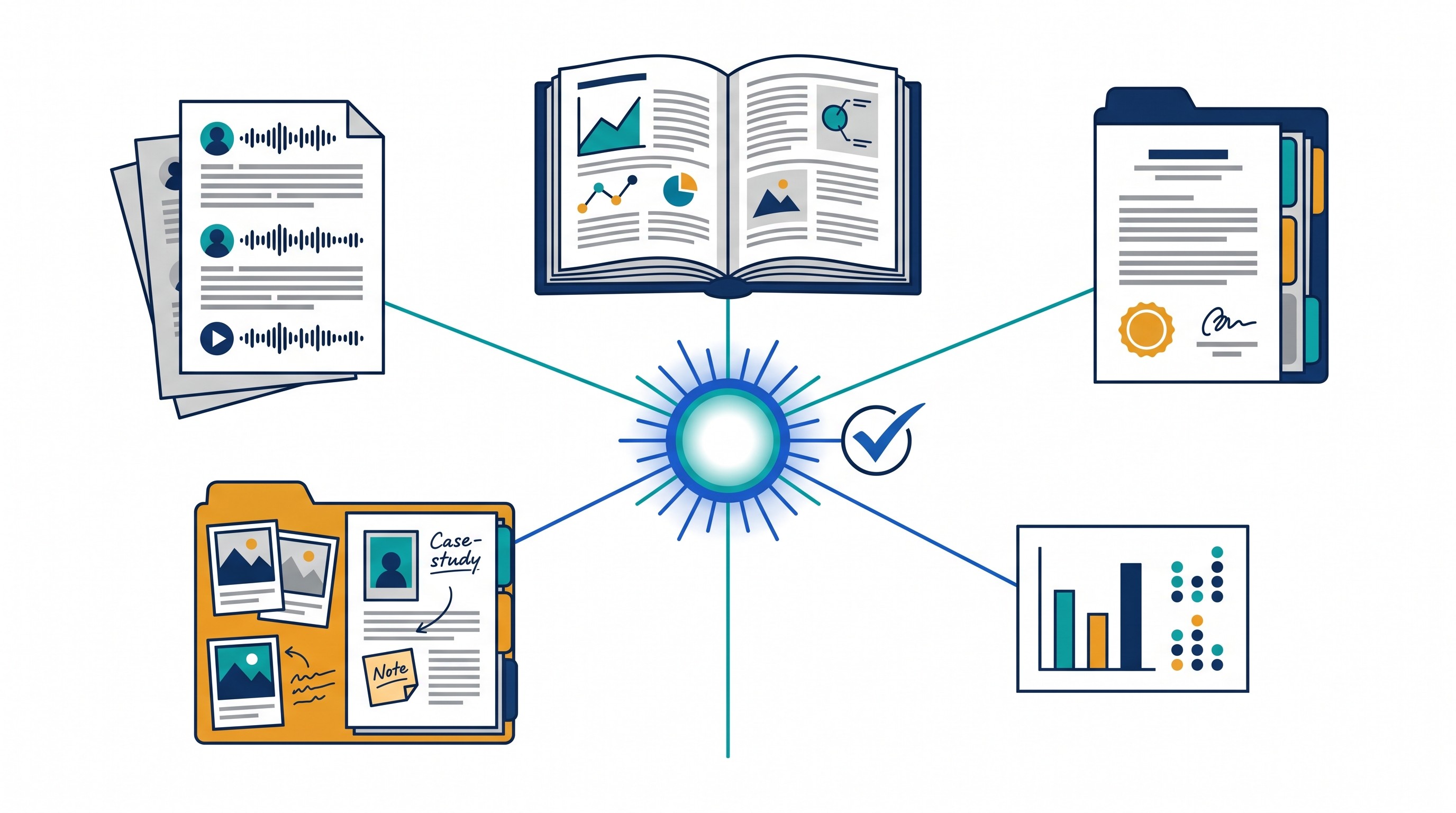
In Otio, researchers working in fields such as policy research or medical evidence review can keep transcripts beside policies, PDFs, notes, web pages, and case materials. That supports the practical work of asking cited questions across a corpus and checking whether a finding is grounded in the right source type.
Use AI to assist analysis without outsourcing interpretation
AI can help with bounded transcript-analysis tasks. It should not replace qualitative judgment.
Good uses include:
Suggesting preliminary codes for a small transcript sample.
Finding passages related to a defined concept.
Clustering similar excerpts for review.
Identifying apparent contradictions.
Producing a first-pass participant-by-theme comparison.
Checking whether a proposed theme has counterexamples.
Summarizing what one participant said about one topic, with transcript references.
Weak uses include:
“Find the themes” without a codebook or research question.
Asking for conclusions without source references.
Treating AI output as evidence.
Ignoring the surrounding transcript context.
Letting the model collapse distinct participant groups.
Using AI-generated themes without documenting the role of AI in the audit trail.
Give the system a bounded task, a source boundary, and an output format. For example:
Task: find excerpts about role confusion.
Source boundary: only transcripts P01–P05.
Code definition: role confusion means uncertainty over who owns a discharge-planning task.
Output: participant ID, timestamp or page, quoted excerpt, brief reason for inclusion, uncertainty flag.
Then check every suggestion against the original transcript. Look at the surrounding turns, speaker identity, interviewer prompt, anonymization decisions, codebook definition, and research question.
If AI assistance materially affects the analysis, retain accepted, rejected, and modified suggestions in the audit trail. That record matters more than a generic statement that “AI was used.”
Otio fits after transcription as a permanent multi-source research workspace. You can keep transcripts, notes, literature, policies, and case materials in one library; ask cited questions across the collection; compare source excerpts; and switch among Multiple AI models for different analytic passes.
Set the boundary clearly: Otio can support source comparison, cited questioning, notes, and evidence tracing. It is not a dedicated qualitative coding platform, a systematic-review platform, or a substitute for researcher interpretation.
Write findings that preserve evidence and uncertainty
A good finding is not a pile of quotations. It is a claim supported by a pattern of evidence.
Structure each finding around:
Claim: the analytic point.
Pattern or mechanism: what explains the finding.
Evidence: representative excerpts and source references.
Variation: who differs, when, and under what conditions.
Triangulation: how other sources support, qualify, or contradict the interviews.
Limits: what the data cannot show.
Introduce quotations with enough context. A quotation from “P04, nurse manager, Hospital B” means more than a floating sentence. Include role, case, setting, or study identifier where appropriate and ethically safe.
Use paraphrase for broad patterns. Use direct quotations for distinctive language, tensions, metaphors, or moments where the participant’s wording is analytically important.
Avoid making a single excerpt carry more weight than it can bear. If only one participant described a problem, say so. If the issue appeared across cases but in different forms, explain the variation.
A defensible write-up might read:
“Across four of six frontline interviews, participants described discharge planning as formally standardized but practically improvised during high-volume shifts. P02 described ‘finding whoever knows the patient best’ when the coordinator was unavailable, while P05 linked the same workaround to weekend staffing. The policy document assigns ownership to the discharge coordinator, but the staffing schedule indicates that role was not consistently available outside weekdays. This suggests the implementation problem was less resistance to policy than a mismatch between formal responsibility and actual coverage.”
That paragraph does several things at once. It states a pattern, gives the scope, uses quotation selectively, triangulates with documents, and avoids claiming more than the data support.
Report uncertainty directly:
Sampling boundaries
Nonresponse or missing perspectives
Interviewer effects
Translation choices
Coding changes
Contradictory cases
Unresolved source conflicts
Limits of transferability
The practical next action is simple: build a small audited corpus, pilot the codebook, create a participant-by-theme matrix, then bring the transcripts and supporting sources into Otio to compare evidence, ask cited questions across the collection, and keep the analysis in one research workspace.
FAQ
Q: What is the difference between coding interview transcripts and identifying themes?
A: Coding labels meaningful portions of transcript data, while themes are broader patterns or interpretations built by examining relationships among codes. A theme should explain something relevant to the research question, not merely name a frequently mentioned topic.
Q: Should qualitative interview analysis use deductive or inductive coding?
A: Many rigorous projects use both. Deductive codes provide a framework from the research question or prior theory, while inductive codes capture unexpected ideas that emerge from participants’ accounts; the codebook and revisions should be documented.
Q: Can AI analyze interview transcripts for me?
A: AI can assist with bounded tasks such as suggesting codes, clustering excerpts, or comparing defined sources, but the researcher must verify context, interpretations, quotations, and methodological fit. AI should not replace qualitative judgment or source review.
Q: How do you make interview transcript findings defensible?
A: Preserve an audit trail with transcript references, speaker labels, anonymization, codebook versions, analytic memos, negative cases, and links between claims and excerpts. Triangulate interviews with appropriate external sources and state sampling and interpretive limitations.
[[OTIO_FOOTER_PROMO:%7B%22title%22%3A%22Apply%20the%20workflow%20to%20your%20research%20sources%22%2C%22description%22%3A%22Add%20your%20transcripts%2C%20field%20notes%2C%20policies%2C%20case%20materials%2C%20and%20literature%20to%20Otio%20to%20ask%20cited%20comparison%20questions%20while%20checking%20every%20interpretation%20against%20the%20originals.%22%7D]]
Related reading
How to Build an Evidence Matrix From PDFs, Web Pages, and Interviews
How to Compare Sources in a Literature Review: Evidence, Themes, and Contradictions
20 Best Qualitative Data Analysis Tools for Coding Interviews and Field Notes
Otter.ai Alternatives for Research Interviews and Lecture Transcripts
Personal Knowledge Management for Researchers: A Source-to-Notes Workflow