
Research Planning
how long does it take to write a research paper? A Planning Framework
A research paper may take days to several weeks depending on scope, sources, method, and revision requirements. Use this stage-by-stage planning framework to estimate the work and build a realistic writing timeline.

A useful answer to how long does it take to write a research paper is: a short source-based course paper may fit into several focused days, a substantial seminar paper often needs a few weeks, and a paper involving original data can require weeks or months. The real estimate comes from the work stages, not the page count.
Plan backward from the deadline and price the project in deliverables: a bounded question, a source shortlist, an evidence matrix, an outline, a draft, checked citations, and a final proofread. If any of those are missing, the paper is not “almost done” just because the document has pages.
How long does it take to write a research paper?
There is no universal timeline because “research paper” can mean three different jobs: explaining existing sources, building an argument from a large literature, or reporting original research. Treat the timeline as a project plan, not a typing estimate.
Here are three practical scenarios.
Paper type | Plausible working timeline | Assumptions | Main risk |
|---|---|---|---|
Short course paper | 3–7 focused workdays | Topic is assigned or easy to narrow; 4–8 sources; no original data; familiar citation style | Research expands and consumes drafting time |
Substantial seminar paper | 2–4 weeks | 12–25 sources; independent research question; multiple revision passes; instructor feedback possible | Argument changes after reading more sources |
Original-data research paper | Several weeks to months | Data collection, method design, analysis, ethics or supervisor review may be required | Method or data problems force a redesign |
These are planning scenarios, not averages. A five-page paper on a difficult archival topic can take longer than a 15-page paper on material you already know. Page count measures the final container; it does not measure the time spent finding credible sources, deciding what counts as evidence, or checking whether every claim is supported.
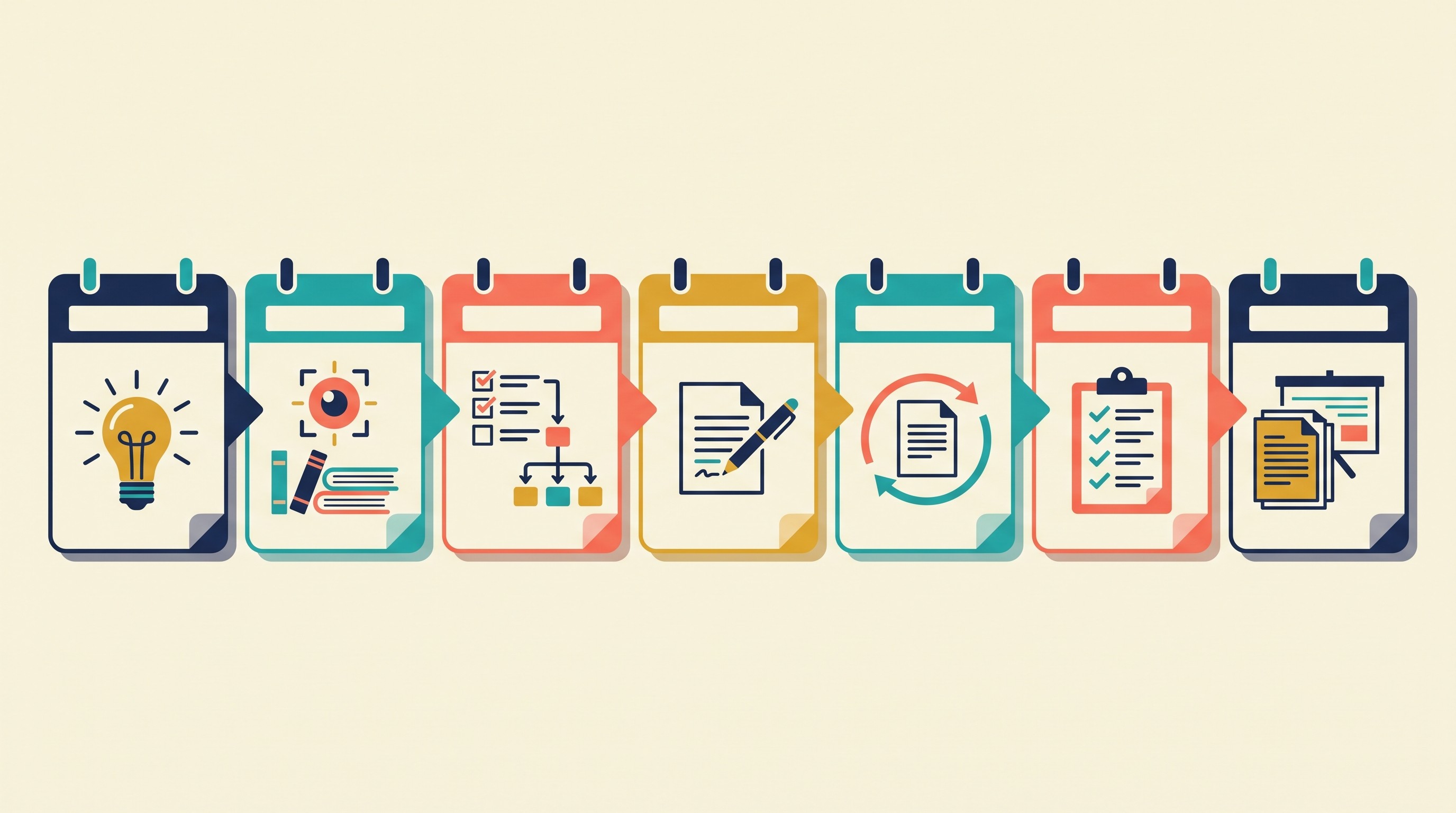
If you are comparing this with adjacent workflows, a general guide to how long to write a research paper can help with speed and execution, while a separate literature review timeline is better if your main task is synthesis rather than producing a full paper with a thesis, method, or original argument.
What determines a research paper writing timeline?
The timeline expands or contracts based on the slowest constraint in the project. Usually, that constraint is not the first draft.
The main variables are:
Assignment length and deadline: longer papers need more structure, but deadline pressure determines how much research and revision you can actually do.
Subject familiarity: familiar material shortens reading time and reduces false starts.
Research-question clarity: a vague question makes every later stage slower.
Source availability: paywalls, missing full texts, poor indexing, or scattered archives add hidden time.
Required evidence: a paper based on peer-reviewed studies, legal authorities, primary sources, or datasets takes longer than one based on assigned readings.
Citation style: APA, MLA, Chicago, legal citation, and discipline-specific formats all require different checks.
Original data collection: surveys, interviews, experiments, fieldwork, coding, or statistical analysis can dominate the schedule.
Feedback cycles: coauthors, supervisors, teaching assistants, or peer-review groups add waiting time and revision time.
Number of revision rounds: a polished paper usually needs more than one pass: argument, structure, evidence, citations, and prose.
The key distinction is discovery work versus writing work. Drafting the sentences may take a day or two. Finding the right sources, reading them well enough to avoid misusing them, and organizing evidence can take much longer.
A common edge case: the topic looks narrow but becomes slow because the vocabulary is unstable. For example, different fields may use different terms for the same concept, older studies may use outdated language, and newer papers may be hidden behind paywalls. The result is repeated searching with no stable source set. That is a scope problem, not a productivity problem.
Before estimating time, read the assignment rubric and method requirements as planning inputs. Look for:
required number or type of sources
whether sources must be peer-reviewed
whether primary sources are required
whether a method section, results section, or dataset is expected
citation style and formatting rules
required draft, proposal, or annotated bibliography checkpoints
grading weight for originality, analysis, organization, and mechanics
If the rubric rewards analysis, reserve more time for outlining and revision. If it rewards source quality, reserve more time for search and reading. If it requires a method, do not treat the paper as a normal essay with citations attached.
How to break a research paper into manageable stages
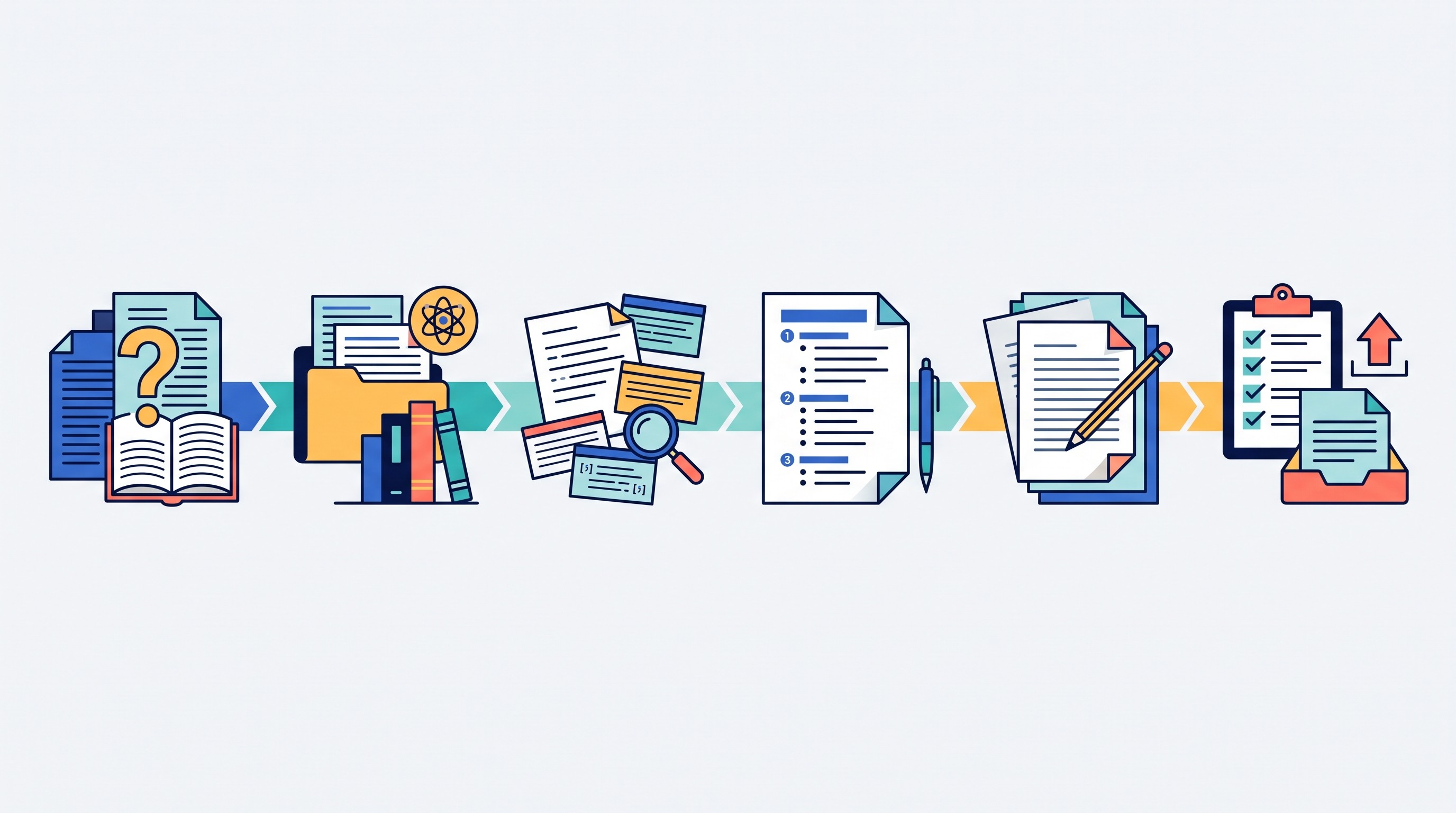
The simplest way to plan a research paper is to assign a deliverable to each stage. A deliverable is the thing that proves the stage is done.
Stage | Deliverable that marks completion |
|---|---|
Topic selection | A topic narrow enough for the deadline and assignment length |
Research question | One bounded question that can be answered with available evidence |
Preliminary search | A quick map of key terms, databases, authors, and source types |
Source collection | A shortlist of credible sources, not an endless pile of tabs |
Focused reading | Notes on the sources that actually matter |
Evidence organization | A matrix connecting claims to sources and page numbers |
Method or argument planning | A clear method, thesis, or line of reasoning |
Outline | Section-level plan with evidence assigned to each part |
First draft | Complete rough version with citations inserted as you go |
References | Checked bibliography or works cited list |
Revision | Improved argument, structure, evidence use, and paragraph flow |
Proofreading | Clean formatting, grammar, citation details, and submission requirements |
1. Topic and research question
Do not start with “climate change,” “social media,” or “AI in education.” Start with a question that has boundaries.
A workable question names the subject, population or case, relationship, time period, and evidence type where relevant. If this is the stage slowing you down, use a structured process for creating a research question before collecting more sources.
Deliverable: one question that can be answered within the assigned length and deadline.
2. Preliminary search
This is a reconnaissance pass. You are not trying to read everything. You are checking whether the question is searchable, whether key terms are stable, and whether credible sources exist.
Use a few searches across your library database, Google Scholar, disciplinary databases, and reference lists from useful papers. If the search returns either nothing useful or thousands of unrelated results, adjust the question.
Deliverable: a short list of search terms, source types, and 5–10 promising sources.
3. Source collection
Collect only what you can plausibly read or screen. More sources do not automatically make a better paper; they often delay the outline.
A useful stop rule: begin outlining once you have enough evidence to support the paper’s main claims, plus a few sources that complicate or challenge them. Do not keep searching just because another tab might contain the perfect article.
Deliverable: a source shortlist organized by claim, method, or section.
4. Focused reading and evidence notes
Read strategically. Titles and abstracts tell you whether a source belongs in the project. Introductions and conclusions reveal the argument. Methods and results matter when you rely on empirical findings. Footnotes and references can point to better sources.
For central sources, read closely. For peripheral sources, extract only what the paper needs.
Deliverable: notes that record source, claim, page or section, usable evidence, limitations, and likely location in your draft.
5. Method or argument planning
A research paper needs a spine. For a source-based paper, that spine is usually a thesis and sequence of claims. For original research, it includes method, data, analysis plan, results, and interpretation.
If a method is required, plan it before drafting the argument. A paper built on weak or unclear methods is hard to rescue in revision.
Deliverable: a thesis or method plan that explains what the paper will show and how.
6. Outline
The outline is where the timeline either becomes realistic or collapses. A good outline does not just list headings; it assigns evidence to each section.
If you need a structure template, use a guide to writing a research paper outline before drafting full paragraphs.
Deliverable: section-by-section outline with claims, evidence, and approximate word count.
7. First draft
Draft from the outline, not from memory. Insert citations while writing, even if the formatting is rough. Bracket uncertainty rather than pretending it is solved: “[verify page number]” is better than losing the source trail.
The first draft’s job is completeness. It should contain the full argument, evidence, and structure. It does not need polished sentences yet.
Deliverable: a complete draft with citations attached to the claims they support.
8. Citations, references, and revision
Do not save citations for the end. That creates citation gaps, misplaced evidence, and accidental overclaims.
Revision should happen in passes:
Argument pass: does the paper answer the research question?
Structure pass: does each section do one clear job?
Evidence pass: does every major claim have support?
Citation pass: do in-text citations and references match?
Style pass: are sentences clear and appropriately formal?
Submission pass: does the file meet the assignment rules?
Deliverable: final paper with checked references, clean formatting, and no unresolved notes.
How to convert stages into calendar time
Do not plan from imaginary full days. Plan from actual work sessions.
If you have five evenings and each evening has 90 usable minutes, that is 7.5 hours, not “a week.” A one-week deadline may contain less usable writing time than a single open weekend.
A practical formula:
Available work time = number of sessions × realistic session length
Then assign one deliverable to each session. If one deliverable cannot fit inside one session, split it. “Research” is too broad. “Find six credible sources and save citation details” is schedulable.
[[OTIO_INLINE_PROMO:%7B%22title%22%3A%22Can%20each%20claim%20be%20traced%20to%20its%20source%3F%22%2C%22description%22%3A%22Keep%20PDFs%2C%20web%20links%2C%20and%20notes%20in%20one%20library%20while%20you%20organize%20evidence%2C%20page%20locations%2C%20and%20outline%20sections%20before%20drafting.%22%7D]]
A practical research paper timeline you can adapt
The best research paper writing timeline protects the end of the project. Revision, citation checks, and proofreading are not optional leftovers; they are where many avoidable mistakes get caught.
If the deadline is one week away
Use this only for a source-based paper with no original data.
Day | Main deliverable |
|---|---|
Day 1 | Confirm rubric, narrow topic, write research question |
Day 2 | Search and collect sources; stop when you have enough for each major claim |
Day 3 | Read central sources and build evidence notes |
Day 4 | Create outline and provisional thesis |
Day 5 | Draft full paper with citations inserted |
Day 6 | Revise argument, structure, and evidence |
Day 7 | Check citations, proofread, format, submit |
Compression rule: narrow the question before cutting revision. A smaller, well-supported paper usually beats a broad paper with weak evidence.
If the deadline is two to three weeks away
This is a healthier timeline for a substantial course or seminar paper.
Phase | Main deliverable |
|---|---|
First 2–3 days | Topic, research question, rubric review |
Days 3–7 | Source discovery, screening, and collection |
Days 6–10 | Focused reading and evidence matrix |
Days 9–12 | Outline, thesis, method or argument plan |
Days 12–16 | First draft |
Days 16–19 | Revision and feedback if available |
Final 2–3 days | Citation check, formatting, proofreading |
Overlap is normal. You may keep searching while drafting, but only for targeted gaps. Do not let open-ended source collection push the first draft into the final night.
If the project is longer
For a thesis chapter, capstone, journal-style paper, or original-data assignment, plan by milestone rather than by week count.
A longer project usually needs:
proposal or question approval
method design
ethics, permissions, or data access if required
data collection or corpus construction
analysis
results drafting
discussion and implications
supervisor or coauthor feedback
multiple revision rounds
Compression is unsafe when the paper depends on original data, unfamiliar methods, complex statistical analysis, source translation, archival access, or required supervisor feedback. Those steps have dependencies outside your control.
A backward-planning example
Suppose a paper is due Friday at 5 p.m. The first move is to reserve the final review period.
Friday morning: final proofread, citation check, formatting, submission
Thursday: revise argument and paragraph flow
Wednesday: complete first draft
Tuesday: build outline and assign evidence
Monday: focused reading and evidence notes
Sunday: source collection and screening
Saturday: narrow question and review rubric
The important move is making Friday morning non-negotiable. Once final review is protected, the rest of the plan becomes honest. If the stages do not fit, reduce scope immediately.
How to plan the research, reading, and citation workload
The fastest reliable workflow is not “read everything, then write.” It is: screen broadly, read selectively, record evidence precisely, draft with citations attached.
Use a source-management system with these fields:
Field | Why it matters |
|---|---|
Source | Full citation or enough metadata to find it again |
Relevant claim | The specific point the source supports or challenges |
Page, paragraph, timestamp, or section | The location you will need when citing |
Quotation or paraphrase | The usable evidence, clearly marked |
Limitation | Sample size, method issue, scope, bias, date, or uncertainty |
Intended place in paper | Introduction, background, method, claim 1, counterargument, discussion |
This can be a spreadsheet, a table in your notes app, Zotero notes, a document, or a dedicated research workspace. The format matters less than the rule: every piece of evidence must remain attached to its source and location.
For discovery, use efficient screening:
title: is the source even about the question?
abstract or summary: what does it claim?
introduction: what problem is it answering?
conclusion: what does it contribute?
methods or source base: can you trust how it reached the claim?
references: does it point to better sources?
Then read central sources closely. A central source is one your argument depends on, not merely one you mention.
This is where Otio’s research-paper drafting workspace can fit: it keeps PDFs, web links, notes, and chats in one research library, so you are not reconstructing your argument from scattered tabs. Its Library stores PDFs, DOCX files, web links, YouTube videos, notes, and folders; the Reader supports PDF search and highlights; and the note editor can help keep outlines and evidence notes near the sources. It does not replace source judgment, close reading, or citation verification.
For better discovery, use focused search tactics rather than generic queries. This guide to Google Scholar search tips is useful when you need better results without making source collection endless.
The failure mode to avoid is drafting from browser tabs or memory and “adding citations later.” That feels fast for a few hours. Then revision becomes forensic work: finding which source supported which sentence, discovering that a claim was stronger than the evidence, and fixing references under deadline pressure.
If you take notes as you read, the final citation check becomes an audit instead of a rescue mission. For a more detailed note workflow, use this guide on how to take notes for a research paper.
How to tell whether your timeline is realistic
A realistic timeline is visible in milestones, not optimism. Before deciding the plan is on track, check whether the project has these pieces:
the question is bounded
the method, if any, is feasible
core sources are available
each major claim has evidence
the outline fits the assignment length
citations are being captured as you write
enough time remains for revision and final checks
Add a buffer for predictable problems: missing full texts, bad metadata, corrupted files, delayed feedback, a weak source set, or a thesis that changes after closer reading. The buffer should be small for a short source-based assignment and much larger for original research.
Use these warning signs as scope-reduction triggers:
you keep searching but cannot build a usable source set
the thesis changes every work session
the outline has more claims than the evidence supports
you have sources but no page numbers or locations
the draft depends on evidence you have not read closely
citation cleanup has been postponed to the final hours
the paper’s method requires tools, data, or approval you do not yet have
Scope reduction is not failure. It is project management. Narrow the population, time period, case, variable, source type, or claim count. A precise paper with fewer moving parts is easier to finish well.
The next action is simple: write the deadline, required length, method requirements, and available work sessions on a calendar. Then assign one deliverable to each session before opening another source.
FAQ
Q: Can I write a research paper in one day?
A: A short, source-based assignment may be possible if the topic is already clear and the sources are accessible, but one day leaves little room for careful reading, citation verification, and revision. Original research or unfamiliar subjects generally require more time.
Q: What part of writing a research paper takes the most time?
A: Research, focused reading, evidence organization, and revision often take longer than typing the first draft. The slowest stage depends on the project’s scope, method, source availability, and your familiarity with the topic.
Q: How do I make a research paper timeline?
A: Start with the submission deadline and reserve time at the end for revision, proofreading, and citation checks. Work backward through drafting, outlining, evidence collection, source reading, and question development, assigning a concrete deliverable to each work session.
Q: Should I research or write first?
A: Begin with enough preliminary research to narrow the question and identify credible evidence, then outline and draft while continuing targeted research. Waiting to read everything before writing can make the project expand beyond its deadline.
[[OTIO_FOOTER_PROMO:%7B%22title%22%3A%22Apply%20this%20timeline%20to%20your%20source%20set%22%2C%22description%22%3A%22Bring%20your%20papers%2C%20articles%2C%20notes%2C%20and%20links%20into%20Otio%20to%20connect%20evidence%20to%20claims%20and%20keep%20citation%20details%20close%20during%20revision.%22%7D]]