
Multi-Source Research Workflows
Multi-Source Research AI: How to Compare PDFs, Web Pages, and Media
Use AI to compare PDFs, web pages, videos, podcasts, and notes in one traceable workflow. Learn how to evaluate claims, preserve citations, check contradictions, and draft a reliable synthesis.

Multi-source research AI is useful when it lets you compare PDFs, web pages, YouTube videos, podcasts, audio, and notes in one traceable workspace, then produce a cited synthesis you can audit. The core workflow is simple: find sources elsewhere, bring them into a permanent library, extract claims, compare evidence, check citations, and only then draft.
That distinction matters. Discovery tools help find material; a research workspace helps you work with it after the tab pile, PDF folder, and transcript dump become too large for a single chat window.
A single chat can answer a question. A long-running research project needs provenance, source context, repeatable comparisons, and a record of why one source outweighed another.
Updated October 26, 2026.
What multi-source research AI should actually do
Effective multi-source research AI should do four jobs:
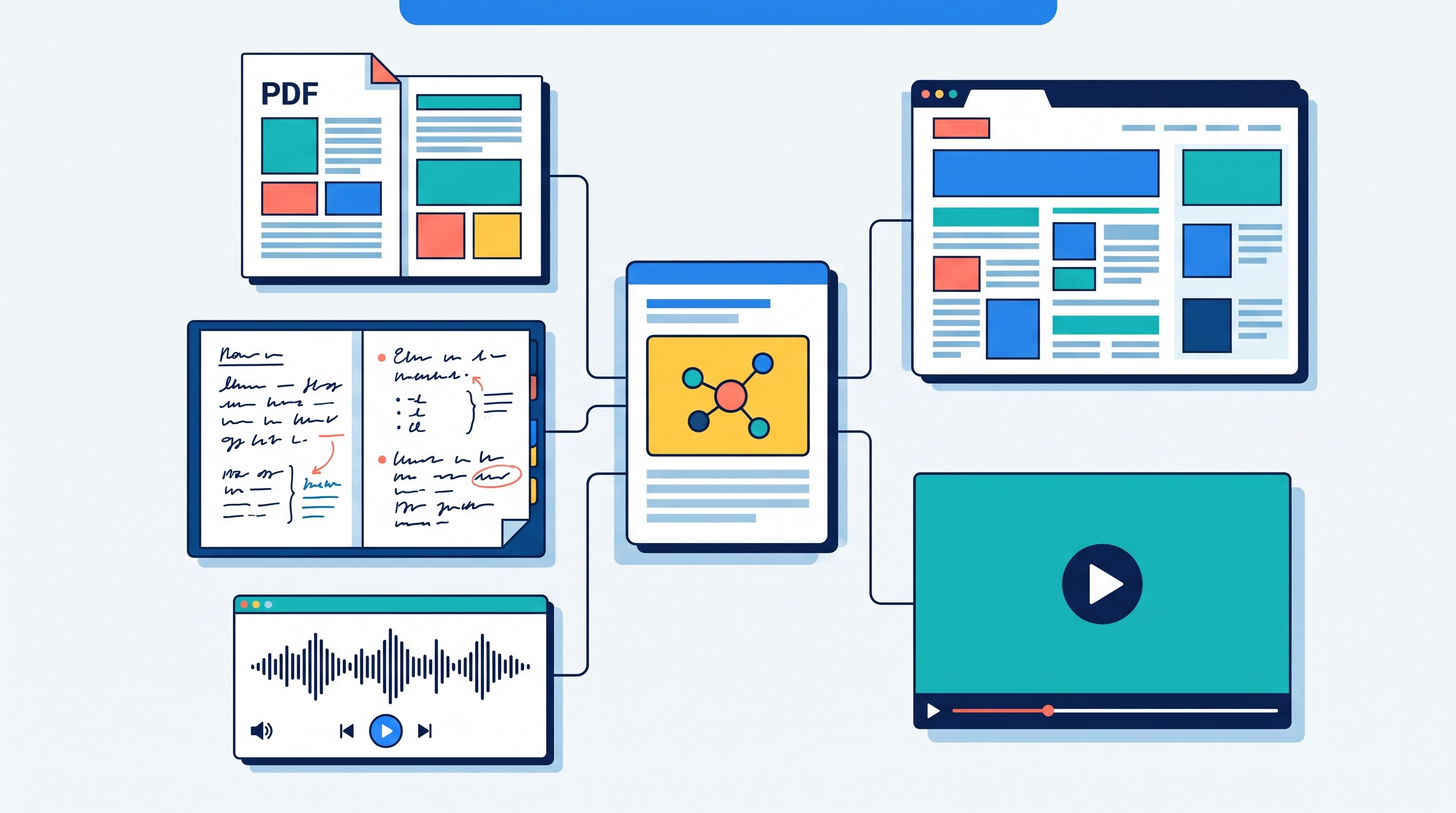
Bring mixed sources into one project: PDFs, DOCX files, web pages, YouTube videos, podcasts, audio files, notes, and sometimes spreadsheets or images.
Preserve source context: page references for PDFs, links for web pages, timestamps for media, and clear labels for researcher-created notes.
Compare evidence across formats: not just summarize each item, but identify where sources agree, disagree, qualify each other, or talk past each other.
Produce cited answers and drafts: every factual claim that matters should point back to a source location you can inspect.
That is not the same as discovery. Search engines, academic databases, paper finders, citation tools, and evidence engines are still where many projects start. Use them to locate papers, reports, statutes, filings, interviews, datasets, web pages, and recordings.
Then move the working set into a research workspace. That is where organization, questioning, comparison, and synthesis happen.
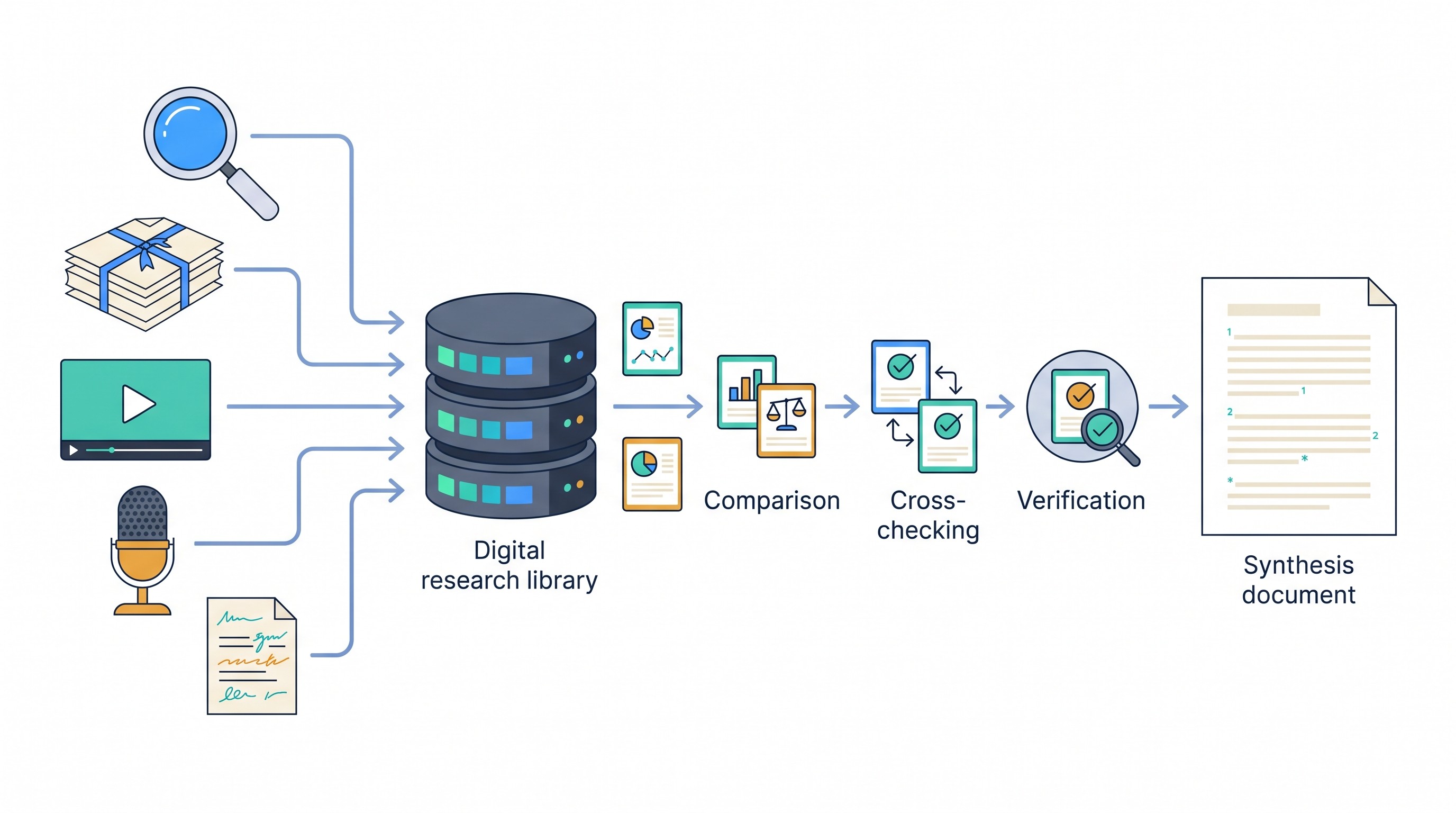
A single chat window breaks down because the research object keeps changing. One day the question is “What does the 2026 guidance say?” The next day it is “Which source contradicts the interviewee?” Two weeks later it is “Which claims survived review?”
If the context sits across pasted excerpts, temporary uploads, browser tabs, and separate notes, provenance decays. The answer may look polished, but the path back to evidence becomes hard to reconstruct.
AI can accelerate reading and comparison. It does not make the conclusion automatically accurate, complete, unbiased, or methodologically sound. The standard is not “the answer sounds plausible.” The standard is “the answer can be traced, checked, and defended.”
The six-step workflow for comparing sources with AI
The reliable workflow is not “upload everything and ask for the answer.” It is a sequence that forces the AI to handle evidence before interpretation.
Step 1: Define the research question and decision
Start with the decision the synthesis must support.
A vague prompt such as “summarize the evidence on remote monitoring” invites a generic answer. A better research question sets scope:
Population: adults with heart failure, Fortune 500 procurement teams, EU member states, federal appellate cases
Period: post-2020, current as of 2026, pre/post-policy change
Geography or jurisdiction: US, UK, EU, Canada, Australia, New Zealand, specific court or agency
Intervention, exposure, legal issue, policy option, or business question
Output: memo, literature review, briefing, due diligence note, risk assessment, expert backgrounder
The tighter the question, the easier it is to detect irrelevant sources and false contradictions.
For academic work, this step often resembles a literature-review scope. For policy, it may be a jurisdiction and timeframe. For legal research, it is the precise proposition each authority must support. For market analysis, it is the decision the client or team has to make.
Step 2: Gather sources and record provenance
Use the right discovery channel for each source type. That may mean Google Scholar, PubMed, Semantic Scholar, agency websites, court databases, company filings, internal repositories, podcast feeds, YouTube, conference pages, or expert interviews.
For each source, record basic provenance before asking AI to synthesize it:
Author or speaker
Organization or publisher
Publication date
Source type
URL or stable identifier
Version or access date where relevant
Whether it is primary or secondary
Whether it is peer-reviewed, official, commentary, internal, or anecdotal
This metadata prevents a common failure: treating a peer-reviewed study, a vendor blog post, a regulator’s guidance page, and a podcast comment as equivalent evidence.
If the project is still in discovery mode, use discovery-focused resources first. For example, a source-finding workflow belongs closer to academic source discovery than to synthesis.
Step 3: Organize sources in one library
Once the working set exists, put it in one library or project space. Do not treat each upload as a disposable conversation.
A project-level library lets you:
Reuse the same source set across multiple questions
Add notes without detaching them from sources
Separate included, excluded, background, and pending-review material
Return to earlier comparisons after new evidence arrives
Keep drafts, source extracts, and decisions together
This is where a permanent workspace matters. Otio is built for this post-discovery stage: PDFs, web pages, videos, podcasts, audio, and notes can live in one research library, with cited answers and multi-format readers inside the same workspace.
Step 4: Extract claims before summarizing
Ask for extraction before synthesis.
A summary compresses. Extraction structures. The difference matters because comparison depends on units of evidence, not prose impressions.
For each source, extract:
Main claims
Supporting passages
Method or basis for the claim
Population, sample, case, market, or jurisdiction
Date or period covered
Definitions used
Key findings
Assumptions
Limitations
Source location
Claim extraction is a known stage in fact-checking workflows because long text must be broken into checkable propositions before it can be verified. Work on document-level claim extraction frames the task this way: identifying claims that can be checked rather than treating a whole document as one undifferentiated statement (arXiv).
Step 5: Compare evidence by claim
Now compare across sources.
Do not ask only, “What do these sources say?” Ask:
Which sources support this claim?
Which sources contradict it?
Which sources qualify it?
Are they studying the same population, period, definition, jurisdiction, or outcome?
Which source has the stronger method or authority for this question?
What evidence is missing?
This is where many apparent contradictions disappear. One source may discuss US adults, another EU employers. One may study a clinical endpoint, another patient satisfaction. One may describe legal doctrine, another practical enforcement.
They are not necessarily disagreeing. They may be answering different questions.
Step 6: Draft a cited synthesis and audit it
Only after extraction and comparison should the AI draft.
The draft should state what the sources collectively support, what remains uncertain, and where evidence quality differs. Every important factual claim should include a citation or source reference.
Then inspect the citations. Check whether the cited passage actually supports the sentence. Look for overstatement, omitted limitations, incompatible populations, and claims that combine evidence from sources that should not be combined.
This last step is not clerical. It is where most AI-assisted research becomes either defensible or dangerous.

How to compare PDFs, web pages, videos, podcasts, and notes in one workspace
Different formats carry different kinds of evidence. A strong workflow keeps those differences visible.
PDFs often contain formal studies, legal filings, policy reports, white papers, contracts, trial documents, slide decks, and technical appendices. They are usually citation-friendly, but extraction can fail on scanned documents, tables, figures, footnotes, columns, and unusual layouts.
PDF parsing quality varies across document categories, which is why inspection still matters before relying on extracted text (arXiv). If a scanned appendix or table is central to the argument, open the original.
Web pages provide current context, institutional positions, guidance, product information, press releases, and public-facing claims. They can also change. Save the page, record the URL, note the access date when needed, and distinguish a current policy page from a durable archived document.
Otio’s webpage summarizer is useful when a web page belongs inside the same research project as PDFs and notes, rather than sitting in a separate browser tab.
YouTube videos and recorded talks often preserve conference presentations, expert explainers, public testimony, product demos, lectures, or interviews. Treat them as timestamped spoken sources. The source reference should include the video link and time range, not just the title.
Podcasts and audio files often contain expert discussion, interviews, earnings commentary, field notes, meetings, or oral history. They need transcripts, speaker labels where possible, and timestamp checks. Poor audio, overlapping speakers, and ambiguous references can make a transcript misleading.
Otio’s AI podcast summarizer can help turn audio into searchable material, but the important claims still need to be checked against the transcript or recording.
Research notes capture observations, hypotheses, inclusion decisions, meeting outcomes, and your own reasoning. They are valuable, but they are not external evidence. Label them clearly so the AI does not treat them as an authority.
A practical example:
A policy analyst evaluating a proposed telehealth rule might compare:
A peer-reviewed study on access outcomes
A government guidance web page
A recorded public hearing
A podcast interview with a regulator or clinician
Internal notes from stakeholder calls
The synthesis should not flatten these into “five sources say.” It should say which kind of evidence supports which claim.
A study may support an empirical claim about outcomes. A government page may establish the current institutional position. A hearing may document stakeholder objections. A podcast may clarify how one expert interprets the change. Internal notes may preserve follow-up questions, not settled facts.
For PDF-heavy projects, use a more focused workflow for extracting data from multiple PDFs without losing source references. For interview-heavy projects, the same principle applies: keep transcript excerpts, speaker identity, and context attached to each claim.
Compare claims, not just summaries
Summaries are useful for orientation. They are weak units for evidence comparison.
A summary might say: “Most sources agree that the policy improved access.” That is not enough. Which sources? What access measure? Which population? What time period? Compared with what baseline? Did the sources measure access, predict it, or merely assert it?
A better extraction asks for one row-like record per claim:
Exact claim
Supporting passage or paraphrase
Source location
Source type
Method or authority
Population, jurisdiction, market, or case
Date or period covered
Strength of evidence
Limitations
Whether it supports, conflicts with, qualifies, or merely mentions the research question
Then compare claims using criteria that match the field.
For academic and scientific work, weigh study design, sample selection, measurement quality, statistical uncertainty, replication, confounding, and whether the source is peer-reviewed or preliminary.
For policy work, weigh legal authority, agency role, jurisdiction, publication date, stakeholder incentives, and whether the source describes enacted policy or proposed policy.
For medical and pharmaceutical work, separate trial reports, systematic reviews, guidelines, regulatory documents, safety updates, conference abstracts, and expert commentary. A conference presentation may be useful but should not be treated like a full peer-reviewed trial report.
For legal work, compare authority, jurisdiction, procedural posture, date, treatment by later cases, and the precise proposition supported. A case that mentions a doctrine is not the same as a case that controls the issue.
For market and consulting work, compare data source, collection method, definition of the market, respondent sample, publication date, and commercial incentive.
Media needs special care. A video, podcast, webinar, or interview can be strong evidence that a person or organization said something. It is not automatically strong evidence that the underlying claim is true.
An evidence matrix helps because it forces separation between claim, source, and evaluation. If that is the bottleneck, use a dedicated guide to build an evidence matrix from PDFs, web pages, and interviews.
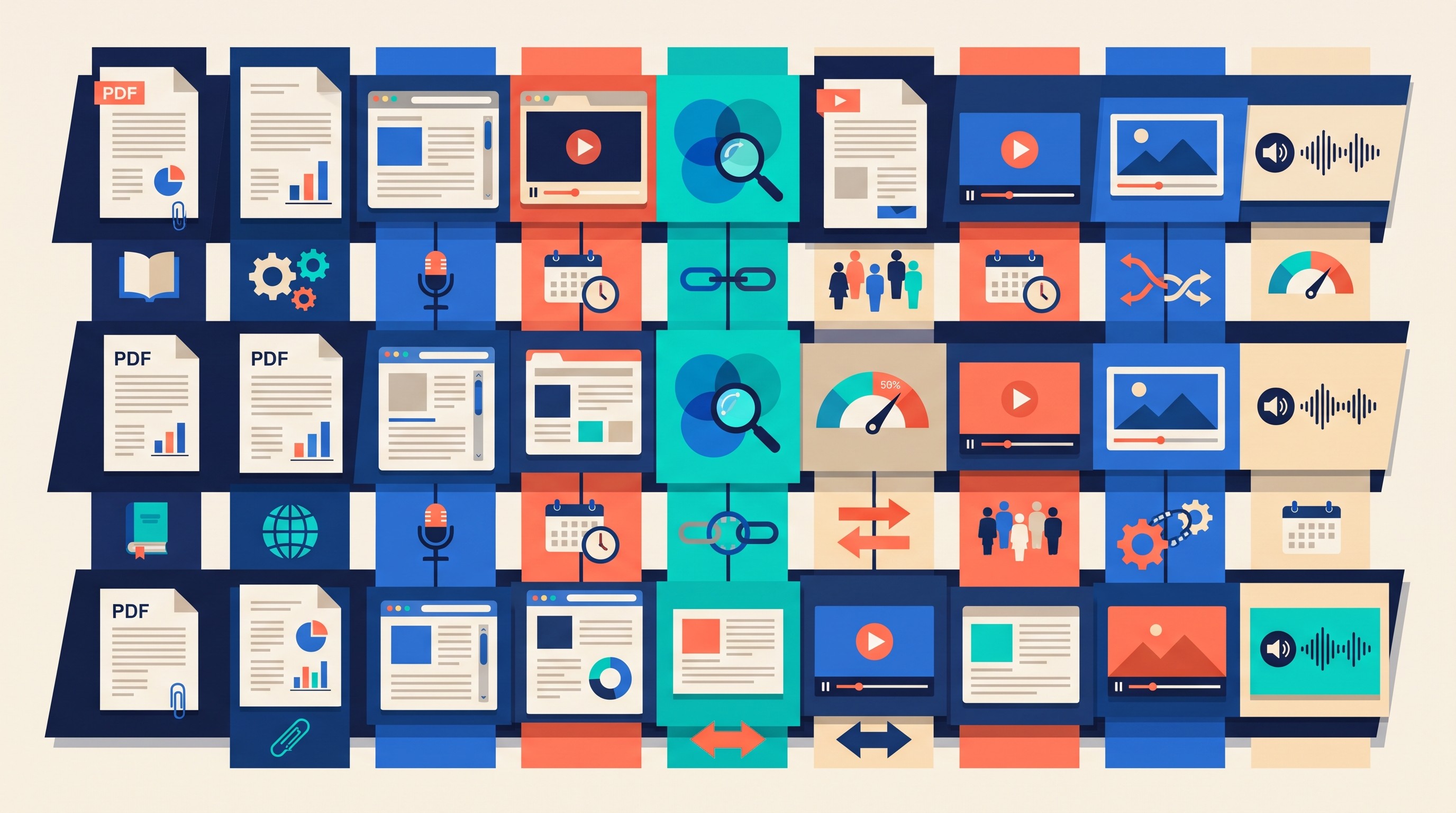
[[OTIO_INLINE_PROMO:%7B%22title%22%3A%22Need%20to%20compare%20claims%20across%20formats%3F%22%2C%22description%22%3A%22Keep%20PDFs%2C%20web%20pages%2C%20videos%2C%20podcasts%2C%20and%20notes%20together%20in%20Otio%2C%20then%20use%20cited%20answers%20to%20test%20which%20sources%20support%2C%20qualify%2C%20or%20contradict%20each%20claim.%22%7D]]
Why traceability and citations matter in AI-assisted synthesis
Citations are not decoration. They are the audit trail.
In AI-assisted synthesis, traceability means the reader can move from a sentence in the draft back to the source passage, page, timestamp, or note that supports it. Without that path, a polished answer can hide weak evidence.
Retrieval-augmented generation systems often use inline citations to ground outputs in external documents and improve verifiability (arXiv). That is the right design direction, but it does not remove the need for review.
A cited answer can still be wrong in several non-obvious ways:
The citation points to a passage that mentions the topic but does not support the claim.
The AI overstates a cautious finding.
A limitation appears in the source but disappears in the synthesis.
Evidence from one population is applied to another.
Correlation is written as causation.
A current web page is treated as if it reflects the policy during an earlier period.
A podcast opinion is treated as empirical support.
Two sources use the same term with different definitions.
The check is sentence-level. Pick every important claim and ask: does the cited source support exactly this wording?
For quotations, preserve the original wording and source location. For paraphrases, preserve the passage being paraphrased. For figures, preserve the table, page, or chart reference. For media, preserve timestamps. For notes, label the note author and context.
Citations improve auditability. They do not guarantee methodological validity.

How multiple AI models improve cross-checking without replacing judgment
Multiple models are useful when they do different jobs.
Do not ask three models for the same generic summary and treat agreement as proof. If they rely on the same extracted text, share the same blind spot, or repeat the same overstatement, their agreement is not independent confirmation.
Use models as role-specific reviewers:
Evidence extractor: pull claims, passages, methods, populations, dates, and limitations.
Contradiction finder: identify sources that appear to disagree and explain whether the disagreement is real or scope-based.
Methodological critic: challenge whether the source can support the inference being drawn.
Alternative interpreter: produce a competing synthesis that fits the same evidence.
Citation checker: test whether cited passages support the draft’s factual claims.
Caveat finder: identify missing limitations, uncertainty, and overgeneralization.
Record prompts and outputs that materially affect the synthesis. If a model’s critique changes the conclusion, keep the trail.
This is where multiple AI models inside the same Otio project can help: one permanent library, the same source set, and the ability to retry or cross-check an interpretation without rebuilding the project elsewhere.
The boundary remains important. Otio supports comparison and synthesis after discovery. It does not replace search engines, paper finders, systematic-review platforms, legal judgment, clinical judgment, or expert review.
Model disagreement is useful because it reveals ambiguity. It is not a vote. The final decision still depends on the sources and the standard of evidence in the field.

Where this workflow helps professional researchers
Multi-source research AI is most valuable when the source set is mixed, the stakes are real, and the output must be defensible.
Academics can compare studies, theory papers, preprints, conference talks, book chapters, and notes without erasing the difference between peer-reviewed evidence and commentary. A doctoral literature review, for example, often needs both synthesis and provenance: what the paper claims, how it studied the question, and where it fits in the field. Otio for academics is built around that kind of source-heavy work.
Policy researchers can align legislation, agency publications, guidance pages, consultation responses, stakeholder interviews, public testimony, and current web sources. The key is to track jurisdiction, authority, and date. A 2026 agency page and a 2022 consultation document may both matter, but they do not carry the same meaning.
Medical and pharmaceutical teams can compare trial reports, reviews, safety documents, guidelines, regulatory materials, conference presentations, and expert discussions. AI can help organize and question the corpus. Specialist review remains essential for clinical, safety, and regulatory decisions.
Legal researchers can place cases, statutes, regulations, commentary, web pages, and internal notes in one project while checking authority, jurisdiction, date, and the exact proposition each source supports. For a narrower workflow, Otio’s page on AI for legal research focuses on legal source review.
Analysts and consultants can combine market reports, company filings, earnings call transcripts, expert interviews, presentations, news coverage, and working notes. The advantage is not a faster generic summary. It is an auditable briefing: which claim came from which source, how reliable it is, and what still needs confirmation.
Researchers comparing AI tools should also separate workflow categories. A PDF chat tool may be enough for a one-off document question. A multi-source project needs a broader workspace. If the decision is specifically between a PDF-first tool and a larger research workspace, use the comparison guide on ChatPDF vs Otio for multi-source research rather than treating this workflow as a product checklist.
Build your next multi-source research project in Otio by adding your PDFs, web pages, videos, podcasts, and notes to one cited workspace.
FAQ
Q: What is multi-source research AI?
A: Multi-source research AI helps researchers collect, compare, and synthesize evidence from different formats such as PDFs, web pages, videos, podcasts, and notes. The useful version preserves source context and citations so important claims can be checked against the originals.
Q: Can AI compare PDFs, web pages, and videos at the same time?
A: Yes, when the research workspace can ingest each format and make extracted text, transcripts, links, and notes available together. Researchers should still verify parsing quality, timestamps, page references, and the original material before relying on the comparison.
Q: How should I compare sources with different levels of credibility?
A: Compare them by claim, method, population, date, evidence quality, authority, and viewpoint rather than treating every source as equivalent. A podcast or commentary may document a perspective, while a study, statute, or official report may provide a different kind of evidence.
Q: Does multi-source research AI replace academic discovery or expert review?
A: No. It is best used after discovery to organize, question, compare, and synthesize sources. Search engines, databases, systematic-review methods, and subject-matter experts remain important for finding relevant evidence and judging its significance.
[[OTIO_FOOTER_PROMO:%7B%22title%22%3A%22Apply%20this%20workflow%20to%20your%20own%20source%20set%22%2C%22description%22%3A%22Add%20your%20sources%20to%20one%20Otio%20library%2C%20ask%20cited%20questions%20across%20them%2C%20and%20verify%20key%20claims%20against%20the%20original%20pages%2C%20passages%2C%20or%20timestamps.%22%7D]]