
Research Note-Taking
How to Take Notes From Multiple Sources Without Losing Citations
Use a citation-safe workflow for notes from PDFs, webpages, videos, podcasts, and interviews. Capture source records, precise locators, note types, and verification checks before drafting.

Updated October 25, 2026.
The citation-safe answer: record provenance before interpretation
The safest way to handle how to take notes from multiple sources is simple: create a source record for every item, give it a stable ID, attach that ID to every substantive note, and record the exact locator before interpreting the evidence.
Most citation problems start earlier than drafting. A researcher copies a sentence from a PDF, a claim from a webpage, a quote from a podcast transcript, and a field-note insight into one document. Two weeks later, the note looks useful but no longer says whether it was a direct quotation, a paraphrase, a summary, an interpretation, a question, or a gap in the evidence.
Your minimum source record should include:
Author, creator, organization, or interviewee identifier
Title or working title
Publication, posting, recording, or interview date
URL, DOI, file name, or recording reference
Access date where the source can change or disappear
Format: PDF, book, webpage, video, podcast, interview, report, dataset, slide deck, or private document
That source record is not the same thing as a final citation. It is the provenance record that lets you build the final citation later in APA, MLA, Chicago, Bluebook, Vancouver, house style, or whatever the publication, client, journal, or organization requires. Harvard’s guide to citing sources puts the basic purpose plainly: citations help the audience locate the sources used in a paper or presentation (Harvard College Writing Program).
This workflow is for professional multi-source research: papers, webpages, videos, podcasts, interviews, reports, working documents, and other evidence that must survive comparison and drafting. If the project is only a single academic paper, use this as the cross-format version and see the paper-specific workflow on how to take notes for a research paper.
Build a source register before taking multi-source research notes
Start with the research question, then build the source register. The question gives the notes a job; the register prevents the evidence from becoming anonymous.
A compact source register can be as simple as one row or card per source:
Source ID: S01, S02, S03
Creator: author, organization, speaker, interviewer, agency, company, court, journal, or participant pseudonym
Title: exact title, episode title, report title, page title, or working label for an interview
Date: publication date, posting date, recording date, interview date, or version date
Format: PDF, webpage, video, podcast, interview, dataset, book, memo, slide deck
Retrieval detail: URL, DOI, database record, folder path, file name, or recording reference
Access date: especially for webpages, dashboards, changing reports, and web-hosted transcripts
Version or edition: edition number, revised date, preprint version, final report, amended page, archived copy
Status notes: permission, confidentiality, transcription status, OCR status, translation status, or missing metadata
Use stable identifiers such as S01, S02, and S03. Titles change. Webpages move. Two reports can share a similar name. A stable ID lets every note remain traceable even if the source metadata is later cleaned up.
Academic library guides often recommend tracking the source as part of the note-taking process, not after it. SMU Libraries advises researchers to list the source citation as part of the notes and separate ideas while reading (SMU Libraries). Lebanon Valley College’s research guide similarly recommends numbered source cards for tracking sources used in a paper (Lebanon Valley College).
Record the source before extracting content. That includes informal interviews, internal calls, private recordings, client documents, and unpublished materials. The final citation may require consent, anonymization, or a private-communication format, but the working note still needs a source record.
Webpages need extra care because the source can change after access. Save the access date, the URL, the page title, and the relevant passage. Where appropriate, preserve an archived copy, downloaded version, screenshot, PDF printout, or captured excerpt. The point is not that every archive is authoritative; the point is that later readers should understand what version was used.

Use one note structure that separates evidence from your thinking
A good multi-source note should make provenance visible at the moment of use. If you have to open five apps to know where a claim came from, the workflow will fail under deadline pressure.
Use one reusable structure:
Source ID: S04
Note type: quotation, paraphrase, summary, interpretation, question, evidence gap
Exact content: the passage, claim, observation, or your own reasoning
Locator: page, section, paragraph, timestamp, transcript line, figure, table, URL fragment, or recording reference
Context: enough surrounding detail to preserve scope and qualifications
Confidence or uncertainty: clear, unclear audio, machine transcript, OCR issue, missing page, ambiguous speaker
Related sources: S02 agrees; S07 contradicts; S11 uses a narrower definition
Follow-up action: verify quote, check date, find primary source, request permission, compare method, inspect appendix
The most important field is note type.
A direct quotation must use quotation marks and preserve the wording exactly. A paraphrase restates a source’s idea in your words and still needs a locator. A summary compresses a larger section or whole source. An interpretation is your reasoning about what the evidence means. A question marks something to investigate. An evidence gap records what is missing, weak, unavailable, or unresolved.
Never store an unattributed claim as if it were original analysis. If the provenance is unknown, label it as unverified or move it to an evidence-gap list. Anonymous evidence has a way of becoming polished prose if it sits in the same file as confirmed notes.
Attach the Source ID to every substantive note, including a paraphrase or a claim generated while comparing sources. The note “Regulators were mainly concerned about downstream misuse” is not safe unless it says which source supports it and where. The same applies to an AI-generated summary, a margin comment, or a sentence drafted after reading several sources.
Capture the smallest useful context around the passage. That usually means the qualifying sentence before or after, the study population, the timeframe, the definition being used, the speaker’s role, or the method behind the claim. A sentence about “significant improvement” means less if the note loses the baseline, sample, endpoint, or comparator.
No single note format is universally best. A structured extraction sheet is good for comparing variables across sources. Structured prose is better when the reasoning chain matters. A legal researcher, policy analyst, clinical reviewer, and investment analyst may use different layouts, but the provenance fields should be stable.
Capture precise locators for every format
A citation-safe note is only useful if the original passage can be found again. “Smith report” is not a locator. “S03, p. 42, Table 4, definition of eligible households” is.
PDFs and books
For PDFs, books, reports, and scanned documents, record:
Page number
Chapter, section, or heading
Figure, table, box, appendix, or footnote number
Edition, version, or report date
Whether the page number is printed in the document or generated by the PDF viewer
OCR or scan problems that could affect quotation accuracy
Printed page numbers and PDF viewer page numbers often diverge because of covers, Roman numerals, appendices, and scanned inserts. Write “printed p. 37” or “PDF viewer p. 42” when the difference matters.
For scanned PDFs, flag unclear text, missing pages, rotated pages, and uncertain OCR. Do not silently clean up a quotation from a bad scan unless the original wording has been checked.
Webpages
For webpages, save:
Page title or heading
URL
Access date
Section heading
Short quoted passage
URL fragment or anchor if available
Note on whether the content is dynamic, personalized, database-driven, or likely to change
A webpage note should be findable even if the design changes. “S08, section ‘Eligibility criteria,’ accessed 25 Oct 2026, quoted passage begins ‘Applicants must…’” is much safer than a naked URL.
Videos and podcasts
For videos and podcasts, record:
Title
Episode or video number if available
Creator, host, guest, or speaker
Timestamp range
Transcript passage
Whether the wording came from a human transcript, automated transcript, or your own listening
Unclear audio, cross-talk, edits, or speaker ambiguity
A timestamp range is usually better than a single timestamp. “14:22–15:10” gives the reader the surrounding claim and reduces the risk of quoting a sentence stripped of its setup.
If podcasts are a major source type in the project, use the more detailed workflow on how to take notes from a podcast. For this cross-format workflow, the key rule is the same: timestamp plus speaker plus transcript status.
Interviews
For interviews, separate the interviewee’s words from your field notes. This matters ethically and analytically.
Record:
Interview date
Participant name, role, code, or pseudonym
Interviewer
Recording file or transcript reference
Transcript line, page, or timestamp
Whether the passage is verbatim, lightly cleaned, translated, summarized, or reconstructed from notes
Consent, confidentiality, attribution, embargo, or institutional-review constraints
Do not treat an interview summary as a quotation. If the exact wording matters, verify it against the recording or transcript before drafting.
Preserve uncertainty
Uncertainty belongs in the note, not in your memory. Mark missing pages, broken links, inaccessible attachments, unclear audio, machine-transcription errors, translated passages, and ambiguous speaker attribution.
A vague locator is a future tax. The cost is paid later, usually when the draft is due.
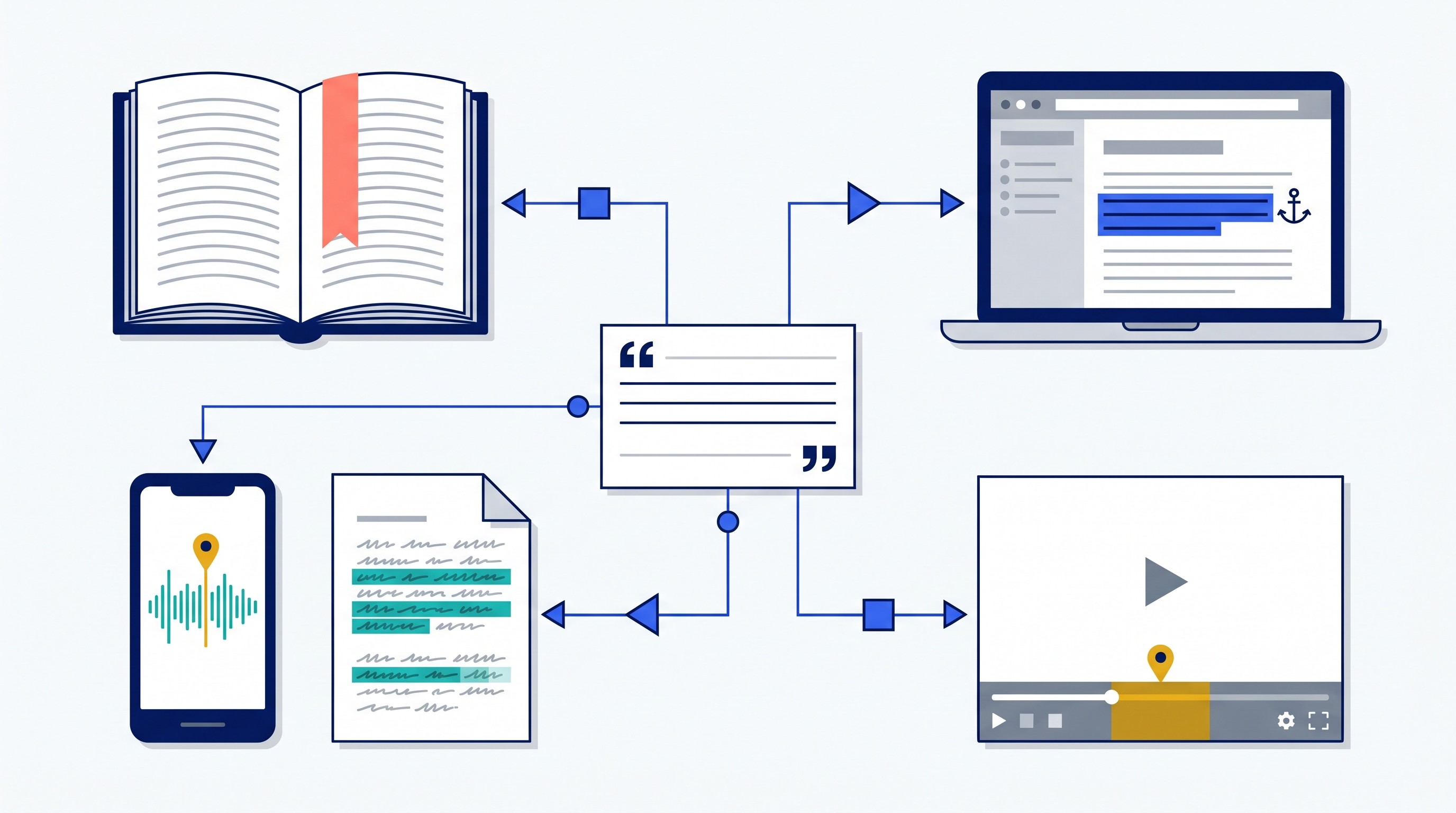
[[OTIO_INLINE_PROMO:%7B%22title%22%3A%22Can%20you%20find%20each%20passage%20again%3F%22%2C%22description%22%3A%22Keep%20PDFs%2C%20web%20pages%2C%20videos%2C%20audio%2C%20and%20notes%20together%20in%20Otio%2C%20then%20inspect%20cited%20passages%20and%20save%20each%20source%20ID%20and%20locator%20before%20drafting.%22%7D]]
Synthesize sources without flattening contradictions
Once the source-linked notes exist, stop organizing only by source. Organize by research question, claim, variable, theme, or decision. Keep the Source ID attached so comparison never removes provenance.
Synthesis is not the same as summarizing one source after another. Purdue OWL explains the distinction directly: synthesis combines material from multiple sources to create a new understanding, while summary restates source information (Purdue OWL). That distinction is where many citation errors appear: the writer forms a cross-source claim but cites only the most convenient source.
Before deciding that two sources contradict each other, compare:
Definitions: are they using the same term in the same way?
Population or scope: country, age group, industry, disease stage, legal jurisdiction, time period
Method: interview study, randomized trial, survey, audit, case law analysis, model output, expert commentary
Date: older data may describe a different policy, market, or clinical practice
Level of evidence: primary data, review, editorial, press release, firsthand interview, secondary summary
Assumptions: baseline, denominator, exclusion criteria, model inputs, legal standard, risk threshold
A practical synthesis unit is the claim record. Keep it short:
Claim: what you might write in the draft
Supporting sources: Source IDs and locators
Opposing or qualifying sources: Source IDs and locators
Reason for disagreement: method, sample, date, definition, jurisdiction, incentive, or genuine conflict
Unresolved questions: what still needs checking
Draft status: ready, needs verification, too weak, or exclude
Contradictions should not be averaged into smooth prose. If S04 says a policy reduced costs and S09 says costs rose, the next step is not “the evidence is mixed” by default. Ask whether they measured different costs, time windows, regions, populations, or implementation stages.
Before drafting, return to the original passage for each planned claim. Check that the paraphrase preserves scope, qualifiers, speaker intent, and uncertainty. A note can be perfectly cited and still misrepresent the source if the context was lost.
If the project needs a formal comparison grid, use an evidence matrix. The workflow here is about preserving provenance across formats; the companion guide on how to build an evidence matrix from PDFs, web pages, and interviews covers the matrix structure itself.
Run a citation check before a claim reaches the draft
The final check is not a bibliography cleanup. It is a claim-by-claim audit before prose hardens.
For every substantive sentence, ask:
What is the claim?
Which Source ID supports it?
Where exactly is the supporting passage?
Is the wording a direct quotation, paraphrase, summary, or interpretation?
Does the source support the full scope of the sentence?
Is the citation placed at the point where the claim appears?
Does another source qualify or contradict it?
Citations should appear where the supported claim appears, not only at the end of a paragraph containing several different ideas. A paragraph might include one factual claim from a report, one interview quotation, one policy interpretation, and one synthesis claim. Those do not all deserve the same trailing citation.
Verify quotations character-for-character against the original. Verify paraphrases against the original passage, not against an AI summary or a secondhand note. If the note came from an automated transcript, listen to the relevant segment before using exact wording.
Review the failure list:
Evidence gaps that accidentally became claims
Uncited claims in the draft
Orphaned bibliography entries that are never cited
Duplicate source records for the same item
Broken or redirected links
Mismatched publication dates
Page numbers that refer to the PDF viewer rather than printed pages
Notes with locators too vague to retrieve
Quotations taken from summaries rather than the source
Interview notes that blur verbatim speech and interpretation
The dangerous failure mode is a note that looks well cited but still misrepresents the source. That happens when the surrounding qualification, transcript uncertainty, sample boundary, legal context, or disagreement has been stripped away.
The drafting handoff should be conservative: move only checked claims into the draft, keep unresolved items visibly marked, and preserve the source register alongside the working notes. If you need help turning source-linked notes into a longer synthesis, the guide on how to synthesize research papers from different sources focuses on the paper-to-paper version of that job.
Use a permanent multi-source workspace when the corpus keeps growing
A spreadsheet, citation manager, and notes file can work for small projects. They start to break when the corpus includes PDFs, webpages, videos, audio files, interview transcripts, screenshots, and draft notes across several research questions.
A permanent workspace helps when it keeps the source and the note close together. Otio for academics is built for that after-discovery stage: a multi-source research workspace where PDFs, web pages, videos, audio, and notes can sit in one library while the researcher compares evidence and drafts with source context available.
A practical workflow looks like this:
Create a project space. Name it after the research question, client matter, policy issue, literature review, or report.
Add the source files and links. Upload PDFs, add web links, bring in videos or audio, and keep private notes in the same project library.
Assign Source IDs. Use the same S01, S02, S03 convention in your notes and file names or item titles.
Inspect passages in the reader or transcript view. For PDFs, use the AI PDF reader to read, search, highlight, and ask source-specific questions. For YouTube and media files, use the transcript view where available and record timestamps.
Save selected evidence into notes. Keep the Source ID, note type, locator, and context together. Do not save a claim without provenance.
Ask source-grounded questions. Use cited answers to compare sources, find passages, and test whether a draft claim is supported.
Switch models when the task changes. Otio supports multiple AI models, which is useful when extraction, synthesis, drafting, and critique benefit from different model behavior.
Draft with verification. Use the essay and drafting workflow only after important claims have been checked against the original passages.
The boundary matters. Otio is not a replacement for search engines, academic discovery tools, systematic-review software, or reference managers. It is the workspace after or beside those tools: the place where the collected sources, source-grounded questions, notes, and cited draft work stay together.
AI-generated notes still require checking. A summary can omit a qualification, misunderstand a passage, or make two sources sound more consistent than they are. Treat AI as a way to navigate and compare the corpus, not as a substitute for reading the source when a claim matters.
Create a multi-source research library in Otio and bring your PDFs, web pages, videos, and notes together so you can compare evidence and draft with citations in context.
FAQ
Q: What should every research note include?
A: Every substantive note should include a source identifier, note type, the claim or passage, and a precise locator such as a page number, section heading, timestamp, transcript passage, or URL fragment. Add enough surrounding context to preserve qualifications and uncertainty.
Q: How do I distinguish a paraphrase from my own analysis?
A: Label paraphrases as paraphrases and attach the original source and locator. Reserve an interpretation label for your reasoning, and cite the evidence that prompted it rather than presenting source-derived ideas as unattributed original analysis.
Q: How should I cite a video, podcast, or interview in my notes?
A: Record the title, speaker or creator, date, source URL or recording reference, and the exact timestamp or transcript passage. For interviews, also record whether the words are verbatim, transcribed, or summarized and note any confidentiality or consent restrictions.
Q: Can AI-generated research notes be trusted without checking the source?
A: No. AI can help locate, compare, and organize evidence, but summaries and citations may omit qualifications or misread a passage. Verify each important claim against the original source before it enters a final draft.
[[OTIO_FOOTER_PROMO:%7B%22title%22%3A%22Bring%20your%20own%20sources%20into%20one%20research%20library%22%2C%22description%22%3A%22Add%20your%20PDFs%2C%20links%2C%20videos%2C%20audio%2C%20and%20notes%20to%20Otio%2C%20preserve%20each%20source%20ID%20and%20locator%2C%20and%20compare%20cited%20evidence%20before%20writing.%22%7D]]