
Literature Review Planning
How Long Does a Literature Review Take? A Realistic Timeline and Faster Workflow
A literature review can take days to months depending on scope, source volume, and synthesis depth. Use a realistic planning method and a faster search-to-citation workflow without sacrificing evidence quality.

A literature review can take a long weekend or a semester. The difference is rarely word count; it is scope, source volume, screening discipline, access to full texts, and how much synthesis the assignment expects.
A tightly bounded class review might fit into several focused work sessions. A thesis literature review usually needs multiple weeks. A systematic or evidence-heavy review can stretch across months because the work includes search documentation, duplicate removal, eligibility decisions, critical appraisal, synthesis, drafting, and reference checking.
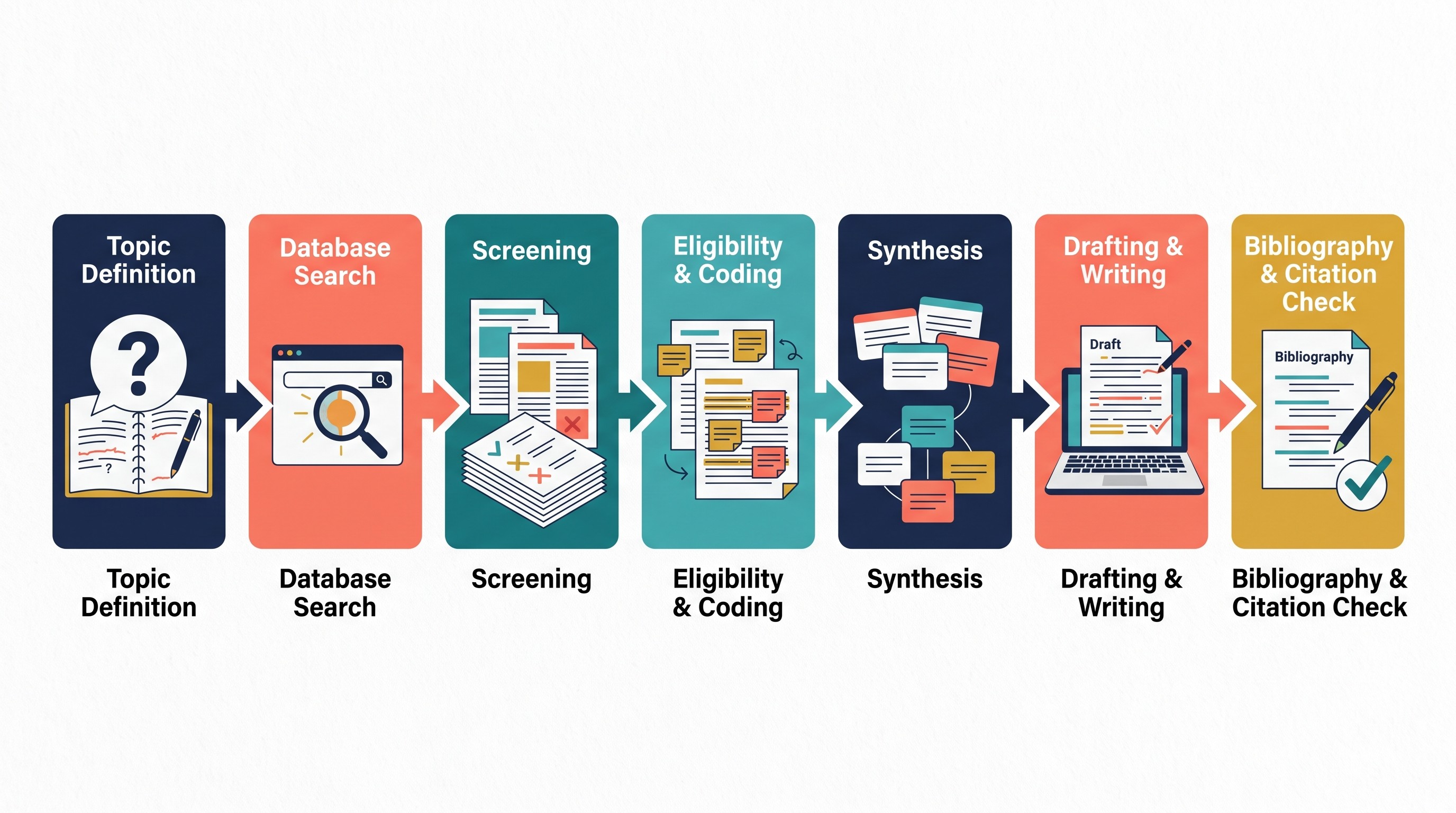
The fastest reliable path is not “read faster.” It is to narrow the question, search in planned passes, screen before reading, build a literature matrix, synthesize by claim, and audit citations at the end.
A realistic answer: literature reviews take days, weeks, or months
The short answer: plan by workload, not by page count.
A five-page review on a vague topic can take longer than a 15-page review on a narrow question. “Social media and mental health” is slow because the literature is broad, contested, and methodologically varied. “Randomized interventions using text-message reminders to improve medication adherence in adults with hypertension” is much easier to search, screen, and synthesize.
Use these ranges as planning estimates, not rules:
Review situation | Realistic timeline | Why it takes that long |
|---|---|---|
Short class review with assigned sources | 1–3 focused work sessions | Little searching; mostly reading, organizing, and writing |
Short class review with independent search | 3–7 days | Search, screening, reading, synthesis, citations |
Undergraduate or master’s paper review | 1–3 weeks | More sources, clearer argument, more revision |
Thesis or dissertation chapter | 3–10+ weeks | Iterative scoping, supervisor feedback, deeper synthesis |
Scoping or systematic-style review | 2–6+ months | Multiple databases, documented screening, eligibility decisions, reproducible methods |
A short review often runs late for four reasons:
The topic is too broad, so every search returns hundreds or thousands of records.
The literature disagrees, which forces real synthesis instead of summary.
Full texts are hard to obtain.
The assignment requires a reproducible search, meaning you must record databases, dates, search strings, criteria, exclusions, and decisions.
A quick self-estimate formula
Start with hours, then convert to calendar time using the number of hours available per week.
Use this planning model:
Estimated hours = scoping + search setup + title/abstract screening + full-text reading + matrix work + synthesis/drafting + reference audit
A practical version:
Scoping: 2–6 hours for a normal paper; more if the question is unsettled.
Search setup: 1–2 hours per database or search platform.
Title and abstract screening: about 1–3 minutes per record.
Full-text reading: about 45–90 minutes per important paper, depending on density and methods.
Matrix extraction: 20–40 minutes per included source.
Synthesis and drafting: add 30–60% of the reading and matrix time.
Citation audit: 2–8 hours, more if references are messy or the style is strict.
Example: suppose the review uses three databases, screens 180 records, reads 25 full texts, includes 16 sources, and requires a moderate synthesis.
That might look like:
Scoping: 4 hours
Search setup: 5 hours
Screening: 6 hours
Full-text reading: 30 hours
Matrix extraction: 10 hours
Synthesis and drafting: 25 hours
Citation audit: 5 hours
Total: about 85 hours.
At 10 focused hours per week, that is roughly 8–9 weeks. At 25 focused hours per week, it is closer to 3–4 weeks. The calendar answer changes because availability changes; the workload does not disappear.
What determines how long your literature review will take?
The main variables are scope, review type, source count, and synthesis depth. The assignment brief matters, but the research question matters more.
A review becomes slower when it requires:
Multiple databases or disciplinary indexes
A long date range
Clear inclusion and exclusion criteria
Methodological critique, not just topic summary
A mix of study types, such as experiments, interviews, surveys, theoretical papers, and policy reports
Citation chasing from reference lists
Attention to contradictory or minority findings
A formal search record or screening log
A review becomes faster when it has:
A narrow population, concept, context, or intervention
A defined date range
A small set of core databases
A clear source boundary, such as peer-reviewed articles only
Assigned or pre-approved sources
A known citation style and reference manager from the beginning
Narrative, scoping, and systematic reviews are different workloads
The label matters because each review type carries different expectations.
Review type | Main purpose | Search burden | Screening burden | Synthesis burden | Typical timeline |
|---|---|---|---|---|---|
Narrative review | Explain and interpret a body of literature | Low to moderate | Often informal | Moderate to high | Days to weeks |
Scoping review | Map what exists, concepts, gaps, and evidence types | Moderate to high | More explicit | Moderate | Weeks to months |
Systematic review | Answer a focused question using reproducible methods | High | High and documented | High | Months |
A narrative review can still be rigorous, but it usually does not require the same level of reproducible screening as a systematic review. A systematic review is slower because the method is part of the product. The reader needs to know how evidence was found, filtered, and included.
For a more detailed breakdown of formats, see Otio’s guide to the different types of literature reviews.

Scope changes everything
Compare these two questions:
Broad: “How does remote work affect productivity?”
This can pull in organizational psychology, economics, management, software engineering, gender studies, real estate, labor policy, and pandemic-era studies. It also creates definitional problems: productivity measured by whom, in which job, over what time frame?
Narrow: “How do hybrid work schedules affect self-reported productivity among software engineers in post-pandemic workplace studies?”
This still needs care, but it has a clearer population, context, outcome, and time boundary. Searches become more precise. Screening becomes easier. Synthesis has fewer moving parts.
The tradeoff is coverage. Stopping after the first useful sources is fast, but it raises the risk of missing foundational work, newer evidence, or studies that contradict the easy answer. A faster review should narrow the question, not pretend the broad question has been fully covered.
Writing is not just paraphrasing sources
Many students underestimate the writing stage because they imagine the review as a sequence of source summaries. That is the slow version.
A strong literature review has an argument about the literature. It groups studies by themes, methods, assumptions, findings, or disagreements. It explains why one cluster of evidence matters more than another. It identifies gaps without treating every absence as a research gap.
That work takes time because it forces decisions:
Which studies are central?
Which are background?
Which findings conflict?
Are the studies measuring the same thing?
Are differences caused by methods, samples, definitions, or context?
What does the reader need to know before your own study, paper, or thesis makes sense?
If the review feels slow at this stage, that is not always a problem. It may mean the work has moved from collection to synthesis.
A faster literature review workflow, step by step
The fastest defensible workflow separates the review into passes. Do not search, read, summarize, cite, and write at the same time. That creates rework.
1. Define a searchable question before opening databases
Write one sentence that defines the review’s job.
Use this structure:
This review examines [population/topic] in relation to [concept/intervention/problem] within [context/date range] to understand [outcome/debate/gap].
Then define:
Population or subject: Who or what is being studied?
Concept or intervention: What is the main idea, exposure, practice, or treatment?
Context: Field, geography, institution type, time period, or setting.
Evidence type: Empirical studies, review articles, theoretical work, policy papers, case studies, or grey literature.
Date range: Why this period?
Exclusions: What looks related but is outside scope?
Bad scope statement: “I’m reviewing AI in education.”
Better scope statement: “This review examines empirical studies from 2020 onward on generative AI tools used for feedback on undergraduate academic writing, focusing on learning outcomes, student dependence, and assessment integrity.”
The second version tells the search where to go and what to ignore.
2. Create a search plan, not a pile of tabs
Use several focused query variations. Search terms should include synonyms, narrower terms, and alternate wording used by the field.
For example:
“generative AI” AND “academic writing” AND undergraduates
“AI feedback” AND “student writing” AND higher education
“large language models” AND “writing instruction”
“ChatGPT” AND “writing feedback” AND university students
Record:
Database or search platform
Date searched
Exact query
Filters used
Number of results
Notes on relevance
If Google Scholar is part of the workflow, use it deliberately rather than endlessly scrolling. Otio has a separate guide to Google Scholar search strategies for literature reviews that covers query structure, citation chasing, and narrowing techniques.
3. Triage results in passes
Do not read every PDF you download. Screen first.
A practical screening sequence:
Title scan: Remove obviously irrelevant records.
Abstract scan: Keep sources that answer the question or define the debate.
Duplicate removal: Merge duplicate records from different databases.
Full-text check: Read only sources that survived title and abstract screening.
Priority mark: Label each source as core, useful background, methods reference, contradictory evidence, or exclude.
This is where many reviews recover time. Reading 80 full texts because they looked vaguely related is the classic failure mode. Screen 80 abstracts; read the 15–25 that can actually carry the review.
4. Build a literature matrix while reading
A literature matrix is the difference between “I read a lot” and “I can now write.” It forces comparable notes.
Use columns like:
Field | What to capture |
|---|---|
Citation | Author, year, title, source |
Research question | What the study asks |
Method | Experiment, survey, interview, review, model, case study |
Sample or corpus | Who or what was studied |
Key findings | Results that matter to your question |
Limitations | Design limits, sample issues, measurement problems |
Useful quote or locator | Page number, section, table, timestamp, or paragraph |
Relevance | Background, core evidence, contradiction, method, gap |
Theme | The synthesis bucket it belongs to |
A matrix prevents the common late-stage panic: remembering that a source was useful but not why.
For a deeper template-level treatment, see Otio’s guide to the literature review matrix.
5. Synthesize by theme, method, outcome, or disagreement
Do not write one paragraph per source unless the assignment explicitly asks for an annotated bibliography.
Instead, group the literature by the structure of the argument:
Theme: What topics recur?
Method: Do experiments, interviews, and surveys point to different conclusions?
Outcome: Which results are consistent, mixed, or absent?
Population: Do findings differ across groups or contexts?
Chronology: Has the field shifted over time?
Disagreement: Where do scholars interpret the same problem differently?
A weak synthesis says: “Smith found X. Jones found Y. Patel found Z.”
A stronger synthesis says: “Across survey-based studies, students report faster drafting and higher confidence, but interview studies complicate that finding by showing uncertainty about authorship, feedback quality, and assessment boundaries.”
That sentence is harder to write because it compares evidence. It is also the point of the review.

6. Draft from claims, not from PDFs
Before drafting, create a claim outline.
Example:
Claim 1: The field defines the problem inconsistently.
Claim 2: Most studies agree on short-term efficiency gains.
Claim 3: Evidence on learning outcomes is weaker because measures differ.
Claim 4: The strongest studies point to feedback design, not tool access, as the important variable.
Claim 5: The gap is not whether students use AI, but under what instructional conditions it improves revision quality.
Then attach sources from the matrix under each claim. This makes the literature serve the argument rather than dictate the structure.
7. Audit citations separately
Citation cleanup should be its own pass. Mixing it into drafting slows the argument and still leaves errors.
During the audit, check:
Every in-text citation appears in the reference list.
Every reference-list item appears in the paper, unless your style allows uncited bibliography entries.
Claims are supported by the cited source.
Page numbers or locators are included when required.
Study types are described accurately.
Citation style is consistent.
DOIs, journal names, and publication years are correct.
If the assignment has strict formatting requirements, do this earlier than the night before submission. Citation errors are boring, but they cost marks and credibility.
8. Use a research workspace when the source pile gets large
When a review involves many PDFs, web pages, notes, and links, the time loss often comes from context switching: database tab, PDF reader, ChatGPT tab, notes app, citation manager, file folder, repeat.
Otio is useful here as an AI research workspace: a unified library for PDFs, web links, notes, and other files; reader views with PDF search and highlights; source-grounded chat with inline citations; text-selection questions inside documents; notes; multi-item chat; and a Zotero integration for researchers who already manage references there.
Use it to reduce friction, not to outsource judgment. Ask questions across a set of papers, extract comparable details into a matrix, or interrogate a selected passage in a PDF. Still read the key sections yourself and verify that any generated summary matches the source.
9. Set a stopping rule
A literature review can always absorb one more article. Without a stopping rule, searching becomes avoidance.
Stop or pause searching when:
New sources repeat themes already represented in stronger papers.
New results fall outside your inclusion criteria.
Additional sources do not change the synthesis.
You have covered the major methods, positions, and contradictions within the defined scope.
The deadline requires moving from collection to writing.
Document the reason. A transparent boundary is better than an implied claim that you found everything.
[[OTIO_INLINE_PROMO:%7B%22title%22%3A%22Ready%20to%20turn%20screened%20papers%20into%20a%20matrix%3F%22%2C%22description%22%3A%22Upload%20your%20screened%20PDFs%20to%20Otio%20and%20ask%20for%20concise%20notes%20on%20each%20study%E2%80%99s%20method%2C%20sample%2C%20findings%2C%20and%20limitations.%22%7D]]
Where AI saves time—and where it can make the review worse
AI is most useful in the middle of the workflow: turning messy source collections into searchable, comparable working material. It is least reliable when treated as an authority.
Good uses include:
Generating search-term variations
Suggesting narrower versions of a broad research question
Summarizing a source after you have read it
Extracting method, sample, findings, and limitations into a matrix
Clustering notes by theme
Identifying contradictions worth checking
Rewriting a rough synthesis paragraph for clarity
Turning a claim outline into a first draft section
Risky uses include:
Asking AI to invent a literature review from memory
Trusting uncited summaries
Accepting citations without opening the source
Letting AI decide whether a study is methodologically strong
Treating a fluent paragraph as evidence of coverage
Using a generated “gap” without checking whether the field has already addressed it

The main failure mode is flattening
AI summaries often sound cleaner than the literature really is. That is useful for orientation but dangerous for synthesis.
A model can flatten important differences:
A correlation becomes implied causation.
A small qualitative study sounds like a general field conclusion.
A limitation disappears.
A minority finding is omitted.
Two related but different constructs are treated as the same thing.
A source is cited for a claim it does not support.
The fix is simple and slow: verify. Compare summaries against the original passage. Check the methods section. Preserve page numbers or other locators when the assignment requires them. Open the cited source before using it in a sentence.
A tool with multiple model options can help because different models may produce different summaries or catch different issues. Otio’s multiple AI models feature is useful for this kind of review pass, especially when one model’s answer seems too smooth. But multiple answers are not independent validation. The paper remains the evidence.
What AI cannot decide for you
AI can speed up discovery and organization. It cannot decide whether the evidence is representative, whether the methods are credible, or whether the synthesis is logically justified.
Those are scholarly decisions.
For example, if five studies support an intervention and two do not, the answer is not automatically “most studies support it.” The two negative studies may have better designs, larger samples, longer follow-up, or more relevant populations. A literature review is not a vote count. It is an argument about the weight and meaning of evidence.
If you want a broader tool comparison, Otio’s guide to AI tools for literature reviews is a useful next step.
How to turn the estimate into a schedule you can finish
A schedule only works if it separates stages. “Read literature for six hours” is not a plan. “Screen 120 abstracts and mark 25 for full-text retrieval” is.
Start with the deadline and work backward.
For a four-week review, a realistic structure might look like this:
Time block | Deliverable |
|---|---|
Days 1–2 | Research question, scope, inclusion/exclusion criteria |
Days 3–5 | Search plan, database searches, source tracking sheet |
Days 6–9 | Title and abstract screening, duplicates removed |
Days 10–16 | Full-text reading and matrix entries |
Days 17–20 | Themes, claim outline, synthesis plan |
Days 21–25 | Draft literature review |
Days 26–28 | Revision, citation audit, reference cleanup |
For a one-week review, compress the same stages; do not remove them entirely.
Day | Deliverable |
|---|---|
Day 1 | Narrow question, source boundary, search terms |
Day 2 | Search and screen |
Days 3–4 | Read priority sources and fill matrix |
Day 5 | Build claim outline and draft |
Day 6 | Revise synthesis |
Day 7 | Citation audit and final edit |
For a thesis chapter, stretch the same workflow over several cycles. Expect the question, scope, and synthesis structure to change after supervisor feedback.
Use measurable deliverables
Good deliverables:
Finalized research question
Inclusion and exclusion criteria written
Three databases searched
200 records screened
25 full texts retrieved
18 matrix rows completed
Four synthesis themes defined
Draft section on methods disagreement completed
Citation audit finished
Weak deliverables:
Work on lit review
Read more
Find sources
Improve writing
Fix citations
The difference matters because vague tasks expand to fill all available time.
Add contingency time
Literature reviews slip because the hidden tasks arrive late.
Build in time for:
Paywalled or inaccessible papers
Broken links and missing PDFs
Duplicates across databases
Ambiguous inclusion decisions
Supervisor or instructor feedback
Scope changes
Citation style issues
Reference manager cleanup
Studies that are harder to interpret than expected
A good rule: if the review matters for a thesis, grant, journal article, or high-stakes grade, do not schedule it with zero slack. The synthesis stage almost always reveals something you did not understand during search.
Minimum viable review plan when time is tight
If the deadline is close, do not pretend to complete a broad review. Narrow the scope and state the boundary clearly.
A defensible minimum plan:
Write a narrow research question.
Define the source boundary: databases, date range, language, source type.
Prioritize recent review articles and highly relevant empirical studies.
Add foundational sources only when they are necessary to understand the field.
Build a small matrix for the most relevant sources.
Synthesize around two to four themes.
State the limitation: this is a bounded review, not a comprehensive systematic search.
That is better than a broad, undocumented search followed by shallow summaries.
The next action
Before opening another tab, write these three things:
One-sentence research question
Inclusion and exclusion criteria
Source-tracking table with columns for database, query, filters, result count, and notes
Then search. A literature review gets faster when every source has to earn its place.
FAQ
Q: Can I write a literature review in one day?
A: A narrowly scoped class review may be possible in one day if the sources and question are already defined. A defensible review that requires broad searching, screening, synthesis, and citation verification usually needs more time.
Q: How many sources should a literature review include?
A: There is no universal source count. The right number depends on the assignment, field, question scope, and whether additional searching is still producing relevant evidence or new themes.
Q: What is the slowest part of writing a literature review?
A: For many projects, synthesis is slower than finding papers because it requires comparing methods, results, limitations, and disagreements across sources. Screening and full-text access can also become the main bottleneck in broad reviews.
Q: Can AI write a literature review faster?
A: AI can speed up search-term generation, source organization, summarization, and drafting assistance. It should not replace direct source checking, methodological appraisal, or verification that each citation supports the claim it accompanies.
[[OTIO_FOOTER_PROMO:%7B%22title%22%3A%22Apply%20this%20workflow%20to%20your%20own%20sources%22%2C%22description%22%3A%22Add%20your%20PDFs%2C%20web%20links%2C%20and%20notes%20to%20Otio%2C%20then%20compare%20themes%20and%20check%20cited%20claims%20while%20drafting%20your%20synthesis.%22%7D]]