
Academic Writing Workflow
How to Paraphrase a Research Paper Without Losing the Original Meaning
Paraphrase research papers accurately with a repeatable workflow for preserving claims, evidence, limits, and citations while avoiding patchwriting and plagiarism.

If you need to know how to paraphrase a research paper, the safe method is: understand the passage, close the source, write the idea from notes in a new structure, then compare your version against the original for meaning and wording. A good paraphrase changes the expression, not the evidence.
The hard part is not sounding different. It is keeping the claim, numbers, limits, and uncertainty intact while avoiding patchwriting. “Replacing a few words” is usually the worst version: it looks close to the source and often changes the meaning.
What it means to paraphrase a research paper accurately
To paraphrase a research paper accurately, restate a source’s idea in your own sentence structure and voice while preserving the original meaning. That includes the claim, the evidence, the population studied, the method, the degree of certainty, and any limitations the authors gave.
Paraphrasing is not the same as summarizing or quoting:
Method | What changes | What stays the same | Use it when |
|---|---|---|---|
Paraphrase | Wording and structure | Main idea and level of detail | The idea matters, but exact wording does not |
Summary | Length and detail | Main argument or finding | You need the broad point, not every detail |
Quotation | Nothing | Exact wording | The wording itself is important |
A paraphrase should usually be about as detailed as the original passage. If the source says a treatment was associated with improved sleep quality in a specific sample, your paraphrase should not become “the treatment improves sleep.” That loses the limitation and strengthens the claim.
The non-negotiable rule: changing a few synonyms is not enough. The sentence structure, emphasis, and wording must change. The original claim, evidence, certainty, and scope must not.
A paraphrase still represents the source’s ideas, so it still needs an in-text citation and a matching reference entry in the required style. The citation tells the reader where the idea came from; your new wording does not make it your idea.
Before writing, isolate the source’s claim and evidence
Most bad paraphrases start too late. The writer picks one sentence, swaps words, and misses the surrounding method, definition, or limitation.
Read beyond the sentence you plan to paraphrase. In a research paper, meaning often sits in nearby sentences: the study design, sample, measures, comparison group, caveats, or the authors’ distinction between correlation and causation.
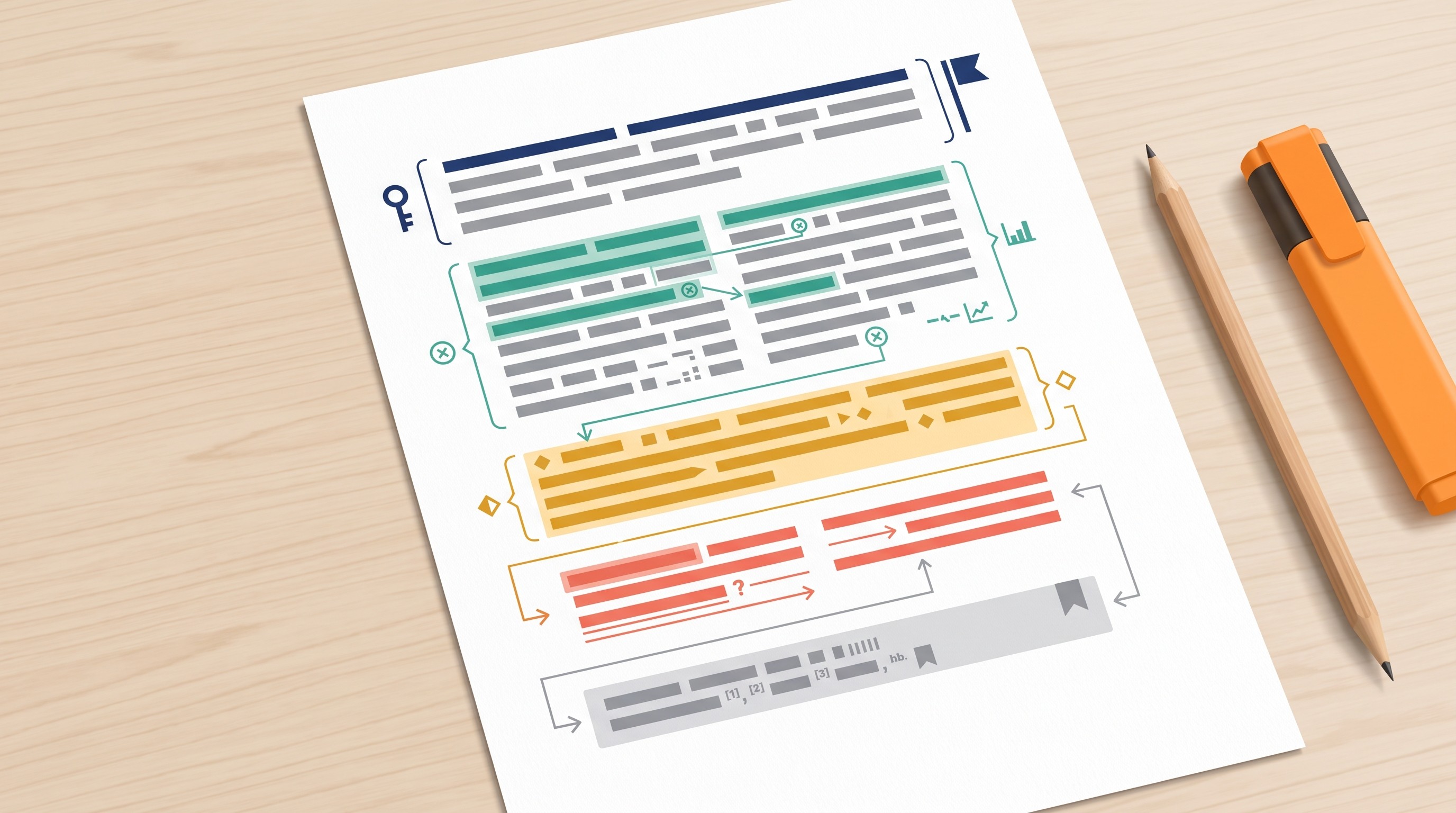
Before drafting, make a short source note with five fields:
Subject: who or what the passage is about
Action or relationship: what happened, changed, predicted, differed, or was associated
Evidence: what data, method, comparison, or result supports the claim
Scope: population, setting, time period, material, condition, or sample
Certainty: words such as “may,” “suggests,” “is associated with,” “did not establish,” or “was consistent with”
That note is the bridge between reading and paraphrasing. It gives you something to write from besides the original syntax.
Separate three things that often get blurred:
The authors’ finding: what the results actually showed.
The authors’ interpretation: what they think the finding means.
Your response: how you use, qualify, challenge, or connect the finding.
That separation prevents a paraphrase from turning an association into causation, a hypothesis into a result, or your interpretation into the authors’ conclusion.
A practical reading workflow helps here. Keep the article, page location, notes, and citation details together, especially when comparing several papers. If you are still finding or checking the underlying article, start with Google Scholar search tips before paraphrasing secondary mentions of a study.
Tools can help if they keep the source visible and traceable. In Otio’s AI PDF reader, for example, you can read a PDF, select text, ask questions about the passage, and keep notes in the same workspace. The important point is not automation; it is reducing the chance that a paraphrase gets separated from its source context.
A five-step workflow for paraphrasing research papers
Use the same workflow every time. It is slower than synonym-swapping for one sentence, but faster than fixing plagiarism and meaning drift later.
Step 1: Read until you can explain the passage without looking
Do not start writing while staring at the source sentence. Read the passage, the previous paragraph, and the next paragraph. If the paper is empirical, check the methods or results section when needed.
Then explain the passage in plain language:
What did the authors examine?
What did they find?
What evidence supports the point?
What limits did they place on the finding?
How strong is the claim?
If you cannot answer those questions, you are not ready to paraphrase. You are ready to keep reading.
Step 2: Identify the elements that cannot change
Some parts of a research passage must survive the paraphrase exactly or nearly exactly. Mark them before drafting.
Preserve:
Technical terms that have field-specific meanings
Numerical results, units, percentages, sample sizes, and dates
Named measures, datasets, materials, organisms, laws, or theories
Comparisons between groups or conditions
Direction of relationships, such as increase, decrease, no difference, or association
Causal limits, such as “associated with” rather than “caused”
Hedging language, such as “may,” “suggests,” “appears,” or “is consistent with”
These are not decorative details. They are often the evidence.
Step 3: Look away and draft from your note
Close the source or move it out of sight. Draft from your claim-evidence-scope-certainty note, not from the original wording.
Change the sentence order and grammatical structure. If the source begins with the method, you might begin with the finding. If the source uses a long noun phrase, you might use a clearer verb structure. If the source compresses several conditions into one sentence, you might split them.
The goal is not to hide the source. The goal is to show that you understood it.
Step 4: Reopen the source and compare both versions
Now check two risks: meaning drift and wording overlap.
For meaning, ask whether your version kept the same:
Subject
Action or relationship
Evidence
Scope
Level of certainty
Conclusion
For wording, look for copied strings, distinctive phrases, unusual transitions, and sentence patterns that survived from the original. If the structure still tracks the source clause by clause, you may have patchwritten even if several words changed.
Step 5: Add the citation immediately
Do not leave citations for later. Add the in-text citation as soon as the paraphrase enters your draft, and preserve any page, paragraph, section, or location details required by your style guide.
This matters because paraphrasing often happens in batches. If you write five paraphrases and plan to “come back to citations,” you may forget which paper supported which sentence. That is how unsupported claims and accidental plagiarism enter otherwise careful drafts.
How to preserve technical meaning, numbers, and qualifications
Technical writing punishes fake variety. If the source uses a precise term, keep it when replacing it would make the sentence less accurate.
For example, “statistically significant,” “randomized controlled trial,” “working memory,” “confidence interval,” “photosynthesis,” “negligence,” and “thematic analysis” are not interchangeable with looser synonyms. Originality should come from your explanation, ordering, and syntax, not from forcing new words where the field requires stable terms.
Numbers require the same discipline. Copy numerical values, units, percentages, sample sizes, model names, and named measures exactly. Then check that your sentence says what the numbers show.
A percentage point is not the same as a percent increase. A correlation is not proof of cause. A non-significant difference is not evidence that two things are identical. A sample of first-year college students is not “people” in general.
Scope words are easy to delete and dangerous to lose. Keep phrases like:
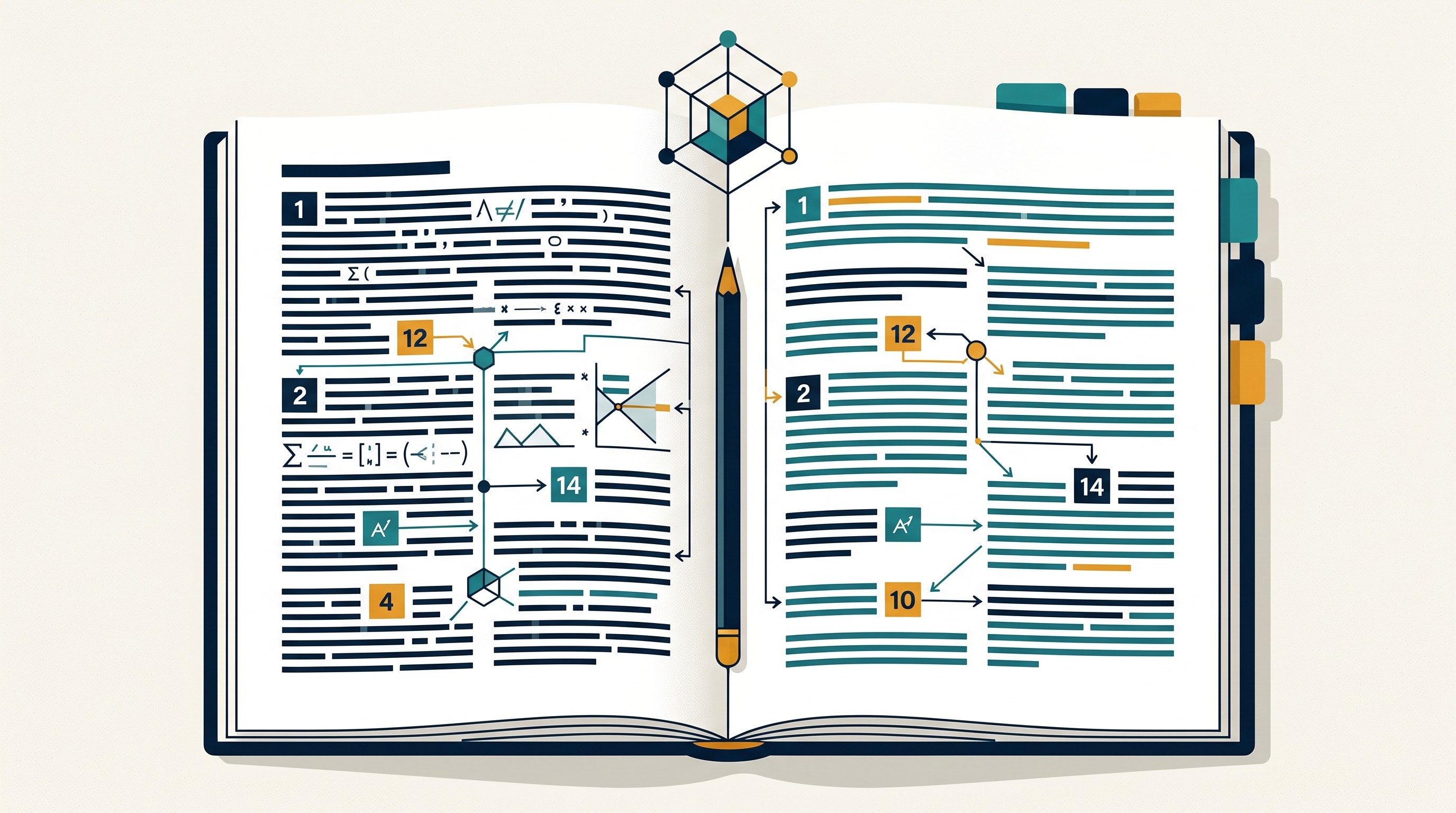
“in this sample”
“among participants”
“under these conditions”
“in the intervention group”
“during the follow-up period”
“the authors report”
“the study suggests”
“the findings are consistent with”
These phrases may look cautious, but they are part of the meaning. Removing them can turn a limited finding into a universal claim.
Modality is evidence too. These changes are not harmless:
“May reduce” becomes “reduces”
“Is associated with” becomes “causes”
“Suggests” becomes “proves”
“Did not find evidence of” becomes “found no relationship”
“In adolescents” becomes “in people”
When several papers address the same point, compare their populations, methods, and conclusions before combining them. Do not write a synthetic sentence that no source actually supports. If one paper studies college students, another studies older adults, and a third is a review of animal studies, you need careful wording before making one broad claim.
When to paraphrase, quote, summarize, or cite several sources
Paraphrase when the source’s idea matters but its exact wording does not. This is the normal choice when integrating evidence into your own paragraph.
A paraphrase works well when you need to:
Explain a study’s finding in your own argument
Connect evidence from one paper to another
Keep the source’s detail without breaking your paragraph’s flow
Show you understand the source rather than pasting it in
Quote when the exact wording matters. That includes formal definitions, legal language, unusually precise terminology, or a sentence whose rhetoric you are analyzing.
Do not quote because you do not understand the source. A long quotation followed by no analysis usually weakens a research paper. A short paraphrase followed by your interpretation is often more useful.
Summarize when you need less detail than the original. For example, you might summarize a paper’s purpose, method, and main conclusion in two sentences before moving to the part you will analyze more closely.
Use multiple citations when one sentence synthesizes several sources. But make the support clear. If the first clause comes from one paper and the second clause comes from another, place citations close enough that the reader can tell which source supports which claim.
If you are still building the source base, use reliable discovery channels rather than paraphrasing whatever is easiest to find. This guide to good websites for research papers and academic articles is useful for broad source discovery. If you need to see how a finished student paper is structured, a high school research paper example can help with layout, but it should not replace source-level paraphrasing practice.
How to check a paraphrase for plagiarism and meaning drift
Check meaning before originality. A paraphrase can look different from the source and still be wrong.
Use this meaning check:
Subject: Did you keep the same person, group, material, or phenomenon?
Action: Did you preserve what happened or what relationship was found?
Evidence: Did you keep the method, result, comparison, or data point that supports the claim?
Scope: Did you keep the population, context, and limits?
Certainty: Did you keep the same level of caution?
Conclusion: Did you avoid adding a claim the source did not make?
Then run the originality check. Mark any distinctive phrase that remains from the source. A phrase is distinctive if it is not a standard technical term and you would be unlikely to write it independently.
Watch especially for patchwriting. Patchwriting follows the original sentence structure while swapping isolated words.
Example:
Original-style claim:
A study of 240 first-year students found that weekly retrieval practice was associated with higher quiz scores during the first six weeks of an introductory biology course.
Patchwritten version:
Research on 240 first-year students discovered that weekly retrieval exercises were linked with better quiz results in the first six weeks of an introductory biology class.
This version is too close. It follows the same order and substitutes words one by one.
Accurate paraphrase:
In an introductory biology course, first-year students who completed weekly retrieval practice had higher quiz scores over the first six weeks; the study reported an association rather than proving that retrieval practice caused the improvement.
This version changes the structure and preserves the limits. It also avoids overstating causation.
A similarity checker can help catch copied wording, but it cannot prove that a paraphrase is accurate. Low overlap can still hide distorted evidence, missing limitations, or a conclusion the paper does not support.
If using an AI writing workspace, use it as a reviewer, not as the authority. Ask it to compare a source passage with your draft, identify possible omissions, and flag language that changes certainty. Then verify every suggested change against the paper.
Otio’s editor supports AI-assisted revisions with a track-changes-style preview, so suggested rewrites can be accepted or discarded rather than silently replacing your text. That is the right posture for research paraphrasing: suggestions are drafts, not evidence.

[[OTIO_INLINE_PROMO:%7B%22title%22%3A%22Can%20you%20verify%20your%20paraphrase%20against%20the%20source%3F%22%2C%22description%22%3A%22Select%20the%20passage%20in%20Otio%E2%80%99s%20PDF%20reader%2C%20ask%20about%20omissions%2C%20and%20compare%20your%20draft%20for%20wording%2C%20evidence%2C%20and%20meaning%20before%20citing%20it.%22%7D]]
A practical paragraph pattern for integrating paraphrased evidence
A paraphrase should not float by itself. It should serve the paragraph’s argument.
Use this pattern:
Start with your point.
Introduce the study only if attribution helps.
Present the paraphrase with a precise citation.
Explain what the evidence does for your argument.
Name any limitation or comparison that matters.
Here is a teaching example using an invented source-like claim.
Weak integration:
Researchers studied sleep and phones. Students who used their phones late had worse sleep. This shows phones are bad for sleep.
The problem is not only style. The final sentence overstates the evidence and removes the likely limits.
Better integration:
Late-night phone use may be one factor in student sleep quality, but the evidence should be framed cautiously. In a survey of college students, the authors reported that more frequent phone use before bed was associated with lower self-reported sleep quality, without establishing that phone use caused the sleep differences (Author, Year). This supports a narrower claim about an observed relationship, not a general claim that phones directly produce poor sleep.
Notice what changed. The paragraph begins with the writer’s point. The paraphrase preserves the sample, measure, association, and causal limit. The follow-up sentence explains how the evidence can and cannot be used.
That is the standard to aim for. A paraphrase is not just a reworded sentence; it is evidence placed under your control.
The final pre-submission test
Before submitting, compare at least one paraphrase against its source using the claim-evidence-scope-certainty checklist. If one fails, check the rest. The same mistake usually repeats.
Ask these questions:
Could a reader recover the source’s original claim from your version?
Did you preserve the evidence that supports the claim?
Did you keep the population, setting, method, and limits?
Did you preserve uncertainty words such as “may,” “suggests,” and “is associated with”?
Did every borrowed idea receive an appropriate citation?
Does each citation point to the source that actually supports the sentence?
Are any copied strings still present?
If the wording is distinctive and necessary, should it be quoted instead?
Does the paraphrase support your argument, or is it replacing your analysis?
Also check the paragraph around the paraphrase. Many meaning errors happen not inside the paraphrased sentence but in the sentence after it, where the writer draws a stronger conclusion than the evidence permits.
The next action is simple: take one source passage from your draft and make a five-field note: claim, evidence, scope, certainty, citation. Draft the paraphrase from that note, then compare it against the original before paraphrasing the rest of the paper.
FAQ
Q: Can I paraphrase a research paper without reading the entire paper?
A: You may not need to read every page, but you should read enough surrounding context to understand the passage’s methods, limitations, definitions, and level of certainty. Paraphrasing an isolated sentence can easily distort the study’s meaning.
Q: How do I paraphrase several research papers in one paragraph?
A: Extract each paper’s claim, population, method, and conclusion separately before synthesizing them. Use citations close to the claims they support and do not combine findings unless the evidence genuinely supports a shared conclusion.
Q: What should I do when a research paper uses unavoidable technical wording?
A: Keep essential technical terms when changing them would reduce accuracy, but rewrite the sentence structure and explain the concept in your own organization. Quote the source if the exact definition or wording is itself important.
Q: Can AI paraphrase a research paper safely?
A: AI can help identify wording differences or possible omissions, but it can also change technical meaning, certainty, numbers, and attribution. Treat its output as a draft and verify every sentence against the original paper before using it.
[[OTIO_FOOTER_PROMO:%7B%22title%22%3A%22Ready%20to%20test%20your%20next%20source%20passage%3F%22%2C%22description%22%3A%22Save%20one%20passage%20and%20its%20five-field%20note%20in%20Otio%2C%20then%20check%20the%20claim%2C%20evidence%2C%20scope%2C%20certainty%2C%20and%20citation%20before%20submitting.%22%7D]]