
Named Research Tools
scite ai: How to Use Scite for Citation Checking and Literature Reviews
Use Scite to inspect how research papers are cited, find supporting and contrasting evidence, and strengthen a literature review without treating citation labels as proof.

Scite AI is useful when the problem is not “can I format this citation?” but “does this source actually support the sentence I attached it to?” Use it to inspect citation contexts: the passages where later papers cite a study and whether those passages appear to support, contrast with, or merely mention the cited work.
The important caveat: Scite is a triage tool, not a judge. Its labels help you decide what to read first, but the final citation decision still comes from the original paper, the citing paper’s surrounding text, and your own assessment of methods, population, outcome, and scope.
What is Scite AI, and what does it do?
Scite AI is a research tool for checking how scholarly papers are cited by later papers. Instead of showing only a citation count, it surfaces citation statements: the actual sentences or passages in which one paper cites another.
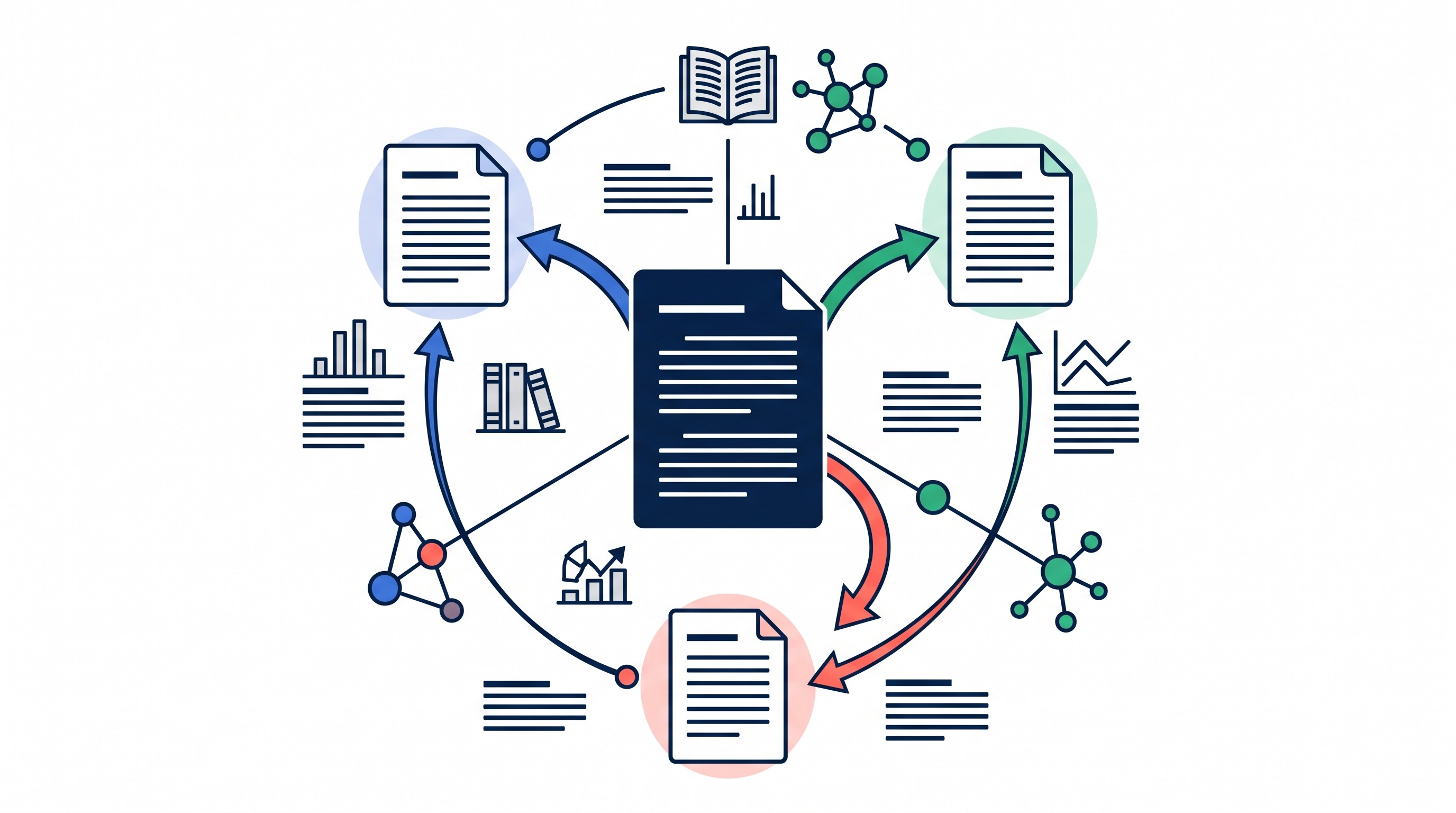
Scite then classifies those citation contexts into broad treatments:
Supporting evidence: the citing paper appears to endorse, replicate, or provide evidence consistent with the cited paper.
Contrasting evidence: the citing paper appears to dispute, fail to replicate, qualify, or provide evidence inconsistent with the cited paper.
Mentioning evidence: the citing paper cites the source as background, method context, prior work, or general framing without clearly supporting or challenging a specific claim.
That makes Scite different from a citation manager. Zotero, Mendeley, EndNote, and similar tools are mainly for collecting sources, storing metadata, organizing PDFs, and formatting bibliographies. Scite is for citation checking: evaluating how a source is being used in the literature.
If you want the broader audit workflow across tools, see Otio’s guide to citation checking tools for academic writers. If the problem is paper discovery rather than citation-context checking, Semantic Scholar is often a better starting point.
The core terms
A few terms matter before using Scite in a literature review.
Cited paper means the paper being referenced. If Paper B cites Paper A, Paper A is the cited paper.
Citing paper means the later paper that includes the reference. In the same example, Paper B is the citing paper.
Citation statement means the sentence or passage where the citing paper refers to the cited paper. This is the unit Scite tries to classify.
Supporting evidence means the citation context appears to back the cited claim or finding.
Contrasting evidence means the citation context appears to challenge, limit, or disagree with the cited claim or finding.
Mentioning evidence means the source is cited, but the context does not clearly support or refute the claim. Many citations in papers are mentions: “Prior work has examined X,” “We used a method adapted from Y,” or “Several studies have addressed this topic.”
The central limitation follows from those definitions. A classification is a screening signal, not proof that a citation is correct. A “supporting” label can still be too narrow for your sentence. A “contrasting” label may apply to one outcome, not the whole paper. A “mentioning” label may still point to useful background.
How to use Scite for citation checking
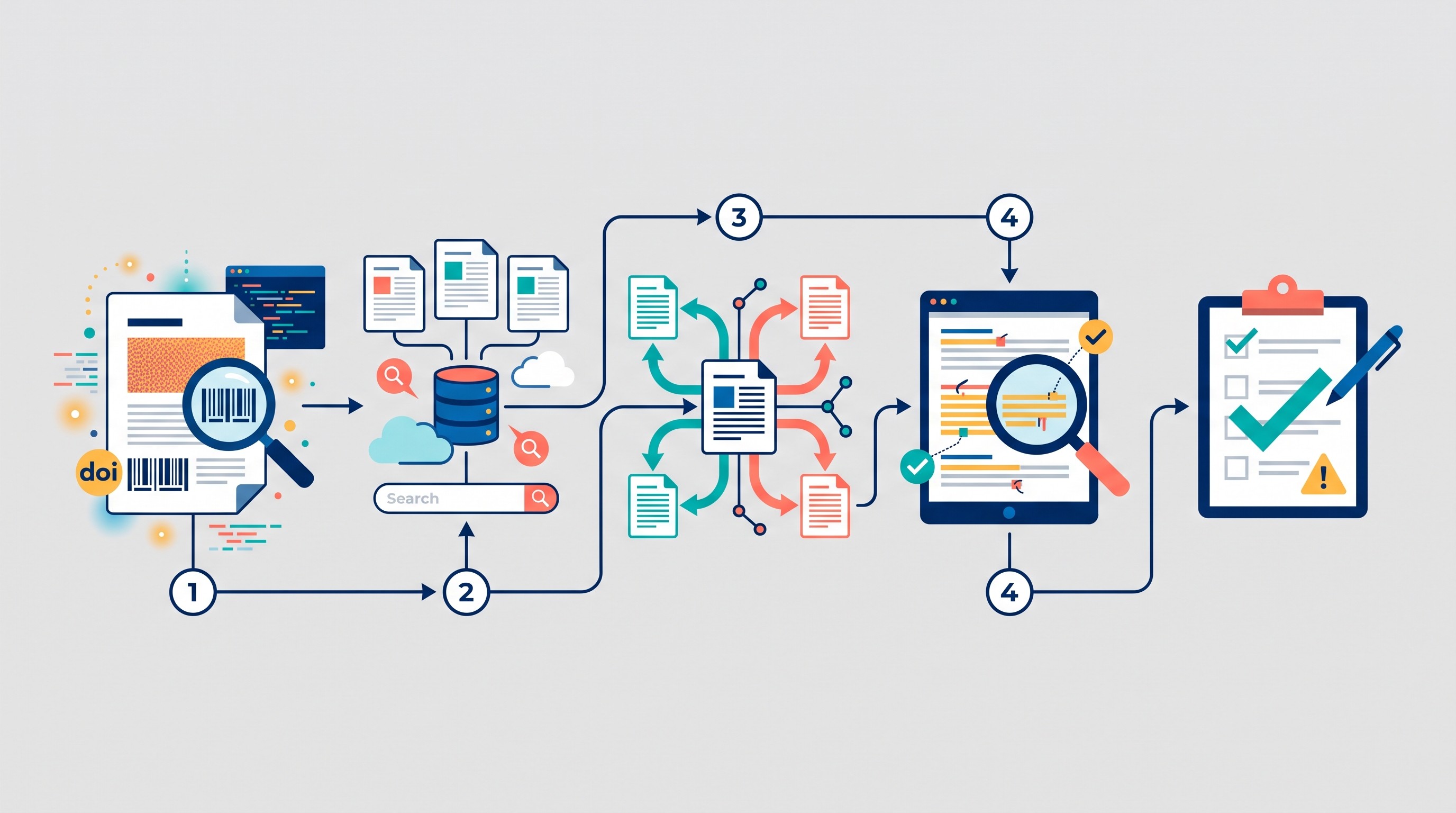
The simplest Scite workflow is: search the paper, open its citation report, inspect citation statements, filter by treatment, open the surrounding source text, then decide whether the citation supports your exact claim.
Do not stop at the label. A citation is only “good” if the cited source supports the sentence you wrote, at the level of specificity you wrote it.
A repeatable citation-checking workflow
Use this process for any important source in a paper, thesis chapter, grant proposal, or literature review.
1. Search for the paper or DOI.
Start with the exact title, DOI, PMID, or author-year combination. DOI is safest when available because titles can vary across preprints, published versions, and database records.
2. Open the citation report.
Look for the paper’s citation contexts rather than the headline citation count. The question is not “how many papers cited this?” It is “what did those papers say when they cited it?”
3. Filter by citation treatment.
Check supporting, contrasting, and mentioning citations separately. Contrasting citations are often the highest-value part of the report because they expose limitations, failed replications, population differences, or unresolved debates.
4. Read the citation statement and surrounding paragraph.
A single sentence may not be enough. Read the paragraph before and after when possible. Authors often introduce a cited result in one sentence, qualify it in the next, and explain the methodological difference later in the section.
5. Open the citing paper when the claim matters.
If the citation affects a major conclusion, read the relevant part of the citing paper. Check whether it is a primary study, review, editorial, commentary, protocol, preprint, or methodological paper.
6. Compare the citation context with your draft sentence.
Your sentence may be broader than the evidence. “Drug X improves outcomes in patients with condition Y” is much stronger than “Drug X improved biomarker Z in a small subgroup under controlled conditions.”
7. Record the judgment.
Do not rely on memory. Save the citation context, the source location, your interpretation, and any caveat.
How to check one sentence in a draft
Citation checking is most useful at the sentence level. Take a sentence like:
“Remote learning reduces student engagement in undergraduate STEM courses.”
Before accepting the citation attached to that sentence, break it down.
Claim: remote learning reduces engagement.
Population: undergraduate STEM students.
Outcome: engagement.
Direction: reduction.
Scope: broad statement across courses, not one course or one institution.
Source attached: the paper currently cited in your draft.
Now inspect how later papers cite that source in Scite.
If most citation statements merely mention the paper as part of pandemic-era teaching research, the source may not support your causal wording. If contrasting citations say engagement effects vary by course design, instructor interaction, or measurement method, your sentence needs to narrow.
A safer revision might be:
“Several studies report lower engagement in some remote undergraduate STEM settings, but the effect appears to vary by course design and how engagement is measured.”
That is a better sentence because it matches the evidence more closely.
What to record during citation checking
A citation audit fails when it becomes a vague feeling: “I checked this and it seemed fine.” A defensible review needs a small record for each important claim.
Use a table like this:
Field | What to record |
|---|---|
Draft claim | The exact sentence or claim being supported |
Cited source | Author, year, title, DOI if available |
Source location | Page, section, table, figure, or paragraph |
Citing paper | The later paper that cites the source |
Citation context | The relevant sentence or passage |
Scite treatment | Supporting, contrasting, or mentioning |
Your judgment | Supports, partially supports, does not support, or needs revision |
Limitation | Population, method, measure, setting, date, or uncertainty |
This table is small enough to maintain, but detailed enough to protect the argument.
The most common failure mode
The most common mistake is treating “supporting” as “supports my sentence.”
Those are not the same thing.
A citing paper may support a finding only for:
a narrow age group
one organism, cell line, or clinical subgroup
a specific intervention dose
a short follow-up period
one statistical model
a particular geography or institutional setting
a proxy outcome rather than the outcome your sentence names
That distinction matters in literature reviews. A source can support “X was associated with Y in this cohort” without supporting “X causes Y.” It can support “this method improved classification accuracy on one benchmark” without supporting “this method is generally superior.”
For major findings, verify the original paper and the citing article. Check the abstract last, not first. The abstract often compresses the claim; the methods, sample, inclusion criteria, and limitations section tell you what the claim actually means.
How Scite can improve a literature review
Scite is most useful after initial discovery. Use Google Scholar, PubMed, Semantic Scholar, your library database, or field-specific indexes to find candidate papers first; then use Scite to inspect how the key papers are treated by later literature.
For broad discovery, start with Google Scholar search tips. Scite works better as a second-stage evidence triage layer than as the only search system.
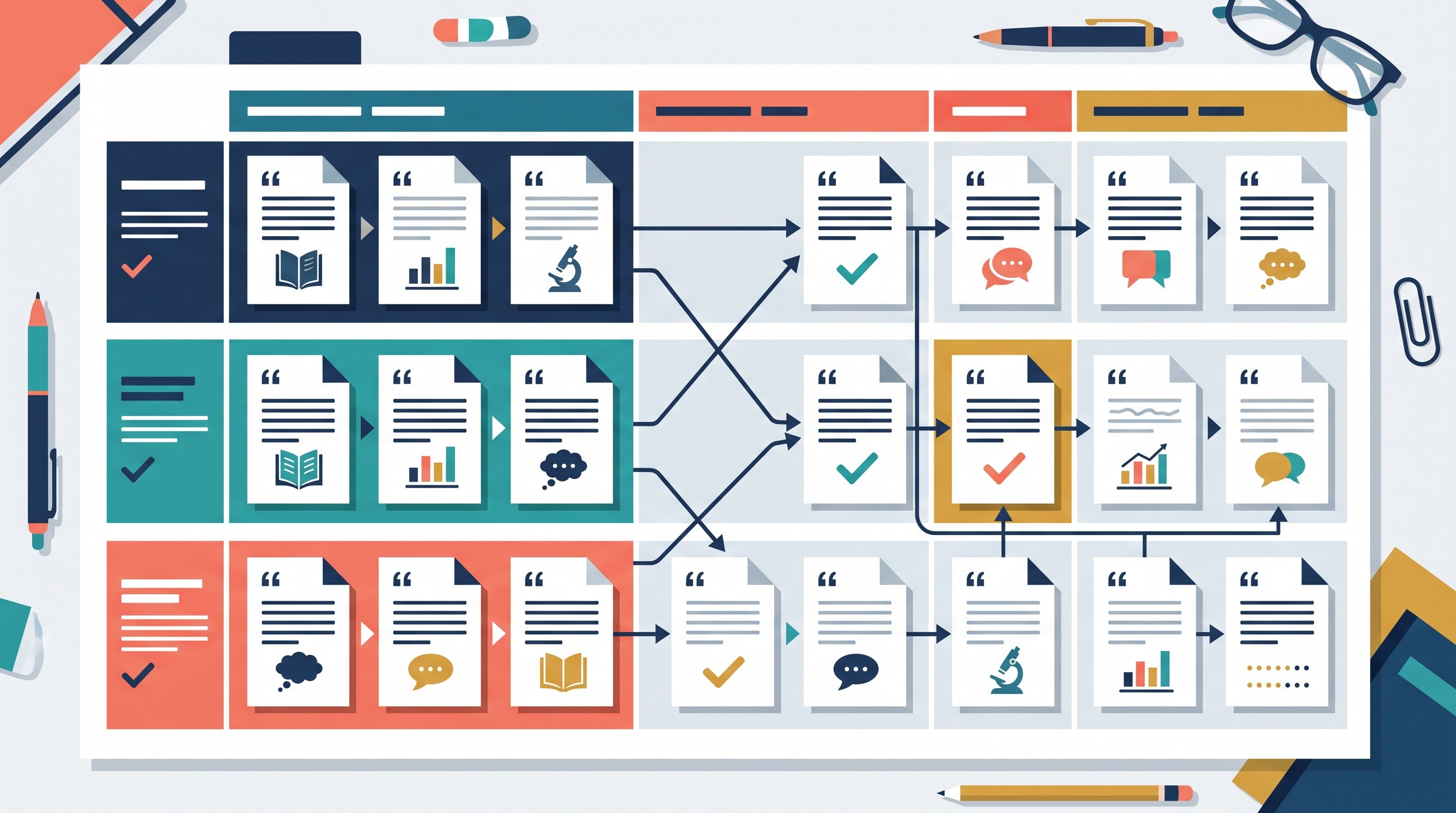
Use Scite to test whether a claim is settled, disputed, or just popular
A paper can be heavily cited for many reasons. It may be a landmark theory paper, a convenient methods reference, a dataset description, a controversial finding, or a review everyone cites in introductions.
Citation frequency alone does not tell you evidential strength.
Scite helps by shifting the question:
Are later papers using this source as background?
Are they reporting consistent findings?
Are they narrowing the claim?
Are they challenging it?
Are they citing it because it is famous, not because it is the best evidence?
That distinction improves the literature review because it prevents the “stack of supportive citations” problem. Many weak reviews present the field as if every citation points in the same direction. Stronger reviews show where the evidence converges, where it diverges, and why.
Build a claim-to-evidence table
For a serious literature review, organize papers by claim rather than by author.
A claim-to-evidence table can look like this:
Research claim | Cited source | Citation treatment | Population or setting | Method | Reviewer’s conclusion |
|---|---|---|---|---|---|
Intervention improves outcome A | Study 1 | Supporting | Adults in one clinical setting | Randomized trial | Supports a narrow version of the claim |
Intervention improves outcome A | Study 2 | Contrasting | Different subgroup | Observational | Suggests effect may not generalize |
Mechanism B explains outcome A | Study 3 | Mentioning | Lab model | Mechanistic experiment | Useful background, not direct evidence |
This is close to a literature review matrix, but the organizing unit is the claim, not merely the source. For a more general structure, see Otio’s guide to a literature review matrix.
The benefit is that contradictions become visible. Instead of writing “Several studies have examined X,” you can write something more precise:
“Evidence for X is strongest in short-term experimental studies, while longitudinal observational studies report mixed results, especially when controlling for baseline differences.”
That is the kind of sentence that signals you have read beyond abstracts.
Use contrasting citations as a map of the debate
Contrasting citations are not a nuisance. They are often the fastest path to a better review.
Use them to identify:
Boundary conditions: when a finding holds and when it does not
Replication concerns: whether later studies failed to reproduce the result
Measurement disputes: whether researchers define the outcome differently
Population limits: whether findings differ across age, geography, disease stage, discipline, or setting
Methodological disagreements: whether results depend on model choice, controls, sampling, or data source
Competing explanations: whether later work proposes a different mechanism
This does not mean every contrasting citation is correct. It means disagreement deserves inspection, especially when your paper relies on the disputed claim.
Separate influence from evidence
Highly cited papers are often important. They are not always the best evidence for your sentence.
A paper may be influential because it introduced a framework. Another paper may provide a stronger empirical test. A recent meta-analysis may be more appropriate for a broad evidence claim than the original study. A methods paper may be cited constantly but irrelevant to a substantive conclusion.
In a literature review, cite the source that best supports the claim you are making. Sometimes that is the foundational paper. Sometimes it is a replication, systematic review, dataset paper, technical validation study, or recent field-specific article.
[[OTIO_INLINE_PROMO:%7B%22title%22%3A%22Turn%20Scite%20results%20into%20a%20claim-to-evidence%20table%22%2C%22description%22%3A%22Bring%20the%20papers%20and%20citation%20passages%20behind%20each%20claim%20into%20Otio%2C%20then%20save%20verified%20excerpts%20and%20caveats%20in%20project%20notes%20as%20you%20synthesize%20the%20review.%22%7D]]
How to interpret supporting and contrasting citation labels
The surrounding wording matters more than the label. Treat Scite’s classifications as a reading order: useful for prioritizing evidence, not for replacing judgment.
A citation context can be subtle. Authors may acknowledge a source, partially agree with it, criticize one aspect, and still use it as a foundation for their own study. One citation can contain both dependence and disagreement.
Three common cases
1. Direct replication or consistent finding
This is the cleanest case. A later study uses a similar method, population, and outcome, and reports a result consistent with the cited paper.
Even then, check the details. “Consistent” may mean same direction but different effect size. It may mean similar conclusion in a different model. It may also mean the citing authors are relying on the earlier result as a premise rather than independently testing it.
2. Qualified support under different conditions
This is common and easy to overstate. A later paper may support the general idea but only under specific conditions.
For example, it may find that an intervention works for early-stage cases but not late-stage cases. Or that an algorithm improves performance on one benchmark but not another. Or that a teaching strategy improves satisfaction but not exam scores.
This is still useful evidence, but it requires careful wording.
3. Explicit disagreement with the original result
A contrasting citation may report a failed replication, a different effect direction, a methodological flaw, or an alternative explanation.
Do not automatically downgrade the original paper because one later paper contrasts with it. Ask why the disagreement exists. Different samples, measures, time periods, confounder controls, or analytic choices may explain the split.
The edge case: criticism and acknowledgment in the same citation
Academic writing often does two things at once. A paper may cite a prior study because it is important while also arguing that it is incomplete.
For example:
“Smith et al. established the dominant model, but their sample excluded rural participants.”
“Prior work found an association between X and Y; our results suggest this relationship disappears after controlling for Z.”
“We adopt the framework proposed by Jones, while modifying its assumptions for high-noise settings.”
A simple label may not capture that nuance. In your notes, record the actual relationship: “uses framework but disputes generalizability,” “supports mechanism but not effect size,” or “contrasts after adding controls.”
Coverage and classification limits
Scite can only classify what it has indexed and what its systems can interpret. Any citation-context system faces limits:
Incomplete coverage: some journals, books, conference papers, preprints, or older materials may be missing.
Disciplinary variation: citation practices differ across biomedical research, social science, humanities, engineering, and law.
Ambiguous language: authors hedge, compress, or imply relationships instead of stating them directly.
Context errors: the surfaced passage may not include the full reasoning around the citation.
Result location: the important finding may be in a table, figure, appendix, or methods section outside the extracted text.
Citation bundling: one sentence may cite five papers, but only one actually supports the specific claim.
Use the labels to decide what to inspect first. Make the final evidence judgment from the original study and the most relevant follow-up research.
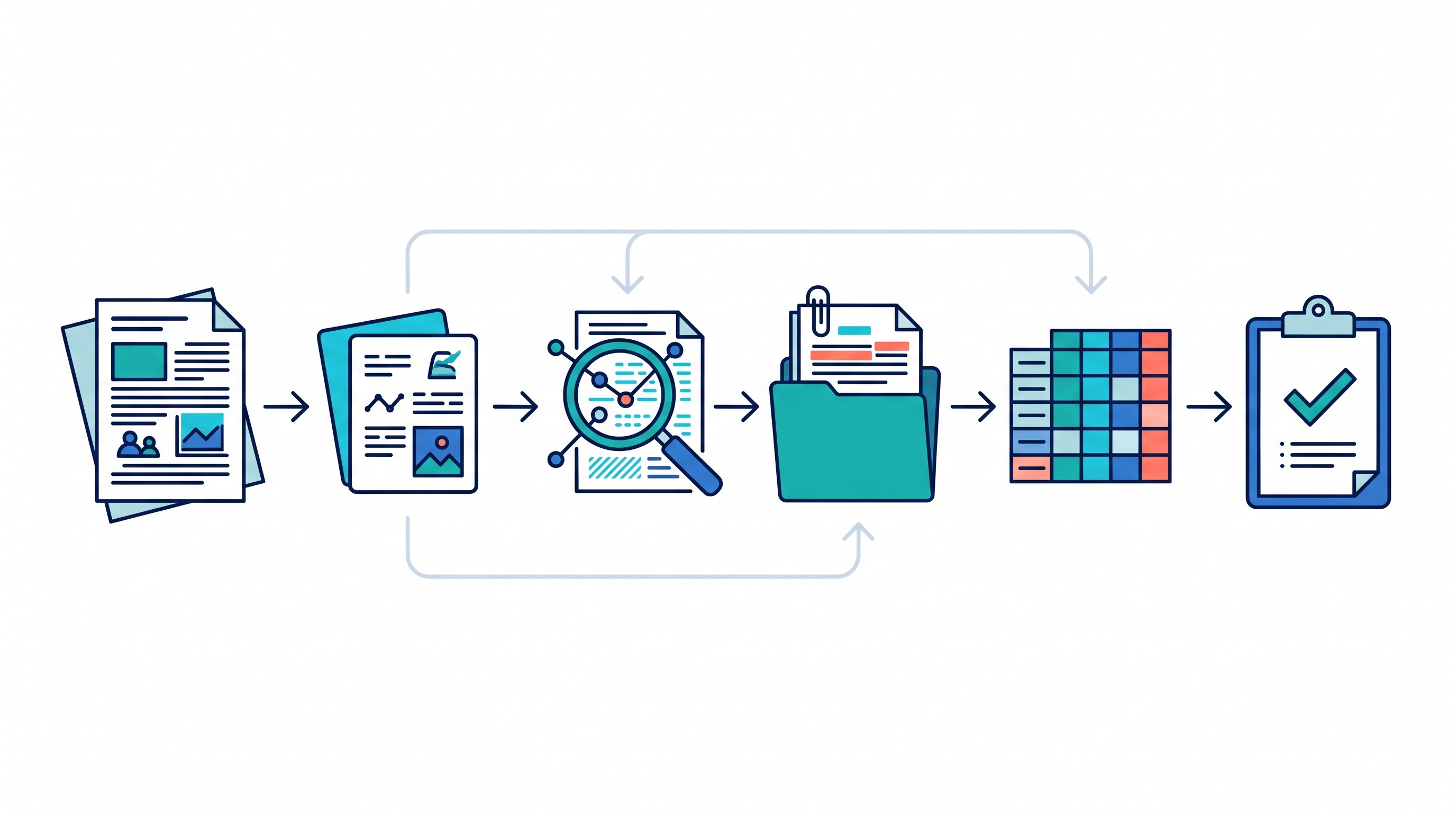
A practical Scite workflow for a defensible research project
A defensible project starts with a focused question and a small set of candidate papers. Do not treat every search result as equally relevant. Start with the claims that carry the weight of your argument.
Step 1: Start with a focused research question
Before opening Scite, define the question tightly enough that “support” means something.
Weak question:
“What does the literature say about AI in education?”
Better question:
“How do AI writing assistants affect revision quality in first-year undergraduate writing courses?”
The second version gives you a population, intervention, outcome, and setting. That makes citation checking possible. If the paper is about graduate engineering students using automated feedback for grammar correction, it may be related but not directly supportive.
If you are still shaping the project, use a guide like how to create a research question before auditing citations.
Step 2: Identify the claims that need the strongest support
Not every sentence deserves the same level of audit.
Prioritize:
thesis-level claims
causal claims
claims about clinical, legal, financial, or policy consequences
claims based on old or controversial papers
claims where the source is cited repeatedly by others
claims where papers disagree
claims that appear in the abstract, introduction, conclusion, or recommendations
Routine background sentences can receive lighter checking. Major claims need manual verification.
Step 3: Check the key papers in Scite
For each important source:
Search the title or DOI.
Open the citation report.
Inspect supporting citations.
Inspect contrasting citations.
Read mentioning citations when you need background or terminology.
Open full citing papers for any context that affects your argument.
Record your judgment in the review table.
Pay special attention to contrast patterns. One contrasting citation may not change the review. Repeated contrast around the same method, sample, or outcome is a signal that your discussion needs nuance.
Step 4: Save the source passages, not just the citation labels
A good literature review is built from traceable passages. Save the exact language that supports your interpretation.
For each important claim, keep:
the original source passage
the citation context from later papers
your interpretation
the limitation or caveat
unresolved questions
whether the draft sentence needs revision
This is where a source-to-notes layer helps. In Otio’s AI PDF reader, you can store PDFs and web links in a unified library, ask questions against collected sources, highlight passages, and save verified excerpts into project notes. That does not replace Scite’s citation classifications; it gives you a workspace for the papers, passages, and notes that sit around the Scite check.
If your PDFs are already in Zotero, Otio’s Zotero integration can help pull papers into the research workspace for reading and note-making.
Step 5: Group evidence by claim or theme
Once the checks are done, stop thinking in individual papers. Group the literature around claims.
For each theme, ask:
Which studies directly support the claim?
Which studies contrast with it?
Which studies only mention it?
Are the strongest studies older or newer?
Do methods differ in ways that explain disagreement?
Are findings consistent across samples and settings?
Is the claim stronger for one subgroup than another?
Is the evidence primary research, review evidence, commentary, or theory?
This turns a list of papers into synthesis. It also helps you avoid a common literature review weakness: summarizing one paper per paragraph without explaining the relationship among them.
Step 6: Revise claims to match the evidence
Citation checking should change the prose.
If Scite and your manual reading show mostly mentioning citations, avoid strong claims. If evidence is mixed, say so. If support is narrow, narrow the sentence. If later papers dispute the finding, describe the disagreement rather than burying it.
Use wording like:
“Evidence is strongest for…”
“Findings are mixed when…”
“Later studies have challenged…”
“This effect appears limited to…”
“The claim is better supported for…”
“The literature distinguishes between…”
These phrases are not hedging for its own sake. They are how you make the scope of evidence visible.
Step 7: Audit final citations before submission
Before submitting, manually audit every citation attached to a major conclusion.
For each one, ask:
Does the cited source support the exact sentence?
Is the citation attached to the right part of the sentence?
Is the source primary evidence, a review, or background?
Does the paper’s population match the claim?
Does the method justify the inference?
Does the outcome match the wording?
Are there important contrasting papers the reader should know about?
Is a newer or stronger source more appropriate?
This final pass catches the errors that automated citation tools cannot: overclaiming, source drift, citation stacking, and using famous papers as stand-ins for evidence.
FAQ
Q: Is Scite AI a citation manager?
A: No. Scite focuses on citation context and how later research treats a paper. A citation manager is mainly for collecting references, managing metadata, organizing PDFs, and formatting citations.
Q: Can Scite prove that a citation is correct?
A: No. Scite can help locate and classify citation contexts, but you still need to read the original source and judge whether it supports the precise claim, population, method, and conclusion in your writing.
Q: Should I use Scite before or after Google Scholar?
A: Use Google Scholar or another discovery system to find a broad set of relevant papers, then use Scite to examine how key papers are cited and where supporting or contrasting evidence appears.
[[OTIO_FOOTER_PROMO:%7B%22title%22%3A%22Apply%20the%20audit%20to%20your%20own%20source%20library%22%2C%22description%22%3A%22Add%20your%20PDFs%2C%20web%20links%2C%20and%20notes%20to%20Otio%2C%20then%20chat%20across%20them%20to%20compare%20supporting%20and%20contrasting%20evidence%20before%20revising%20each%20claim.%22%7D]]