
Video and Audio Research
How to Analyze a Podcast Transcript for Evidence, Themes, and Claims
A practical method for analyzing a podcast transcript: extract claims, assess evidence, identify themes, preserve timestamps, and use AI without treating its summary as proof.

To answer how to analyze a podcast transcript: do not start with a summary. Start by separating the transcript into claims, evidence, themes, context, and unanswered questions, while preserving speaker names and timestamps.
The useful output is not “what the episode was about.” It is a timestamped evidence brief or claim matrix: who said what, where they said it, what support they offered, whether the claim needs verification, and how it relates to the research question.
A transcript records statements. It does not turn those statements into facts. That distinction is the difference between a podcast recap and analysis you can defend.
Updated October 31, 2026.
What podcast transcript analysis should produce
A good podcast transcript analysis produces a structured evidence record, not a polished paraphrase.
The final output should let another person trace every important point back to the source. If the episode is part of academic research, policy analysis, journalism, consulting, legal review, market intelligence, or medical/pharma monitoring, that traceability matters more than a fluent summary.
At minimum, the output should preserve:
Speaker: who made the statement.
Timestamp: where the statement appears in the episode.
Exact wording: the short quotation or passage that matters.
Claim type: descriptive, causal, predictive, normative, experiential, or interpretive.
Stated support: what evidence, source, example, dataset, study, or experience the speaker invokes.
Verification status: supported by the episode, requires external verification, contradicted, opinion, unresolved, or outside scope.
Research relevance: why the passage matters to the question being investigated.
Follow-up sources: papers, laws, reports, datasets, organizations, or earlier interviews that need checking.

This is especially important because podcasts blend different kinds of material. A single episode may include firsthand testimony, expert interpretation, promotional claims, speculation, personal memory, reported research, and offhand opinion. Treating all of that as equal “content” makes the analysis weaker.
A defensible analysis distinguishes:
Speaker testimony: “I saw this happen in my organization.”
Reported evidence: “A 2023 study found…”
Interpretation: “This suggests the market is moving toward…”
Opinion: “I think regulators should…”
Prediction: “This will probably happen within two years.”
Checkable claim: “The law took effect on this date.”
Uncheckable or weakly checkable claim: “Most people in the field privately agree.”
That separation is the core discipline. It keeps a compelling guest from becoming an accidental authority on facts they have not supported.
Prepare the transcript before analyzing it
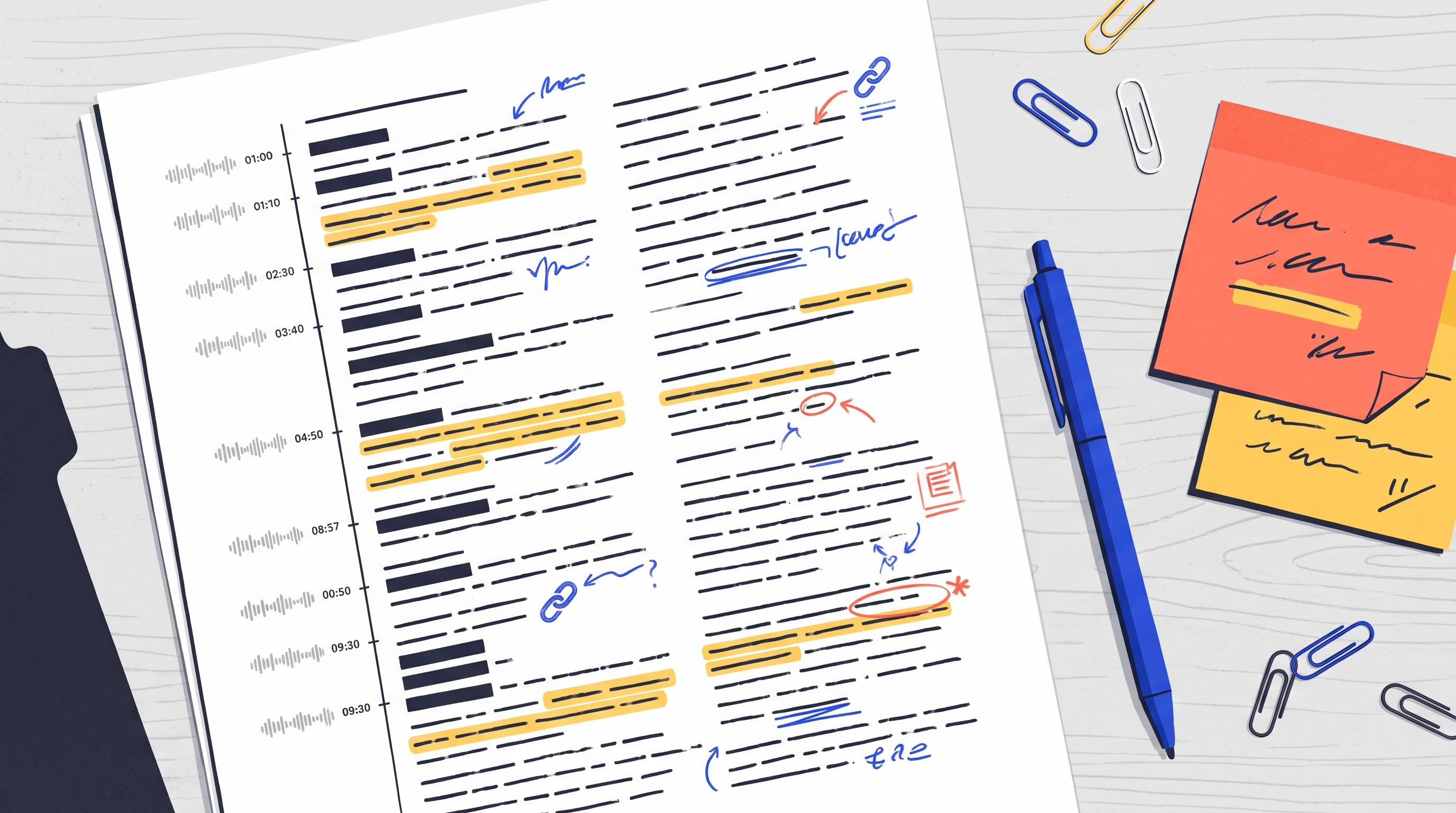
Before coding themes or extracting claims, make the transcript usable as a source.
Check whether it includes:
Episode title
Podcast name and publisher
Episode date
Guest names, roles, and affiliations
Speaker labels
Timestamps
Links to referenced studies, organizations, reports, books, laws, companies, or datasets
A URL for the episode page, audio, video, or transcript
If the transcript came from Apple Podcasts, YouTube, Spotify, a podcast site, Otter, Descript, Rev, Whisper, or another transcription tool, keep the original audio or video available. Apple’s podcast transcript support, for example, makes transcripts viewable and shareable in supported episodes, but transcript access is not the same as source verification (Apple Podcasts for Creators).
Correct obvious transcription problems, but do not silently rewrite meaning. Fixing “policy bait” to “policy rate” may be necessary in a central-bank interview. Changing a hesitant answer into a clean declarative sentence is not.
Use a consistent notation for uncertain passages:
[unclear] when the word cannot be resolved.
[phonetic: ___] when a name or technical term is guessed.
[overlapping speakers] when attribution is uncertain.
[laughter], [pause], or [interruption] only when tone affects interpretation.
[verify acronym] when a shortened term may have multiple meanings.
Speaker labels matter. Timestamps matter. Audio context matters. A transcript can miss sarcasm, emphasis, interruption, hesitation, and whether the host challenged a claim or let it pass.
If you are analyzing one episode, store the transcript with the audio or video and create a working copy for annotations. If you are analyzing a series, do not scatter transcripts across downloads, docs, and chat histories. Put every episode in one research space with consistent metadata.
For note capture rather than full evidence analysis, use a lighter workflow like taking notes from a podcast for research and study. Analysis asks a harder question: what can this transcript support?
Extract claims before looking for themes
Themes are easier to find than claims, which is why they are dangerous to start with.
If you begin by asking “what are the big themes?”, you may flatten the transcript into broad categories before you have recorded what anyone actually said. Extract claims first. Then build themes from the claim record.
Work in short passages: one answer, one exchange, or one coherent segment at a time. For each substantive claim, record the speaker’s wording before paraphrasing it.
A useful claim record includes:
Claim: concise paraphrase.
Exact quotation: the transcript wording that supports the paraphrase.
Timestamp: start time, and end time if the passage is long.
Speaker: name or label.
Claim type: descriptive, causal, predictive, normative, experiential, interpretive.
Stated support: study, data, anecdote, professional experience, analogy, no support.
Qualification: “in our sample,” “usually,” “in 2022,” “for early-stage firms,” “in my experience.”
Verification status: not checked, externally verified, unsupported, contradicted, opinion, unresolved.
Relevance: how it connects to the research question.
Do not compress too soon. “The guest says AI improves clinical work” is too vague. Better: “At 18:42, the guest claims ambient documentation reduced after-hours charting for clinicians at their hospital, citing internal time-use data but not naming a published study.”
That record preserves the important features: the claim, the scope, the source basis, and the missing verification.
Use claim types to avoid false equivalence:
Descriptive claims say what happened or what exists. Example: “The program launched in three states.”
Causal claims say one thing produced another. Example: “The policy reduced churn.”
Predictive claims say what may happen. Example: “The market will consolidate.”
Normative claims say what should happen. Example: “Regulators should require disclosure.”
Experiential claims report personal experience. Example: “Patients told us the form was confusing.”
Interpretive claims explain meaning. Example: “That response shows institutional mistrust.”
Causal and predictive claims usually need the most scrutiny. Personal experience may be valuable evidence for what a speaker experienced, but weak evidence for broad population-level conclusions.
Do not treat repetition as evidence. Do not treat confidence as evidence. Do not treat a guest’s title as evidence. Credentials may affect how you weigh expert reasoning, but they do not replace support.

Evaluate evidence without confusing it with assertion
For every important claim, ask a blunt question: what evidence is actually present?
A podcast statement may contain:
Firsthand observation: the speaker directly saw or experienced it.
Cited research: the speaker names or describes a study.
Data: numbers, datasets, surveys, financials, measurements.
Documentation: laws, policies, contracts, filings, emails, reports.
Expert reasoning: a domain expert explains why a conclusion follows.
Anecdote: a single case or story.
Analogy: a comparison to another situation.
Unsupported assertion: a claim stated without evidence.
Evidence quality is not only about whether something sounds plausible. MIT Open Learning’s evidence guidance puts the point simply: even when a source appears to provide evidence, the reader still has to evaluate whether that evidence is reliable (MIT Open Learning Library).
In transcript analysis, that means checking whether the transcript preserves the full qualification around a claim. A clipped quotation can change:
Population: all patients, Medicare patients, one clinic’s patients.
Timeframe: this quarter, since 2020, during the pilot.
Geography: US, UK, EU, one city, one institution.
Baseline: compared with what?
Magnitude: percentage points or percent change?
Certainty: “may,” “suggests,” “proved,” “we think.”
Source basis: internal estimate, published study, press release, memory.
Follow named sources back to the original where possible. If a guest says “a Lancet paper showed…,” the podcast is not the evidence for the medical claim. The paper is. If a founder says “our retention improved by 30%,” the podcast is evidence that the founder made the claim, not that the metric is accurate.
A practical status system works better than a binary true/false field:
Supported by the episode: the transcript contains enough direct support for a limited claim about what was said or experienced.
Requires external verification: the claim concerns facts, numbers, laws, studies, or events outside the episode.
Externally supported: a primary or reliable independent source supports it.
Contradicted by available evidence: another source directly conflicts with it.
Opinion or recommendation: the claim is normative or judgment-based.
Unresolved: evidence is incomplete or mixed.
Out of scope: the claim is not relevant to the current research question.
Record problems explicitly: missing baseline, vague metric, unnamed study, possible conflict of interest, unclear definition, anecdotal support, or need for domain review.
AI can help find candidate claims, but AI-generated extractions still need source-level checking. The same rule applies: the model output is not evidence. It is a pointer back to the transcript, audio, and underlying sources.

[[OTIO_INLINE_PROMO:%7B%22title%22%3A%22Can%20you%20trace%20each%20claim%20to%20its%20source%3F%22%2C%22description%22%3A%22Add%20the%20transcript%20and%20referenced%20papers%20or%20reports%20to%20Otio%2C%20then%20compare%20claims%20with%20citations%20before%20marking%20anything%20verified.%22%7D]]
Identify themes without flattening disagreement
Once the claim record exists, begin thematic analysis.
A theme is not just a repeated word. It is a meaningful pattern across passages. Thematic analysis is commonly used to identify, analyze, and interpret patterns of shared meaning in qualitative material (Thematic Analysis: A Step by Step Guide).
For podcast transcripts, code more than topics. Track:
Repeated concepts
Problems or pain points
Proposed solutions
Assumptions
Metaphors
Tensions
Disagreements
Shifts in speaker position
Claims that recur with different evidence
Claims that sound similar but differ in scope
A topic label might be “remote work.” A stronger theme might be: “The speakers frame remote work as a retention tool for senior employees but a training risk for junior staff.” That theme explains a pattern and preserves the internal tension.
Track who introduces each theme. A host’s framing can shape the episode differently from a guest’s answer. A co-host’s challenge can reveal uncertainty. A producer’s inserted narration may summarize or redirect the conversation.
Useful theme fields include:
Theme name: short, analytical label.
Theme description: what pattern it captures.
Supporting passages: timestamped quotations or claim IDs.
Speakers: who supports, qualifies, or challenges the theme.
Evidence strength: strong, mixed, thin, anecdotal, opinion-heavy.
Counterpoints: passages that complicate the theme.
Open questions: what remains unknown.
Preserve minority views. If three speakers agree and one dissents with a well-supported objection, the dissent is not noise. It may be the most valuable part of the transcript.
Also preserve movement over time. Some interviews begin with a strong claim and later narrow it after questioning. If the final brief only reports the opening version, it misrepresents the episode.
For multi-episode analysis, do not compare themes across the series until each transcript has been coded consistently. Use the episode, speaker, and timestamp as the unit of evidence. Otherwise, a loud guest in one episode can distort the apparent pattern across the whole series.
This is where podcast transcript analysis starts to resemble analysis of interview transcripts: the method is less about summarizing speech and more about preserving evidence, attribution, and disagreement.
Use AI to analyze podcast transcripts without outsourcing judgment
AI is useful for bounded transcript tasks. It is risky when treated as the analyst.
Use AI to:
Extract candidate claims.
Identify speaker turns.
Find repeated concepts.
Suggest preliminary codes.
Locate passages relevant to a research question.
Compare two versions of a claim across a long transcript.
Flag missing evidence or vague references.
Draft a first-pass evidence matrix for human review.
Require timestamps and verbatim quotations for every extracted claim. If the model cannot point to exact transcript text, treat the output as a hypothesis, not a finding.
Run separate passes for different jobs:
Extraction pass: identify candidate claims with timestamps and quotations.
Classification pass: assign claim types and stated support.
Evidence pass: mark what needs external verification.
Theme pass: group coded claims into themes and counterthemes.
Critique pass: identify overreach, missing context, contradictions, and weak evidence.
This separation matters. If the first prompt asks for a summary, the model may impose a narrative that shapes every later answer. Extraction before interpretation keeps the transcript in control.
For consequential work, compare outputs from more than one model. One model may be better at careful extraction; another may be better at critique or long-context synthesis. Differences are useful because they show where the transcript needs human attention.
Otio’s AI podcast summarizer can help move from audio or video to source-grounded notes inside a larger research library. More importantly for transcript analysis, Otio can keep the media file, transcript, web pages, PDFs, notes, and related documents together, so the claim matrix does not detach from the source.
For harder analysis, using multiple AI models is useful when extraction, critique, and synthesis benefit from different model strengths. The researcher still decides which claims are supported. The model should not get the last word on evidence.
A good AI-assisted workflow looks like this:
Upload or save the audio, video, transcript, and related sources in one project.
Ask AI for candidate claims with timestamps and quotations.
Check the highest-consequence claims against the transcript and audio.
Ask a separate model or prompt to critique the claim list.
Verify named studies, laws, reports, and datasets outside the podcast.
Build themes only after claim extraction.
Save the transcript, prompts, model outputs, corrections, and final brief together.
That audit trail is not bureaucracy. It is how someone else can understand how the analysis moved from spoken words to research conclusions.
Turn the analysis into a source-linked research brief
The final brief should not retell the episode minute by minute. It should answer the research question using the strongest transcript evidence, then explain what the episode does and does not establish.
Start with:
Research question: the question the transcript helps answer.
Short answer: two to five sentences grounded in the strongest evidence.
Source scope: episode title, guest, date, publisher, transcript source, and whether audio was checked.
Main claims or themes: organized by analytical importance, not chronology.
Limitations: unresolved claims, missing sources, weak evidence, and contested interpretations.
For each major point, include the source trail:
Speaker
Timestamp
Short quotation or faithful paraphrase
Evidence status
External source link or note, where applicable
Relevance to the research question
Use clear categories in the brief:
What the episode establishes: claims supported by the transcript itself, such as what a guest reported experiencing or what position a speaker took.
What the episode suggests: patterns, interpretations, or hypotheses that are plausible but not settled.
What remains unknown: claims that need outside verification, stronger evidence, or further interviews.
This distinction is important for predictions, personal accounts, and contested claims. A founder’s podcast interview may establish how the company presents its strategy. It may not establish whether the strategy works. A doctor’s interview may provide expert interpretation. It may not establish the clinical effectiveness of an intervention unless the underlying evidence is checked.
When the podcast is one source in a larger project, compare it with papers, reports, legislation, datasets, filings, or other interviews. A podcast can supply context, explanation, and testimony. It rarely should stand alone for factual claims that have primary sources elsewhere.
For multi-source work, build a reusable evidence matrix. The same structure can apply to podcasts, PDFs, interviews, reports, and web pages. If the project moves into a literature review, use a comparison method that tracks evidence, themes, and contradictions across sources, not one summary per source.
For larger evidence projects, a dedicated matrix helps prevent source drift. The process is similar to building an evidence matrix from PDFs, web pages, and interviews: each source contributes traceable claims, not free-floating notes.
End the workflow by verifying the highest-consequence unresolved claims against primary sources. Then save the approved claim matrix, theme notes, research brief, transcript, and original episode together.
If the transcript analysis is part of academic, policy, medical, or professional research, a permanent workspace matters. Otio for academics is built around that longer-lived source-to-synthesis workflow: mixed sources in one library, cited answers, notes, and model choice without treating AI output as proof.
FAQ
Q: How is podcast transcript analysis different from summarizing a podcast?
A: A summary describes the main points. Transcript analysis evaluates claims, evidence, themes, speakers, qualifications, and gaps while preserving timestamps and source context.
Q: Can AI accurately analyze a podcast transcript?
A: AI can extract candidate claims, suggest themes, and locate passages, but it can misread speakers, invent connections, or treat assertions as facts. Check important outputs against the transcript, audio, and original sources.
Q: How should I cite evidence from a podcast transcript?
A: Record the episode title, speaker, publisher, date, URL, transcript location, and timestamp. If the speaker refers to a study, law, report, or dataset, cite that underlying source separately.
Q: What is the best format for analyzing a long podcast series?
A: Use the same claim and theme schema across episodes, with episode-level metadata and timestamps for every passage. A shared research library makes it easier to compare speakers and episodes without losing the original sources.
[[OTIO_FOOTER_PROMO:%7B%22title%22%3A%22Apply%20the%20matrix%20to%20your%20research%20sources%22%2C%22description%22%3A%22Keep%20the%20episode%2C%20transcript%2C%20papers%2C%20reports%2C%20and%20notes%20in%20one%20library%20so%20you%20can%20compare%20claims%2C%20preserve%20citations%2C%20and%20revisit%20unresolved%20questions.%22%7D]]