
Financial and Market Research
Earnings Call Transcript Analysis: A Cited Workflow for Analysts
Analyze earnings call transcripts alongside filings, presentations, and prior calls using a cited workflow. Compare management claims, verify numbers, and produce an auditable analyst brief.

Earnings call transcript analysis is not a cleaner summary of the call. It is a traceable comparison of management commentary, reported results, guidance, analyst questions, and supporting documents.
The output should be an analyst brief that separates what the company reported, what management says it means, what the Q&A tested, and what still needs verification. The transcript is one input. The filing, earnings release, investor deck, webcast, and prior calls are the control set.
Updated October 30, 2026.
What earnings call transcript analysis should produce
A good earnings call workflow produces a decision document, not a transcript recap.
The brief should answer a few questions fast:
What materially changed versus the prior quarter or prior year?
Which claims are supported by reported numbers?
Which claims depend on management interpretation?
What did analysts press on in Q&A?
What needs to be checked before the next model update, memo, IC meeting, or client note?
That structure matters because an earnings call mixes different kinds of evidence. Prepared remarks are management’s narrative. Q&A reveals pressure points. Guidance is forward-looking. Non-GAAP metrics may use company-specific definitions. The transcript gives searchable language, but it is not the full source of record.
Academic and professional research guides treat earnings calls as one component of company research, alongside financial filings, market position, and operating history. The UC Law SF company research guide frames earnings call transcripts as part of a broader business and company research process, not a standalone artifact (UC Law SF Library).
For analysts, the right deliverable is usually a short investment or business brief with four layers:
Reported facts: revenue, margins, cash flow, segment results, guidance ranges, volume, pricing, costs, capital allocation.
Management explanation: the company’s stated causes for change, strategic priorities, risk framing, and forward-looking commentary.
Analyst interpretation: what the evidence may imply for the model, thesis, valuation, competitive view, or business decision.
Open questions: contradictions, missing data, unclear definitions, weak answers, and items to monitor next quarter.
Otio’s financial analysis workspace fits this job when the work spans transcripts, filings, PDFs, web pages, decks, recordings, notes, and cited answers. The point is not to replace judgment. It is to keep the evidence trail intact while the analysis moves from source collection to synthesis.
Build a source set before you interpret the call
Do not start with the transcript. Start with the corpus.
For one quarter, collect:
Current earnings release
Quarterly or annual regulatory filing
Investor presentation
Official webcast or recording
Prepared remarks, if separately published
Transcript
Prior-quarter call transcript
Prior-year comparable-quarter call transcript
Relevant peer calls, if the question is sector-level
Your prior model, memo, or monitoring list
Then label each source before reading. At minimum, use company, reporting period, publication date, source type, and evidence type.
Evidence type is the important field. Mark each item as one of these:
Reported data: numbers from the filing, earnings release, segment note, or reconciliation.
Management commentary: prepared remarks, Q&A answers, strategic claims, risk framing.
Analyst question: the market’s challenge, concern, or requested clarification.
Analyst inference: your interpretation, not the company’s claim.
That labeling prevents a common failure: a polished narrative that quietly turns management commentary into “evidence.”
Use the transcript for language. Use the filing and earnings release to verify numbers, definitions, periods, accounting treatment, and non-GAAP reconciliations. If management says “demand improved sequentially,” the transcript tells you the claim. The filing, release, segment data, order commentary, backlog, channel checks, or peer evidence help test whether it holds.
Keep versions together. Third-party transcripts may have omissions, speaker-attribution mistakes, missing questions, transcription artifacts, or altered wording. Transcript-verification guidance for AI and automated transcripts recommends checking words, speaker labels, time coverage, and missing context before quoting or reusing transcript material (Digital Applied).
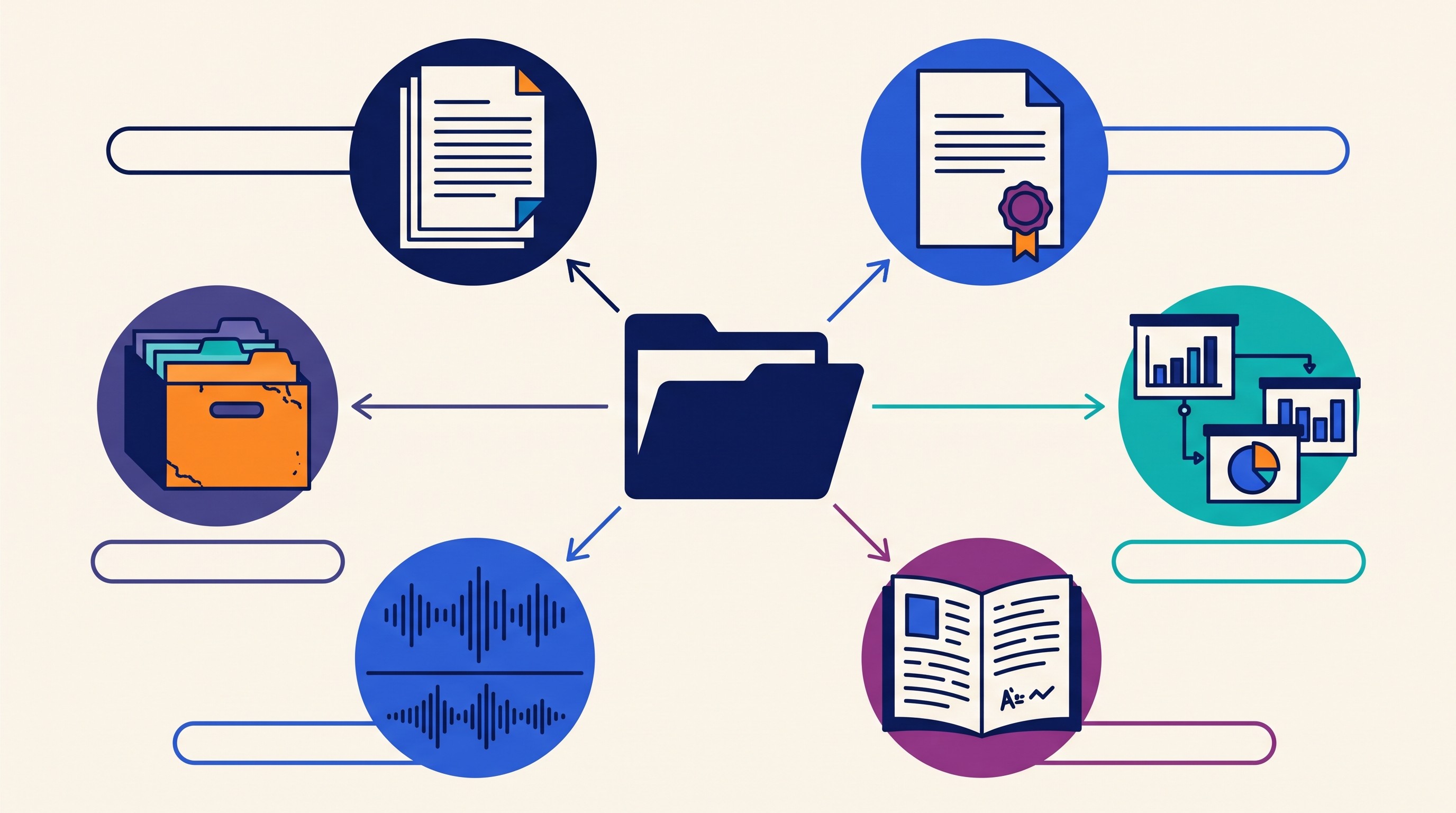
This is where a permanent workspace beats a folder of downloads. In Otio, analysts can keep PDFs, web pages, audio, video, transcripts, and notes in one library, then work across them instead of rebuilding the source set every quarter. The AI PDF reader is useful for filings and investor decks; multiple AI models matter when comparing interpretations of ambiguous passages or dense filings.
The operating rule is simple: one company or coverage project gets one persistent space. Each quarter becomes an update to a living evidence base, not a new scavenger hunt.
Read the transcript in four passes
Reading a transcript once from top to bottom is the slowest way to analyze it. Use four passes, each with a different job.
Pass one: map the call
First, identify the structure.
Mark:
Company and reporting period
Call date
Participants and roles
Prepared remarks
Q&A start
Analyst firms represented
Missing, inaudible, or unclear passages
Any places where the transcript does not align with the recording
This pass is mechanical. It protects the rest of the analysis from basic attribution errors. If the CFO gives a margin bridge and the CEO gives a strategic answer, those claims carry different evidentiary weight.
Pass two: extract concrete facts
Next, pull out hard claims.
Look for:
Revenue and growth rates
Gross margin, operating margin, EBITDA, EPS, or other margin measures
Free cash flow and working capital commentary
Segment results
Volume, pricing, mix, utilization, churn, bookings, backlog, or ARPU
Guidance ranges and assumptions
Cost programs
Capital allocation
Inventory, supply chain, hiring, capex, or customer behavior
Record the source location for each claim. If the transcript has timestamps, preserve them. If it has sections, preserve section names. If you are working from a PDF, page references are enough for drafting, but the final brief should point to the exact passage.
At this stage, avoid explaining. Extract first. Interpret later.
Pass three: mark management’s narrative
Now move from facts to framing.
Mark:
Stated causes of change
Strategic priorities
Risk language
Forward-looking statements
Repeated phrases from prior calls
New language that did not appear last quarter
Removed language that used to appear regularly
This pass is where transcript analysis becomes useful. A company may report the same metric movement two quarters in a row while changing the explanation. That shift can be more important than the number itself.
For example, “temporary destocking” is different from “a cautious customer spending environment.” “Normalized demand” is different from “stabilization.” None of those phrases proves the business is improving or deteriorating, but each gives you a testable claim.
Pass four: study analyst questions
Analyst questions show what the market is trying to verify.
Track questions about:
Guidance assumptions
Segment weakness
Pricing durability
Customer budgets
Competitive pressure
Margin sustainability
Capital allocation
Working capital quality
Regulatory or macro exposure
Management credibility on prior targets
Do not only record the answers. Record the question itself. A weak answer to a sharp question is often more useful than a polished prepared remark.
Still, tone is not evidence. Confidence, repetition, evasion, or unusually long answers are prompts for verification. They are not proof of deception, operational weakness, or future performance.
Turn transcript passages into an evidence matrix
An evidence matrix converts the call from a pile of quotes into an audit trail.
Create one row per material claim. Each row should capture:
Claim
Speaker
Call section or timestamp
Exact quotation or precise paraphrase
Evidence type
Supporting source
Reporting period
Metric definition
Confidence level
Contradiction or caveat
Follow-up question
This sounds more formal than it is. For a single company, the matrix may only contain 20 to 40 rows. The point is not bureaucracy. The point is to prevent memory from selecting the most vivid quote rather than the most material evidence.
A useful matrix separates three things:
Reported result: “Segment revenue declined year over year.”
Management explanation: “The decline was attributed to customer inventory correction.”
Analyst inference: “If true, this may imply a shorter-cycle headwind rather than share loss.”
Those three lines may belong near each other, but they are not the same kind of claim.

For every major claim, look for corroboration in at least one primary or adjacent source:
Filing
Earnings release
Investor presentation
Segment note
Non-GAAP reconciliation
Prior call
Official recording
Peer call
Industry data, if relevant
Record contradictions explicitly. A transcript statement may refer to a different period, metric definition, currency, segment boundary, or adjusted measure than the document you are using for support.
Example:
Management says “margins improved sequentially.”
The investor deck shows adjusted operating margin improved.
The filing shows GAAP operating margin declined because restructuring charges increased.
The right matrix note is not “margin improved.” It is “adjusted operating margin improved sequentially; GAAP operating margin declined due to restructuring charges.”
That distinction is the difference between analysis and narrative laundering.
If the work involves broader document comparison, Otio’s existing guide to AI financial statement analysis is a useful companion for checking how reported numbers and narrative claims line up.
[[OTIO_INLINE_PROMO:%7B%22title%22%3A%22Ready%20to%20build%20your%20evidence%20matrix%3F%22%2C%22description%22%3A%22Bring%20the%20transcript%2C%20filing%2C%20earnings%20release%2C%20and%20investor%20deck%20together%20to%20organize%20claims%2C%20citations%2C%20contradictions%2C%20and%20follow-up%20questions.%22%7D]]
Compare the current call with prior periods and peer evidence
The value of earnings call transcript analysis compounds over time.
One call tells you what management said. Several calls show whether the story is changing.
Build a longitudinal view across:
Guidance
Demand
Pricing
Volume
Cost inflation or savings
Hiring
Inventory
Customer behavior
Sales cycles
Capital allocation
Risk language
Competitive positioning
A “new” issue may not be new. It may be a repeated statement, a seasonal pattern, a change in wording, or a change in metric definition. Treat each as a different analytical case.
When comparing calls, ask:
Did the metric change, or did the definition change?
Did the period change from year-over-year to sequential?
Did management move from quantified guidance to directional commentary?
Did an issue shift from Q&A into prepared remarks?
Did the same analyst question recur?
Did management stop mentioning a prior priority?
Peer calls can add context, but they are easy to misuse.
Normalize for reporting period, business mix, accounting terminology, geography, end-market exposure, and market conditions. Two companies may both say “enterprise demand remains cautious” while selling into different buyers, contract lengths, and budget cycles. Similar language is not automatically comparable evidence.
Keep three notes separate:
Observation: what changed in the transcript or reported numbers.
Possible explanation: why it may have changed.
Implication: what it could mean for the model, thesis, forecast, diligence question, or business decision.
That separation preserves analytical humility. It also makes the final brief easier to audit under pressure.
Handle the failure modes that make transcript analysis unreliable
Transcript analysis fails when the evidence boundary gets blurry.
The most common failure modes are predictable.
Treating transcript numbers as authoritative.
Verify every material number against the filing, earnings release, or official investor materials. Transcripts are useful research inputs, but they are often not the best authority for exact figures.
Comparing different metric types.
Before comparing, check whether a metric is GAAP, non-GAAP, operational, constant-currency, annualized, forward-looking, or management-defined. “Adjusted EBITDA,” “free cash flow,” “organic growth,” and “net retention” can vary meaningfully across companies.
Ignoring period mismatch.
Quarter-over-quarter, year-over-year, trailing twelve months, fiscal year-to-date, and annualized numbers answer different questions. Do not let a transcript quote collapse them into one trend.
Overreading tone.
Confidence, vagueness, repetition, or a long answer can indicate where to look next. They do not prove business performance. Require repeated evidence or corroboration from reported data.
Missing speaker attribution problems.
If a transcript assigns an answer to the wrong executive, the analysis may misread accountability. This matters when a CFO discusses guidance assumptions, a segment leader discusses operational demand, or a CEO frames strategy.
Using summaries as evidence.
AI-generated summaries are navigational aids. They help find claims, themes, and contradictions. They are not the claim source. Open the cited passage before using any summary in a client memo, investment thesis, diligence note, or internal decision.
Uploading sensitive work without checking controls.
Earnings analysis may include unpublished models, client materials, MNPI-sensitive workflows, confidential diligence, or internal investment views. Use the appropriate controlled workspace and check tool terms, access controls, and organization policy before uploading sensitive material.
A related caution applies to any transcript workflow, not just earnings calls: transcript text is a derived record. If a passage matters, check it against the recording, filing, or official release.
Use AI to accelerate synthesis without outsourcing judgment
AI is useful in earnings call transcript analysis when it is assigned narrow jobs.
Good AI tasks include:
Extract all guidance-related passages.
List every claim about pricing and attach source locations.
Compare this quarter’s demand language with the prior four calls.
Identify questions analysts asked that management did not answer directly.
Group Q&A passages by business driver.
Draft a source-linked outline for an analyst brief.
Flag claims that need verification against the filing or earnings release.
Bad AI tasks ask for unsupported conclusions:
“Is this stock a buy?”
“Was management lying?”
“Summarize the call and tell me what matters.”
“Predict next quarter’s earnings from the transcript.”
Those prompts invite overreach. A better prompt asks for evidence classification: reported facts, management explanations, analyst questions, contradictions, and follow-ups.
Google’s Gemini Enterprise documentation, for example, presents earnings call summarization as a transcript-based chat task using prompts framed around an equity analyst role (Google Cloud docs). That is a useful starting point, but the analyst workflow should still require source comparison and verification.
The best setup keeps the whole corpus together. The AI should be able to distinguish the transcript from the filing, presentation, recording, and analyst notes. If those materials live in separate chats, folders, or tools, the model may produce a fluent answer while missing the source that proves or disproves it.
Otio supports this workflow with a unified library for PDFs, web pages, audio, video, transcripts, and notes; inline citations; source selection; and model switching. For large coverage workflows, use one space per company or project and preserve the evidence matrix beside the source set and final brief. If the work includes ESG, sustainability, governance, or company-performance research, Otio for ESG research is the closest audience fit.
Multiple models can help with difficult passages or competing interpretations. Use that as a stress test, not validation. If two models agree on an unsupported inference, the inference is still unsupported.
For data-heavy work beyond the transcript, Otio’s guide to financial statement analysis techniques can help structure the reported-data side of the review.
Write the final analyst brief around decisions and citations
The final brief should not follow the order of the call. It should follow the decision.
Open with the two or three most material changes. Each should have a citation to the transcript passage and, where relevant, a corroborating primary source.
A strong opening might look like this in structure:
Demand: Management moved from “stabilization” to “modest recovery,” but reported segment revenue still declined year over year. Verify against next quarter’s order and backlog commentary.
Margins: Adjusted margin improved sequentially, while GAAP margin was affected by restructuring charges. Keep the metric distinction explicit in the model.
Guidance: Full-year guidance was maintained, but Q&A narrowed the implied second-half assumptions. Monitor whether the implied acceleration is supported by bookings or customer activity.
Then organize the body by business driver, not by transcript chronology:
Revenue and demand
Segment performance
Pricing, volume, and mix
Margin bridge
Guidance and assumptions
Cash flow and balance sheet
Capital allocation
Risk language
Analyst Q&A pressure points
Open questions
Use short quotations only when the wording matters. If management changes from “transitory” to “persistent,” quote it. If the passage is a routine explanation of margin movement, paraphrase precisely and preserve the source location.
For each section, separate four layers:
What happened: reported result or observed transcript change.
What management says caused it: explanation or narrative.
What remains uncertain: missing evidence, contradictions, or weak answers.
What to monitor next: metrics, thresholds, customer signals, or questions.
End with a next-quarter monitoring list. This is where transcript analysis becomes operational.
Include:
Metrics that would confirm or challenge management’s explanation
Guidance thresholds that matter
Segment disclosures to watch
Customer or market indicators
Questions to ask on the next call
Peer disclosures that could corroborate or contradict the story
Before distribution, audit every consequential claim for:
Source coverage
Period accuracy
Metric definition
Speaker attribution
Fact versus interpretation
Whether the transcript passage has been checked against the filing, release, deck, or recording
This audit is not administrative overhead. It is what makes the brief defensible.
If the work becomes recurring, save the source set, evidence matrix, and cited draft in a persistent research workspace. The next earnings cycle should begin with last quarter’s questions, not a blank document. For analysts comparing tool fit by corpus size, connectors, media handling, and workspace needs, Otio pricing gives the current plan structure.
FAQ
Q: What sources should be used with an earnings call transcript?
A: Use the transcript alongside the official earnings release, regulatory filing, investor presentation, webcast or recording, and prior-period calls. The transcript provides searchable commentary, while primary filings and releases should verify material figures and definitions.
Q: How do you compare earnings call transcripts across quarters?
A: Normalize the reporting period and metrics, then compare changes in results, guidance, business drivers, risk language, and unanswered questions. Record each comparison in an evidence matrix with citations to the relevant passages and supporting documents.
Q: Can AI summarize earnings call transcripts accurately?
A: AI can accelerate extraction, organization, and comparison, but its output still requires verification because transcripts may contain errors and models can confuse reported facts with interpretation. Use cited passages and primary filings as the source of record.
Q: What is the biggest mistake in earnings call transcript analysis?
A: The biggest mistake is treating management commentary or transcript wording as equivalent to verified financial evidence. Analysts should check periods, metric definitions, speaker attribution, and claims against official filings and other primary sources.
[[OTIO_FOOTER_PROMO:%7B%22title%22%3A%22Apply%20this%20workflow%20to%20your%20next%20call%22%2C%22description%22%3A%22Add%20your%20company%E2%80%99s%20transcripts%2C%20filings%2C%20decks%2C%20recordings%2C%20and%20notes%20to%20one%20workspace%2C%20then%20produce%20a%20cited%20brief%20with%20verified%20facts%20and%20open%20questions.%22%7D]]