
Citation Reliability
Why AI-Generated Citations Fail Even When the Prose Sounds Right
AI can produce fluent prose with fabricated, mismatched, or unverifiable citations. Learn why citation errors happen and how to verify every source before submitting academic work.

A polished paragraph is not evidence that its citations are reliable
AI-generated citations fail because language models are built to produce plausible continuations, not to independently prove that a source exists, matches its metadata, and supports the sentence it follows. A paragraph can sound like a literature review and still contain a fake paper, a real paper attached to the wrong claim, or a valid DOI that proves only that something exists.
Treat every AI citation as unverified until it passes three tests:
Existence: Does the source actually exist?
Metadata: Are the author, title, journal, year, volume, issue, pages, and DOI correct?
Support: Does the source support the exact claim being made?
That third test is the one most people skip. It is also the one that matters most.
A citation checker can catch missing fields, malformed references, duplicate records, and broken identifiers. It cannot tell you whether a cited paper about undergraduates in one country supports a claim about adults worldwide, or whether a cautious correlation has been rewritten as a causal finding.
This is why AI citation errors keep showing up in academic drafts, peer-review anecdotes, and discussion around ChatGPT mistakes in papers and dissertations. The prose looks academic. The references look familiar. The failure is buried in the relationship between the sentence and the source.
The four citation failures that fluent AI prose can hide
Citation failure is not one problem. It is four related problems that require different checks.
1. Fabricated citations
A fabricated citation points to a source that does not exist, or to publication details that were assembled from familiar academic patterns.
Common signs include:
A real scholar paired with a paper they did not write
A plausible article title that does not appear in the journal record
A journal name that exists, but not with that volume, issue, or page range
A DOI-shaped string that resolves nowhere
A book chapter or conference paper with no trace in library catalogues or proceedings
This happens because academic references are highly patterned. Author names, article titles, journal names, and DOI formats follow conventions. A model can imitate those conventions without retrieving a real bibliographic record.
The dangerous part is that fabricated citations often look more professional than a student’s rough notes. They may use correct APA, MLA, Chicago, or Vancouver formatting while pointing to nothing.
2. Mismatched citations
A mismatched citation points to a real source, but the source does not support the claim attached to it.
This is the most common “looks fine at first glance” failure. The paper exists. The title is relevant. The abstract contains familiar keywords. The problem is narrower: the generated sentence says more, less, or something different.
Examples:
The draft says a treatment improved long-term outcomes; the study measured only short-term symptoms.
The draft describes “children”; the source studied college students.
The draft generalizes across countries; the source used one local sample.
The draft cites a systematic review; the cited sentence actually reflects one included study, not the review’s conclusion.
The draft says “caused”; the source reports an association.
A basic existence check will not catch this. The source is real. The citation is formatted. The sentence is still unsupported.
3. Distorted citations
A distorted citation starts from a real finding and changes its meaning.
The source may say:
“May be associated with”
“In this sample”
“Under these conditions”
“Evidence remains limited”
“Further research is needed”
The AI-generated sentence may turn that into:
“Proves”
“Shows that”
“Is effective for”
“Researchers agree”
“The evidence confirms”
This is not a formatting error. It is an evidentiary error.
Distortion matters because academic writing depends on scope. A cautious finding from a small qualitative study, a pilot trial, or an observational dataset cannot support the same language as a large randomized trial or a well-conducted systematic review.
4. Unverifiable citations
An unverifiable citation may refer to a real source, but the writer cannot inspect it well enough to rely on it.
That can happen when:
The reference omits page numbers for a quoted or highly specific claim
The full text is inaccessible
A link is broken
The citation points to an unclear edition of a book
The metadata differs across databases
The source is a preprint, report, dataset, or archived web page with unstable records
The cited claim appears in a table, appendix, supplement, or footnote that the AI did not identify
Unverifiable does not always mean false. It means unusable until verified.
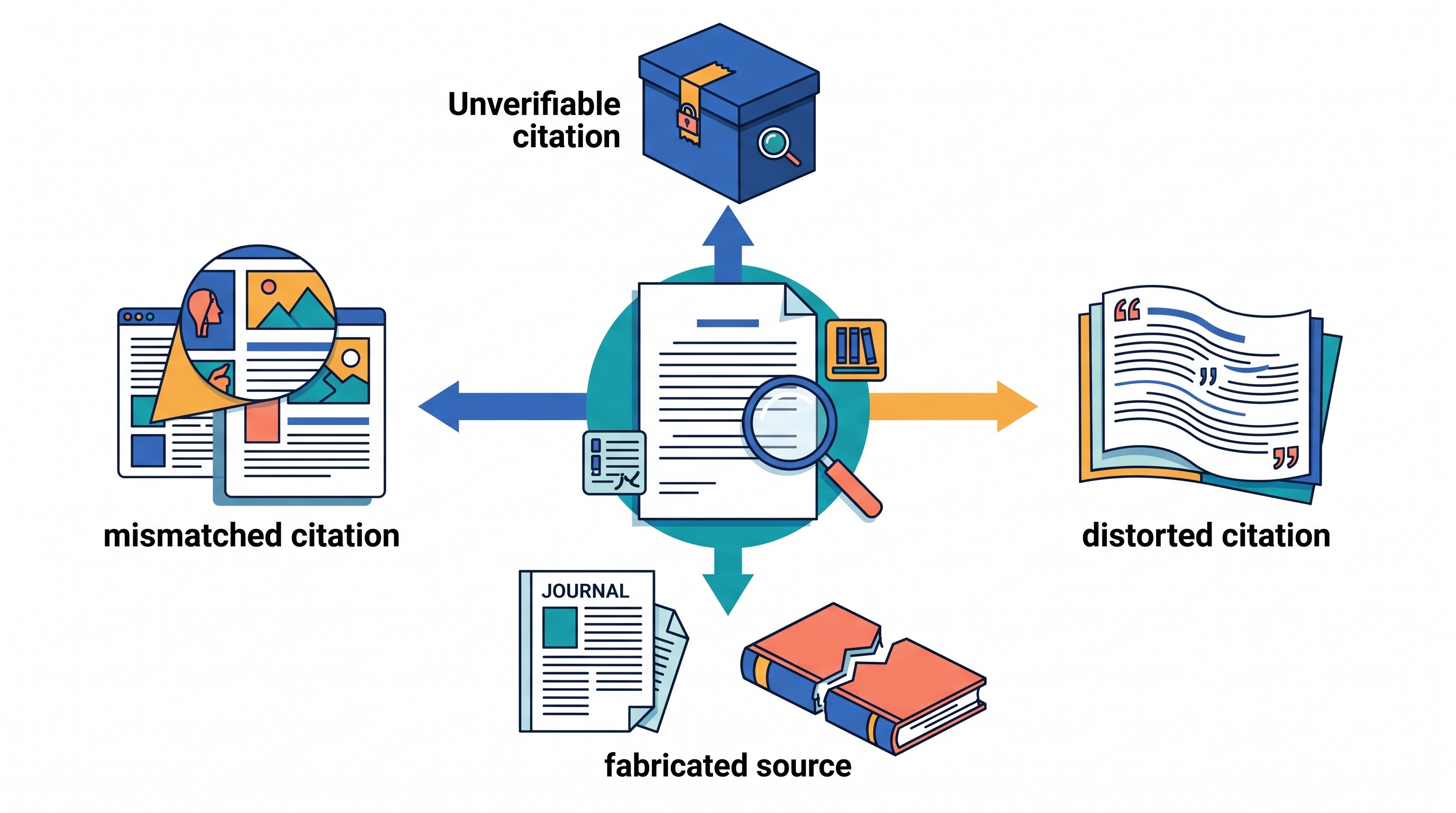
The non-obvious lesson: a citation can pass an existence check and still fail the support test. A valid DOI only tells you that a publication record exists. It does not prove that the paper warrants the exact sentence in your draft.
Why research prompts and research questions make the problem worse
Broad prompts create broad failure modes.
Ask a model to “write a literature review on social media and adolescent mental health,” and it has to produce a coherent structure across a large field. If it is not grounded in retrieved sources, it may fill gaps with plausible study names, familiar authors, or claims that resemble the literature without being traceable to a specific paper.
That is not a safe literature search. It is fluent gap-filling.
A precise research question helps, but it does not solve citation accuracy by itself. “How does short-form video use affect sleep duration among adolescents?” is better than “write about TikTok and sleep,” but the model can still miss the study population, design, measurement period, confounders, or actual conclusion.
The prompt may identify the right topic. It does not guarantee the right evidence.
The bad workflow: generating references before searching
The worst workflow looks like this:
Ask AI to draft a literature review.
Accept the generated bibliography as a starting point.
Search only for the sources that appear in the draft.
Shape the paper around whatever can be found.
This reverses the research process. The generated bibliography starts steering the review before the sources are verified.
It also creates sunk-cost pressure. Once a paragraph sounds complete, removing a citation feels like damaging the draft. In reality, removing an unsupported citation is the repair.
The better workflow: source-grounded AI use
Use AI after the source boundary is clear.
A safer sequence:
Search scholarly databases, journal sites, library catalogues, Google Scholar, Semantic Scholar, PubMed, JSTOR, HeinOnline, SSRN, or discipline-specific indexes.
Save the actual papers, reports, datasets, or legal authorities.
Read enough to know what each source can and cannot support.
Ask AI to summarize, compare, extract study details, organize themes, or draft from those sources only.
Verify every citation against the original passage before submission.
This is the useful role for ChatGPT-style research assistance: synthesis, organization, questioning, and revision. It should not be treated as a citation authority.
For a broader workflow view, see Otio’s guide to using ChatGPT for research effectively. The same principle applies here: the model can help with research work, but the evidence has to come from sources you can inspect.
A verification workflow that catches more than a citation checker
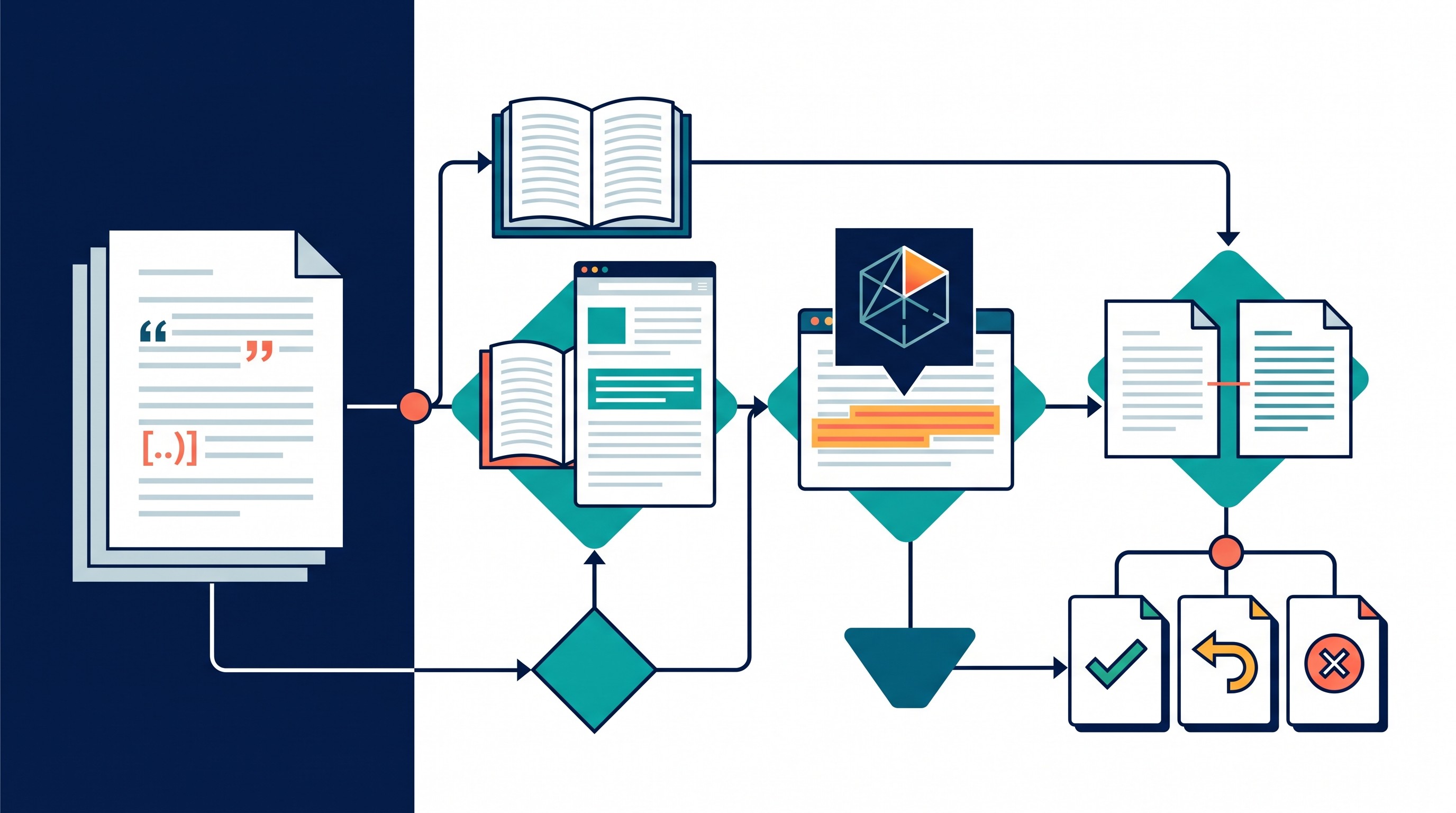
Citation verification is not glamorous. It is a line-by-line audit. The fastest reliable method is to break the draft into claims, then check whether each citation proves what the sentence says.
Step 1: Break each paragraph into checkable claims
Do not verify a whole paragraph as one unit. Split it into factual claims.
Example paragraph:
“Recent studies show that AI feedback improves academic writing quality among university students. Automated writing tools also reduce revision time and increase students’ confidence in research writing.”
That contains at least four claims:
Recent studies exist on AI feedback and academic writing quality.
Those studies involve university students.
AI feedback improves writing quality.
Automated writing tools reduce revision time and increase confidence in research writing.
Each claim may need a different source, or more careful wording.
Step 2: Locate the original source
Find the source through an authoritative route, not only through the citation string in the AI output.
Good routes include:
Journal website
DOI resolver record
University library catalogue
Publisher page
Scholarly database record
Author’s institutional repository
Official report page
Dataset archive
Court, agency, or legislative database for legal and policy material
If the source cannot be found through any reliable route, mark it as unverified. Do not keep it because it “sounds right.”
Step 3: Check the bibliographic details
Compare every field against the authoritative record:
Author names and order
Article or chapter title
Journal, book, conference, or report title
Year
Volume
Issue
Page range
DOI
Publisher
Edition
URL or archive location, if relevant
Do not silently accept imported metadata. Citation databases, reference managers, PDFs, and AI outputs can all carry errors. Record the correction so the bibliography and in-text citation stay aligned.
If this is the main bottleneck, a tool guide such as Otio’s list of citation checking tools for academic writers can help you decide which software handles duplicate references, broken identifiers, and format cleanup. That still leaves the support test.
Step 4: Read the relevant part, not only the abstract
Abstracts are screening tools, not proof for every claim.
Depending on the sentence, inspect:
Abstract for broad topic and headline finding
Methods for population, sample, measures, intervention, and design
Results for actual outcomes and statistical claims
Tables and figures for exact numbers
Discussion for limitations and interpretation
Footnotes, appendices, or supplements for details
Page range for quotations or book claims
Write down what the source establishes in your own words. Also write down what it does not establish.
That second note prevents overclaiming.
Step 5: Check the scope before broadening the claim
Before using a source to support a broader sentence, check:
Population: Who was studied?
Sample: How many cases, participants, documents, or observations?
Intervention or exposure: What exactly was tested or observed?
Comparison: Compared with what?
Outcome: What was measured?
Date: When was the data collected or published?
Study design: Qualitative, observational, experimental, review, meta-analysis, legal analysis, case study, report?
This is where many AI citations fail. The source may support a narrower version of the sentence, but not the broader one.
“AI tutoring improves exam performance in this course sample” is not the same as “AI improves student learning.”
“An association was observed” is not the same as “X caused Y.”
“A review found mixed evidence” is not the same as “research confirms.”
Step 6: Decide: accept, revise, replace, or remove
After checking the source, make one of four decisions:
Accept: The source exists, metadata is correct, and the source supports the claim.
Revise: The source supports a narrower or more cautious version.
Replace: The claim may be valid, but this source does not support it.
Remove: The claim is not worth keeping without evidence.
Never keep a citation merely because the paragraph reads well. A complete-looking paragraph with unsupported references is worse than a shorter paragraph with verified evidence.
A simple verification log
Use a log so the audit does not live in memory.
Claim | Cited source | Source location | Support level | Correction needed | Final decision |
|---|---|---|---|---|---|
AI feedback improved writing scores among first-year students | Author, year | Journal PDF, results table | Partial | Limit to first-year sample and measured rubric score | Revise |
Tool reduced revision time by 30% | Author, year | Not found in paper | None | Remove statistic | Remove |
Review found mixed evidence on student confidence | Author, year | Discussion section | Strong | Add page range | Accept |
The “support level” column is the key. Use simple labels: strong, partial, weak, none, unverifiable.
[[OTIO_INLINE_PROMO:%7B%22title%22%3A%22Ready%20to%20test%20one%20paragraph%20claim%20by%20claim%3F%22%2C%22description%22%3A%22Add%20the%20paper%20to%20your%20Library%2C%20highlight%20the%20relevant%20passage%2C%20and%20ask%20Otio%20to%20compare%20it%20with%20the%20claim%20before%20you%20accept%20the%20citation.%22%7D]]
Where citation-checking tools and AI research workspaces help—and where they stop
Automation helps with bibliographic hygiene. It does not replace evidentiary judgment.
Task | Automated tools can help | Human review is still required |
|---|---|---|
Detect missing fields | Yes | Confirm correct source version |
Resolve DOI or title | Yes | Check whether the source supports the claim |
Find duplicate references | Yes | Decide which record is authoritative |
Format APA, MLA, Chicago, or Vancouver | Yes | Confirm page numbers and quoted material |
Extract source summaries | Sometimes | Evaluate scope, method, and limitations |
Compare claims across papers | Sometimes | Judge strength of evidence |
A valid DOI or matching title proves bibliographic existence. It does not prove relevance.
This distinction matters for AI research workspaces too. They are most useful when the documents are already in the library and the task is to interrogate them: extract quotations, find page references, summarize methods, compare findings, or build a literature matrix.
A workspace such as Otio’s AI PDF reader can keep PDFs, web links, notes, and chats together, answer questions with inline citations, and let researchers open the underlying source. That makes verification easier because the answer and the source sit closer together.
It does not remove the need to inspect the passage.
The right use is:
Upload or save the real papers first.
Ask document-specific questions.
Use inline citations as navigation aids.
Open the cited passage.
Confirm that the wording in your draft matches the evidence.
Otio’s Library and Reader views are useful here because they keep PDFs, web pages, notes, and chats in one place. The text-selection toolbar also lets you ask about a highlighted passage and quote it back into chat, which is much safer than asking a blank model to invent a bibliography.
If you use Zotero, an integrated workflow can reduce the copy-paste mess. Otio’s Zotero integration is relevant when the research library already contains verified papers and you want to question or summarize those materials inside one workspace.
Still, no tool should be treated as peer review. The final responsibility is the same: inspect the source, compare the claim, and decide whether the citation belongs.
For related writing safeguards, see best practices for using AI when writing scientific manuscripts. Citation verification is one part of the larger problem: AI can improve drafting speed while also making unsupported claims look cleaner than they are.
The submission rule: fewer verified sources are better than a fuller-looking bibliography
Submit only citations whose identity and relevance you personally verified.
A shorter bibliography with sources that actually support the paper is stronger than a long bibliography padded with uncertain references. Reviewers, supervisors, examiners, and editors do not reward reference volume when the evidence does not match the claims.
Prioritize sources in this order when a claim depends on a specific result:
Primary studies
Official reports
Authoritative datasets
Original legal, policy, or archival records
Systematic reviews and meta-analyses, when the claim is about the body of evidence
Scholarly books or chapters, when the claim is conceptual, historical, or theoretical
Be extra strict with high-risk claims:
Statistics
Direct quotations
Causal claims
Legal or policy statements
Systematic-review conclusions
Claims involving exact dates
Claims involving sample sizes
Claims about clinical, educational, financial, or safety outcomes
The practical next step is small: take one AI-written paragraph, isolate every factual claim, and complete the verification log before revising the rest of the paper. If that paragraph collapses, the problem is not the paragraph. It is the workflow.
FAQ
Q: Can AI-generated citations be accurate?
A: Yes, but fluent wording and a convincing reference format do not prove accuracy. Each citation still needs an existence check, metadata check, and comparison with the source’s actual content.
Q: Does a DOI prove that an AI citation is correct?
A: No. A DOI can help confirm that a publication exists and identify its bibliographic record, but it does not prove that the paper supports the specific claim made in the draft.
Q: Are citation-checking tools enough for an academic paper?
A: No. They can help find missing, malformed, duplicate, or difficult-to-resolve references, but researchers must read the relevant source passages to verify context and meaning.
Q: What should I do when I cannot verify an AI-generated citation?
A: Treat it as unusable until you locate an authoritative record and supporting passage. Replace it with a verified source or remove the claim rather than leaving an uncertain citation in the paper.
[[OTIO_FOOTER_PROMO:%7B%22title%22%3A%22Audit%20your%20own%20sources%20before%20submission%22%2C%22description%22%3A%22Add%20your%20verified%20PDFs%2C%20web%20pages%2C%20and%20notes%20to%20Otio%2C%20then%20review%20each%20claim%20against%20the%20passage%20it%20cites.%22%7D]]