Report Writing
How Many Sources Should Be In A Literature Review (Detailed Guide)
How Many Sources Should Be In A Literature Review: Learn to assess citation coverage for credible academic work. Otio streamlines source organization.

https://otio.ai/blog/how-many-sources-should-be-in-a-literature-review#:~:text=Document%20Generation%20Processes-,6%20Best%20Practices%20for%20Finding%20Reliable%20Literature%20Review%20Sources,-Strategic%20sourcing%20helpsDetermining the appropriate number of sources for a literature review can be challenging. The number of sources in a literature review depends on factors such as the subject area, research scope, and academic expectations. Careful consideration of these elements helps clarify the balance between thorough research and concise analysis.
Modern AI tools streamline the process by organizing citations, detecting gaps in scholarship, and simplifying evaluation tasks. Leveraging an AI research and writing partner like Otio provides efficient source management while enabling a sharper focus on critical analysis. To put these ideas into practice, our AI research and writing partner helps you get started right away.
Summary
The number of sources in your literature review should be determined by coverage rather than arbitrary counting. Academic expectations vary by level: undergraduate papers typically require 10 to 15 sources, master's theses demand 20 to 40, and doctoral dissertations often require 50 or more. These ranges reflect the depth of analysis expected at each stage, not random targets to hit.
Discipline-specific norms shape source expectations more than universal rules. STEM fields often require 60 or more empirical studies because research builds incrementally on experimental data, while humanities scholarship engages fewer sources with greater theoretical depth. Medical systematic reviews may include hundreds of studies following strict protocols, but these specialized review types don't represent typical narrative literature reviews.
Source saturation occurs when new papers no longer change your understanding of the field. You've reached adequate coverage when you can explain key debates, identify dominant theoretical frameworks, recognize why studies reached different conclusions, and articulate gaps in existing scholarship. Adding citations beyond this point dilutes rather than strengthens your argument.
Information overload remains the primary obstacle in literature review, with academic databases returning millions of results even for narrow queries. Google Scholar produces over 2 million hits for "machine learning bias," while PubMed yields 50,000 articles on "inflammation biomarkers." Researchers waste weeks skimming abstracts that contribute nothing to their understanding because they lack effective filtering strategies to separate relevant work from peripheral studies.
Research topics fragmented across multiple disciplines create systematic coverage gaps that most researchers never recognize. Work on user trust in AI systems appears in computer science journals, psychology publications, business ethics reviews, and human-computer interaction conferences, each using different terminology and theoretical frameworks. According to data integrity research, data quality remains the top challenge, and this applies directly to literature searches where no single database captures conversations happening across disciplinary boundaries.
AI research and writing tools like Otio address this by consolidating source collection, extraction, and synthesis in one workspace where you can chat with your entire research library to identify patterns, contradictions, and coverage gaps across dozens of papers simultaneously.
Table of Contents
How Many Sources Should Be In A Literature Review

The number of sources in a literature review should be based on coverage rather than on sheer quantity. If important debates have been talked about, theoretical ideas have been identified, and research gaps related to the question have been found, then you have enough sources. Adding more citations after this point does not strengthen the argument; it actually weakens it.
Academic expectations change depending on the level of work being done. The ResearchPal Blog shows that undergraduate papers typically require 10-15 sources, while master's theses usually need 20-40 sources to show a deeper understanding of the field. These numbers are not random; they show the scope of analysis expected at each level. An undergraduate review puts together basic concepts, while a master's thesis compares methods, critiques ideas, and positions new research within the current scholarship. In this process, collaborating with an AI research and writing partner can enhance your insights and streamline your writing.
How do discipline differences affect source count?
STEM fields often need more empirical studies because research builds on experimental data step by step. For example, a biology literature review might mention 60 recent papers to show the current understanding of a protein pathway. In contrast, humanities scholarship uses fewer sources but with greater theoretical depth. A philosophy thesis, for instance, might examine 25 texts to show how one idea changed over hundreds of years. As an AI research and writing partner, our solutions can help streamline the process of gathering and referencing sources.
What is the protocol for medical reviews?
Medical systematic reviews follow strict protocols and often include hundreds of studies, which makes them different from regular narrative reviews. These reviews use predefined search strategies, specific inclusion criteria, and careful quality assessments. If a researcher is not doing a systematic review, those numerical guidelines don't apply to their work.
How do examiners evaluate your literature review?
Examiners don't count citations; instead, they look at how well you understand the conversation in your field. Can you explain why two studies came to different conclusions? Do you know which theoretical framework is most popular in current research and why some scholars disagree with it? Have you figured out what is missing from the existing work? We can be your trusted AI research and writing partner to clarify these aspects, so you truly grasp the current scholarship landscape.
What distinguishes strong and weak reviews?
A review with 30 carefully selected sources that maps these relationships will always work better than one with 70 loosely connected citations. The weaker review feels like a list of notes. Each paragraph summarizes a different study, but doesn’t show how they relate to one another. The stronger review builds an argument. It groups studies by theme, compares their methods, and explains what each study adds to your understanding.
How can tools help with managing sources?
Most researchers handle literature reviews using a mix of different tools. PDFs get saved in a folder, important parts are highlighted, quotes are pasted into a document, and citations are managed in a reference manager. They switch between tabs to compare their findings. As they gather more sources, this method becomes increasingly broken. Researchers might forget which paper made a particular claim, struggle to recall whether a specific study has been discussed, and lose track of the gaps they intended to investigate. Utilizing an AI research and writing partner can help streamline this process.
How does AI streamline literature reviews?
Platforms like Otio make the literature review process easier by organizing sources in one place. In this workspace, AI identifies key points, recognizes connections between themes, and helps identify areas that need more coverage, all without re-reading many papers. This allows researchers to focus on synthesizing information while the tool handles organizing and locating the necessary materials, making it an ideal AI research and writing partner.
What is expected in doctoral literature reviews?
Doctoral work typically requires 50 or more sources, as students must show they have mastered their field. The literature review serves as a helpful resource for other researchers. It should cover the intellectual area well enough that someone new to the topic can understand the major debates, methodological approaches, and unresolved questions.
What sources are essential to include?
Including sources doesn't mean citing every paper that is loosely connected. It means covering the foundational work that sets the stage for your field, the recent studies that advance current ideas, and the key voices that question common beliefs. Your committee will see if you've missed a major theoretical contribution or ignored a whole way of thinking.
How do you choose between old and new sources?
Many researchers think that newer sources are always better, and sometimes they are. In fast-changing areas like machine learning, a paper from three years ago might really be outdated. However, foundational theories don't go out of date. If research is based on social identity theory, it is important to cite Tajfel's original work from the 1970s, not only recent uses. This is similar to how our AI research and writing partner helps you to blend both old and new insights effectively.
What is the balance of sources in a review?
The strongest literature reviews balance classic and contemporary sources. This approach shows that you understand where ideas came from and how they have changed over time. Citing only recent papers might make it seem like you don’t know much about the field's history. On the other hand, only using older work suggests that you haven't stayed updated with current developments; our AI research and writing partner can assist you in finding this balance.
What role do irrelevant sources play in a review?
Including sources that do not directly support your narrative makes readers sort through unrelated citations. This can cause them to doubt your knowledge of the topic. Each source should deserve its spot by adding a specific insight, showing opposing evidence, or representing a methodological approach that needs to be discussed.
How do you identify filler citations?
A citation that can be removed without changing your argument does not belong. This rule is important, even when you're trying to meet a specific target number. Supervisors can easily spot filler citations; they make your review look less thorough than it is. In this context, having a reliable AI research and writing partner can help you streamline your citations and maintain the quality of your work.
Why is finding the right sources essential?
Knowing which sources to include is important, but it only matters if you can actually find the right ones in the first place. Leveraging an AI research and writing partner can significantly enhance your ability to identify credible and relevant sources.
Challenges of Finding Reliable Sources
Finding the right sources means navigating six persistent obstacles that slow down researchers at every level of experience. These aren't small problems. They decide if your literature review builds a clear argument or falls apart because of unrelated citations. Academic databases often return thousands of results even for specific searches. For instance, a search for machine learning bias in Google Scholar yields over 2 million results, while a search for inflammation biomarkers in PubMed returns around 50,000 articles. Researchers face significant challenges when databases return too many results, making it hard to find important research amid less relevant studies. To overcome these issues, consider partnering with an AI research and writing partner to streamline your search for reliable sources.
Why is separating signal from noise important?
The problem isn't about having too little information; it's about sorting out the important stuff from the unimportant. You can't go through 2,000 papers to find the 20 that really matter. If you don't have a good way to filter them, you might give up too soon and miss important work, or waste weeks looking at abstracts that don't help you understand much.
What barriers do unaffiliated researchers face?
Students and researchers without institutional affiliations face significant challenges when trying to access premium scholarly journals that require payment. A single article can cost between $30 and $50. Reading 40 sources for a master's thesis could mean spending up to $1,500 on their own. Sadly, many valuable studies remain behind paywalls, forcing researchers to look for open-access journals that may not publish the best work in their field. Having institutional access helps solve these problems, but only for people enrolled or working at those institutions. Independent researchers, professionals seeking to update their knowledge, and students at smaller schools often find themselves left out of top research. This situation not only slows research but also shapes which voices and findings influence our overall understanding.
How do search terms impact results?
Using broad terms like climate change impacts brings up everything from atmospheric science to agricultural economics. Choosing vague or too general search terms can often give you irrelevant or outdated results while missing important research papers that could help you understand better. If you pick a term that is too narrow, you might miss related areas where important debates are happening. For instance, searching for neural networks could make you overlook important work published under deep learning or connectionist models. Our AI research and writing partner can help you refine your search terms to yield more relevant results.
Why is vocabulary knowledge essential for effective searches?
Most databases don't think as users do; they match strings, not concepts. If the terminology in your field changed five years ago, older foundational papers won't surface with current keywords. It's important to understand how the vocabulary in your field has evolved to search effectively, but you are searching to learn that vocabulary with the help of an AI research and writing partner.
What challenges are associated with aging studies?
Researchers face the challenge of distinguishing aging studies that no longer reflect current understanding from sources that lack strong peer review or good standards. For example, a paper from 2010 might present a theory that later research has improved or disagreed with. If you cite this paper without recognizing how it has changed, your review might look uninformed.
How do you distinguish credible sources?
Not all published work is equally important. Predatory journals publish articles without proper peer review, and conference papers may share early findings that are later withdrawn. Preprints on arXiv or bioRxiv have not undergone peer review. Newcomers often find it hard to distinguish a landmark study from a marginal contribution. This confusion can lead to literature reviews that mistakenly treat all citations as equally trustworthy.
Why is it challenging to find literature across disciplines?
Some research areas span multiple academic subjects, making it harder to find all the important information in one place. For example, studies on user trust in AI systems can be found in many sources, such as computer science journals, psychology articles, business ethics reviews, and human-computer interaction conferences. Each field uses its own words and publishes in separate places, leading to ideas grounded in different theories.
How does data quality affect literature searches?
According to Precisely & LeBow College of Business, data quality is the top challenge in data integrity, and this greatly affects literature searches. When a topic spans multiple fields, no single database can capture the full conversation. Researchers often need to look across different platforms, translate between various terms, and combine frameworks that were not meant to work together. Most researchers do not realize they have overlooked many important studies just because the information is found in a different academic silo.
What challenges do novice researchers face in evaluating the literature?
Novice researchers often struggle to find key or well-cited works that have significantly influenced their field of study. Citation counts can be helpful, but they are usually outdated. For example, a paper published last year might be life-changing but has probably not yet gained 500 citations. On the other hand, an older paper with many citations may be frequently cited, but often to criticize it or point out that it has been replaced. As an AI research and writing partner, our tool can help streamline the literature evaluation process, making it easier to identify key works.
How can you effectively synthesize literature findings?
You can't evaluate a field's intellectual structure until you understand which papers established the dominant paradigms, which introduced methodological innovations, and which represent turning points in the debate. This knowledge comes from spending time with the literature; however, beginners often struggle to find that literature at first. The circularity traps them in shallow searches that never reach the field's conceptual core. Identifying the right sources is only useful if you can effectively organize and put together what you find. Having an AI research and writing partner can help streamline this process, ensuring you compile insights efficiently.
Related Reading
6 Best Practices for Finding Reliable Literature Review Sources

Strategic sourcing helps researchers build coherent arguments instead of getting lost in citations. A structured approach is key to finding relevant work quickly, checking quality correctly, and organizing findings to make synthesis easier. These six practices create that structure.
1. Start with your research question, not a database
Your golden thread, research aims, objectives, and questions, decides which sources matter. Before you start any database search, make sure you know exactly what you're looking for. This means you should come up with a specific question with clear limits rather than starting with a broad topic. For instance, if you're examining how remote work impacts team cohesion in software companies, that will guide your search. Papers about remote work in healthcare won’t be useful. While research on team cohesion in offices where people are in the same place can provide some contrast, it shouldn’t take over your review.
Studies about communication tools might be relevant if they relate to cohesion outcomes. Your question serves as a test to determine the value of each potential source. This clear focus helps avoid the most common sourcing error: gathering interesting papers that do not support your argument. If your question changes during the review process, which is often the case, adjust your sourcing strategy right away. Don’t keep adding sources for the old question.
2. Build keyword lists that evolve
Start with obvious terms from your research question. Then, expand in a clear way. Include synonyms, different spellings, and related ideas. For organizational trust research, your first list might include phrases like organizational trust, organizational trust (US spelling), workplace trust, employee trust, and institutional trust. As you read abstracts and skim papers, look for words you may have missed. Fields are always changing their language. Terms that researchers called 'computer-mediated communication' in 2010 might now be known as 'digital collaboration' or 'virtual teamwork.' It's important to add new words to your vocabulary as you find them.
Boolean operators (AND, OR, NOT) help you create smart keyword combinations when searching. For example, using "Remote work AND team cohesion" yields smaller, more specific results. On the other hand, "Team cohesion OR group dynamics" yields broader results, while "Software teams NOT healthcare" excludes unrelated areas. Even though these tools are very useful, many researchers don’t use them enough and end up feeling frustrated by too much information they could have avoided.
3. Use specialist databases, not just Google Scholar
According to Current Protocols, navigating 5 databases effectively requires understanding which ones match your field of study. Google Scholar offers a wide range of information, but doesn't provide the filtering tools that specific subject databases do. PubMed is the main source for medical research. IEEE Xplore focuses on engineering and computer science. JSTOR saves important works in the humanities. PsycINFO is great for psychology research. Your university librarian knows which databases are important for your field. A quick 15-minute conversation can save you weeks of unproductive searching. Librarians understand database architectures, different search commands, and coverage gaps that you might not find on your own.
4. Distinguish primary, secondary, and tertiary sources
Primary literature reports original research and includes data collection and analysis. These sources are the foundation for any review. For example, a journal article reporting survey results on remote work satisfaction is considered primary literature. Researchers use these studies to support arguments about current knowledge. Secondary literature combines existing research, like review articles, meta-analyses, and theoretical integrations. These sources help show the field's layout and highlight seminal works, but they already offer interpretations. Use them to get your bearings, then explore the primary sources they refer to.
Tertiary sources, including industry reports, news articles, and white papers, offer context and show what is important today. For example, a McKinsey report on trends in remote work won't form the base of your theoretical framework; however, it might explain why your research question is important right now. These sources are better for your introduction than for your literature review. Beginners often get this order wrong by building their arguments on secondary sources and only using primary research as extra support. This way of thinking shows that they haven't really engaged deeply with the field's actual scholarship.
5. Evaluate source quality systematically
Not every peer-reviewed article deserves the same importance. Publication venue is very important. Articles in top-tier journals undergo rigorous peer review and editorial oversight. On the other hand, papers in newer or less reputable journals might have only met basic quality standards. Citation count shows influence, but needs context. For instance, a paper published last month won't have many citations yet, while a well-cited paper from 15 years ago might be referenced a lot, but mainly to be critiqued. It's important to check whether citations are positive, meaning they build on the work, or critical, pointing out its weaknesses.
The quality of the methods used distinguishes reliable evidence from weak claims. Key questions to consider include: Does the study use the appropriate methods for its research question? Is the sample size big enough? Do the authors recognize limitations? For example, a survey of 30 undergraduate students at one university cannot support broad claims about workplace behavior, but researchers sometimes try to do this. Author credentials are another clue about quality. Experienced researchers with track records in the field usually bring more credibility than graduate students who are publishing their first paper. While new voices shouldn't be overlooked, their conclusions should be considered less important than those from more experienced authors. Having the right AI research and writing partner can also enhance the accuracy and quality of your literature assessments.
6. Organize sources for synthesis, not just storage
Reference managers like Mendeley, Zotero, and EndNote are great for managing citations and formatting. However, they don't help with putting ideas together. For that, you need a literature catalog that collects more than just bibliographic data. To improve your research, create a spreadsheet to track key details, including author, date, title, key findings, methodology, theoretical framework, and sample characteristics. Write your own notes on how each source relates to your argument. Add columns for themes or categories that are specific to your research question. Also, label sources as supporting, contradicting, or extending specific claims that you are working on.
When reviewing 50 papers, it is hard to remember which one showed a specific finding about trust and communication frequency. Organizing your catalog helps you get that information quickly. You can group all quantitative studies, all research from European contexts, or all papers that use social identity theory. Many researchers understand too late how important this level of organization is. After reading 30 papers without taking systematic notes, they end up needing to read them again. It is important to start your catalog before you read your first full article.
What tools do you need to work with your collection?
Even the best-organized collection of sources is only effective when you have the right tools to work with them.
9 Best AI Tools for Literature Review

The right AI tool does more than just organize sources; it changes how we create summaries. Instead of jumping between tabs, taking notes by hand, and forgetting which paper said what, users can work within a system that shows connections that might not be seen otherwise. These nine tools cover different parts of the literature review process, from finding information to finishing the draft.
1. Otio
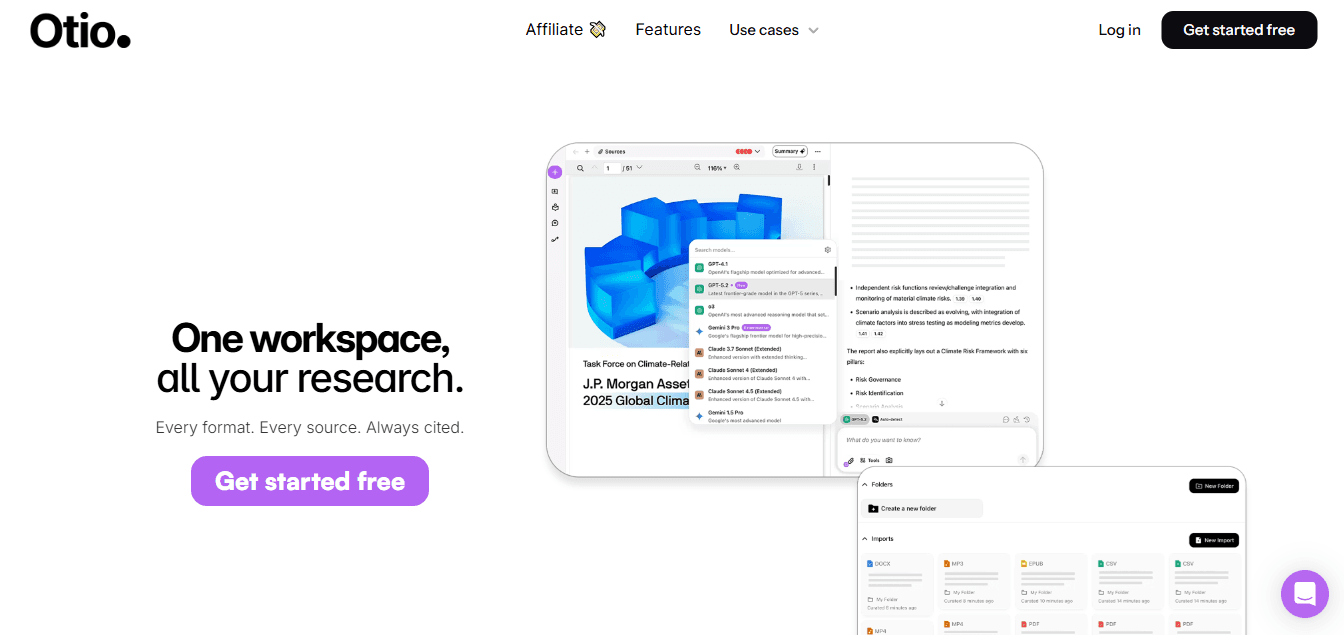
Otio brings together all parts of the literature review into a single workspace. Users can gather PDFs, journal articles, web pages, books, and video lectures in one place. The platform lets users interact with everything through AI-powered analysis. Notes are automatically made for each source, pulling out key findings, arguments, and details about the methods used without the need to read every page manually. What makes Otio different from regular AI tools is how it helps with synthesis. Users can chat with individual sources to clarify specific claims or search their entire knowledge base to find patterns, contradictions, and gaps across many papers at once. This feature is particularly important for understanding how five different studies addressed the same research question using different frameworks.
The writing help goes beyond just checking grammar. Otio writes literature review sections right from your gathered sources, keeping the right focus and structure while you concentrate on the important task of building arguments. According to a research survey on AI adoption in academic workflows, 96% of researchers say AI tools save them time during literature reviews. That time saving adds up when you're not constantly switching between reading, note-taking, and writing environments. Researchers with large collections of sources find that Otio greatly reduces the mental effort required to track themes and compare methods. There’s no need to scroll through highlighted PDFs trying to remember where a certain finding was. The system brings it up when needed, based on the actual sources that have been checked.
2. Jasper
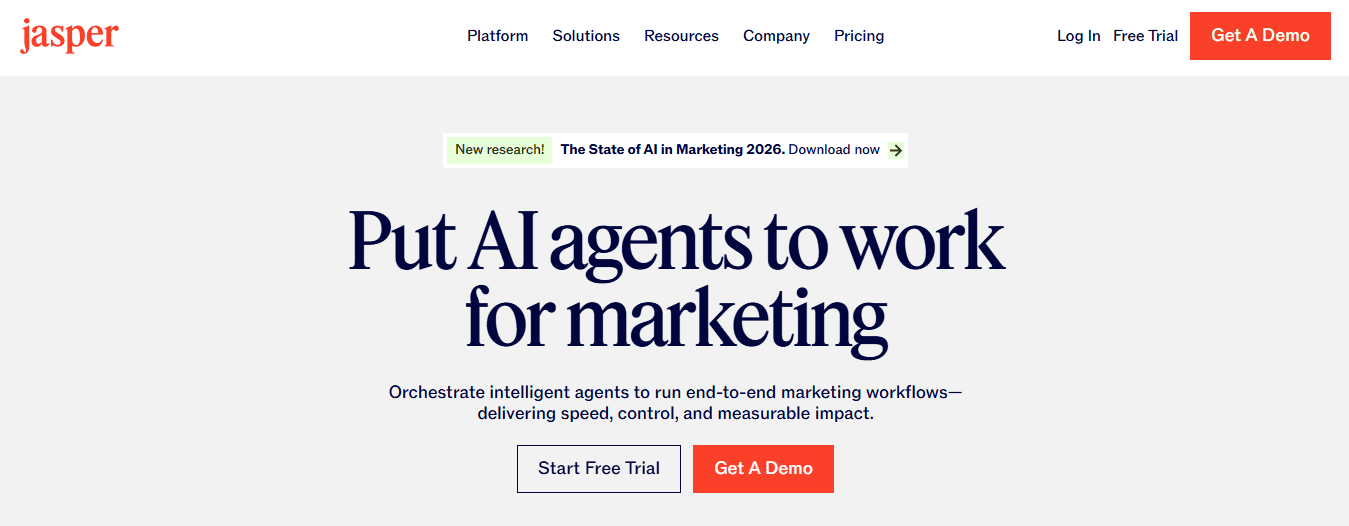
Jasper is an AI writing partner that helps find the main arguments and build a structure around them. Users can provide a rough outline or a collection of notes, and Jasper generates titles, introductions, conclusions, and section outlines. This is especially helpful when you know what you want to say but struggle to organize it clearly. The tool also has basic editing features, such as grammar correction, rephrasing, and readability improvements. The "explain it to a 5th grader" feature simplifies difficult academic language, which is helpful when explaining complex ideas in your introduction. Cover letter template for journal editors, poll and survey template for data collection, and Quora Answers template for social media promotion.
There is a learning curve because Jasper needs user guidance. You cannot just put in a research question and expect a full literature review; instead, users need to guide the AI step by step. This requires more involvement than what is needed with fully automated tools. Also, unused monthly credits do not carry over, which can be frustrating for researchers with changing workloads, as they might need 50,000 words one month and only 5,000 the next.
3. ProWritingAid
ProWritingAid effectively catches grammar mistakes that standard spell-checkers often miss, especially contextual mistakes where a word is spelled right but used incorrectly. The rephrasing tool suggests alternatives for awkward sentences, offering multiple options so users can choose the one that best preserves their intended meaning. The analytical language goals feature helps writers keep a proper formality for academic purposes. It points out when the passive voice is overused, identifies weak verbs, and suggests stronger alternatives. For instance, power verb suggestions replace general verbs like 'show' or 'indicate' with more specific choices like 'demonstrate' or 'reveal.'
The learning tool provides a detailed look at writing patterns, highlighting the mistakes that are often made. This turns the tool into a teaching resource rather than just a correction tool. Users start to notice their own habits, such as using certain transition words too much or making sentences with predictable structures. The free version has limited features, so a premium subscription is needed for serious academic work. Some users find the detailed reports can feel overwhelming at first, especially when the tool highlights many potential improvements in a single paragraph. It's important to develop a good sense of which suggestions truly improve writing and which ones just change it.
4. Quillbot
Quillbot paraphrases text while keeping the original meaning. It uses machine learning to understand context and gets better with each use. After you enter a sentence or paragraph, the tool creates different ways to say the same thing while changing the structure and words. The built-in thesaurus function works at the word level, letting users change individual words without rewriting whole sentences. Writing modes also change the tone and formality. Standard mode keeps the original style, while Fluency mode focuses on natural-sounding language.
Creative mode offers more freedom with phrasing. The Word Flipper controls how many synonyms the tool uses. When you slide it toward fewer changes, you get safer rewording. Sliding it more brings outputs that differ more from the original. This feature is important when incorporating ideas from sources without inadvertently plagiarizing their exact words.
The free version limits users to 700 characters per paraphrase, roughly three sentences. On the other hand, premium accounts can handle up to 10,000 characters and process text faster. The interface also shows which words changed, letting users see exactly what the AI changed, not just the final result. Quillbot works with Microsoft Office, Google Docs, and Chrome, allowing users to paraphrase right within the tools they already use. The $15 monthly fee might make some users hesitate, but after they see how much time the mix of paraphrasing, editing, and grammar tools saves, they often feel it is worth it.
5. Trinka
Trinka focuses on academic and technical writing, finding mistakes that typical grammar checkers might miss. It fixes spelling errors that are correct in general but wrong in scientific contexts. Plus, it highlights complex grammatical mistakes that often appear in research papers, such as inconsistent use of terms or incorrect technical language.
The Consistency Check ensures you use the same terms, abbreviations, and formatting throughout your document. For example, if you say "machine learning" in one part and "ML" in another without explaining what "ML" means, Trinka will warn you about this. This feature is especially important for literature reviews, where using different terms can confuse readers about whether the same idea or different ideas are being discussed.
As part of the free plan, the Publication Readiness feature checks whether your manuscript meets the standards for journal submissions. It looks at formatting rules, the consistency of citation styles, and structural parts that editors expect. Many papers are rejected not because the research is weak, but because of formatting mistakes that show a lack of attention. Trinka uses a credit-based pricing model with free monthly credits, which is better for researchers with changing workloads than fixed monthly subscriptions.
The free version allows up to 10,000 words per month, which is enough for smaller projects but not for long dissertations. Right now, there's no desktop or mobile app available, so everything has to be done completely in the browser.
6. LaTeX
LaTeX is the standard for technical and scientific writing because it handles complex equations, figures, and citations better than word processors. You write in plain text with markup commands that manage formatting, which helps keep content separate from presentation. This separation stops the formatting problems that often happen in Word when you copy content from different sources.
With BibTeX for bibliography management, you can keep a master database of sources and automatically create formatted reference lists in any citation style. When you add or remove citations, the reference list updates on its own, so you don’t have to reorder it manually. LaTeX creates professional-looking documents with consistent formatting, correct hyphenation, and proper line breaks. Journals in subjects like mathematics, physics, computer science, and economics often require submissions in LaTeX because it manages technical notation that can break in other formats.
The learning curve can scare beginners, since you are writing code that compiles into a document rather than seeing immediate visual results. Syntax errors can lead to confusing error messages. Also, simple tasks like adding images require understanding coordinate systems and positioning commands. While the time you spend learning LaTeX is worth it for researchers who want to write many technical papers in their careers, using LaTeX just for a single literature review might seem excessive unless your field expects you to know LaTeX. If you're considering a better way to organize your research, think about how an AI research and writing partner could assist you.
How do researchers combine tools effectively?
Most researchers eventually create a workflow that uses several tools. They use Otio or similar platforms to gather sources and extract insights, then write in Google Docs or Word, with tools like Grammarly or ProWritingAid checking their writing. They manage citations in Zotero or Mendeley, export to LaTeX for final formatting when needed, and use Quillbot to rephrase when adding ideas from sources. A common mistake is using tools randomly as issues arise, rather than planning a workflow in advance. Knowing which tool performs each task helps researchers avoid extra problems caused by changing contexts or by repeating work across platforms. In the end, choosing the right tools is important, but it only matters if researchers understand what they want to achieve with them.
Related Reading
Stop Guessing How Many Sources Your Literature Review Needs
Most students have a hard time, not because they lack sources, but because they can't tell which sources truly belong in their review. For instance, you might find 80 papers on your topic, but only 22 really answer your research question. The other papers may focus on related issues, use methods that don't match up, or explain key terms differently than your field does. The challenge is not finding references, but knowing when you've cited enough of the right ones.
Source saturation occurs when new papers no longer change your understanding. You read another study and realize it confirms what three earlier sources already showed, uses a method you've already reviewed, or discusses a debate you've already mapped out. That's your signal. Adding more citations at that point doesn't make your argument stronger. It just makes your reference list longer. The common way of doing things often involves keeping many sources in folders, skimming abstracts to assess relevance, highlighting sections across multiple PDFs, and copying quotes into documents, all while trying to remember which paper made which claim. As your source count goes over 40, this method starts to break down. You might lose track of which studies support certain arguments, struggle to see how different researchers approached the same question, and waste time re-reading papers to find passages you know are somewhere.
Platforms like Otio simplify this messy process into one workspace where you can gather papers, pull out key insights with AI-generated notes, and connect with your entire research library to spot patterns and gaps. Instead of managing files separately from your analysis, you work within a system that shows connections between sources as you add them. When checking if you've covered the main theoretical views or research methods, you can ask your collection directly, rather than having to look through every paper again. The best literature reviews don't aim for the most citations; they demonstrate thorough coverage. Your committee or examiner looks for proof that you have engaged with the main works that started your field, the recent studies that reflect current thinking, and the key voices that challenge popular views.
If you can explain why two studies came to different conclusions, identify which theoretical framework shapes most current research, and point out what's missing from existing scholarship, you will have done the work. In this case, the number of citations doesn't matter. You will reach source saturation faster when you can actively analyze what you've gathered instead of just storing it. Stop adding sources when new papers merely confirm existing patterns rather than offering new insights. This way, you can be sure you've cited enough relevant material.
Related Reading
Document Generation Tools
How To Use Ai For Literature Review
How To Write A Research Summary
How To Write A White Paper
Best Ai For Literature Review
Best Report Writing Software