
AI Model Evaluation
How to Detect AI Model Nerfing: A Repeatable Benchmarking Method
Test whether an AI model has genuinely regressed with a controlled benchmark: freeze prompts, repeat tasks, score outputs consistently, and preserve evidence before claiming nerfing.

If you want to know how to detect AI model nerfing, do not compare one great answer from last month with one bad answer today. Build a controlled benchmark: freeze the prompts and inputs, rerun them under comparable conditions, score outputs with the same rubric, and preserve enough evidence for someone else to reproduce the result.
That method can show a real regression signal. It usually cannot prove the provider intentionally reduced capability. “Nerfed” is a claim about cause; benchmarking is strongest when it stays close to observed behavior.
How to detect AI model nerfing with a controlled benchmark
Treat model nerfing as an operational claim: the same model or product now performs measurably worse on the same tasks under comparable conditions. Not “the answer felt lazier.” Not “the tone changed.” Not “one prompt failed after an update.”
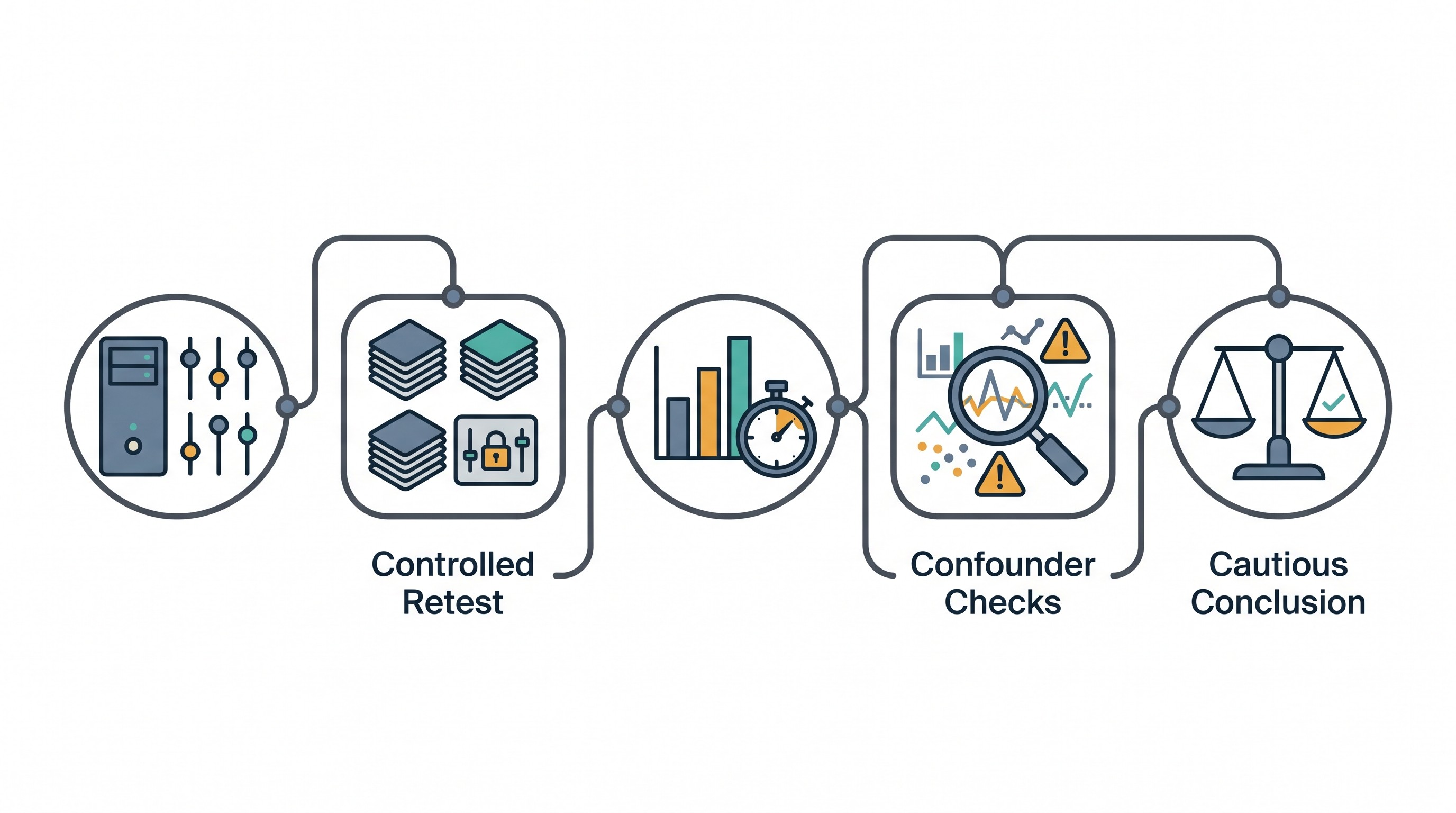
A repeatable test has five parts:
Freeze the task set and prompts. Use the same questions, files, context, and expected output format.
Save a baseline. Store the original outputs, scores, model label, account tier, settings, timestamps, and any attached files.
Rerun multiple trials. Do not rely on one new answer.
Score with a fixed rubric. Blind the scorer where possible so they do not know whether an output is old or new.
Check confounders. Rule out routing changes, tool failures, account limits, context differences, and safety-policy changes before calling it a regression.
A good benchmark does not need to be huge. It needs to be stable, relevant, and honest about uncertainty.
The output should look like this: “On a 40-task benchmark covering extraction, reasoning, coding, and long-context retrieval, the retest score fell from 82% to 63%, with repeated failures in long-context retrieval across fresh sessions. Conditions were controlled except for possible provider-side routing.” That is stronger than “Model X is cooked.”
Separate model nerfing from changes that only look like regression
Most alleged nerfing starts with a true observation: the model gave a worse answer. The problem is attribution.
The same product can perform worse for reasons that have little to do with the base model’s capability. Before interpreting score changes, record the conditions that shape the output.
Check for:
Model-version changes. The visible label may change, or the provider may retire the exact model used in the baseline.
Silent routing. Some products route requests across model variants depending on load, plan, or task type.
Account tier differences. Free, Plus, Pro, Team, Enterprise, API, and regional accounts may not receive the same model or limits.
Temporary rate limits. A throttled account may get shorter outputs, slower tool use, or fallback behavior.
Context-window differences. A long file may fit in one session and be truncated in another.
Tool availability. Web search, code execution, file parsing, retrieval, image input, and browsing can fail independently of the model.
System-prompt changes. The provider’s hidden instructions can shift formatting, refusal behavior, tone, or tool-use strategy.
Safety-policy updates. A task that was previously answered may now be refused or redirected.
Web-search behavior. Search-backed answers depend on sources retrieved at that moment, not just model weights.
Conversation history. A fresh session and a long, primed conversation are different test conditions.
Locale and language settings. Region, interface language, and browser settings can influence response style and available tools.
For every run, log:
Field | What to record |
|---|---|
Model label | Visible name, API model ID if available, product mode |
Account state | Plan, region, workspace, quota warnings |
Settings | Temperature, top-p, max tokens, system prompt if exposed |
Context | Files, URLs, pasted text, conversation history |
Tools | Web search, code interpreter, retrieval, file parser, vision |
Timing | Date, time, latency, completion failures |
Output | Raw answer, screenshots, citations, tool traces if visible |
Score | Rubric score, scorer name, exclusions |
A single viral screenshot is useful for generating a hypothesis. It is not evidence of broad model regression.
This is especially true for research and document workflows. A tool that searches papers, parses PDFs, or retrieves passages can fail because the evidence pipeline changed. The same lesson appears in adjacent workflows like Consensus AI, where the quality of the answer depends on evidence search, and ChatPDF-style document Q&A, where parsing and retrieval affect what the model can see.
Build a benchmark that can reveal performance regression
A benchmark should match the work that matters. If the suspected regression is in legal extraction, do not test only riddles. If the complaint is long-context failure, do not rely on short trivia prompts.
Build a balanced task set across the categories that matter for the model’s job:
Factual accuracy: Does the model answer correctly without inventing facts?
Structured extraction: Can it extract fields from documents into JSON, tables, or bullet summaries?
Multi-step reasoning: Does it handle constraints, intermediate steps, and edge cases?
Coding: Can it write, debug, refactor, or explain code under realistic requirements?
Long-context retrieval: Can it find information buried in a long PDF, transcript, or repository?
Instruction following: Does it obey format, tone, length, and exclusion rules?
Refusal boundaries: Does it answer allowed tasks and refuse genuinely disallowed ones?
Formatting reliability: Does it produce valid CSV, Markdown, JSON, citations, or code blocks?
Tool use: Does it choose and use tools correctly when tools are part of the product?
A small but useful benchmark might have 30 to 80 tasks. That is enough to reveal patterns without becoming too expensive to rerun. Keep a separate holdout set with tasks that were not used while tuning the benchmark, so a suspected regression can be checked against fresh examples.
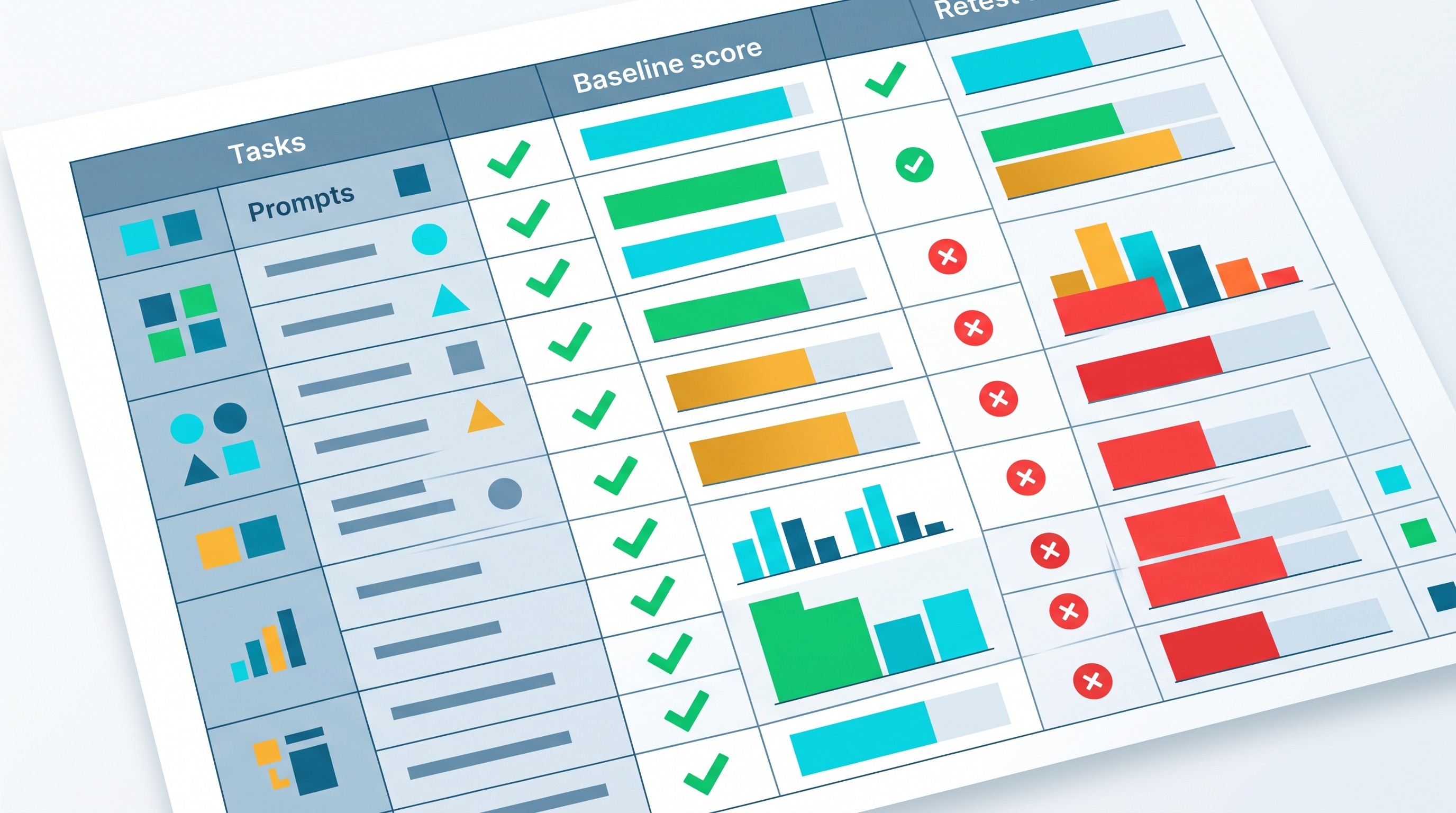
Use a mix of stable anchors and realistic unseen tasks.
Stable anchors are tasks you expect to stay constant: a fixed contract excerpt, a known coding bug, a fixed extraction file, a fixed reasoning problem. They help detect longitudinal change.
Unseen tasks reduce overfitting. Public benchmark questions may be memorized, optimized for, or accidentally included in training data. Real work examples are harder to fake and more useful for deciding whether to change workflows.
Write the rubric before rerunning
The rubric is where most amateur nerfing claims fail. If the scoring rules are created after seeing the new answer, the benchmark becomes an argument rather than a test.
For each task, define:
Pass criteria: What must be present for a full score?
Partial credit: Which missing pieces reduce the score but do not fail the task?
Unacceptable errors: Hallucinated citations, wrong calculations, invalid JSON, unsafe advice, missed key facts.
Style relevance: Does verbosity matter, or only correctness?
Allowed alternatives: Are equivalent phrasings, different algorithms, or alternate structures acceptable?
Scoring scale: Binary pass/fail, 0 to 2, 0 to 5, or category-specific points.
Example rubric for a structured extraction task:
Criterion | Points |
|---|---|
Extracts all required fields | 2 |
Uses exact source values, not paraphrases | 2 |
Produces valid JSON | 1 |
Does not invent missing values | 2 |
Includes uncertainty for ambiguous fields | 1 |
Total | 8 |
For coding tasks, include test cases. For document tasks, include page or paragraph references. For reasoning tasks, include the expected conclusion and the important constraints.
If comparing multiple models is the goal rather than detecting regression in one model, use a different design. A cross-sectional comparison asks “which model is better now?” A regression benchmark asks “did the same system get worse over time?” Otio has a separate guide to real-world AI model comparison tests if the decision is model selection rather than longitudinal change.
Run repeated trials instead of comparing two memorable answers
Language-model outputs vary. If temperature is above zero, variation is expected. Even with deterministic API settings, provider infrastructure, tool calls, and routing can introduce differences.
Run multiple trials per task when outputs are stochastic. For a small benchmark, three trials per task is often a practical starting point. For high-stakes tasks, use more. The point is not to reach mathematical purity; it is to avoid cherry-picking the best old output and the worst new one.
Use this run plan:
Start fresh sessions when measuring first-turn behavior.
Use identical prompts and files from the baseline.
Randomize task order to reduce time-of-day, load, or fatigue effects in human scoring.
Rerun failed tasks only after the primary run is complete, and label those reruns separately.
Blind the scorer where practical. Remove timestamps and model labels from outputs before scoring.
Keep all outputs. Do not delete “weird” completions unless the exclusion rule was defined in advance.
For long-context or tool-use tests, preserve the exact source material and access conditions. If the old run used a PDF and the new run uses a copied excerpt, that is not the same test. If web search is enabled in one run and disabled in another, the comparison is compromised.
This matters for research workflows. A model can appear worse because the PDF parser missed tables, a transcript was incomplete, or a retrieval system selected the wrong chunks. That is not necessarily model nerfing. It is a product-level failure, and the remedy may be different.
[[OTIO_INLINE_PROMO:%7B%22title%22%3A%22How%20will%20you%20preserve%20each%20trial%E2%80%99s%20evidence%3F%22%2C%22description%22%3A%22Keep%20benchmark%20files%20in%20Otio%E2%80%99s%20Library%2C%20attach%20identical%20inputs%20to%20fresh%20chats%2C%20and%20save%20each%20response%20with%20its%20model%20and%20trial%20notes.%22%7D]]
Score the results with thresholds and uncertainty
Set the regression threshold before reviewing the retest results.
Without a threshold, every disappointing output becomes evidence. With a threshold, the claim has to clear a defined bar.
Useful thresholds include:
Overall score drop: Example: a decline of at least 10 percentage points across the full benchmark.
Category-specific drop: Example: long-context retrieval falls by 20 percentage points while other categories remain stable.
High-priority repeated failure: Example: the model fails the same compliance extraction task across three fresh sessions.
Completion reliability change: Example: more refusals, timeouts, invalid formats, or empty tool calls.
Error-type shift: Example: more fabricated citations, missed constraints, or unsafe completions.
Do not collapse everything into one leaderboard score. Report category-level results and error types.
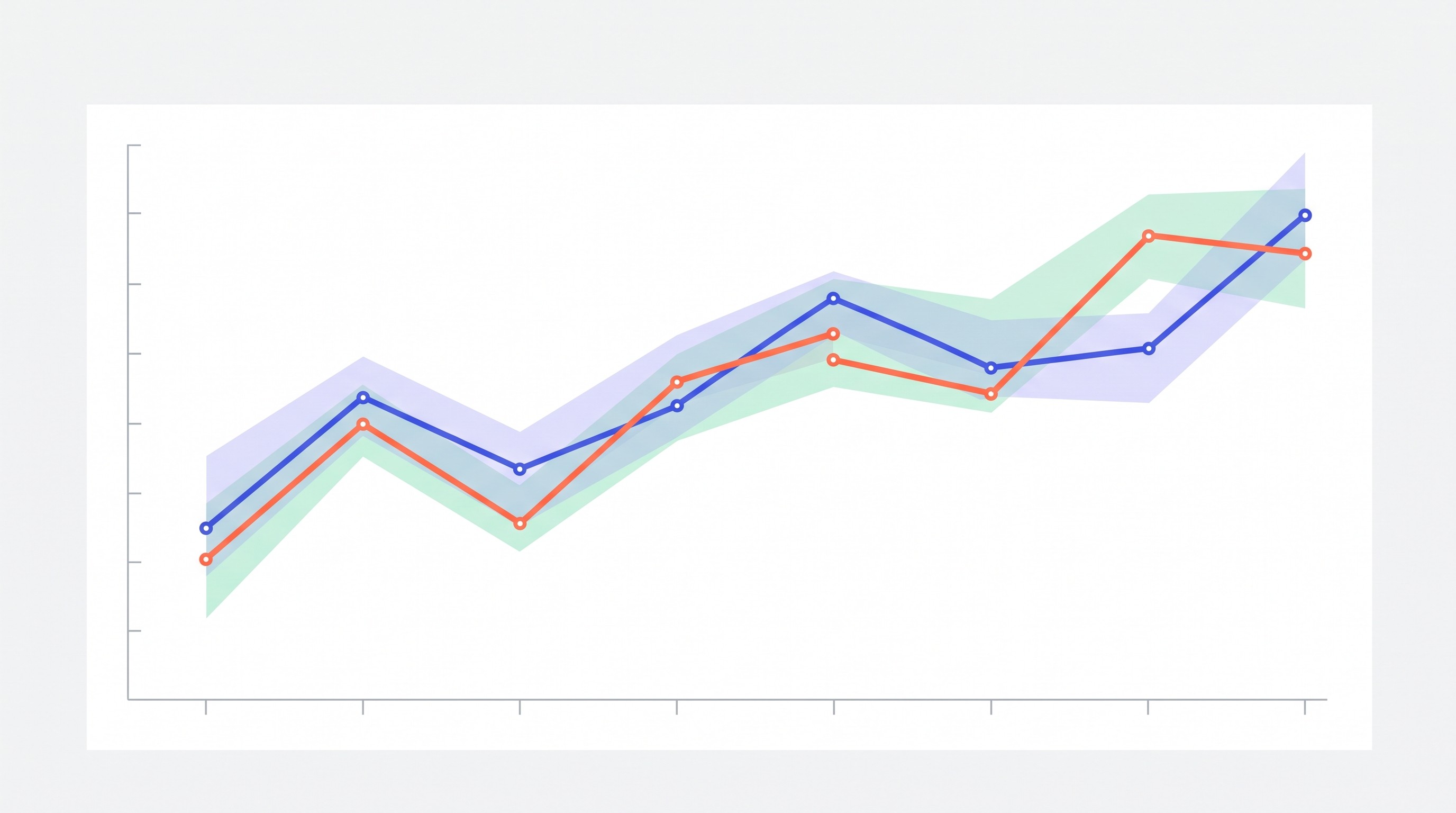
A simple result table is often enough:
Category | Tasks | Trials per task | Baseline | Retest | Signal |
|---|---|---|---|---|---|
Extraction | 12 | 3 | 86% | 83% | No meaningful change |
Coding | 10 | 3 | 74% | 61% | Possible regression |
Long context | 8 | 3 | 81% | 52% | Strong regression signal |
Refusals | 6 | 3 | 92% | 90% | No meaningful change |
Formatting | 8 | 3 | 88% | 70% | Narrow regression |
When the sample is small, say so. A five-prompt test can uncover a bug, but it cannot support a broad claim about a frontier model. A 20-task benchmark can show a practical workflow risk, but it may still be underpowered for general statements.
A useful uncertainty note can be plain English:
“Because this benchmark has only eight long-context tasks, the long-context result should be treated as preliminary. The failures repeated across three trials and two fresh sessions, so the signal is worth retesting with the holdout set.”
That is better than false precision.
Distinguish broad regression from narrow failure
Not all declines mean the same thing.
A model might:
Refuse more often while reasoning quality stays stable.
Follow safety policy differently while extraction remains unchanged.
Produce shorter answers because a system prompt changed.
Fail JSON formatting but answer correctly in prose.
Lose performance on one domain but improve in another.
Perform worse only when tools are enabled.
Call the failure by its shape. “Broad nerfing” is a high bar. “Task-specific regression in long-context retrieval” is usually more defensible.
Preserve evidence so another person can reproduce the finding
If the benchmark result matters, preserve the raw evidence before arguing about it.
Save:
Prompts
Input files
Source URLs
Raw outputs
Screenshots of relevant product behavior
Model labels and version strings
Account tier and region
Generation settings
Tool traces, search results, citations, and retrieved snippets
Timestamps
Scoring rubrics
Scorer decisions
Exclusion decisions
Summary tables
Store raw outputs separately from cleaned scores. A table that says “Task 14 failed” is not enough. The next person needs to see the prompt, the answer, the rubric, and why it failed.
Version benchmark files when possible. A simple filename convention is enough for small tests:
benchmark_v1_prompts_2026-10-02.csvbaseline_outputs_modelname_2026-09-20.jsonlretest_outputs_modelname_2026-10-02.jsonlrubric_v1.mdscore_sheet_v1_annotated.csv
For stronger integrity, hash the prompt files and input documents. The point is to make silent edits visible.
A workspace helps here because nerfing tests quickly sprawl across transcripts, screenshots, PDFs, spreadsheets, and notes. Otio’s multiple AI model selection can be useful for keeping model-specific conversations and evidence in one research space, while its library can hold prompts, transcripts, screenshots, source files, and notes. If scores are in CSV form, Otio’s Spreadsheet AI can help inspect result tables, but it should be treated as an analysis aid, not proof that the benchmark was automated or unbiased.
For sensitive or unpublished material, be careful about what gets uploaded to any AI product. If the benchmark uses private research data, legal documents, source code, or client material, read the privacy terms and consider local or enterprise-controlled testing. Otio has a separate guide on why researchers should protect unpublished research data and ideas from AI tools.
Interpret the result without overclaiming intentional nerfing
A benchmark can show that observed performance declined. It usually cannot show why.
Use a classification that separates behavior from cause:
Finding | What it means |
|---|---|
No detectable regression | Scores are stable within the benchmark’s limits |
Task-specific regression | One category declined, but the pattern is narrow |
Probable product or routing change | Failures align with tools, context, account state, or version differences |
Broad regression signal | Multiple categories declined under controlled conditions |
Inconclusive | Conditions were not controlled or the test was too small |
A second model or second account can help diagnose the problem, but it cannot replace the original baseline.
If Model A got worse and Model B did fine, that may suggest the task is still solvable by current systems. It does not prove Model A was intentionally weakened. If a second account using the same product performs differently, that may suggest routing, tiering, regional rollout, or quota effects.
Repeat the benchmark on another day before publishing a strong claim. Temporary infrastructure problems, degraded tools, or rollout bugs can look like nerfing for a few hours.
Use careful language:
Strong: “The retest scored 19 points lower on our fixed long-context benchmark.”
Strong: “The failures repeated across three fresh sessions and a holdout set.”
Too strong without provider evidence: “The company deliberately nerfed the model.”
Too broad: “The model is worse at everything.”
More accurate: “We found a regression signal in structured extraction and long-context retrieval under these product conditions.”
If provider documentation confirms a model change, cite that documentation in your evidence bundle. Without it, stay with observed results.
What to do after detecting a credible regression
Once the signal looks real, stop tweaking the benchmark. Freeze the evidence bundle.
Then run a short confirmation sequence:
Rerun the highest-impact failures. Use fresh sessions and identical inputs.
Ask an independent scorer to review outputs. Remove model labels and timestamps if possible.
Run the holdout set. Check whether the pattern generalizes beyond the tasks that first failed.
Test a second account or environment. Look for account-tier, routing, or regional differences.
Check the provider’s release notes or status page. Do not assume cause from timing alone.
Document the retest date. Performance may recover.
Then decide what to change in the workflow.
Possible fallbacks:
Revise the prompt or add examples if the model now needs clearer constraints.
Switch models for the affected task if another model handles that category reliably.
Add human review for high-risk outputs such as citations, code, legal analysis, medical content, or financial calculations.
Use a retained older model if the provider still offers it and the older version is necessary.
Move retrieval or extraction outside the chat model if the failure is caused by document handling rather than reasoning.
Split long-context jobs into smaller audited steps when end-to-end answers become unreliable.
If publishing the result, include:
Benchmark definition
Prompt and input policy
Scoring rubric
Number of tasks and trials
Baseline and retest dates
Model labels and account conditions
Known uncontrolled variables
Raw-result policy
Holdout result, if available
The exact claim being made
The best benchmark is boring to read and hard to dismiss. It does not try to win an argument with one screenshot. It gives enough method and evidence for someone else to rerun the test and see whether the signal holds.
FAQ
Q: What counts as evidence that an AI model has been nerfed?
A: A repeatable, practically meaningful decline on a fixed task set under comparable conditions is evidence of a regression signal. It does not by itself prove that the provider intentionally reduced the model’s capability.
Q: How many tests are enough to detect AI model regression?
A: There is no universal number. Use repeated trials across several task categories, then label small benchmarks as preliminary until the result repeats on a holdout set.
Q: Why might the same AI model perform worse without being nerfed?
A: Routing changes, rate limits, context differences, tool failures, safety-policy updates, prompt changes, and stochastic variation can all reduce observed performance. Log those conditions before attributing the decline to the model itself.
Q: Can I compare outputs from different AI models to detect nerfing?
A: A second model can serve as a diagnostic control, but it cannot replace the original model’s saved baseline. Cross-model differences provide context, not proof of regression.
[[OTIO_FOOTER_PROMO:%7B%22title%22%3A%22Apply%20the%20benchmark%20to%20your%20own%20sources%22%2C%22description%22%3A%22Add%20your%20PDFs%2C%20transcripts%2C%20URLs%2C%20and%20prior%20outputs%20to%20Otio%2C%20then%20test%20retrieval%20and%20extraction%20under%20the%20same%20documented%20conditions.%22%7D]]