
Research Methodology
Importance of Research Design: How It Shapes Methods, Evidence, and Validity
Research design determines which methods fit a question, what evidence a study can produce, and how confidently its conclusions can be trusted. See how design choices affect validity, feasibility, and interpretation.

The importance of research design is simple: it decides whether a study can actually answer the question it asks. Design connects the research question to participants or cases, measures, data collection, analysis, and the strength of the final claim.
A good design does not make a conclusion automatically true. It does something more useful: it limits what can be claimed, exposes rival explanations, and shows readers how much confidence the evidence deserves.
Most weak studies do not fail at the statistics stage. They fail earlier, when the question, method, sample, measure, or comparison does not fit the claim.
Why research design is important
Research design is the study’s overall plan. It specifies who or what will be studied, what will be measured or observed, how evidence will be collected, how it will be analyzed, and what kind of conclusion the study can support.
That makes design different from method.
A method is a specific technique: a survey, interview, randomized experiment, focus group, content analysis, regression model, archival search, or observation protocol. A design is the organizing logic that explains why those methods fit the question.
For example:
A survey is a method.
A cross-sectional descriptive design using a survey to estimate student stress levels in one university is a design.
A randomized experiment testing whether a new advising intervention reduces stress is a different design, even if it also uses a survey as one measure.
The design is what turns data collection into an argument.
Without design, methods become a shopping list. A researcher might say, “I’ll use interviews and a questionnaire,” but that does not yet explain what evidence those tools will produce, whose experience or behavior they represent, or what claim the study can responsibly make.
A strong design matters because it forces four decisions before the data are collected:
What exactly is the question?
What claim should the evidence support?
What data would count as relevant evidence?
What alternative explanations could weaken the claim?
That last question is often the most important. Research rarely proves something in isolation. It becomes credible by ruling out, reducing, or at least naming the most plausible ways the conclusion could be wrong.
A study of a tutoring program, for instance, might find that students who attended tutoring scored higher on exams. But if the design does not account for prior achievement, motivation, course difficulty, and voluntary participation, the conclusion “tutoring caused higher scores” is too strong. The design may support “students who used tutoring had higher scores,” but not necessarily “tutoring caused the improvement.”
That difference is the practical importance of research design: it governs the verbs you are allowed to use. Describe. Compare. Associate. Predict. Explain. Evaluate. Understand. Cause.
Each verb requires a different evidentiary burden.
How design choices shape the methods you use
The cleanest way to think about research design is as an alignment chain:
Research question → design → method → data → analysis → conclusion
If one link is wrong, the study weakens even if every later step is polished.
A vague question creates vague methods. A causal question paired with a purely correlational design creates an overclaim. A broad population claim based on a narrow convenience sample creates a generalizability problem. A sophisticated analysis applied to poorly defined measures creates false precision.
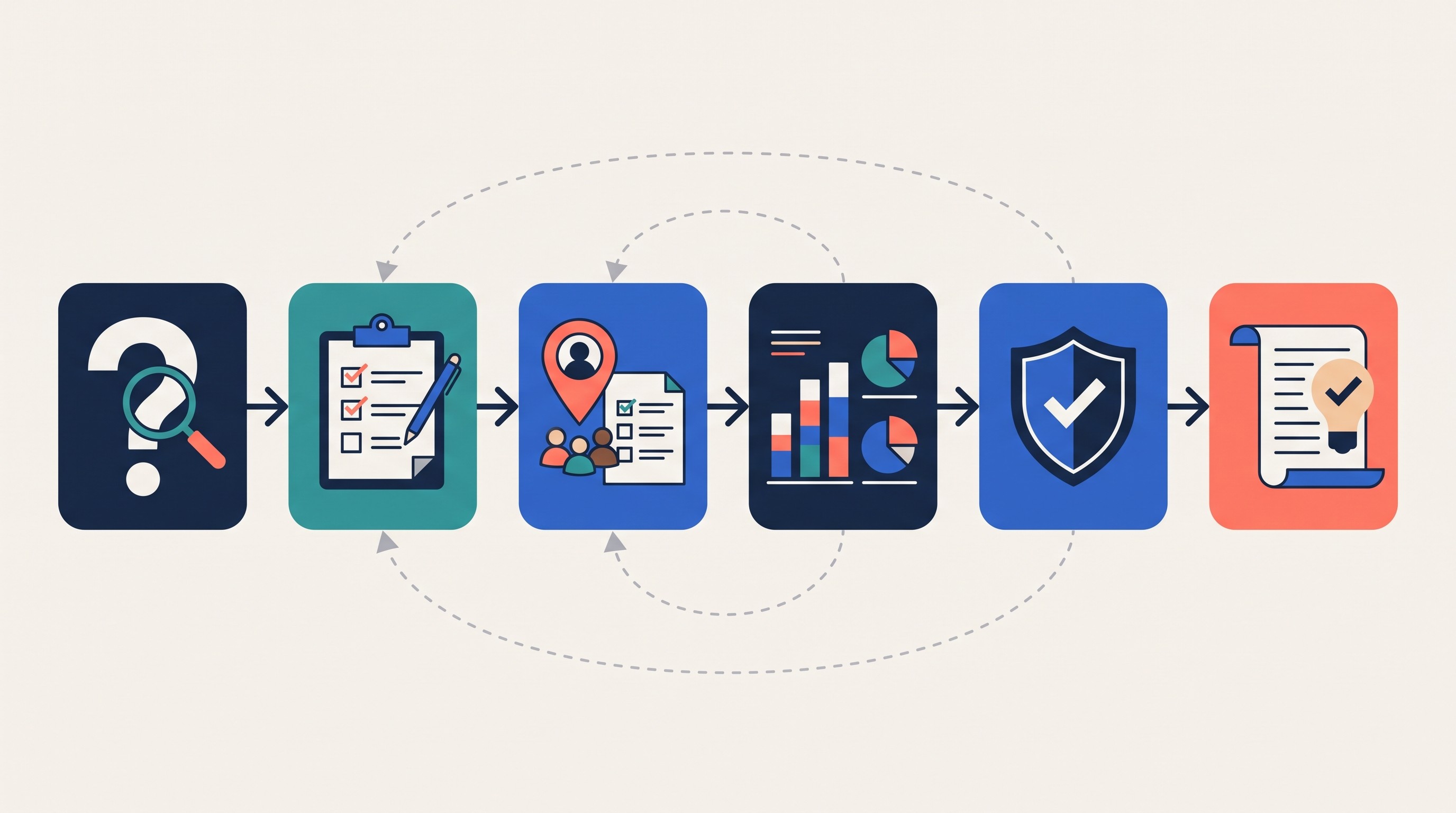
A precise research question narrows the defensible design choices. If you are still forming the question, start with the guide to how to write a research question before selecting methods.
Different questions require different designs
The same topic can demand very different designs depending on the purpose.
Take the topic “remote work and employee engagement.” It could become at least five different studies:
Research purpose | Example question | Better-fitting design | Likely methods |
|---|---|---|---|
Describe | How engaged are remote employees in this company? | Descriptive cross-sectional design | Survey, HR records |
Compare | Do remote and in-office employees report different engagement levels? | Comparative non-experimental design | Survey, matched groups |
Explain | Why do some remote employees feel disconnected? | Qualitative design | Interviews, thematic analysis |
Predict | Which factors predict engagement among remote employees? | Predictive correlational design | Survey, regression |
Evaluate | Did a new meeting policy improve engagement? | Experimental or quasi-experimental design | Pre/post measures, comparison group |
The topic is the same. The design is not.
That is why “What method should I use?” is usually the wrong first question. The better question is: What kind of claim do I need the study to support?
Experiments test causal effects
Experiments are strongest when the question asks whether an intervention or condition causes an outcome. The defining design feature is control over the independent variable, ideally with random assignment.
A simple experiment might randomly assign students to use either a practice-testing study strategy or a rereading strategy, then compare exam performance. Random assignment helps reduce the risk that pre-existing differences explain the result.
Experiments are not always possible. They may be unethical, impractical, too expensive, or too artificial for the research context. But when the claim is causal, the design must still address causality: sequence, comparison, confounding variables, and alternative explanations.
Surveys measure patterns, prevalence, and associations
Surveys are useful when the goal is to measure attitudes, behaviors, characteristics, or relationships across many people.
A survey can answer questions like:
How common is burnout among first-year teachers?
Which study habits are associated with exam confidence?
Do students in different programs report different levels of belonging?
But surveys do not automatically establish causation. If a survey finds that students who sleep more also report higher grades, the design supports an association. It does not prove that sleep caused the grades. Prior academic performance, workload, health, stress, and socioeconomic conditions may all matter.
Survey design depends heavily on sampling and measurement. A large survey with a biased sample can still mislead. A short questionnaire with weak items can still measure the wrong thing at scale.
Qualitative designs explain meanings, processes, and lived experience
Qualitative designs fit questions about how people interpret, experience, negotiate, or make sense of something.
Interviews, focus groups, observations, field notes, document analysis, and case studies can produce evidence that a survey may miss: mechanisms, meanings, contradictions, and context.
A qualitative study might ask why doctoral students hesitate to share early drafts with supervisors. A survey could count how often that happens. Interviews could reveal fear of appearing unprepared, prior negative feedback, unclear expectations, or departmental norms.
The validity standard is different from a randomized trial. The question is not “Can this estimate be generalized to a national population?” It is “Are the interpretations credible, well-supported, transparent, and grounded in the data?”
For more design-specific guidance, see the overview of qualitative research design.
Mixed methods connect breadth with depth
Mixed methods designs combine quantitative and qualitative evidence in a deliberate sequence or integration plan.
A researcher might first run a survey to identify patterns, then conduct interviews to explain surprising results. Or they might begin with interviews to understand a problem, then build a survey instrument from those findings.
The key word is deliberate. Mixed methods is not stronger just because it includes more data. It is stronger when each method answers a part of the question that the other cannot answer well.
If you want to see how variables, methods, and claims fit together in complete study plans, use these research design examples for thesis writers as a companion resource.
How research design affects the quality of evidence
Evidence quality is not just about how much data you collect. It depends on whether the design produces evidence that matches the claim.
Five design choices do much of the work:
Sampling: Who or what is included?
Comparison: What is the result being compared against?
Measurement: How are the concepts turned into observable evidence?
Timing: When is data collected, and in what order?
Procedure: How consistently and transparently is the evidence gathered?
A broad claim about a population requires appropriate sampling. A claim about change requires time-ordered evidence. A causal claim requires attention to alternative explanations. A claim about meaning or experience requires data rich enough to support interpretation.
A study can be careful and still limited. The problem is not limitation itself. The problem is hiding the limitation or making a claim the design cannot support.
Sampling determines who the evidence represents
If a study claims to describe “college students,” but all participants come from one psychology course at one university, the sample does not represent college students in general. It may still be useful. It just supports a narrower claim.
Sampling decisions affect external validity, bias, feasibility, and interpretation.
Key questions:
Who is the target population?
Who is actually accessible?
Who is excluded by the recruitment method?
Are the excluded groups relevant to the claim?
Is the sample meant to be statistically representative, theoretically informative, or strategically selected?
Not all research needs a representative sample. A qualitative case study may intentionally select a small number of information-rich cases. A legal research project may select statutes, cases, or doctrines based on relevance rather than population sampling. A design is judged by whether the sampling logic fits the purpose.
For a domain-specific example of how purpose shapes method selection, see this guide to methods of legal research.
Comparison groups determine what differences mean
Comparison is where many studies quietly fail.
If a study says an intervention “worked,” the reader should ask: compared with what?
Possible comparisons include:
A control group receiving no intervention
A group receiving standard practice
A group receiving a different intervention
The same participants before and after the intervention
Historical data from a previous cohort
A matched group with similar baseline characteristics
Each comparison has weaknesses. A pre/post design can show change over time, but it may not rule out other events that happened during the same period. A historical comparison may be affected by cohort differences. A non-random comparison group may differ in motivation, resources, or prior ability.
The right comparison does not eliminate every problem. It makes the interpretation more disciplined.
Operationalization turns ideas into evidence
Many research concepts are abstract: stress, engagement, trust, learning, resilience, satisfaction, legitimacy, quality, bias.
Operationalization is the design decision that translates those concepts into something observable.
For example:
Stress might be measured through a validated questionnaire, cortisol levels, sleep disruption, self-reported workload, or interview narratives.
Engagement might be measured through attendance, survey responses, platform activity, participation quality, or observed behavior.
Trust might be measured through willingness to share information, survey ratings, repeated use, or interview accounts.
None of these measures captures the whole concept. Each captures a slice.
That is why measurement decisions should be stated plainly. A study should not say, “We measured trust,” as if trust were a simple object. It should say how trust was operationalized and what that choice leaves out.
This is especially important when using convenient proxies. Platform clicks may indicate engagement, but they may also indicate confusion, required participation, or inefficient navigation. Attendance may indicate interest, but also mandatory grading. A measure can be easy to collect and still be conceptually weak.
Transparency lets readers evaluate evidence
Findings are not self-explanatory. Readers need to know how the evidence was produced.
At minimum, a design should document:
Inclusion and exclusion criteria
Recruitment or case-selection procedures
Instruments, protocols, or data sources
Timing of data collection
Missing data and attrition
Changes to instruments or procedures
Main analytic choices
Known constraints on interpretation
This is not bureaucratic decoration. It is how readers decide whether a conclusion follows from the evidence.
For students and researchers handling many PDFs, protocols, and notes, an AI research workspace such as Otio can help keep source documents, extracted notes, summaries, and design memos in one library. The point is not to outsource judgment; it is to reduce the chance that the rationale for a design decision gets separated from the evidence later.
Control and realism often trade off
A non-obvious design tradeoff sits at the center of many research decisions: control versus realism.
Highly controlled designs make it easier to isolate a relationship. Laboratory experiments, standardized tasks, scripted instructions, and random assignment can strengthen causal inference.
But control can reduce realism. Participants may behave differently in an artificial setting. The intervention may work under ideal conditions but fail in ordinary classrooms, clinics, offices, or communities.
Naturalistic designs have the opposite profile. They may capture real behavior in real settings, but with more noise, less control, and more competing explanations.

Neither side is automatically better. The choice depends on the claim.
If the claim is “this mechanism can occur,” control may matter more. If the claim is “this intervention works in ordinary practice,” realism and implementation context matter more.
[[OTIO_INLINE_PROMO:%7B%22title%22%3A%22Can%20your%20sources%20support%20the%20claim%3F%22%2C%22description%22%3A%22Add%20your%20papers%2C%20protocols%2C%20and%20notes%20to%20Otio%20to%20compare%20how%20sampling%2C%20measurement%2C%20timing%2C%20and%20procedures%20support%E2%80%94or%20limit%E2%80%94your%20intended%20conclusion.%22%7D]]
The role of design in internal, external, and measurement validity
Validity is not one thing. A study can be strong in one respect and weak in another.
Three forms matter most when reviewing research design:
Internal validity: How confident can we be that the study’s explanation fits the observed result?
External validity: How confidently can findings apply beyond the study sample, setting, or period?
Measurement validity: How well do the measures represent the concepts they claim to measure?
A design is rarely simply “valid” or “invalid.” The better question is: valid for what claim, in what context, and with what limitations?

Internal validity: does the explanation fit the result?
Internal validity is strongest when the design can rule out plausible alternative explanations.
Common threats include:
Confounding variables: A third factor influences both the supposed cause and the outcome.
Selection bias: Groups differ before the study begins.
Weak comparison groups: The comparison does not represent a meaningful counterfactual.
History effects: An outside event affects the outcome during the study.
Maturation: Participants change over time for reasons unrelated to the intervention.
Attrition: People drop out in ways that distort the results.
Instrumentation changes: Measurement tools or procedures shift during the study.
Suppose a school introduces a new reading program and test scores rise. The program may have helped. But scores may also have changed because of a new teacher, different test difficulty, smaller class sizes, extra parent involvement, or a more selective group of students.
A stronger design anticipates those possibilities. It might use a comparison school, baseline measures, matching, random assignment, or repeated measurement. The goal is not perfection. The goal is to make the strongest rival explanations less convincing.
External validity: where else does the finding apply?
External validity concerns transfer beyond the immediate study.
A result may hold for one group, institution, country, age range, time period, platform, policy environment, or professional setting. That does not mean it holds everywhere.
Threats to external validity include:
A narrow or unusual sample
A single site or organization
Short-term observation
Artificial study conditions
Cultural or institutional specificity
Volunteer participants who differ from nonparticipants
Conclusions that exceed the sampled population
External validity is not only a quantitative issue. Qualitative studies also face transfer questions, though they usually address them through detailed context, case selection logic, and thick description rather than statistical representativeness.
A small interview study of nurses in one hospital may not represent all nurses. But it may still reveal processes, tensions, or categories that help readers judge whether the findings apply to similar settings.
Measurement validity: are you measuring the intended concept?
Measurement validity is often the quietest problem and the hardest to repair after the fact.
A study can have a large sample, clean statistical analysis, and a significant result while still measuring the wrong construct.
Examples:
Using “time logged into a learning platform” as a full measure of learning
Using “number of publications” as a full measure of research quality
Using “likes” as a full measure of trust
Using “attendance” as a full measure of engagement
Using one survey item to represent a complex attitude
The issue is not that proxies are forbidden. Research often needs proxies. The issue is whether the proxy is defended, limited, and interpreted with care.
If the measure is weak, statistical sophistication cannot rescue the claim. A regression model cannot turn a bad operational definition into a good one. A large sample can make a wrong measure look precise.
Correlation can still be useful evidence
A common mistake is to treat correlational evidence as worthless because it cannot prove causation. That goes too far.
Associations can be useful for description, prediction, screening, theory-building, and identifying patterns worth further study.
If students with irregular sleep schedules also report lower concentration, that association matters. It can guide advising, generate hypotheses, or justify a stronger follow-up design. What it cannot do on its own is prove that irregular sleep caused the concentration problem.
The defensible language is different:
Stronger than warranted: “Irregular sleep reduces concentration.”
Better: “Irregular sleep was associated with lower self-reported concentration.”
Better still, if accurate: “The design cannot determine whether sleep patterns caused concentration differences.”
That distinction protects the study from overclaiming.
If the assignment specifically asks for correlational work, these correlational research design examples show how to frame variables without slipping into causal language.
How to choose and review a research design before collecting data
Review the design before collecting data, not after results arrive. Once the data are visible, it becomes much easier to rationalize a design around the finding you hoped to get.
Use this sequence.
1. State the research question and target population
Write the question in one sentence. Then name the population, setting, documents, cases, or phenomenon the study is meant to speak about.
Weak: “How does social media affect students?”
Stronger: “How is daily TikTok use associated with self-reported sleep quality among first-year undergraduate students at a commuter university?”
The stronger version narrows the design. It signals a population, variables, likely data source, and a non-causal association claim.
2. Identify the claim the study needs to support
Before choosing methods, decide what the final claim should be able to say.
Is the study trying to claim:
How common something is?
Whether two variables are associated?
Whether an intervention caused a change?
How people experience a process?
Why a pattern occurs?
Whether a policy, product, or program worked?
How a concept is defined or debated in documents?
Each claim implies a design. A mismatch here creates the most damaging errors.
3. Choose the design that can produce relevant evidence
Select the design because it fits the claim, not because it is familiar or easy.
A practical rule:
Intended claim | Design requirement |
|---|---|
“This is common in a population” | Sampling strategy that supports population inference |
“These groups differ” | Comparable groups and consistent measures |
“This predicts that” | Appropriate variables, adequate data quality, model plan |
“This caused that” | Sequence, comparison, and controls for rival explanations |
“This is how people experience it” | Rich qualitative data and transparent interpretation |
“This policy or intervention worked” | Baseline, comparison, outcome measures, implementation context |
This table does not replace methodology training. It gives a first-pass diagnostic: if the design requirement is missing, the claim probably needs to be weakened.
4. Define measures and sampling
For each major concept, state:
The operational definition
The instrument, source, or observation method
Why that measure fits the concept
What the measure does not capture
For sampling, state:
Who or what can be included
Who or what is excluded
How participants, documents, sites, or cases will be selected
How the selection affects interpretation
If the study depends on existing papers, reports, policies, or case materials, keep a transparent source trail. Tools such as Otio’s AI PDF reader can help annotate PDFs, ask source-specific questions, and preserve citations while reviewing design decisions across documents.
5. Anticipate threats to validity
Do this before data collection.
Ask:
What else could explain the result?
Who is missing from the sample?
What might participants misunderstand?
Which measures are weakest?
What data might be missing?
What would make the comparison unfair?
Where might the setting limit generalization?
What conclusions will remain out of reach?
This step is uncomfortable because it weakens the fantasy version of the study. That is exactly why it matters.
A design memo should include the main threats and how the study will handle them. Some threats can be reduced. Others can only be acknowledged. Both are better than pretending they do not exist.
6. Specify the analysis before collecting data
The analysis plan should follow from the design.
For quantitative studies, specify the main variables, comparisons, statistical tests or models, inclusion rules, and handling of missing data. For qualitative studies, specify the coding or interpretive approach, data sources, sampling logic, and credibility checks. For mixed methods, specify how the strands will be integrated.
The point is not to remove all flexibility. Some research legitimately adapts as evidence emerges, especially qualitative and exploratory work. The point is to distinguish planned analysis from post hoc interpretation.
A common failure mode is changing the question, sample, measure, or analysis after seeing results, then writing the final paper as if the design had always aimed at that claim. This makes the evidence look stronger than it is.
If the study changes direction, say so. Transparency is not a weakness; it is part of the design’s credibility.
7. Check ethics and feasibility
A design can be theoretically elegant and still unusable.
Review:
Access to participants, sites, records, or documents
Time required for recruitment and data collection
Budget and software requirements
Researcher skill and training
Participant burden
Privacy and confidentiality risks
Consent requirements
Data storage and security
Likelihood of missing or low-quality data
Institutional review requirements, if applicable
Feasibility is not a secondary concern. A design that cannot be executed well will produce weaker evidence than a simpler design executed carefully.
Ethics also shapes validity. If participants feel coerced, unsafe, rushed, or unclear about the study, the data may suffer. If privacy risks are mishandled, the project may harm participants and compromise trust.
8. Document what the study cannot conclude
Every design has boundaries. Naming them makes the research more credible.
Use plain language:
“This design can identify associations but cannot establish causation.”
“Findings apply most directly to the sampled institution.”
“The measure captures self-reported stress, not physiological stress.”
“The study examines short-term outcomes only.”
“The interview sample is designed for depth, not statistical representation.”
This is not apologizing. It is accurate interpretation.
The next action is simple: before choosing a method, write one sentence that includes the research question, intended claim, evidence needed, and main validity risk.
For example:
This study asks whether weekly peer feedback is associated with improved draft quality among first-year writing students; it needs comparable writing-quality measures before and after the intervention, and its main validity risk is that more motivated students may be more likely to participate.
That sentence will expose most design problems early enough to fix them.
FAQ
Q: What is the main purpose of research design?
A: Its main purpose is to create a coherent plan that connects the research question with data collection, analysis, and a defensible conclusion. It also makes limitations and threats to validity easier to identify.
Q: What happens when the research design does not match the research question?
A: The study may collect evidence that cannot answer the question, even if the analysis is technically accurate. A common result is an overextended conclusion, such as treating correlation as proof of causation.
Q: Is qualitative research design less valid than quantitative research design?
A: No. Validity depends on whether the design fits the question and whether the evidence supports the interpretation. Qualitative and quantitative designs answer different kinds of questions and use different standards of credibility.
Q: Can a strong research design eliminate all limitations?
A: No. A strong design reduces important sources of error and makes limitations explicit, but tradeoffs involving feasibility, control, measurement, sampling, and generalizability remain.
[[OTIO_FOOTER_PROMO:%7B%22title%22%3A%22Apply%20the%20design%20checklist%20to%20your%20sources%22%2C%22description%22%3A%22Bring%20your%20own%20PDFs%2C%20research%20notes%2C%20and%20data-collection%20plans%20into%20Otio%20to%20identify%20evidence%20gaps%2C%20rival%20explanations%2C%20and%20limits%20before%20you%20write.%22%7D]]