
Video Summarization
9 Best Google Summarizer Free Alternatives
Google Summarizer free alternatives: Discover 9 top tools, including Otio, built to speed up research with precise summaries and source links.

Long meetings and lectures often demand a quick way to capture key points. Video summarization systems like Google Summarizer use transcript parsing, natural language processing, and machine learning to extract highlights, generate concise summaries with timestamped clips, and build searchable content for faster discovery. This approach transforms lengthy recordings into clear insights that can be applied immediately.
Extracted information can be repurposed as outlines or drafts to accelerate research and writing. Advanced processing techniques enable swift transitions from raw content to actionable work. For a smoother transition from insight to final content creation, Otio offers integrated tools as an AI research and writing partner.
Summary
Summaries dramatically reduce review time: Google Summarizer reduces reading time by 50% on average, accelerating content discovery and decision-making.
User confidence in AI summaries is substantial: 80% of users found Google Summarizer accurate in summarizing complex articles, making the outputs reliable for initial research and claim checks.
Summarization applies across workflows, as evidenced by the article's listing of 20 distinct use cases, from media monitoring to patent scanning, which span nearly every stage of information work.
Teams capture measurable efficiency gains: the average team saves 3 hours per week with AI summarization tools, and individual research tasks shrink by about 30 minutes.
Search and content strategy must adapt, since 13% of global searches already include AI-driven elements, shifting visibility toward concise, intent-focused answers rather than headline-first ranking.
Adoption patterns favor accessibility: over 50% of users prefer free summarizer tools, but these options often sacrifice integrations, volume handling, or research-grade features as teams scale.
This is where Otio, an AI research and writing partner, addresses this by centralizing diverse sources, preserving provenance, and converting summaries and transcripts into outlines, drafts, and citations.
Table of Contents
What is Google Summarizer?

Google Summarizer is an AI-powered tool that generates clear, source-linked summaries from long documents and multimedia content. This helps users quickly grasp key points without losing context or the original citations. It is designed to accelerate research and decision-making by preserving links to sources and distilling complex material into readable, actionable summaries.
What are its core capabilities?
Core capability Google Summarizer creates concise, context-aware summaries from text and media. It prioritizes source links, enabling users to verify claims and follow up easily. Think of it as a focused reading assistant that keeps provenance intact, instead of a blunt compressor that removes evidence. For those seeking an effective AI research and writing partner, our solution can significantly streamline your writing process.
What file and media formats does it support?
The engine handles a wide range of file and media formats. It reworks content from PDFs, Word documents, Excel sheets, PowerPoint slides, plain text files, images with embedded text, audio transcripts, and video captions into readable summaries. This broad format support allows users to place different types of documents into a single workflow, resulting in unified outputs that preserve citations. With Otio as your AI research and writing partner, you can streamline this process even further.
How does it integrate with native Google apps?
Native Google app integrations let you work smoothly. It connects directly to Gmail, Google Docs, Google Sheets, and Google Slides, so you can create summaries without leaving the apps you already use. This integration makes tasks easier when sorting through emails, preparing a presentation, or reviewing research in a spreadsheet. The summary appears next to the original file and remains linked. As your AI research and writing partner, Otio streamlines these processes even further, allowing you to focus on what matters most.
What are the summary presentation options?
Users can choose between paragraph-style narratives and compact bullet-point extracts. This flexibility makes the output suitable for a range of tasks, from quick skimming to outlining for deeper analysis. The option to switch styles is helpful when a single paper needs both a high-level overview and a concise checklist of claims.
Why do people reach for a tool like this?
People often look for tools like this for a common reason. Researchers, product teams, and busy readers need quick, reliable summaries of dense content to avoid delays in decision-making. It can be tiring to sift through many full-length articles just to find one solid fact. This difficulty is a significant reason summarization tools, such as our AI research and writing partner, are gaining popularity.
What is the hidden cost of the usual approach?
The hidden cost of the usual approach, and a practical alternative. Most teams scan and clip manually because it's familiar and doesn’t require new permissions. However, as content volume grows, this habit disrupts context, hides source links, and slows validation. Platforms like Google Summarizer, which create linked, context‑aware summaries within the apps you use, help reduce that fragmentation and allow teams to manage content faster. According to WordStream, "Google Summarizer reduces reading time by 50% on average.", published in 2025. This shows how summaries can shorten review cycles and give more time for meaningful work.
How can you trust the outputs?
Trust is more important than speed; a quick but wrong summary is worse than being slow but accurate. How users perceive the approach helps build confidence. A study by WordStream, "80% of users found Google Summarizer to be accurate in summarizing complex articles.", published in 2025, supports the idea that many readers think the results are reliable enough for starting research and checking claims. Having an effective AI research and writing partner, like our Otio platform, can enhance the reliability of your outputs.
What is a practical image to hold onto?
A good way to think about the Summarizer is to see it as a skilled editor. This editor highlights the main idea, tracks sources, and provides a summary that includes the sources. This helps you decide whether to read more or continue.
What happens when those summaries are applied?
What happens when those short summaries with source links are used in real workflows and by different roles? That's where things start to get surprising. Our AI research and writing partner helps streamline the process, enhancing productivity and ensuring quality.
Related Reading
Use Cases of AI Summarization
AI summarizers fit into almost every part of today's information work, from sorting through information to putting it together to creating final drafts. Below are twenty specific examples that show how summarization saves time, reduces confusion, and highlights verifiable claims, enabling faster action.
How does media monitoring benefit from summarization?
Media monitoring faces a common problem: scale, not scarcity. Teams must monitor multiple feeds and alerts and quickly determine what is essential. Summaries condense large amounts of information into concise briefs, highlighting trends, quotes, and conflicting statements. This helps analysts focus on what to investigate instead of wading through every mention. For those looking to enhance their processes, an effective AI research and writing partner can significantly streamline these tasks.
Why are newsletters more effective with summaries?
Newsletters and editorial digests are much more helpful when they provide short, easy-to-read takeaways rather than just a list of links. This is especially important on mobile devices, where readers often skim through content. A March 2025 report from the Pew Research Center found that Google users who saw an AI summary were less likely to click on links to other websites compared to those who did not see a summary. This shows that adding a readable summary to your newsletter helps keep readers informed without losing their interest.
How is SEO intelligence improved with summarization?
Search marketing and competitive SEO intelligence need a fast way to identify key themes and claims across many top-ranking pages. This helps marketers focus on topical authority instead of just keywords. Multi-document summarization highlights shared subtopics, common evidence, and undercovered areas. This helps create content that effectively addresses the customer needs shown in the search results. This is especially important as AI features appear in search results, altering user behavior. According to SellersCommerce, 13% of global searches (2025), AI-driven elements already make up a large portion of queries. As you explore these themes, consider how an AI research and writing partner can streamline your content creation process.
What role does summarization play in internal reporting?
Internal knowledge triage and reporting: Large teams often create large piles of notes and memos that go unread. Summaries help analysts distill this messy information into concise briefs, enabling faster cross-team reporting and reducing duplicate research. As a result, decisions can leverage existing knowledge rather than starting from scratch. Having an AI research and writing partner can significantly enhance this process.
How can summarization assist in financial analysis?
Financial research and market signal extraction are fundamental in today’s fast-paced environment. Wall Street relies on speed and signal quality. Customized summarizers can extract key metrics, future guidance, and sentiment from earnings calls and analyst notes. This helps traders and researchers see significant changes without having to read every bulletin.
What benefits does summarization offer legal teams?
Contract and clause distillation for legal teams. Legal experts need clear visibility on risk areas. A focused summarizer points out unusual indemnities, termination triggers, and liability caps. It can also create side-by-side comparisons, helping lawyers focus on negotiation points rather than reading complete contracts word for word.
How does summarization enhance social media content creation?
Social media repurposing and microcontent generation are essential strategies for getting more visibility. Long reports and white papers can be automatically broken into social-sized takeaways, captions, and thread starters. This ability helps content teams to scale distribution effectively while keeping consistent messaging across channels. By reusing existing intellectual property, organizations can boost their content creation efforts.
How can summarization improve chatbot responses?
Question answering for assistants and chatbots improves with summarization. When a question requires evidence from multiple sources, a summarizer synthesizes key points into a clear, source-linked answer. This way, assistants can provide concise, verifiable responses rather than relying on broken quotes or incorrect information. If you're looking for an AI research and writing partner, consider how our solutions can enhance your content creation process.
What advantages does summarization bring to video production?
Consolidating video scripting and research is essential for producing effective videos. Video producers need a clear story grounded in multiple sources. Summaries of articles, transcripts, and prior videos help scriptwriters build a research-backed storyline. This method also provides bullet points for B-roll, saving hours of manual note-taking.
How is summarization utilized in telehealth?
Clinical case triage for telehealth. Remote networks depend on the swift routing of cases to specialists. Summaries that capture symptoms, prior treatments, and key lab values help expedite the triage process. This efficiency helps clinicians determine which cases require immediate attention and which can be scheduled for routine follow-up.
What value do automated abstracts provide for literature?
Reader-facing book and literature abstracts are essential for buyers and students who want to determine whether a book warrants further attention. Automated abstracts can provide quick summaries of themes and essential critiques, helping readers choose which works to buy or assign. Striving for clarity in these summaries can benefit from an AI research and writing partner, as our Otio platform helps create concise, informative abstracts.
How does summarization change email management?
Email and inbox compression can make communication much easier. Instead of having everyone open every message, summarizers can identify the actions needed, pending decisions, and the one sentence that changes the conversation. This method helps reduce context switching and cuts time spent on email.
How can educators benefit from summarization?
Course preparation and assignment curation can greatly help educators. Teachers can use summaries to turn current events, papers, and case notes into short teaching prompts and reading packets. This method makes it easier to update course material each term without starting from the beginning.
What is the role of summarization in research surveillance?
Research surveillance and scientific trend mapping are critical for tracking entire fields. Grouping and compressing paper abstracts into topic clusters makes it easier to identify emerging trends. This method helps researchers avoid missing essential signals among the hundreds of publications released each month.
How does summarization assist in patent analysis?
Patent landscape scanning is a crucial tool for patent lawyers and research and development (R&D) teams. By using summarizers, they can quickly find independent claims, novelty statements, and cited prior art from many filings. This significantly accelerates prior art searches and freedom-to-operate assessments with an AI research and writing partner.
What are the benefits of meeting summarization?
Meeting capture and action-item extraction can bring significant benefits. Meetings often create noise instead of clarity. Systems that turn voice transcripts into short summaries with clear decisions and assigned actions help lessen the follow-up burden. This capability strengthens asynchronous collaboration and makes it more reliable.
How does summarization help with customer support?
Help desk and customer support documentation are essential. Support teams can provide users with a single, consolidated answer compiled from several help articles. This helps customers understand both the practical fix and the root causes without having to navigate three separate documents.
How does summarization aid accessibility?
Accessibility aids are essential for people with hearing or cognitive challenges. Summaries of audio and video content help those with hearing difficulties quickly understand the main points. They also help anyone who prefers skimming over reading long transcripts.
What advantages do summarizers provide for onboarding?
Codebase and project onboarding summaries provide new engineers with a brief overview of a repository, highlighting its main components and recent design decisions. This way, the time to get started is much shorter, allowing the first commit to be based on the architecture rather than guesswork.
How does summarization facilitate content creation?
Automated research-first content creation can improve the writing process. When writers create briefs from the best sources on a topic, an advanced summarizer makes a structured first draft that keeps citations. This converts research directly into an outline or an article ready for human editing.
What practices help prevent fragmentation when summarizing?
Most teams still combine this work using clips, notes, and spreadsheets because it is familiar and does not require new systems. This approach can work with a handful of sources, but as the number of documents increases to dozens, context splinters. Citations can get lost, and review cycles may stretch from days to weeks. Platforms like the AI research and writing partner centralize collection, produce source-grounded notes, and maintain an auditable trail. This enables teams to transition from fragmented bookmarks to a cohesive brief in hours, rather than days.
What should teams consider when applying summarization?
When choosing where to apply summarization, think about the failure modes involved. Single-document summaries work well until conflicting claims arise; then, multi-document fusion is needed to surface contradictions. While high-compression summaries can save time, they may obscure minority viewpoints, so it's essential to maintain a linked audit that preserves the original extracts. In practice, the best workflows combine short triage briefs with longer, source-linked summaries for validation. For teams seeking support in this area, consider partnering with an AI research and writing partner like Otio to streamline their summarization efforts.
What impact do summarizers have on researcher efficiency?
Exhausted researchers and analysts often express a common frustration: too much content, too little time. This fatigue underscores the importance of summarizers, as they not only speed up the process but also help maintain judgment. With summarizers, researchers can skim confidently and read more deeply only when the summary highlights something important.
What features does Otio offer for research?
Otio addresses fragmentation by providing researchers with a unified, AI-native workspace. This workspace aggregates sources, extracts detailed notes from them, and supports Q&A sessions. Users can chat with individual links or whole knowledge bases and get help in drafting outputs from their collected material. Let Otio be your AI research and writing partner, helping you streamline your projects. Try Otio for free today.
What should you consider about scalability in summarization?
This may seem decisive, but the information presented below will prompt you to question which alternatives actually work at scale. For organizations looking to enhance their efficiency, partnering with an AI research and writing partner can provide insights that help refine these alternatives.
9 Best Google Summarizer Free Alternatives
These nine free alternatives serve different purposes in summarizing text, transcripts, and research. Each option has trade-offs to think about, depending on your workflow and file types. Below are brief descriptions that highlight unique strengths and practical limitations, helping you choose tools for specific tasks rather than looking for a one-size-fits-all app. According to the Fellow AI Blog, "Over 50% of users prefer using free summarizer tools over paid ones." (Fellow AI Blog, 2025). This preference underscores the importance of no-cost options for evaluating and adopting these tools.
1. Otio
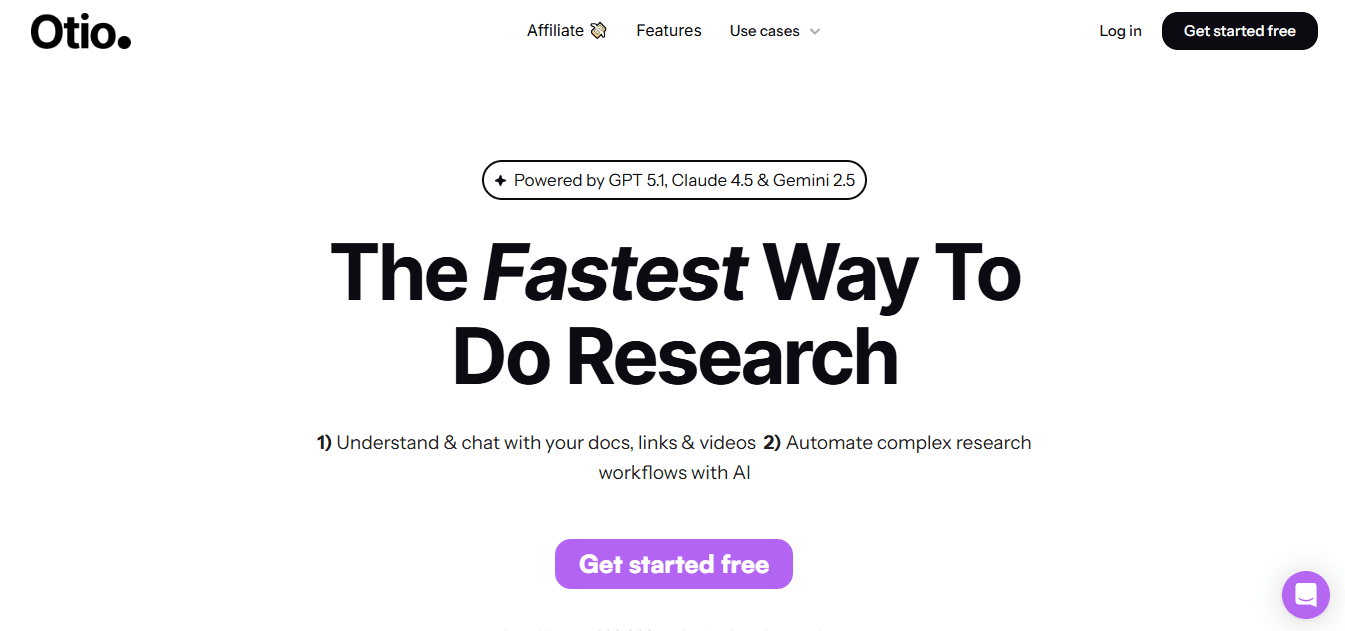
Otio brings diverse source materials together into a single research workspace. Users can gather bookmarks, tweets, books, PDFs, and video links, which helps them create notes and drafts based on that collection. It is aimed at researchers and knowledge workers who want a linked trail from sources to their first draft. As an AI research and writing partner, we strive to enhance your workflow and productivity.
2. QuillBot AI Summarizer
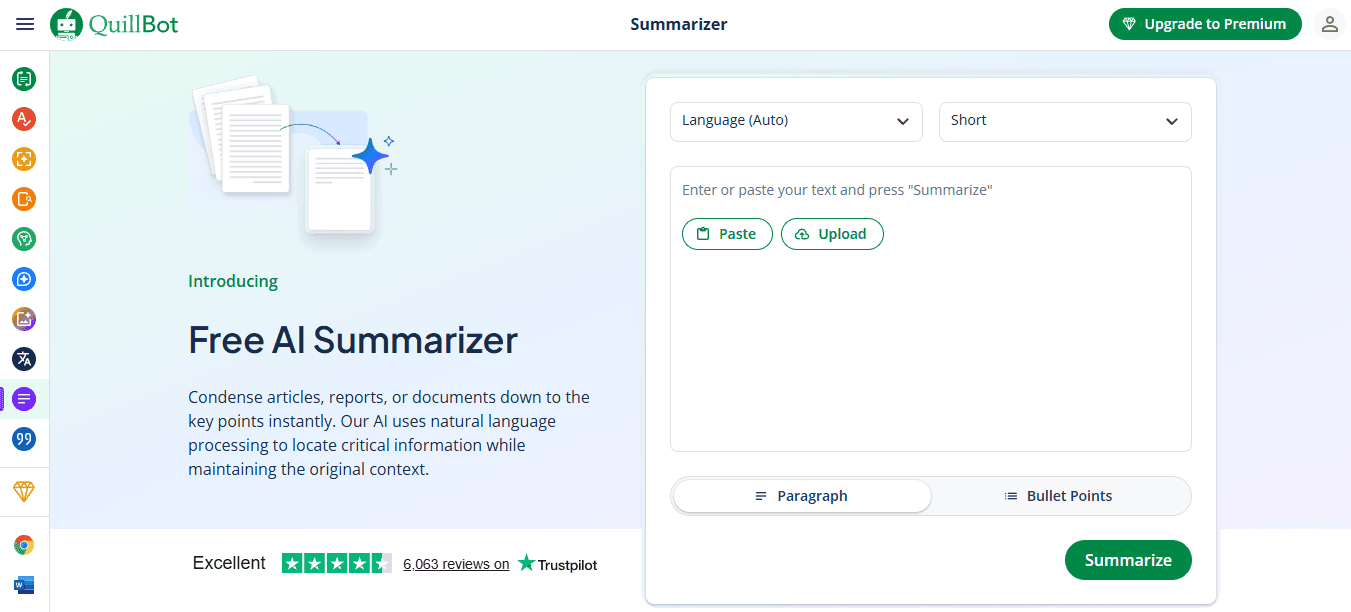
QuillBot's AI Summarizer reduces long texts to clear paragraphs or bullet points. Users can adjust the length or tone, making it useful for quick summaries or for editing existing content. It works efficiently with browsers and writing tools, so it fits wherever you draft. Our AI research and writing partner enhances your writing experience.
Adjustable output style, which lets users choose between bullet points and longer written forms.
A familiar interface that makes it easier to learn.
Broad use cases, which include essays and marketing documents.
Faster processing and higher word limits are available only in paid versions.
The tool may flatten the highly technical nuances when condensing complex material.
3. Summarizer.org
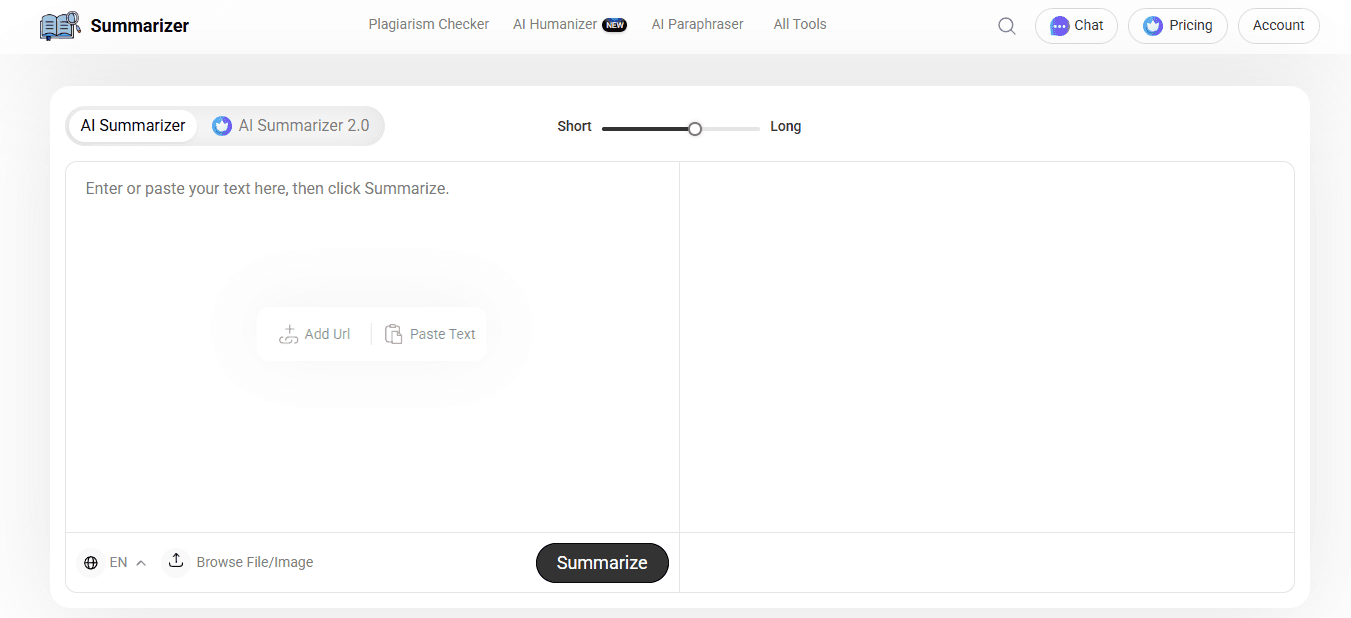
A lightweight web tool that lets users paste or upload text and adjust a control to choose how much they want to shorten it. It supports multiple languages and does not need a login for basic use. This tool is made for speed and immediacy. As an AI research and writing partner, our product simplifies the writing process and enhances productivity.
Supports multiple languages, which is excellent for non-English content.
Has a simple design that allows quick access to results.
No account is required for casual use.
The ad-supported interface can distract users.
Limited customization options and no built-in workflow integrations.
4. Notta (Transcription + Summarization)
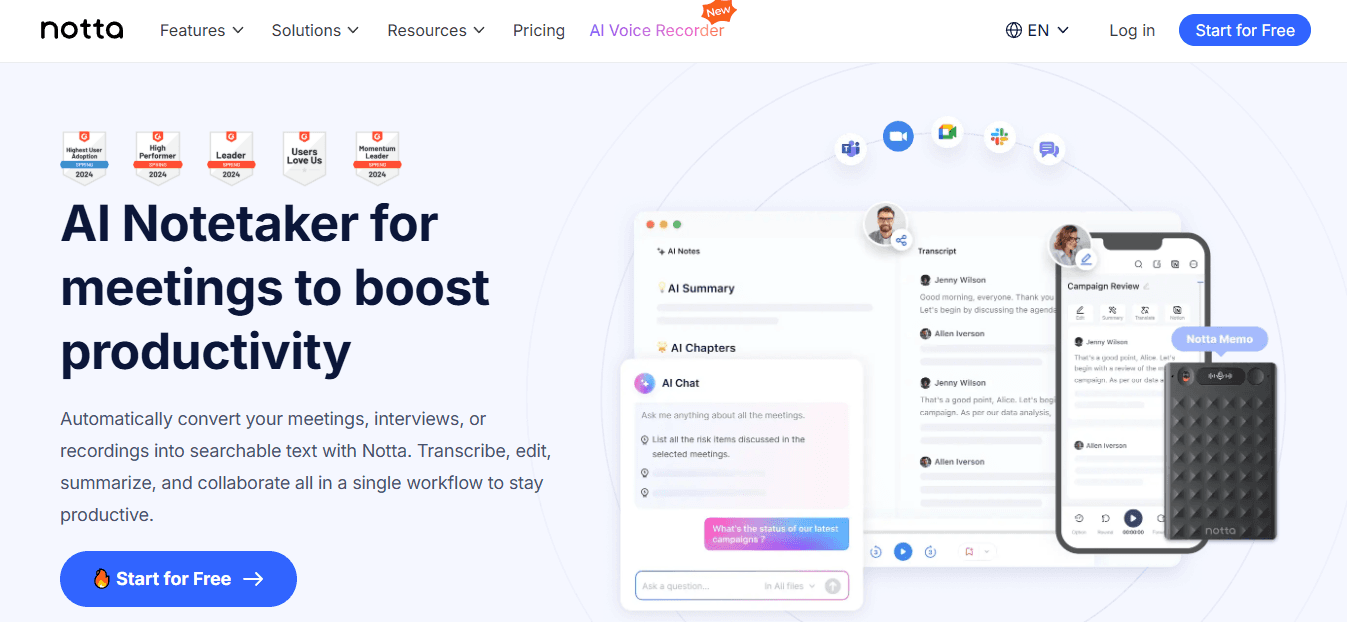
Notta focuses on converting audio and video into accurate transcripts. It then extracts structured summaries that can be exported as DOCX or PDF. Notta also connects to meeting platforms for automated capture, making it an effective tool when you're looking for an AI research and writing partner.
Strong transcription accuracy and clean summary formatting.
Direct integrations with Zoom and Teams for meeting capture.
Multiple export formats available for record-keeping.
On the downside, Notta is not designed to summarize plain-text articles; it focuses on media files. The free plan has limitations. Heavier use requires paid features. Additionally, you need stable connectivity for uploads and processing.
5. Scholarcy
Scholarcy automates the extraction of key findings, figures, and references from academic papers and long PDFs. It creates shortened article cards that help speed up literature reviews and citation gathering. As you enhance your research process, consider how an AI research and writing partner can streamline your projects.
Automated reference and key-point extraction tailored to research.
It effectively handles PDFs and Word documents.
It creates structured, citation-aware summaries.
Scholarcy is mainly designed for academic use, so it's less useful for casual blog or news summaries.
It lacks some creative formatting options or outputs that work well for blogs.
6. WriteSonic Text Summarizer
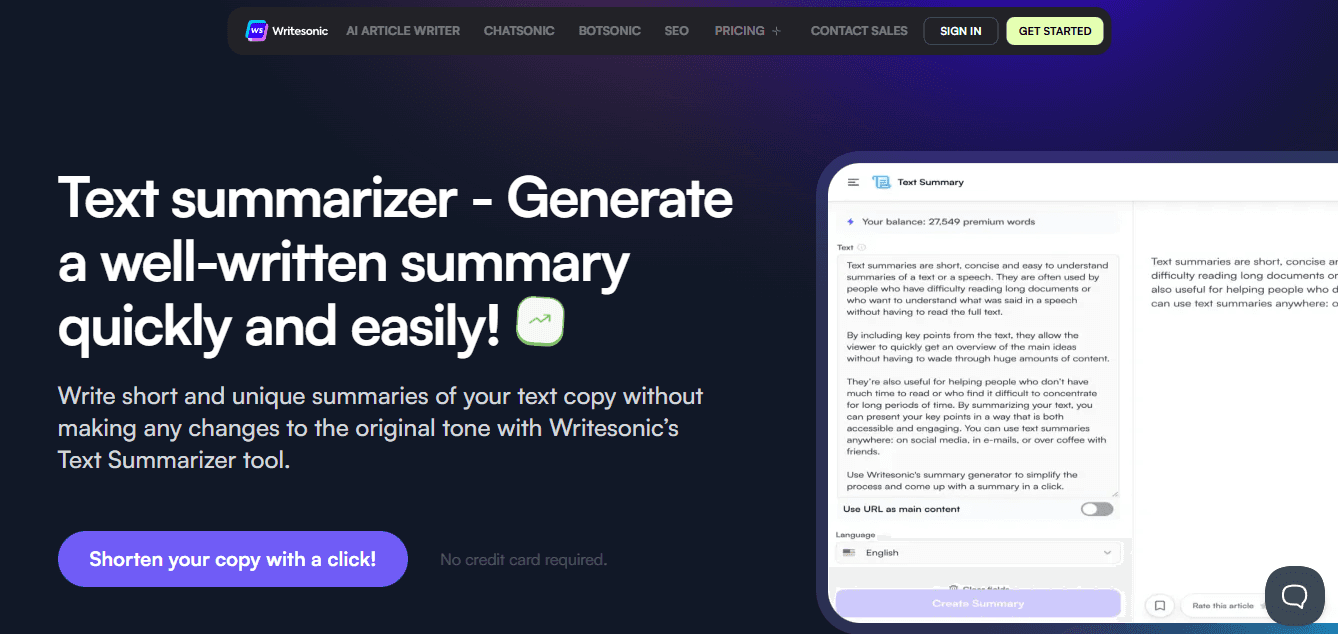
WriteSonic Text Summarizer is a flexible tool that works with both text and URLs. It can provide short or detailed summaries and supports multiple languages as part of a larger set of AI writing tools. This feature is invaluable when summarizing is a key part of content creation; our AI research and writing partner helps streamline the entire writing process.
It accepts article URLs and supports over 25 languages.
It offers two different summarization modes: one for concise points and another for more human-like prose.
It easily fits into larger content workflows.
The free version has word and input limits.
Some plans may not allow file uploads, which can disrupt workflows.
7. Jasper AI Text Summarizer
Jasper’s summarizer is part of a creative AI tool that helps teams change voice, tone, and formality while summarizing. This feature is handy for content creators who want to keep a consistent brand voice, making it an excellent choice for those seeking an effective AI research and writing partner.
Robust language support with adjustable style and tone controls.
Effective for repurposing long pieces into branded microcontent.
A strong content-creation ecosystem surrounds the summarizer.
Only a limited free trial is available. To use it on an ongoing basis, you need a subscription.
Character limits can constrain batch processing, potentially affecting workflows.
8. Genei (Research Summarizer & Analyzer)
Genei, the Research Summarizer & Analyzer, aims to improve research productivity by summarizing papers, extracting figures and tables, and answering specific questions about documents. It also includes annotation features and a browser extension. For those seeking an efficient solution, our AI research and writing partner can streamline your entire research process.
Imports and processes PDFs and web pages, with citation features.
Built-in annotation and citation management streamline research workflows.
The Chrome extension allows for quick page summarisation to improve efficiency.
Summarisation is available only in English, which limits international projects.
Performance may drop with very long texts or extensive document collections.
9. TLDR Text Summarization Tool
TLDR is a simple web service that quickly turns articles into short takeaways or bullet points. It is perfect for users who need a fast headline and some supporting points, making it an excellent choice if you're looking for an AI research and writing partner.
Fast, minimal setup, and low friction for reading on the go.
Supports multiple languages for quick summaries.
Great for clipping headlines or taking short notes.
Limits on daily free summaries can be a problem for heavy users.
It is not well-suited for in-depth technical documents where detail matters.
What are the tradeoffs of using free tools?
When manual clipping and scattered notes are the default, this familiar approach works until things get more complex. As you add more sources, the hidden costs become clear: context is lost, the source of the information is obscured, and fact-checking becomes slow and manual. Platforms like Otio act as an essential connection by centralizing note capture, revealing source-based notes, and turning collections into draft outputs. This feature helps teams reduce extra work while keeping a clear record. Practical tradeoffs to consider when choosing among these nine tools: free tools make it easier to start and reduce the cost of trying things out, but they often give up on volume, integrations, or technical depth for ease of use. This is important because the average team saves 3 hours per week using AI summarizer tools. (Fellow AI Blog, 2025). So, decide if you want a quick time-saver, a research-quality extractor, or an integrated drafting assistant before you pick a tool to use. If you seek assistance, consider how our AI research and writing partner can enhance your team's efficiency.
How to choose the right summarization tool?
A quick rule of thumb, just like picking the right lens for a camera, will save you time. Use TLDR or Summarizer.org when you need speed and want to skim through many short texts. Select Notta or Genei to extract information from media and academic sources. If tone and content changes are essential, go with QuillBot, WriteSonic, or Jasper. Our AI research and writing partner can help streamline your summarization process. This solution appears complete, but a common issue can help determine which option is best for teams working at scale.
Pros and Cons of Google Summarizer

Google Summarizer gives brands clear advantages in speed and discoverability. But it also introduces new challenges related to control and competition that require careful planning. Below are the key benefits and drawbacks to help brands decide how to proceed.
Advantages for Brands
Why does this increase brand awareness even without clicks? Brand visibility improves because summaries place your key claims and citations where decision-makers look first. It's like a well-arranged display window that shows off the maker. This type of exposure helps people remember your brand, especially when the summary quotes or rewrites a defining stat or recommendation that your team owns. How does it help with matching user intent? Improved search intent matching is critical because AI understands the user’s question, not just the keywords. Well-written content with clear, question-focused answers is more likely to be chosen for summaries. Writing for user intent, rather than just headlines, shifts the focus from chasing higher rankings to ensuring you are the go-to answer for buying or research moments.
Can summaries still drive traffic to the site? There is still a chance for more traffic even when click behavior changes. Summaries increase awareness across a broader range of searches, turning that visibility into more brand searches, direct visits, and later engagement. For teams that view summaries as top-of-funnel touchpoints, the benefit is greater awareness that ultimately drives conversions rather than just immediate clicks. How fast can teams act on research and insights? Speed and efficiency are the key benefits here. According to a survey, 85% of users reported increased efficiency with Google Summarizer. Content teams and analysts are now completing more work every week. Additionally, the Google Summarizer reduced analysis time by 30 minutes on average, making individual research tasks quicker and freeing up time for deeper strategy and creative work. Our AI research and writing partner enhances these capabilities by streamlining content creation and optimizing output.
Disadvantages for Brands?
Why does click volume often fall? Click-through rates decline when answers are included in search results. It’s frustrating to see traffic decline even as impressions rise. Many teams find that this change in metrics leads them to rethink their KPIs, moving from sessions to mentions, brand queries, and downstream conversions. Who wins when AI chooses snippets? Increased competition for top spots means authority and clarity are significant. This situation pushes out smaller or poorly organized pieces, leaving the top spots for well-established brands or highly optimized explanations. If content does not clearly demonstrate its value, it will not be selected.
What risks come from automated summaries?
Losing control over brand messaging is a worry because AI can simplify tone and nuance. When a summary cuts context or highlights different details, the intended voice can sound blunt or off. Fixing that misrepresentation often requires a public follow-up or more precise on-page framing. What happens if the AI misrepresents a claim? Relying on AI for content representation can be risky. If the model selects an out-of-context quote or omits essential details, reputational friction can follow, and the brand has little direct way to modify the generated text. Monitoring and quick corrective actions are necessary to prevent small mistakes from escalating. How do teams adapt without losing momentum? Most teams continue to optimize content for organic clicks because it's familiar and doesn't require new tools. This works on a small scale. However, as content volume and AI features grow, hidden costs appear. Editorial cycles slow; it becomes harder to track what is working, and teams spend hours figuring out which pieces the AI actually uses.
Solutions like Otio help by centralizing source capture, identifying referenced pages, and shortening review cycles. This helps teams maintain audit trails and work faster while measuring AI visibility separately from traditional traffic. A few practical tradeoffs to manage. This pattern shows up when balancing quick tactical wins against long-term authority. If quick-answer formatting is emphasized, visibility and summaries improve, but nuance might be lost. On the other hand, if nuance is preserved for in-depth analysis, trust is built, but instant selection may not occur. Prioritize based on whether this quarter's focus is on generating demand, improving lead quality, or strengthening brand positioning. Create workflows that tag content by its intended result, so every page is handled accordingly.
Analogy for practicality. Think of AI summaries like a store window that answers a passerby’s question about product features. However, not every passerby who sees the window will come inside. Your job is to design the window so the right people feel welcome to enter. That simple change in how entry points are designed is where the real struggle begins.
Related Reading
Best YouTube Summarizer
Supercharge Your Research Ability With Otio. Try Otio for Free Today
Scrubbing through hour-long videos to find a single supporting quote is how most teams operate. This familiar habit can kill momentum while scattering evidence across notes and timelines. Platforms like Otio index timestamped transcripts into evidence cards linked to original timestamps. They also assemble draft-ready paragraphs from those highlights, allowing your team to transition from hunting for clips to building verified narratives. This shift is like trading a messy VCR for a searchable library. Additionally, having an AI research and writing partner can further streamline your workflow, making research and writing more efficient.